
Technical Support Outsourcing: The Complete Business Guide for 2026
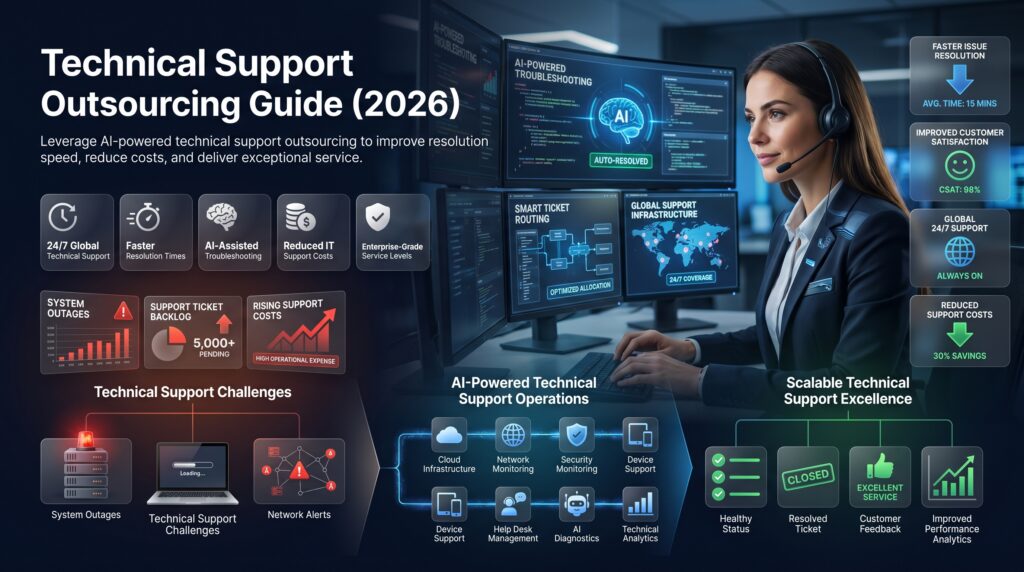
In 2026, technical support outsourcing has become one of the most strategic decisions a technology company can make. Whether you run a SaaS platform with thousands of self-serve users, a hardware brand managing warranty support globally, or an IT services firm that needs 24/7 helpdesk coverage, outsourcing your technical support function can reduce costs by 60–70%, unlock round-the-clock coverage, and give your customers access to certified specialists—all without the overhead of building an internal team from scratch.
This guide covers everything you need to know: how the tiered support model works, how to evaluate pricing, what to look for in a provider, how to manage the transition, and how to measure success once your outsourced program is live. If you are evaluating whether to outsource technical support, comparing providers, or optimizing an existing program, this is your complete 2026 reference.
What Is Technical Support Outsourcing?
Technical support outsourcing is the practice of contracting a third-party provider to handle your organization’s IT helpdesk, product support, and customer-facing technical assistance. Instead of maintaining a full in-house team, businesses partner with specialized BPO (Business Process Outsourcing) firms that deliver trained agents, proven workflows, and the technology infrastructure needed to resolve technical issues efficiently.
This model has evolved far beyond simple call-center overflow. Today, outsourced technical support covers everything from Tier 1 password resets to Tier 3 infrastructure troubleshooting—delivered across phone, email, live chat, and self-service portals around the clock.
Companies across SaaS, hardware manufacturing, telecommunications, e-commerce, and managed IT services rely on technical support outsourcing to keep customers satisfied while controlling operational costs. The global technical support outsourcing market exceeded $60 billion in 2025 and continues to grow as digital products multiply and customer expectations for fast, knowledgeable support intensify.
Types of Technical Support: Tier 1, 2, and 3 Explained
Understanding the tiered support model is essential before you decide which functions to outsource. Each tier handles a different complexity level:
Tier 1 — First-Line Support
Tier 1 agents handle the highest volume of contacts. Common tasks include password resets, account unlocks, basic connectivity troubleshooting, software installation guidance, and FAQ-style questions. These interactions are typically scripted, repeatable, and resolve in under ten minutes. Tier 1 is the most cost-effective tier to outsource because onboarding is straightforward and knowledge-base articles guide resolution.
Tier 2 — Intermediate Technical Support
Tier 2 agents handle escalations from Tier 1 and require deeper product knowledge. They diagnose software bugs, configure complex settings, interpret log files, and coordinate hardware replacements. Resolution times are longer, and agents typically hold product certifications or vendor credentials. Outsourcing Tier 2 requires a more thorough knowledge transfer but delivers significant savings versus maintaining senior in-house staff.
Tier 3 — Advanced Engineering Support
Tier 3 involves engineers who can trace issues to root cause in code, databases, or infrastructure. This tier often works directly with your development team to identify defects, apply patches, or escalate critical incidents. While some companies keep Tier 3 entirely in-house, many outsource a hybrid model where the provider handles triage and escalation coordination, with your engineers reserved for genuine product engineering work.
Benefits of Technical Support Outsourcing
Cost Reduction of 60–70%
Labor arbitrage remains the most cited benefit of IT support outsourcing. Staffing a 24/7 in-house support team in North America or Western Europe carries fully-loaded costs of $55,000–$90,000 per agent annually when you include salary, benefits, office space, hardware, training, and management overhead. Outsourcing to a high-quality BPO in Eastern Europe, Latin America, or Southeast Asia reduces that figure to $18,000–$35,000 per agent year—a saving of 60–70% without sacrificing quality when the right provider is selected.
24/7 Coverage Without Staffing Headaches
Covering global time zones in-house means multiple shift rotations, weekend premiums, and the constant churn of night-shift hiring. Technical support BPO firms already operate around the clock across distributed delivery centers. You gain instant 24/7 coverage as a standard contract term rather than an expensive staffing exception.
Access to Specialized Expertise
Leading technical helpdesk outsourcing providers maintain certification programs across Microsoft, Cisco, AWS, ServiceNow, Salesforce, and dozens of other platforms. Rather than training your own staff to certification level, you access pre-certified agents immediately. This is particularly valuable for companies deploying new technology stacks or supporting complex enterprise integrations.
Elastic Scalability
Product launches, seasonal peaks, and viral growth events create unpredictable demand spikes. An outsourced tech support partner scales up agent capacity within days rather than the months required for in-house recruitment. Equally important, providers scale down during low-demand periods so you pay for actual support volume, not standing headcount.
Faster Time to Resolution
BPO firms optimized for technical support run knowledge management systems, AI-assisted triage tools, and continuous QA programs that compress resolution times. When you partner with a mature provider, you inherit a decade of operational best practices rather than rebuilding them internally.
Technical Support Outsourcing Cost: Pricing Models Explained
Cost structures vary by provider and contract type. Understanding each model helps you select the right fit for your support volume and budget:
Per-Agent (Dedicated FTE) Model
You pay a fixed monthly fee per dedicated agent. Rates typically range from $1,500–$4,500/month per agent depending on location, language, tier, and hours of coverage. This model suits companies with predictable, consistent volumes where agents can be fully occupied. It provides maximum control over agent training, brand alignment, and quality.
Per-Ticket (Transactional) Model
You pay per resolved ticket or interaction, typically $5–$20 for Tier 1 contacts and $25–$80 for Tier 2 escalations. This model is ideal for early-stage companies with unpredictable volume or for overflow coverage during peak periods. Cost scales precisely with demand, eliminating idle-agent expense.
Monthly Shared-Services Model
A pool of agents handles contacts for multiple clients, with your work prioritized by contract tier. This model is cost-effective for lower volumes—typically $3,000–$15,000/month for small to mid-size programs—but offers less exclusivity than dedicated staffing.
Hybrid Model
Many mature programs combine dedicated agents for peak hours with shared-pool agents for overnight and weekend coverage. This hybrid approach typically reduces overall program cost by 20–30% compared to full dedicated staffing while maintaining quality during primary business hours.
In-House vs. Outsourced Technical Support: Full Comparison
| Factor | In-House Team | Outsourced Tech Support |
|---|---|---|
| Cost per agent/year | $55,000–$90,000 | $18,000–$35,000 |
| 24/7 coverage | Requires multiple shifts + overtime | Standard in most contracts |
| Setup time | 3–6 months (hiring + training) | 4–8 weeks (knowledge transfer) |
| Scalability | Slow (weeks to months) | Fast (days to weeks) |
| Brand control | Full | Governed by SLA and QA program |
| Specialized expertise | Limited to internal certifications | Multi-platform certifications available |
| Technology infrastructure | You own and maintain | Provider supplies ticketing + telephony |
| Turnover risk | Disrupts institutional knowledge | Provider manages continuity |
| Risk in early stage | High fixed cost pre-product-market fit | Variable cost matches growth stage |
The decision is rarely binary. Most companies find the optimal structure involves keeping product escalations and engineering-adjacent support in-house while outsourcing high-volume, script-driven Tier 1 and Tier 2 contacts to a specialist provider.
What to Look for in a Technical Support Outsourcing Provider
Choosing the wrong BPO partner is costly to reverse. Evaluate providers against these critical criteria:
Technical Depth and Certification Portfolio
Verify that agents hold certifications relevant to your product stack. A SaaS platform built on AWS requires agents certified in cloud infrastructure fundamentals, not just general helpdesk skills. Ask for certification counts, renewal policies, and training investment per agent per year.
Industry-Specific Experience
A provider that has run technical support for healthcare software navigates HIPAA-compliant data handling differently than one focused on consumer electronics. Domain experience shortens ramp time and reduces compliance risk. Request client references in your specific vertical.
Security and Compliance Posture
Outsourced agents access your customer data, internal systems, and sometimes production infrastructure. Require ISO 27001 certification, SOC 2 Type II reports, and documented data handling procedures. For regulated industries, confirm GDPR, HIPAA, or PCI DSS compliance capabilities upfront.
SLA Commitments and Penalty Structure
Service Level Agreements should specify first response time, resolution time by tier, CSAT minimums, and uptime for support channels. Equally important is the penalty clause—providers who won’t accept financial penalties for SLA breaches signal low confidence in their own performance.
Technology Stack and Integration Capability
Confirm that the provider’s ticketing, CRM, and telephony platforms integrate with your existing tools. Disconnected systems create data silos and agent inefficiency. Leading providers support native integrations with Zendesk, Salesforce Service Cloud, Freshdesk, Jira Service Management, and major UCaaS platforms.
QA Program and Continuous Improvement
Ask how the provider evaluates agent performance. A mature QA program includes call/ticket scoring rubrics, calibration sessions, coaching cycles, and root-cause analysis for repeat contacts. Providers who can share trend data on First Contact Resolution (FCR) and Mean Time to Resolution (MTTR) demonstrate operational maturity.
Transition and Ramp Support
The first 90 days of an outsourcing engagement are highest risk. A strong provider assigns a dedicated implementation manager, creates a structured knowledge transfer plan, and agrees to a graduated go-live with clear escalation paths back to your team during the stabilization period.
Technical Support Outsourcing for SaaS Companies
SaaS companies face a unique support challenge: high contact volumes from self-serve users, complex product integrations, and the expectation of near-instant help from technically sophisticated customers. Technical support outsourcing addresses all three pressure points.
Outsourced Tier 1 agents deflect password resets, billing queries, and onboarding questions that consume internal team bandwidth. This frees your customer success engineers to focus on retention-driving activities—QBRs, integration projects, and expansion conversations—rather than reactive ticket queues.
For SaaS companies managing multi-tenant platforms, a good BPO partner implements strict data isolation protocols so agents supporting one account cannot accidentally access another. This is non-negotiable in any outsourcing contract for cloud software businesses.
Many fast-growing SaaS companies combine outsourced support with their internal product teams through a co-sourced model: the BPO handles volume, while two or three senior in-house specialists focus on Tier 3 escalations and feeding bug reports back to engineering. This structure scales elegantly from Series A through IPO.
Technical Support Outsourcing for Hardware and IT Companies
Hardware manufacturers, IT value-added resellers (VARs), and managed service providers (MSPs) face different outsourcing dynamics than pure software businesses. Physical products require depot repair coordination, warranty verification, and dispatch management—capabilities that demand a provider with proven hardware support experience.
For these companies, tech support BPO services often include:
- Remote diagnostic triage to determine whether a device requires repair, replacement, or configuration fix
- RMA (Return Merchandise Authorization) processing integrated with your ERP system
- On-site dispatch coordination for field service incidents when remote resolution is impossible
- Vendor warranty management to submit and track claims against component manufacturers
When outsourcing hardware support, provider logistics capabilities matter as much as agent expertise. Confirm that the provider has documented workflows for multi-vendor environments and can update agents rapidly when firmware versions, model revisions, or known-issue bulletins change.
KPIs to Measure Outsourced Technical Support Success
Defining success metrics before contract signing prevents disagreements during performance reviews. Track these four primary KPIs across your outsourced tech support program:
First Contact Resolution (FCR)
FCR measures the percentage of support contacts resolved without escalation or callback. Industry benchmarks for well-run outsourced programs target 70–85% FCR at Tier 1. Low FCR signals gaps in agent training, knowledge base coverage, or empowerment to make resolution decisions.
Mean Time to Resolution (MTTR)
MTTR tracks the average time from ticket open to verified resolution. Target MTTRs vary by tier: Tier 1 contacts should close within 15–30 minutes on average; Tier 2 within 4–8 hours; Tier 3 within 24–72 hours depending on severity. Spikes in MTTR by category reveal training gaps or knowledge base deficiencies.
Customer Satisfaction Score (CSAT)
Post-interaction CSAT surveys capture the customer’s subjective experience of the support interaction. Best-in-class outsourced programs maintain CSAT scores above 4.2/5.0 (84%+). Benchmark your outsourced team’s CSAT against historical in-house scores to validate quality continuity during the transition.
SLA Compliance Rate
SLA compliance tracks the percentage of contacts responded to and resolved within contracted time windows. Aim for 95%+ SLA compliance across all priority tiers. Review SLA breach root causes monthly—if a specific category or shift repeatedly misses SLAs, it indicates a structural issue requiring intervention rather than a one-off incident.
Secondary Metrics Worth Tracking
Beyond the big four, mature programs monitor agent utilization rate (target 75–85%), escalation rate by tier, repeat contact rate (indicator of permanent fixes vs. workarounds), and Net Promoter Score (NPS) delta between customers who contacted support and those who did not.
Transition Process: How to Migrate Technical Support Smoothly
The migration from in-house to outsourced technical support is the highest-risk phase of the engagement. A structured transition plan prevents the quality dip that undermines confidence in outsourcing decisions.
Phase 1: Knowledge Capture (Weeks 1–3)
Document every support process before transitioning a single contact. This includes issue classification taxonomies, troubleshooting decision trees, escalation paths, system access requirements, and customer communication templates. The quality of this knowledge transfer determines everything that follows. Allocate your most experienced in-house agents to lead knowledge transfer sessions—their institutional knowledge is the provider’s starting asset.
Phase 2: Agent Training and Certification (Weeks 3–6)
The outsourced team completes your product training curriculum, passes internal certification assessments, and shadows your in-house agents on live contacts. Insist on a minimum assessment pass rate (typically 80%+) before any agent goes live. Identify two or three provider-side subject matter experts who receive deeper training for escalation handling.
Phase 3: Shadowing and Co-Handling (Weeks 6–8)
Outsourced agents begin handling contacts under supervision, with in-house leads reviewing responses before they go to customers. This phase catches knowledge gaps early in low-risk conditions. Gradually reduce the review requirement as quality metrics confirm readiness.
Phase 4: Graduated Go-Live (Weeks 8–12)
Begin routing a percentage of live contacts to the outsourced team—typically 25% in week one, 50% in week two, 75% in week three, and 100% by week four. Monitor CSAT, FCR, and MTTR daily during this phase. Retain a rapid escalation path back to your in-house team for any emerging category where the provider needs additional support.
Phase 5: Optimization and Steady State (Month 3+)
Monthly business reviews (MBRs) with your provider should analyze performance data, review SLA adherence, identify knowledge base gaps, and agree on process improvements for the coming period. This continuous improvement cadence is what separates high-performing outsourcing partnerships from transactional vendor relationships.
Mascallnet Technical Support Services
Mascallnet delivers enterprise-grade 360-degree customer support services that include fully managed technical helpdesk outsourcing across all three support tiers. Our contact center services are purpose-built for technology companies that need scalable, skilled support without the overhead of in-house staffing.
Our technical support programs are designed to integrate seamlessly with your existing product and engineering workflows. Whether you need 24/7 Tier 1 coverage to handle your growing self-serve user base or a co-sourced Tier 2 team that works alongside your internal engineers, Mascallnet configures the delivery model to match your specific requirements.
Our CallMaster platform provides real-time visibility into every support interaction—CSAT scores, FCR rates, MTTR by category, and SLA compliance—so you always know exactly how your customers are being served. Unlike black-box outsourcing arrangements, Mascallnet gives you full transparency and a collaborative partnership focused on continuous improvement.
For companies evaluating their outsourcing options, our detailed 2026 customer support outsourcing cost guide breaks down pricing models and ROI calculations so you can build an accurate business case. You can also explore our BPO vendor selection guide for a framework to evaluate and compare providers objectively.
Companies already benefiting from outsourced customer support outsourcing in 2026 are seeing an average 48% reduction in cost-per-ticket alongside measurable improvements in CSAT. Discover how much your organization could save with our cost savings calculator.
Ready to explore what technical support outsourcing looks like for your business? Contact the Mascallnet team to discuss your requirements and receive a customized program proposal.
Frequently Asked Questions About Technical Support Outsourcing
What is technical support outsourcing?
Technical support outsourcing is the practice of contracting a third-party BPO provider to handle your company’s helpdesk and product support functions. This includes Tier 1 through Tier 3 support delivered via phone, email, chat, and self-service portals, typically on a 24/7 basis.
How much does technical support outsourcing cost?
Costs vary by pricing model and delivery location. Dedicated agent programs typically run $1,500–$4,500 per agent per month. Per-ticket models range from $5–$80 per resolved contact depending on tier complexity. Most companies save 60–70% compared to fully-loaded in-house staffing costs.
What types of technical support can be outsourced?
Nearly all support tiers can be outsourced, including Tier 1 (password resets, basic troubleshooting), Tier 2 (software configuration, log analysis, advanced diagnostics), and portions of Tier 3 (incident escalation coordination, patch testing). Most companies outsource Tier 1 and Tier 2 while retaining Tier 3 close to their engineering team.
How long does it take to transition to outsourced tech support?
A well-managed transition typically takes 8–12 weeks from contract signing to full go-live. This covers knowledge transfer, agent training, shadowing, and a graduated rollout of live contacts. Rushing this timeline is the most common cause of post-launch quality problems.
What is the difference between IT support outsourcing and customer support outsourcing?
IT support outsourcing typically refers to internal employee-facing helpdesk services—managing employee devices, network access, software licenses, and IT incidents. Customer support outsourcing handles external end-user or customer contacts about your product or service. Technical support outsourcing can encompass both, though the training and process requirements differ significantly.
How do I maintain quality with an outsourced technical support team?
Quality maintenance requires a robust SLA contract with measurable KPIs (FCR, CSAT, MTTR), a regular QA program including call/ticket scoring, monthly business reviews with performance data, a well-maintained knowledge base, and an escalation path back to your internal team for edge cases. Provider-side team leads who attend your product training are also critical for quality continuity.
Can a small or startup company outsource technical support?
Yes. Transactional (per-ticket) and shared-services pricing models make outsourcing accessible for companies with 50–200 monthly support contacts. Many startups outsource their support from the day they launch to avoid building internal capacity prematurely. As volume grows, transitioning to dedicated agent staffing becomes more cost-effective.
What security risks are associated with technical support outsourcing?
Primary security risks include unauthorized data access, credential exposure, and social engineering vulnerability. These are mitigated by selecting providers with ISO 27001 and SOC 2 Type II certification, implementing role-based access controls that limit agent system permissions, requiring multi-factor authentication on all support tools, and conducting regular security audits. Include data handling requirements and breach notification obligations in the outsourcing contract.
What KPIs should I track for outsourced tech support?
The four primary KPIs are First Contact Resolution (FCR), Mean Time to Resolution (MTTR), Customer Satisfaction Score (CSAT), and SLA Compliance Rate. Secondary metrics include escalation rate, repeat contact rate, agent utilization, and cost per ticket. Review these monthly in a structured business review with your provider.
Is technical support outsourcing right for every company?
Outsourcing delivers the most value for companies with consistent support volume, globally distributed customers requiring 24/7 coverage, or products supported by well-documented troubleshooting processes. Companies with highly specialized, cutting-edge products where troubleshooting requires direct code access may find a hybrid model—outsourcing Tier 1 while keeping Tier 3 in-house—delivers better outcomes than full outsourcing.