
How Much Does It Cost to Outsource a Call Center to India? (2026 Pricing Guide)
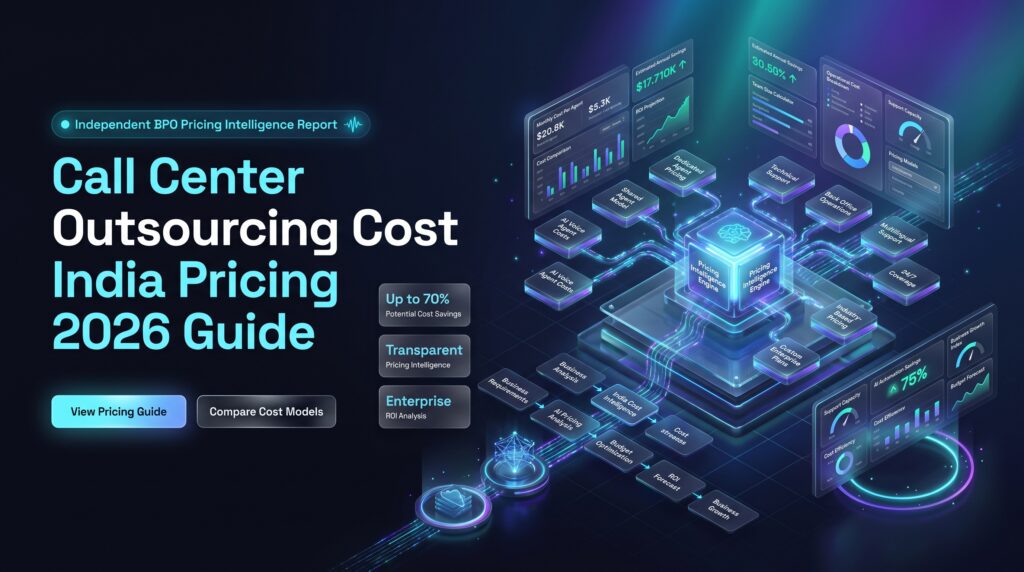
India remains the world’s #1 destination for call center outsourcing — and in 2026, AI has made it even more compelling.
If you have ever Googled “how much does it cost to outsource a call center to India,” you already know the problem.
Every article gives you a vague range. Nobody tells you what you actually pay. Nobody tells you what drives the price up or down. And nobody tells you the part that really matters — what you get back.
This guide fixes that.
We will give you the exact numbers. The real pricing models. The hidden costs that most vendors do not mention. And the framework to figure out whether outsourcing your call center to India actually makes financial sense for your business.
We have been running AI-powered contact center operations in India for years. We have onboarded businesses from 3-person startups to enterprise operations handling 50,000+ monthly tickets. What you are about to read comes from that experience — not from a pricing page.
Let’s get into it.
What Does It Cost to Outsource a Call Center to India in 2026?
Here is the short version before we get into detail:
| Model | Price Range |
| Per agent per hour | $8 – $18 |
| Dedicated agent per month | $1,200 – $2,500 |
| Per ticket / per contact | $0.50 – $8.00 |
| AI-hybrid (automated + human) | 40–65% less than fully human |
Those numbers mean very little without context. Let us explain exactly what you get at each price point — and what you are giving up if you go cheaper than you should.
The Real 2026 India Call Center Pricing Breakdown
Model 1: Per Hour Pricing
This is the most common pricing model, especially for businesses that are new to outsourcing. You pay for the hours your agents work.
$8 – $10/hour covers your basic Tier 1 support. Think order tracking, simple FAQs, password resets, basic troubleshooting. These are high-volume, low-complexity interactions. You get trained agents, quality monitoring, and standard reporting.
$11 – $14/hour is your mid-tier. Billing disputes, account management, moderate technical support, onboarding assistance. Agents at this level require deeper product knowledge and more structured escalation handling.
$15 – $18/hour covers your complex support. Regulated industries like healthcare and financial services, Level 3 technical support, enterprise account management. At this price point, you should expect industry-certified agents, compliance infrastructure, and dedicated quality assurance.
Below $8/hour? It exists. You will find vendors offering $5 or $6. What you get at that price is shared agents handling multiple clients simultaneously, minimal training, high attrition, and a support experience that actively hurts your brand. We see businesses recover from $6/hour experiments regularly. It is never a quick fix.
Model 2: Dedicated Agent Per Month
This is the model that makes most sense for businesses with consistent volume above 5,000 monthly contacts.
Instead of paying by the hour, you pay a monthly fee per dedicated agent. That agent works exclusively on your account. They know your product. They know your tone. They become an extension of your team.
$1,200 – $1,600/month for standard English-language support with basic CRM integration.
$1,600 – $2,000/month for agents with technical depth, industry knowledge, or omnichannel (phone + chat + email) capability.
$2,000 – $2,500/month for senior agents in regulated verticals, team lead roles, or AI-assist integrated positions.
For context: a comparable in-house agent in the US costs $3,500 – $5,500/month including salary, benefits, taxes, equipment, and management overhead. In the UK, it is £2,800 – £4,200/month. India gives you equivalent quality for 40–60% of that cost.
Model 3: Per Ticket / Per Contact
This model works best for businesses with unpredictable or seasonal volume.
| Channel | Cost Per Contact |
| AI / chatbot (self-service) | $0.10 – $0.50 |
| Email support | $0.50 – $2.00 |
| Live chat (human) | $1.50 – $4.00 |
| Inbound voice | $2.00 – $6.00 |
| Complex voice (regulated) | $4.00 – $8.00 |
The advantage here is cost alignment with your actual volume. The risk is that you lose pricing predictability. Most businesses with mature support operations prefer the dedicated model because the economics improve as volume increases.
Model 4: Outcome-Based Pricing
This is the model that separates serious BPO vendors from everyone else.
Instead of paying purely for time or volume, you pay based on what actually gets accomplished. Revenue recovered. CSAT scores achieved. Tickets resolved on first contact. Churn prevented.
Not every vendor offers this. Those that do are telling you something important about their confidence in their own performance. At MasCallNet, our AI-powered customer support outsourcing model is structured around outcomes — because we believe your support operation should make you money, not just save it.
What Drives the Price Up or Down
If two businesses get quotes from the same vendor and one pays $10/hour while the other pays $16/hour, here is why that happens.
Industry and Regulatory Complexity
Healthcare, banking, insurance, and financial services require agents who are HIPAA-aware, PCI-DSS certified, or trained in financial regulations. That training takes longer and costs more. It also requires ongoing compliance monitoring, which adds to overhead.
A retail eCommerce support operation is structurally simpler than a healthcare billing support operation. The price difference reflects that — and it should.
AI Integration Depth
Vendors running AI-assist tools — Zendesk AI, Freshdesk Freddy, Salesforce Einstein, custom LLM integrations — can handle more volume with fewer agents. This usually means lower per-contact costs and better quality (AI helps agents give accurate, faster answers). The integration itself has a setup cost, but it pays off quickly at scale.
Language and Communication Requirements
Standard Indian-English is the baseline. Add specialist language requirements, accent neutralization training, or multilingual coverage and the rate adjusts accordingly. Spanish, French, German, and Arabic support are available in India but at a premium over English-only operations.
Operating Hours
Standard business hours are priced at the base rate. Extended hours, night shifts aligned to US time zones, and true 24/7/365 coverage all carry premiums. The good news: India’s time zone (IST, UTC+5:30) naturally covers US overnight hours during Indian daytime — which means 24/7 coverage is cheaper out of India than from any nearshore geography.
Team Size and Engagement Model
Smaller teams cost more per agent because the vendor’s overhead is spread across fewer heads. A 50-agent program typically costs 15–25% less per agent than a 5-agent program. This is not exploitation — it is standard operational economics. If you are starting small, build that into your cost model.
Technology Stack Complexity
If you are running Salesforce with custom objects, a homegrown CRM, or an industry-specific platform with limited API documentation, integration takes longer and costs more. Zendesk, HubSpot, Freshdesk, and Intercom integrations are standard and fast. Bespoke systems require additional scoping.
The Hidden Costs Nobody Puts in Their Pricing Guide
This is the section most vendors skip. We are including it because we have seen it cost businesses more than the outsourcing program itself.
Transition and Onboarding
Getting your processes, documentation, and product knowledge transferred to a new team takes time and internal resources. Budget $15,000 – $75,000 for this depending on your complexity. If your vendor is not helping you build SOPs and knowledge bases as part of onboarding, find a different vendor.
Technology Integration
Connecting your helpdesk, CRM, and communication platforms to your outsourcing partner’s infrastructure has a real cost. Simple Zendesk or Freshdesk integrations run $3,000 – $8,000. Salesforce with custom configuration runs $8,000 – $25,000. Legacy systems or on-premise infrastructure can run $25,000 – $80,000. Ask for this number upfront. It will not appear in a standard pricing proposal.
Agent Attrition
India’s BPO industry has an average annual attrition rate of 35 – 45%. Every time an agent leaves, you are paying for recruitment, retraining, and a temporary dip in quality. High-quality vendors actively manage attrition through compensation, culture, and career development. Ask any vendor you are evaluating: what is your current attrition rate? If they do not know immediately, that is your answer.
Quality Management Overhead
Someone on your side needs to review QA reports, handle escalations, manage the vendor relationship, and make sure standards are maintained. This is typically a 0.25 – 0.5 FTE of internal bandwidth. It is not zero.
The Real First-Year Number
Take your vendor’s quoted rate. Add 25 – 35% for the items above. That is your realistic Year 1 cost. In Year 2, onboarding costs disappear and the program becomes significantly more economical.
AI vs Human vs Hybrid — Which Model Should You Choose?
This question comes up in almost every conversation we have with new clients. Here is the honest answer.
Pure human support is appropriate when your interactions are emotionally complex, legally sensitive, or require genuine judgment and empathy. It costs more. It is harder to scale. But for the right use cases, there is no substitute.
Pure AI support is appropriate for high-volume, low-complexity interactions where speed matters more than nuance. Self-service portals, automated tracking updates, FAQ bots. The cost is excellent ($0.10 – $0.50 per interaction). The CSAT is acceptable (55 – 70%). The limitations become apparent the moment a customer has a problem the bot was not trained for.
AI-hybrid is what most serious businesses should be running in 2026. AI handles 60 – 75% of your volume — the repetitive, predictable stuff. Human agents handle the 25 – 40% that requires judgment, empathy, or complexity. The result: better CSAT than pure human or pure AI, significantly lower cost than pure human, and dramatically better scalability.
The Numbers Side by Side
| Dimension | Pure Human | Pure AI | AI-Hybrid |
| Cost per interaction | $3.50 – $8.00 | $0.10 – $0.50 | $0.80 – $2.50 |
| CSAT score | 72 – 82% | 55 – 70% | 78 – 88% |
| First Contact Resolution | 65 – 75% | 45 – 60% | 78 – 88% |
| 24/7 availability | Expensive | Yes | Yes |
| Complex issue handling | Excellent | Poor | Excellent |
| Scalability | Low | Very High | Very High |
| Implementation time | 30 – 60 days | 60 – 120 days | 45 – 90 days |
The AI-hybrid model is not a compromise. It is the architecture that wins on every dimension except emotional complexity — and that is what your human agents are there for.
At MasCallNet, we deploy AI-augmented human teams as our standard model. AI handles the volume. Humans handle what matters. Together, they outperform either alone.
India vs Philippines vs Eastern Europe — The Honest Comparison
India is not automatically the right choice for every business. Here is how it compares to the other major outsourcing destinations.
| Dimension | India | Philippines | Eastern Europe |
| Hourly rate | $8 – $18 | $9 – $16 | $18 – $35 |
| English proficiency | Very High | Very High | Moderate – High |
| AI talent availability | Highest globally | Moderate | High |
| Technical depth | Very High | Moderate | Very High |
| US cultural affinity | High | Very High | Moderate |
| 24/7 cost efficiency | Excellent | Excellent | High cost |
| Compliance maturity | Very High | High | Very High |
| Talent pool size | Largest | Large | Moderate |
| Time zone for US | Overnight (good) | Overnight (good) | Day (limited overlap) |
India wins on: Technical depth, AI capability, talent volume, cost efficiency at scale.
Philippines wins on: US cultural alignment, conversational warmth, strong hospitality-sector heritage.
Eastern Europe wins on: European language capability, near-shore to Western European markets, data privacy alignment with EU law.
For US businesses needing technical support, complex process management, AI-integrated operations, or large-scale coverage — India is the strongest choice in 2026.
How to Calculate Your ROI Before You Sign Anything
Most businesses approach outsourcing with one question: how much can I save?
The better question is: what is the total financial impact of changing how my support operation works?
Here is a straightforward framework. Run your own numbers.
Step 1: What Are You Spending Now?
Add up all in-house support costs: salaries, benefits, management, technology, office space, training, attrition. Most businesses discover this number is 30 – 40% higher than they thought. A 10-person support team in the US typically costs $650,000 – $950,000 per year when you include everything.
Step 2: What Would India Cost?
Take your monthly contact volume. Apply the relevant pricing model from Section 1. Add 30% for hidden costs in Year 1. That is your realistic outsourcing cost.
Step 3: The Revenue Side (Most People Skip This)
Here is where outsourcing decisions become genuinely interesting.
Every percentage point of improvement in customer retention is worth real money. If your business has $10 million in annual recurring revenue and your current annual churn rate is 8%, retaining just 2% more customers adds $200,000 in annual revenue. If better support is responsible for half that improvement, your support operation just generated $100,000 — before counting cost savings.
If your agents are trained to identify upsell opportunities during support interactions — and most are not, in-house — you can add 8 – 15% of revenue uplift on top of retention improvement.
A Simple Illustration
Business profile: eCommerce company, 15,000 monthly contacts, $85,000/month current support cost (US team), CSAT 66%, annual churn 9%, average customer value $3,500.
| Metric | Current State | With India AI-Hybrid | Change |
| Monthly support cost | $85,000 | $21,000 | −$64,000 |
| CSAT | 66% | 84% | +18pts |
| Annual churn | 9% | 3.5% | −5.5% |
| Customers retained (annually) | Baseline | +220 customers | +$770,000 LTV |
| Annual total value | Baseline | $1,538,000 | +$1.5M |
These are illustrative numbers. Your results will depend on your specific business, volume, and implementation quality. We build a customized model during our consultation process.
Industry-Specific Pricing and What You Need to Know
Healthcare
Rate: $12 – $17/hour | AI-Hybrid: $8 – $13/hour
Healthcare is one of the most demanding outsourcing verticals. HIPAA compliance is non-negotiable. Agents need to understand medical terminology, insurance verification processes, and the emotional sensitivity required when speaking to patients.
MasCallNet’s healthcare BPO services for US hospitals include dedicated HIPAA-compliant infrastructure and trained agents who handle patient appointment scheduling, insurance verification, prior authorization, and billing support.
Hospitals using AI-assisted scheduling support through outsourcing report 15 – 22% reductions in appointment no-shows — recovering significant clinical revenue that simply was not being captured before.
Banking and Financial Services
Rate: $12 – $18/hour | AI-Hybrid: $8 – $13/hour
Fraud management, account inquiries, loan processing support, and collections — these require agents with financial acumen and a clear understanding of regulatory frameworks. PCI-DSS and SOC 2 compliance are standard requirements. AI-assisted collections programs using sentiment-scored prioritization recover 18 – 28% more outstanding balance per agent FTE than traditional approaches.
Retail and eCommerce
Rate: $8 – $13/hour | AI-Hybrid: $5 – $9/hour
The highest-volume outsourcing segment. Seasonal spikes, returns processing, order management, and loyalty support. Integrations with Shopify, WooCommerce, Stripe, and PayPal are standard. Per-contact or outcome-based models often work better than per-FTE for this segment because of volume variability.
If you are managing more than 10,000 monthly tickets, the MasCallNet model for high-volume customer support outsourcing provides a purpose-built architecture for that scale.
Insurance
Rate: $11 – $16/hour | AI-Hybrid: $7 – $12/hour
Claims support, FNOL (First Notice of Loss), policy inquiries, and renewal management. AI tools are particularly effective here at triaging claim complexity and routing appropriately. Sentiment analysis during FNOL calls identifies at-risk policyholders before they churn.
Telecommunications
Rate: $10 – $15/hour | AI-Hybrid: $7 – $11/hour
High volume, emotionally charged, technically demanding. Billing dispute management and proactive churn intervention are the highest-value use cases. AI-assist tools reduce average handle time on billing interactions by 28 – 35%.
Logistics and Supply Chain
Rate: $9 – $14/hour | AI-Hybrid: $6 – $10/hour
Time-sensitive, exception-heavy, and increasingly global. AI handles tracking inquiries and standard status updates (50 – 65% of volume). Human agents manage exceptions, claims, and high-value shipper relationships.
How to Choose the Right BPO Partner in India
The vendor you choose matters more than the price they quote.
We have seen businesses save money on the vendor and lose far more through poor quality, high attrition, and brand damage. Here is what to actually evaluate.
1. AI Integration — Not Just as a Talking Point
Ask specifically: what AI tools are deployed in your operations? How does AI assist your agents in real time? What percentage of volume does automation currently deflect for your comparable clients?
If the answer is vague, the capability is either nascent or nonexistent. In 2026, any serious BPO partner should be able to give you specific answers about their AI architecture.
2. Industry Depth
A vendor who supports 12 different industries usually does none of them exceptionally well. Look for demonstrated depth in your specific vertical. Ask for client references in your industry. Review case studies. Ask what compliance certifications are held.
3. Attrition Rate
Ask directly: what is your average agent attrition rate? Industry average is 35 – 45% annually. High-performing operations run 15 – 25%. This single number tells you more about operational quality than any marketing claim.
4. Technology Stack Compatibility
Confirm that your CRM, helpdesk, and communication platforms integrate natively with their systems. Salesforce, Zendesk, HubSpot, Freshdesk, Intercom, and ServiceNow should all be standard integrations for any Tier 1 vendor.
5. Pricing Model Flexibility
A vendor willing to offer outcome-based pricing components is a vendor that believes in their own performance. It is a meaningful quality signal.
6. Compliance Certifications
Minimum: ISO 27001, SOC 2 Type II. Add HIPAA for healthcare, PCI-DSS for payment operations, GDPR provisions for European customer data.
7. Scalability Architecture
How quickly can they add 10 agents? 50? What is their geographic redundancy? What happens if their primary facility has a problem? These are not hypothetical questions — they are operational requirements.
8. What Their Clients Say
Ask for three client references you can actually speak to. Not testimonials on a website. Real conversations with real operations leaders who have run programs with this vendor for more than a year.
Real Results — What Businesses Actually See
We want to give you something more useful than generic promises. Here is a representative client outcome.
US eCommerce Retailer | $45M Annual Revenue | Shopify + Stripe + PayPal
This business came to us with 14 in-house agents, a monthly support cost of $112,000, and a CSAT score of 64%. Their biggest frustration was not the cost — it was that their team was spending 70% of their time on order status questions that did not require a human being.
We implemented an AI-hybrid model: AI handling all Tier 1 interactions (order tracking, return initiation, FAQ), six dedicated MasCallNet agents handling everything that required judgment or empathy.
Six months later:
| Metric | Before MasCallNet | After MasCallNet |
| Monthly support cost | $112,000 | $28,500 |
| CSAT | 64% | 86% |
| First Contact Resolution | 58% | 84% |
| Average Handle Time | 9.2 min | 4.8 min |
| Monthly customer churn | 6% | 2.1% |
| Annual value created | — | $1,892,000 |
The cost reduction was meaningful. The revenue impact from churn reduction was what genuinely changed how leadership thought about the support function.
Results vary by business, industry, and implementation. We provide customized projections during our consultation process.
India’s Structural Advantages in 2026
People ask whether India’s BPO advantage is sustainable as AI develops. The answer is yes — and here is why.
Talent volume: India produces over 1.5 million English-proficient graduates annually. The pipeline is deep and growing.
AI-ready workforce: The generation of agents entering India’s BPO workforce today has grown up with digital tools, AI interfaces, and technology-first communication. They adapt quickly and well.
Cloud infrastructure: AWS, Google Cloud, and Microsoft Azure all operate major data center regions in India. Enterprise-grade, compliant cloud infrastructure is not a constraint — it is a given.
Government support: India’s National BPO Promotion Scheme and state-level incentives in locations like Noida, Bangalore, Hyderabad, and Pune create favorable operational cost structures that pass through to clients.
Time zone leverage: IST (UTC+5:30) provides natural 24/7 coverage alignment for US businesses. Your overnight support hours are Indian daytime hours. You get 24/7 coverage without premium night-shift rates.
MasCallNet’s AI-powered contact center operations in Noida, NCR sit at the center of India’s most concentrated BPO talent ecosystem — with direct access to Delhi NCR’s engineering talent pool and tier-1 connectivity infrastructure.
Security and Compliance — What You Need to Know
Security concerns are the most common reason businesses hesitate on India outsourcing. They are legitimate concerns that deserve direct answers.
What You Should Require
| Certification | Why It Matters | Who Needs It |
| ISO 27001 | Information security management baseline | Everyone |
| SOC 2 Type II | US enterprise data handling standard | US-facing operations |
| PCI-DSS | Payment card data protection | Any business handling payments |
| HIPAA | US patient data protection | Healthcare |
| GDPR provisions | EU customer data handling | European customer base |
The Real Security Risk
The risk is not India. The risk is a vendor that has not invested in security infrastructure. India’s top-tier BPOs operate on zero-trust security architectures, end-to-end encryption, real-time audit logging, and data residency configurations that satisfy even the most demanding enterprise security teams.
Ask every vendor you evaluate: walk me through your security architecture. The quality of the answer tells you what you need to know.
MasCallNet operates with ISO 27001 certification, SOC 2 compliance, dedicated HIPAA infrastructure for healthcare clients, and PCI-DSS configuration for payment-sensitive operations. Our cloud infrastructure runs on AWS and Google Cloud with Indian data residency where required.
Your Decision — In-House, Nearshore, or India?
Here is a clean framework for making the decision.
Stay in-house if:
- Your support interactions are a core product differentiator and require deep institutional knowledge
- Your volume is under 1,000 monthly contacts
- You are in an extremely niche regulatory environment with no qualified India vendor
Consider nearshore if:
- Your primary requirement is US time-zone alignment during business hours
- Cultural proximity matters more than cost efficiency
- You are managing Spanish-language support for US-Latin American markets
Outsource to India if:
- You need 24/7 coverage at a sustainable cost
- Your monthly volume exceeds 3,000 contacts
- You want to integrate AI into your support operations
- You need technical depth and a large, stable talent pool
- Your cost structure cannot support US or UK equivalent hiring
The hybrid answer that most sophisticated businesses land on: outsource volume to India, keep relationship-critical and strategically sensitive interactions onshore or in-house. That is a real model and it works well.
Before You Sign — The Checklist
Do not engage a vendor without running through this list.
Operationally:
- Do I have documented SOPs for my top 20 interaction types?
- Is my CRM/helpdesk accessible via API for external integration?
- Do I have a clear escalation path defined?
- Have I identified who internally will manage this vendor relationship?
Vendor Evaluation:
- Have I asked for the vendor’s current attrition rate?
- Have I verified compliance certifications independently?
- Have I spoken to at least two existing clients in my industry?
- Have I received a written SLA with specific CSAT and FCR targets?
- Do I understand exactly what is and is not included in the quoted price?
Commercial:
- Have I calculated my true current-state cost including hidden overhead?
- Have I modeled the revenue impact (not just cost savings)?
- Have I asked about outcome-based pricing provisions?
- Do I understand the contract exit terms?
Implementation:
- Is there a defined pilot scope before full deployment?
- Is the onboarding timeline in writing?
- Is there a 90-day review clause?
Frequently Asked Questions
How quickly can an India call center go live?
With documented processes and a standard technology stack (Zendesk, HubSpot, Freshdesk), a structured pilot can be live in 4 – 6 weeks. Full program deployment including training, integration, and parallel operation typically takes 8 – 12 weeks.
Is the quality actually comparable to in-house US or UK agents?
At Tier 1 India BPOs with proper training, quality assurance, and AI-assist tools — yes. Businesses moving from in-house US operations to quality India BPOs regularly see CSAT improvements of 10 – 22 percentage points within 90 days, primarily because the India operation has more structure, consistent QA, and better technology than their in-house setup did.
What is the minimum volume to make India outsourcing viable?
Shared models (per-contact pricing) are viable from around 500 monthly interactions. Dedicated model economics become favorable above 3,000 – 5,000 monthly contacts.
Can India BPOs integrate with my existing tools?
Yes. Salesforce, Zendesk, HubSpot, Freshdesk, Intercom, ServiceNow, Slack, Microsoft Teams, Shopify, WooCommerce, Stripe, and PayPal are all standard integrations for Tier 1 vendors. More complex or legacy systems require additional scoping and cost.
What happens to my data when an Indian BPO handles it?
This depends entirely on the vendor’s security architecture. Require SOC 2 Type II and ISO 27001 as a minimum. For healthcare, require HIPAA BAA. For EU customer data, require GDPR data processing agreements. For payment operations, require PCI-DSS certification. Vendors that cannot produce these certifications should not be on your shortlist.
How do I handle cultural and communication differences?
Modern India BPOs invest heavily in communication training, cultural alignment programs, and AI-assisted communication quality monitoring. The cultural gap that existed in first-generation India BPOs has largely closed in Tier 1 operations. Client references from businesses in your market will tell you more than any vendor claim.
What is customer support outsourcing and how does it work?
Customer support outsourcing means contracting a third-party vendor to handle some or all of your customer interactions — phone, chat, email, social — on your behalf. The vendor recruits, trains, manages, and quality-monitors the agents. You set the standards, review the performance data, and manage the overall relationship. The best programs feel like a seamless extension of your internal team.
Can I outsource just part of my support operation?
Yes, and this is often the best starting point. Many businesses outsource Tier 1 volume (high-volume, low-complexity interactions) while keeping Tier 2 and 3 in-house. This is called a tiered outsourcing model and it is a logical pilot structure for organizations new to outsourcing.
Conclusion
India call center outsourcing in 2026 costs between $8 and $18 per agent hour for human operations, $1,200 – $2,500 per agent per month for dedicated teams, and $0.50 – $8.00 per contact for transactional models.
But the price is not the point.
The point is that well-executed outsourcing to India does two things simultaneously: it cuts your support costs by 60 – 80%, and it improves your support quality measurably. That combination — lower cost, higher quality — is what makes India the global benchmark. And in 2026, with AI-augmented operations becoming the standard, the gap between a good India outsourcing program and your current in-house setup is wider than it has ever been.
The businesses that win with India outsourcing treat it as a strategic investment, not a cost-cutting exercise. They choose vendors who can demonstrate AI capability, industry depth, and compliance maturity. They build proper SOPs before they start. They measure the right things — not just cost per contact, but customer retention, revenue influence, and operational intelligence.
If you are ready to have a real conversation about what this looks like for your business — including a customized cost model and ROI projection — we would like to talk.
Ready to Find Out What It Would Actually Cost for Your Business?
Every business is different. Volume, industry, complexity, technology stack, and growth trajectory all affect what the right model is and what it will cost.
We do not offer generic quotes. We build a customized cost and ROI model for your specific situation — including a realistic assessment of what you are currently spending (including the hidden costs), what outsourcing would cost, and what the combined financial impact looks like.
There is no pressure and no commitment. Just a clear picture of the numbers.
Request a Custom Pricing Analysis →
We respond within one business day. Your information is confidential.