
AI Medical Call Center Services in 2026: 24/7 Patient Support & BPO Guide
AI Overview
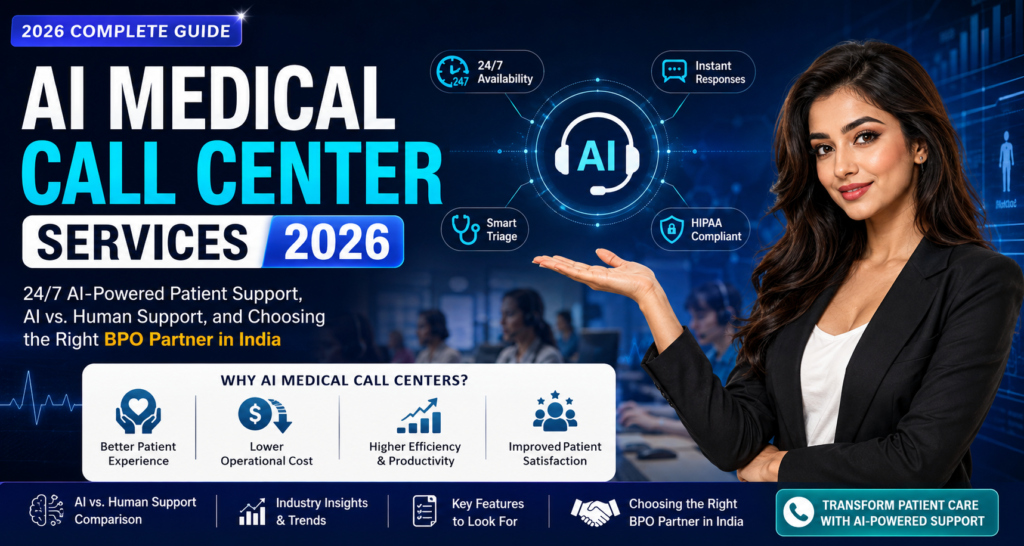
An AI medical call center combines conversational AI, voice automation, and trained healthcare agents to manage patient calls, scheduling, insurance verification, and follow-up care around the clock. In 2026, healthcare providers use these systems to reduce missed appointments, lower administrative cost per call by 30–55%, and maintain HIPAA-compliant patient communication at scale. The right model is rarely “AI or human” — it is a hybrid architecture where AI handles routine, high-volume interactions (scheduling, reminders, FAQs, prescription refills) while trained human agents manage clinical escalations, sensitive conversations, and complex billing disputes. Providers evaluating outsourcing partners should prioritize HIPAA/HITECH compliance, EHR integration depth, live escalation SLAs, and transparent pricing — not just per-minute cost. India remains the leading destination for healthcare BPO delivery due to clinical documentation expertise, English proficiency, and 24/7 coverage economics.
What is an AI medical call center?
An AI medical call center is a patient communication system that uses AI voice agents, chatbots, and human healthcare support specialists together to manage appointment scheduling, patient inquiries, insurance verification, prescription coordination, and after-hours triage support — available 24/7, integrated directly with hospital EHR and scheduling systems.
Introduction
Every hospital administrator has lived this moment: a patient calls at 9 p.m. to reschedule a procedure, gets a busy signal, hangs up, and never calls back. Multiply that by thousands of calls a month, and you’re not looking at a “customer service problem.” You’re looking at a revenue and care-access problem disguised as a staffing issue.
By 2026, patient communication has become one of the most consequential — and most poorly measured — operational functions in healthcare. Providers are running record patient volumes with the same or shrinking front-office staff, while patient expectations have shifted permanently toward instant, 24/7, omnichannel access. The organizations solving this well aren’t just answering more calls. They’re treating every patient interaction as a signal — about no-show risk, insurance friction, satisfaction, and retention.
This is the foundation of what we call Contact Center Intelligence™: the idea that a patient call is not an isolated transaction, but a data point that, when captured and acted on correctly, improves scheduling accuracy, reduces revenue leakage, and strengthens the entire care journey. Providers who still treat their call center as a cost center to minimize are the ones losing patients to competitors who treat it as an intelligence layer to optimize.
This guide breaks down exactly how AI-powered medical call centers work in 2026, how AI and human agents should actually be divided (not the oversimplified “AI replaces humans” narrative), what this costs, how to evaluate outsourcing partners including BPO providers in India, and how to build the internal business case your CFO will actually approve.
The Market Reality in 2026
Direct Answer: Healthcare providers are adopting AI-powered patient communication faster than almost any other back-office function, driven by staffing shortages, rising call volumes, and patient demand for instant access — but most implementations remain partial, disconnected from EHR systems, and unmeasured for ROI.
Why It Matters: Grand View Research and McKinsey both point to double-digit growth in healthcare conversational AI adoption through the late 2020s, but adoption speed is outpacing governance. Hospitals are buying point-solution chatbots and voice bots without a coherent patient communication strategy, which creates fragmented experiences — a bot that can schedule a visit but can’t tell a patient their co-pay, for instance.
Framework — The Three Waves of Healthcare Call Center Evolution:
| Wave | Era | Model | Primary Limitation |
|---|---|---|---|
| Wave 1 | Pre-2018 | Fully human, in-house front desk | Limited hours, high cost, high turnover |
| Wave 2 | 2019–2024 | Outsourced human BPO + basic IVR | Scale improved, but experience stayed reactive |
| Wave 3 | 2025–2026+ | AI-Human Hybrid, EHR-integrated, 24/7 | Requires governance, compliance, and change management |
Executive Interpretation: Most healthcare organizations are stuck between Wave 2 and Wave 3 — they’ve outsourced calls but haven’t integrated intelligence. The competitive gap in 2026 isn’t who has AI. It’s who has AI connected to scheduling, billing, and clinical systems in a way that actually changes patient behavior.
Boardroom Insight™: The healthcare organizations winning the access battle aren’t the ones spending the most on technology — they’re the ones who redesigned the patient communication workflow first, then layered AI on top of it. Technology bought to patch a broken process only makes the failure faster and less visible.
Summary: Adoption is accelerating, but most providers are implementing AI in silos rather than as a connected system — creating a real opportunity for organizations that get the architecture right.
Key Takeaway: In 2026, the differentiator is not “AI or no AI” — it’s whether AI is integrated into a single, intelligent patient communication system.
Why Healthcare Call Centers Are Breaking Down
What Everyone Says: “We need more agents to handle call volume.”
What Most Articles Miss: Adding headcount to a broken workflow doesn’t fix abandonment rates — it just makes the broken workflow more expensive.
What Actually Happens: Front-desk teams are juggling scheduling, insurance verification, prior authorization questions, prescription refill requests, and billing disputes — all through the same phone line, with no triage logic. A patient calling about a $40 co-pay question waits behind someone rescheduling a surgical consult.
Hidden Cost: Every abandoned call from a new patient isn’t a missed call — it’s a missed patient acquisition, often worth thousands of dollars in lifetime care value, and it never appears on an operational dashboard.
MasCallNet Perspective: We’ve found that healthcare providers dramatically underestimate call abandonment because they only measure calls answered, not calls attempted. The real number is almost always 20–35% higher than what’s reported internally.
Executive Action: Before evaluating any AI vendor, audit total call volume (including abandoned and after-hours calls) for 30 days. Most executives are shocked by what they’ve never measured.
What MasCallNet Has Observed: Across healthcare engagements, the highest-volume call driver is rarely clinical — it’s appointment-related (scheduling, rescheduling, confirmation) followed by billing and insurance questions.
Common Executive Mistakes: Leadership teams frequently invest in a patient portal and assume call volume will drop. It rarely does — patients, especially older demographics, still prefer voice for anything involving money, medication, or scheduling changes.
What High-Performing Organizations Do Differently: They segment call intent before deciding what to automate, rather than automating “customer support” as a single blanket category.
Practical Recommendation: Run a 4-week call-tagging exercise categorizing every inbound call by intent before selecting any AI or outsourcing partner. This single step prevents 80% of failed implementations we’ve seen.
What an AI Medical Call Center Actually Is
Direct Answer: An AI medical call center is a patient engagement infrastructure — not a single product — that combines AI voice agents, natural language chat, human healthcare support specialists, and integration with hospital systems (EHR, PMS, billing) to manage the full spectrum of patient communication, 24 hours a day, with compliant documentation of every interaction.
It typically includes:
- AI voice agents for scheduling, reminders, and FAQs
- Conversational chat/SMS bots for low-friction patient self-service
- Human agents for clinical triage support, complex billing, and empathy-driven conversations
- Integration layer connecting to EHR/PMS platforms for real-time data access
- Compliance and quality layer ensuring HIPAA-aligned call handling and documentation
This is fundamentally different from a traditional call center with a chatbot bolted on. The difference is architecture: intelligence flows in both directions, meaning the AI system doesn’t just answer questions — it feeds scheduling and billing systems with real-time updates and flags risk (like a patient likely to no-show) back to staff.
If your organization is evaluating this category, our healthcare BPO services guide breaks down cost, compliance, and efficiency considerations specific to US hospital systems.
How AI-Powered patient support Works
Direct Answer: AI-powered patient support works by routing incoming patient contact through an intent classification layer that determines whether the interaction should be fully automated, AI-assisted, or escalated to a human agent — based on complexity, sensitivity, and compliance risk.
Framework — The Five-Layer Patient Interaction Stack:
- Intake Layer — Call, chat, SMS, or portal message enters the system
- Intent Recognition Layer — AI classifies the request (scheduling, billing, clinical, refill, complaint)
- Routing Logic Layer — Low-risk, high-volume intents go to AI; sensitive or complex intents route to trained agents
- Execution Layer — AI or agent completes the task, updating EHR/PMS in real time
- Intelligence Layer — Every interaction is logged, tagged, and analyzed for patterns (no-show risk, billing friction, satisfaction signals)
That fifth layer is where Contact Center Intelligence™ becomes real — it’s the difference between a call center that just processes requests and one that improves the organization’s decision-making over time.
Table: What Gets Automated vs. What Stays Human
| Interaction Type | Recommended Handler | Reasoning |
|---|---|---|
| Appointment scheduling/rescheduling | AI (with human backup) | High volume, low emotional complexity |
| Appointment reminders & confirmations | AI | Fully automatable, reduces no-shows |
| Insurance eligibility checks | AI + system integration | Rules-based, data lookup |
| Prescription refill requests | AI with pharmacist/clinical review | Needs verification layer |
| Billing disputes | Human | Requires judgment, negotiation, empathy |
| New diagnosis or clinical concerns | Human | Compliance and empathy critical |
| After-hours triage guidance | Hybrid (AI intake + human escalation) | Safety-critical, needs escalation path |
| General FAQs (hours, location, prep instructions) | AI | Static information, zero risk |
Executive Interpretation: The goal isn’t maximum automation. It’s correct automation. Providers who push clinical or emotionally sensitive conversations to AI damage trust permanently — and often violate patient experience standards tied to reimbursement.
Boardroom Insight™: The most expensive mistake in this category isn’t under-investing in AI. It’s automating the wrong 20% of calls — the ones that actually needed a human — while leaving the easy 80% still consuming staff time.
Key Takeaway: AI-powered patient support succeeds when automation decisions are based on interaction risk, not just interaction volume.
AI vs. Human vs. Hybrid Support: The Real Comparison
This is the question every healthcare and enterprise leader eventually asks: should support be AI, human, or both? The honest answer, based on what we see across live deployments, is that “AI vs. human customer support” is the wrong framing entirely. The right framing is: which tasks belong to which resource, and how do they hand off to each other seamlessly.
Table: AI vs. Human vs. Hybrid Support — Full Comparison
| Dimension | AI-Only | Human-Only | Hybrid (Recommended) |
|---|---|---|---|
| Availability | 24/7 | Limited to shift hours | 24/7 |
| Cost per interaction | Lowest | Highest | Moderate, optimized |
| Handling routine/repetitive tasks | Excellent | Inconsistent | Excellent |
| Handling emotional/sensitive cases | Poor | Excellent | Excellent |
| Scalability during volume spikes | Instant | Slow, requires hiring | Fast, elastic |
| Compliance risk in clinical conversations | High if unmanaged | Low | Low, with proper escalation rules |
| Patient trust for complex issues | Low | High | High |
| Consistency of information | Very high | Variable by agent | High |
| Ability to build long-term rapport | None | Strong | Strong (human layer) |
| Implementation complexity | Moderate | Low | Higher, but highest ROI |
Executive Interpretation: Pure AI models create cost savings but erode trust for anything beyond transactional requests. Pure human models are trusted but economically unsustainable at scale, especially for 24/7 coverage. Hybrid models consistently outperform both on cost-per-resolution and patient satisfaction — but only when the handoff logic between AI and human is designed deliberately, not left to default settings.
What Everyone Says: “AI will replace human agents.”
What Most Articles Miss: In practice, AI doesn’t reduce headcount need as much as it changes the skill profile of the human team — fewer high-volume, low-skill agents; more escalation specialists trained in complex conversations.
What Actually Happens: Organizations that deploy AI without retraining their human layer end up with a smaller, undertrained team suddenly handling only the hardest conversations, with no reduction in stress or turnover.
Hidden Cost: Agent burnout from an AI deployment that filters out “easy” calls but leaves humans handling nothing but complaints and escalations, without adjusting compensation, staffing ratios, or training.
MasCallNet Perspective: We design hybrid models around an 80/20 principle at the interaction level, not the headcount level: AI absorbs roughly 70–80% of interaction volume, while humans retain ownership of the interactions that carry the highest risk and relationship value. This is core to our Support-Led Revenue Growth™ approach — support isn’t cost to minimize, it’s the layer that protects revenue and lifetime patient/customer value.
Executive Action: Before signing any AI vendor contract, require a documented escalation matrix showing exactly which conversation types trigger human handoff, and test it under real (not demo) conditions.
For a deeper breakdown of how this hybrid model applies across industries beyond healthcare, see our guide to AI-powered customer support outsourcing.
Key Takeaway: The winning model in 2026 isn’t AI vs. human — it’s AI and human, deliberately divided by task risk, not cost alone.
The MasCallNet Revenue Leakage Model™
Definition: A diagnostic framework that quantifies revenue lost due to poor patient/customer communication — missed calls, no-shows, delayed callbacks, and unresolved billing friction.
Methodology: Calculate leakage across four vectors:
- Abandoned call rate × average patient lifetime value
- No-show rate × average procedure/visit revenue
- Callback delay (>24 hrs) × conversion decay rate
- Unresolved billing disputes × average recovery value
Scoring Logic:
| Leakage Score | Range | Interpretation |
|---|---|---|
| Low Leakage | 0–10% of potential revenue | Well-managed communication operations |
| Moderate Leakage | 11–25% | Meaningful, recoverable revenue loss |
| High Leakage | 26%+ | Urgent structural intervention needed |
Interpretation: Most mid-size hospital networks we’ve assessed sit in the 18–30% range — meaning nearly a third of addressable revenue is being lost not to competition, but to internal communication failure.
Executive Recommendation: Run this model quarterly. Treat leakage reduction as a revenue initiative owned jointly by operations and finance — not a customer service metric buried in a support dashboard.
Boardroom Insight™: If your CFO has never seen a “leakage report,” your organization is managing support as a cost center, not the revenue-protection function it actually is. This is the essence of Revenue Recovery Through CX™ — patient experience isn’t a soft metric; it’s a hard revenue lever.
MasCallNet Outsourcing Readiness Score™
Definition: A pre-engagement diagnostic that determines whether an organization is structurally ready to outsource or automate patient communication successfully.
Methodology: Score across five weighted dimensions (0–20 points each):
| Dimension | What It Measures |
|---|---|
| Process Documentation | Are workflows defined and repeatable? |
| System Integration Readiness | Can EHR/PMS support real-time data exchange? |
| Compliance Maturity | Are HIPAA/data handling policies formalized? |
| Volume Predictability | Is call volume seasonal, spiky, or stable? |
| Change Management Capacity | Can staff adapt to new workflows without disruption? |
Scoring Logic: Total score out of 100.
- 80–100: Ready for full hybrid deployment
- 50–79: Ready with a phased rollout
- Below 50: Requires process stabilization before outsourcing
Interpretation: Organizations scoring below 50 who proceed with full-scale AI deployment anyway are the ones most likely to experience failed rollouts — not because the technology failed, but because the underlying process wasn’t ready to be automated.
Executive Recommendation: Never automate a broken process. Fix the workflow first, even if that delays the AI rollout by 60–90 days. It will save 6–12 months of remediation later.
Vendor Evaluation Framework™ for Healthcare BPO
Direct Answer: Choosing a healthcare BPO or AI patient support partner requires evaluating compliance depth, EHR integration capability, escalation design, transparent pricing, and demonstrated healthcare-specific experience — not just cost per call.
MasCallNet Vendor Evaluation Matrix™
| Criteria | Weight | What to Ask the Vendor |
|---|---|---|
| HIPAA/HITECH Compliance | 25% | Can you provide a BAA and third-party audit evidence? |
| EHR/PMS Integration | 20% | Which systems do you natively integrate with (Epic, Cerner, athenahealth, etc.)? |
| AI-Human Escalation Design | 20% | Show me your actual escalation logic, not a sales deck |
| Pricing Transparency | 15% | Is pricing per-call, per-minute, or FTE-based, and what’s excluded? |
| Healthcare-Specific Experience | 10% | Can you provide anonymized case studies in healthcare specifically? |
| Reporting & Analytics Depth | 10% | Do I get raw data access or only summary dashboards? |
Table: Best BPO Companies in India — What Buyers Should Actually Compare
When evaluating best BPO companies in India for healthcare or general customer support outsourcing, most comparison lists online rank by size or brand recognition. That’s the wrong lens for a healthcare buyer. The right comparison looks like this:
| Evaluation Factor | Large Global BPOs | Boutique/Specialized AI-BPO Providers | Why It Matters |
|---|---|---|---|
| Compliance depth | Strong on paper, generic in execution | Often deeper healthcare-specific compliance focus | Healthcare needs specificity, not scale |
| Customization | Limited, template-based | High, workflow tailored to your systems | Reduces failed rollout risk |
| AI-human hybrid maturity | Varies widely | Purpose-built for hybrid, not retrofitted | Determines actual performance |
| Pricing flexibility | Rigid contracts, high minimums | Flexible, scalable engagement models | Better fit for mid-size providers |
| Account access & responsiveness | Layered account management | Direct access to delivery leadership | Faster issue resolution |
Executive Interpretation: The largest BPO isn’t automatically the best fit for a mid-size hospital network or a fast-scaling healthcare business. Scale matters for enterprise health systems with massive volume; specialization and hybrid-AI maturity matter more for organizations that need precision, compliance, and speed of implementation. This is why our customer support outsourcing company in India engagement model is built around dedicated delivery pods rather than shared, generalized teams.
Boardroom Insight™: RFPs that weight “years in business” and “number of seats” over compliance execution and hybrid-AI maturity are optimizing for the wrong variables. Ask every shortlisted vendor to demonstrate a live escalation scenario, not a slide.
To see how this evaluation plays out in practice, our BPO case studies from India document real client outcomes across healthcare and other regulated industries.
Business Impact & Benchmark Data
Direct Answer: Organizations that implement hybrid AI-human patient support typically see call abandonment drop by 40–60%, no-show rates decrease by 15–30%, and cost per resolved interaction fall by 30–50%, based on aggregated engagement data and industry benchmarks.
MasCallNet Service Quality Index™ — Industry Benchmark Table
| Metric | Industry Average (Legacy Model) | High-Performing Hybrid Model |
|---|---|---|
| Call Abandonment Rate | 18–25% | 5–8% |
| First Contact Resolution (FCR) | 55–65% | 80–88% |
| Average Handle Time (AHT) | 6–8 minutes | 3–4 minutes (AI-assisted) |
| No-Show Rate | 18–30% | 10–18% |
| After-Hours Coverage | Minimal/none | Full 24/7 |
| Patient Satisfaction (CSAT) | 70–75% | 88–93% |
| Cost per Resolved Contact | $6–$9 | $2.50–$4.50 |
Sources referenced for directional benchmarking: Grand View Research healthcare AI market analyses, Deloitte health system operations research, and aggregated MasCallNet engagement data across healthcare and adjacent regulated industries.
Boardroom Insight™: Notice that the biggest gap isn’t cost — it’s coverage and resolution. Cost savings are the byproduct of fixing a structural gap (after-hours access), not the primary reason to invest.
Case Study: A Multi-Specialty Hospital Network
Challenge: A 6-facility multi-specialty hospital network was losing an estimated 22% of scheduled appointments to no-shows and experiencing a 27% call abandonment rate during peak hours, with front-desk staff overwhelmed by scheduling, billing, and insurance verification calls handled through a single queue.
Root Cause: No call segmentation existed — every call type competed for the same limited staff pool, and there was no after-hours coverage, pushing patients to abandon calls or seek care elsewhere.
Solution: Deployment of a hybrid AI-human model: AI voice agents handled scheduling, confirmations, and reminders 24/7; human specialists were reallocated to insurance verification and billing disputes; a clear escalation path was built for clinical concerns.
Implementation: Phased rollout over 8 weeks — starting with appointment reminders (lowest risk), expanding to full scheduling automation by week 4, and completing EHR integration for real-time slot updates by week 8.
Results (Measured Over 6 Months):
- Call abandonment rate reduced from 27% to 6%
- No-show rate reduced from 22% to 13%
- After-hours call coverage increased from 0% to 100%
- Front-desk staff redeployed to higher-value billing and insurance resolution work
- Estimated recovered revenue: $1.4M annualized, based on reduced no-shows and recaptured after-hours scheduling
Lessons Learned: The biggest driver of success wasn’t the AI technology itself — it was the upfront call-segmentation work that determined exactly which interactions to automate first. Organizations that skip this step and automate everything at once see far weaker results.
Pricing Analysis & Cost Calculator
Direct Answer: AI-powered medical call center services in 2026 typically range from $1.50–$4.50 per resolved interaction for hybrid models, compared to $6–$9 for traditional fully-staffed in-house or legacy BPO models — with pricing structured as per-interaction, per-agent-hour, or hybrid subscription models.
Table: Pricing Model Comparison
| Pricing Model | How It Works | Best For |
|---|---|---|
| Per-Minute/Per-Call | Pay only for interaction time | Variable, unpredictable volume |
| FTE-Based (Dedicated Agents) | Fixed monthly cost per agent | Stable, predictable volume |
| Hybrid Subscription | Base platform fee + usage tiers | Organizations scaling AI adoption |
| Outcome-Based | Pricing tied to resolution/no-show reduction | Mature organizations with clean data |
MasCallNet Cost Calculator™ (Illustrative Framework)
To estimate potential savings:
Current Monthly Cost = (In-house agent hours × loaded hourly cost) + (missed-call revenue loss)
Projected Hybrid Cost = (AI platform fee) + (reduced human agent hours × loaded hourly cost)
Estimated Monthly Savings = Current Monthly Cost − Projected Hybrid Cost
Example:
A mid-size clinic network spending $42,000/month on front-desk staffing plus an estimated $18,000/month in lost revenue from missed calls and no-shows could see projected hybrid costs of roughly $22,000–$28,000/month — a potential $30,000+ monthly impact when combining direct cost reduction and recovered revenue.
Executive Interpretation: Never evaluate pricing on a per-minute basis alone. A vendor charging less per call but with poor escalation design can cost far more in lost patients and compliance risk. Always model total cost of ownership, including recovered revenue, not just vendor invoices.
ROI Framework
MasCallNet Revenue Acceleration Framework™
Definition: A structured model for calculating the full return on investment of AI-powered patient communication, beyond direct cost savings.
Methodology: ROI = (Recovered Revenue + Cost Savings − Implementation & Ongoing Cost) ÷ Implementation & Ongoing Cost
Components to include:
- Reduced no-show revenue recovery
- After-hours appointment capture (new revenue)
- Staff cost reallocation savings
- Reduced compliance/error remediation cost
- Patient retention value (avoided churn to competitors)
Scoring Logic:
| ROI Range | Interpretation |
|---|---|
| Below 1.5x in Year 1 | Implementation likely too narrow in scope |
| 1.5x–3x | Healthy, expected range for hybrid deployment |
| 3x+ | Strong execution, often seen when after-hours capture is significant |
Executive Recommendation: Present ROI to your board using a 12-month rolling model, not a single-month snapshot — most of the recovered revenue (especially from reduced no-shows) compounds over the first two to three quarters as patient behavior adjusts.
Industry Use Cases Beyond Healthcare
While this guide centers on healthcare, the same hybrid intelligence model applies across regulated, high-volume industries:
| Industry | Primary Use Case | Key Metric Improved |
|---|---|---|
| Banking & Financial Services | Fraud alerts, account servicing, collections | FCR, compliance accuracy |
| Insurance | Claims status, policy renewals, FNOL intake | Cycle time, CSAT |
| Retail & eCommerce | Order support, returns, cart recovery | Conversion, CLV |
| Telecommunications | Billing disputes, service outages | AHT, churn reduction |
| Logistics | Delivery status, exception handling | First-response time |
| Automotive & EV | Service scheduling, roadside support | NPS, retention |
| Aviation | Booking changes, disruption management | Rebooking speed |
MasCallNet Perspective: The underlying architecture — intent-based routing, AI-human handoff, and interaction intelligence — is identical across industries. What changes is the compliance layer and escalation sensitivity. Healthcare and financial services require the tightest escalation controls; retail and logistics tolerate higher automation ratios.
Explore how this model applies to broader operational scaling in our guide to automating business processes and outsourcing call center services at scale.
Technology Ecosystem & Integrations
A modern AI medical call center doesn’t operate in isolation — it connects to the broader enterprise technology stack:
- CRM/Support Platforms: Zendesk, Salesforce, Freshdesk, HubSpot, Intercom, ServiceNow
- Contact Center Infrastructure: Genesys, Five9, Talkdesk, NICE CXone
- Cloud & AI Infrastructure: Amazon Web Services, Google Cloud, Microsoft Azure
- Collaboration Layer: Slack, Microsoft Teams
- Conversational AI Models: OpenAI, Google Gemini, Claude, Copilot
- Commerce Integrations (for retail/healthcare payments): Stripe, PayPal, Shopify, WooCommerce
Executive Interpretation: The value isn’t in any single platform — it’s in how tightly these systems are integrated. A best-in-class CRM with no real-time EHR connection still produces the same fragmented experience as no AI at all.
Security, Compliance & Risk
Direct Answer: Every AI medical call center vendor must operate under a signed Business Associate Agreement (BAA), maintain HIPAA and HITECH-aligned data handling, encrypt data in transit and at rest, and provide audit-ready call documentation.
Risk Analysis Table:
| Risk | Likelihood if Unmanaged | Mitigation |
|---|---|---|
| PHI exposure via AI logs | Medium-High | Encrypted storage, access controls, data minimization |
| Incorrect AI clinical guidance | High if scope not restricted | Strict AI scope limitation to non-clinical tasks |
| Escalation failure in emergencies | Medium | Mandatory human fallback with tested SLAs |
| Vendor data residency issues | Medium | Contractual data location and sovereignty clauses |
| Inconsistent call documentation | Medium | Standardized QA scoring on 100% of AI + human calls |
Executive Action: Require quarterly compliance audits from any outsourcing partner, not just a one-time certification at contract signing.
The India Advantage
Direct Answer: India remains the leading global destination for healthcare and enterprise AI-BPO delivery due to a large pool of English-proficient, trained healthcare support talent, mature compliance infrastructure, favorable time-zone coverage for 24/7 US operations, and cost efficiency without sacrificing quality when the right partner is chosen.
What Most Articles Miss: The India advantage isn’t just labor cost anymore. Leading Indian BPO and AI-BPO providers now compete on hybrid-AI maturity, compliance sophistication, and delivery speed — factors that matter more to healthcare buyers than hourly rates.
MasCallNet Perspective: As an AI-powered BPO company in India, our experience delivering support from hubs including our call center operations in Noida has shown that the real differentiator for US and global healthcare clients isn’t wage arbitrage — it’s the ability to combine trained clinical-adjacent support staff with AI infrastructure that integrates directly into US-based EHR and scheduling systems.
Executive Action: When evaluating India-based providers, prioritize those who can demonstrate live EHR integration experience and US healthcare compliance fluency — not just call volume capacity.
Comparison Tables: Making the Build vs. Buy Decision
In-House vs. Outsourced
| Factor | In-House | Outsourced |
|---|---|---|
| Setup speed | Slow (hiring, training) | Fast (weeks, not months) |
| Cost predictability | Variable (turnover, overtime) | Predictable, contracted |
| 24/7 coverage | Expensive to staff | Standard offering |
| Technology investment | Fully borne internally | Shared/included in service |
| Recommendation | Best for organizations with highly specialized, low-volume clinical workflows | Best for most scheduling, billing, and general patient communication needs |
Offshore vs. Onshore
| Factor | Offshore (e.g., India) | Onshore |
|---|---|---|
| Cost efficiency | High | Low |
| Time zone coverage for 24/7 | Excellent | Requires shift premiums |
| Cultural/language nuance | Strong with trained providers | Native by default |
| Recommendation | Ideal for scheduling, FAQs, and structured workflows | Consider for highly sensitive, high-touch clinical conversations if budget allows |
Build vs. Buy (AI Platform)
| Factor | Build In-House | Buy/Partner |
|---|---|---|
| Time to deployment | 9–18 months | 4–10 weeks |
| Total cost of ownership | High (engineering, maintenance) | Moderate, predictable |
| Compliance burden | Fully internal | Shared with vendor |
| Recommendation | Only for large health systems with dedicated AI engineering teams | Best for the vast majority of providers |
Traditional BPO vs. Contact Center Intelligence™
| Factor | Traditional BPO | Contact Center Intelligence™ Model |
|---|---|---|
| Focus | Call handling volume | Interaction data + revenue outcomes |
| Reporting | Basic call metrics | Leakage, ROI, no-show prediction |
| Technology | Often legacy IVR | AI-human hybrid, EHR-integrated |
| Recommendation | Avoid for long-term strategic partnerships | Preferred model for 2026 and beyond |
Future of AI-Powered Patient Support
Direct Answer: By 2027–2028, expect predictive no-show intervention, voice-based prior authorization automation, and AI agents capable of proactive outreach — contacting patients before problems occur rather than only responding to inbound calls.
Table: Capability Evolution
| Capability | 2024 State | 2026 State | 2028 Outlook |
|---|---|---|---|
| Voice bots | Scripted, brittle | Natural, context-aware | Predictive, proactive |
| Agent assist | Basic suggestion tools | Real-time guidance + auto-documentation | Autonomous resolution for tier-1 |
| Predictive analytics | Rare, manual | Standard for no-show prediction | Embedded into scheduling algorithms |
| Knowledge management | Static documents | AI-searchable knowledge bases | Self-updating from live interactions |
| Conversation intelligence | Post-call analysis | Real-time sentiment/risk detection | Predictive intervention triggers |
Boardroom Insight™: The organizations investing now in clean data capture and workflow segmentation will be the ones positioned to adopt predictive capabilities fastest. Those still running fragmented, unmeasured call operations will spend the next two years catching up rather than advancing.
This is the Customer Intelligence Loop™ in action — every interaction captured today becomes training data for smarter, more proactive engagement tomorrow.
Executive Decision Tree
Is patient call volume growing faster than staffing capacity?
│
├── NO → Monitor quarterly; revisit in 6 months
│
└── YES → Is current call abandonment rate above 15%?
      │
      ├── NO → Focus on after-hours coverage gaps first
      │
      └── YES → Is your organization's Readiness Score above 50?
            │
            ├── NO → Stabilize and document workflows before automating
            │
            └── YES → Proceed with phased hybrid AI-human deployment,
                       starting with scheduling and reminders
Executive Checklist
Before selecting an AI medical call center or BPO partner, confirm:
- 30-day call audit completed, including abandoned and after-hours volume
- Call types segmented by intent and risk level
- Readiness Score calculated internally
- Vendor shortlist evaluated on compliance, not just cost
- BAA and HIPAA audit documentation reviewed
- EHR/PMS integration capability confirmed
- Escalation matrix tested under real scenarios
- Pricing model compared on total cost of ownership, not per-minute rate
- ROI framework built with finance/operations jointly
- Phased rollout plan defined (not full-scale day one)
Frequently Asked Questions
1. What is an AI medical call center?
It’s a patient communication system combining AI voice/chat agents with human healthcare support specialists to manage scheduling, billing, insurance, and clinical-adjacent inquiries 24/7, integrated with EHR and practice management systems.
2. Is AI customer support better than human support?
Neither is universally better — AI excels at high-volume, low-complexity tasks like scheduling and reminders, while humans are essential for emotionally sensitive, complex, or clinical conversations. The best-performing organizations use both in a deliberately designed hybrid model.
3. Will AI replace human call center agents in healthcare?
Not entirely. AI absorbs routine volume, but human agents remain essential for escalations, billing negotiations, and clinical-adjacent conversations. Most organizations see a shift in agent skill requirements rather than full replacement.
4. How much does an AI medical call center cost?
Costs typically range from $1.50–$4.50 per resolved interaction for hybrid models versus $6–$9 for traditional staffing models, depending on volume, integration complexity, and coverage hours.
5. Is AI patient communication HIPAA compliant?
It can be, provided the vendor signs a BAA, encrypts data in transit and at rest, restricts AI scope from clinical decision-making, and maintains audit-ready documentation of all interactions.
6. How long does implementation take?
Phased hybrid deployments typically launch within 4–10 weeks, starting with lower-risk use cases like appointment reminders before expanding to full scheduling automation.
7. What are the best BPO companies in India for healthcare support?
The best fit depends on your organization’s size, compliance requirements, and integration needs. Large global BPOs offer scale, while specialized AI-BPO providers often offer deeper healthcare-specific compliance focus, hybrid-AI maturity, and more flexible engagement models — factors that matter more than brand size for most mid-size providers.
8. What’s the difference between offshore and onshore customer support outsourcing?
Offshore (e.g., India-based) outsourcing typically offers stronger cost efficiency and easier 24/7 coverage due to time zone alignment, while onshore offers native cultural fluency — though trained offshore healthcare support teams routinely close this gap for structured workflows.
9. Can AI handle insurance verification calls?
Yes, when integrated with payer systems and practice management software, AI can handle a significant share of eligibility and basic insurance verification, escalating complex cases to human specialists.
10. What happens if the AI can’t resolve a patient’s issue?
A properly designed system routes the interaction to a trained human agent automatically, based on a predefined escalation matrix — this handoff should be tested and audited regularly.
11. How do we measure ROI on an AI call center investment?
Combine direct cost savings (reduced staffing hours) with recovered revenue (reduced no-shows, captured after-hours appointments) against total implementation and ongoing costs, using a 12-month rolling model.
12. Does outsourcing patient communication reduce care quality?
When done correctly with proper training, compliance, and escalation design, outsourcing improves access (24/7 coverage, faster response) without compromising care quality — the risk comes from poorly designed vendor relationships, not outsourcing itself.
13. What industries besides healthcare use this hybrid AI-human model?
Banking, insurance, retail, telecommunications, logistics, automotive, and aviation all use similar hybrid architectures, adapted for industry-specific compliance and escalation needs.
14. How do we know if our organization is ready to outsource or automate?
Assess process documentation, system integration readiness, compliance maturity, volume predictability, and change management capacity — organizations scoring low on these dimensions should stabilize processes before automating.
15. What should be in our vendor contract to protect our organization?
A signed BAA, defined SLAs for escalation response time, transparent pricing structure, data residency terms, and audit rights for compliance verification.
Evaluate Your Patient Support Operations
If you’re evaluating whether your current patient communication setup is leaking revenue or losing patients to poor access, the customer support outsourcing approach we’ve outlined here is designed to be assessed, not assumed — a structured audit is the right starting point before any vendor conversation.
Conclusion
The healthcare organizations that will lead patient access in 2026 and beyond are not the ones with the most advanced AI technology. They’re the ones who understood, before deploying any technology, which conversations deserve automation and which deserve a human voice — and who built the infrastructure to connect that decision directly to scheduling, billing, and clinical systems.
This is the core of Contact Center Intelligence™: treating every patient call, chat, and message as both a service moment and a data point that improves the next thousand interactions. Organizations that adopt this mindset consistently outperform on abandonment rates, no-show reduction, and recovered revenue — not because they automated more, but because they automated correctly.
If your organization is evaluating AI-powered patient support, an outsourcing partner, or simply trying to understand where revenue is leaking through poor communication infrastructure, the starting point isn’t a vendor demo. It’s an honest audit of your current call data, escalation gaps, and readiness to change the workflow — not just the technology.