
Automate High-Volume Support with Customer Support Outsourcing (2026 Guide)
AI Overview
Modern businesses are under pressure to deliver instant, personalized, and always-available customer support while controlling operational costs. This is why customer support outsourcing and call center outsourcing have become strategic growth drivers rather than simple cost-cutting initiatives.
Today’s leading organizations combine AI automation, global talent, and advanced contact center services to scale support without sacrificing customer experience. By automating business processes such as ticket routing, workflow management, knowledge delivery, and quality assurance, companies improve efficiency while maintaining strong CSAT and SLA performance.
Hybrid support models are now the industry standard. AI handles repetitive requests while outsourced human teams manage escalations, retention, technical issues, and compliance-sensitive conversations. Businesses leveraging platforms like Zendesk, Salesforce, Freshdesk, and Google Cloud are building scalable support infrastructures designed for long-term growth.
Introduction
Customer support has become one of the biggest operational bottlenecks for growing companies.
SaaS businesses are handling increasing ticket volumes. eCommerce brands face seasonal traffic spikes. Fintech companies must deliver secure real-time assistance. Healthcare providers manage compliance-sensitive communication across multiple channels.
At the same time, customers expect:
- Instant responses
- 24/7 availability
- Omnichannel communication
- Personalized interactions
- Faster issue resolution
Traditional in-house support models struggle to keep up.
Internal hiring is expensive. Agent turnover is high. Support infrastructure scales slowly. And overloaded teams directly impact customer satisfaction, retention, and revenue growth.
This is why enterprise leaders are rapidly investing in customer support outsourcing and call center outsourcing strategies powered by AI automation and global delivery models.
Companies that outsource customer support to India and other mature outsourcing markets are reducing operational costs while improving customer experience performance.
The shift is no longer optional.
Support operations are now directly tied to:
- Revenue retention
- Brand reputation
- Operational scalability
- Customer lifetime value
- Global expansion
Businesses that fail to modernize support infrastructure risk losing customers to faster, more efficient competitors.
Key Insights
- Customer support outsourcing can reduce support costs by 30–60%
- AI-assisted workflows improve response times by 2–3x
- Hybrid AI + human support models outperform AI-only systems in CSAT
- Offshore support teams provide scalable 24/7 coverage
- Advanced contact center services improve SLA compliance and retention
- Automating business processes reduces repetitive workloads and agent burnout
- Outsourced support operations improve scalability during rapid growth periods
Why Businesses Are Outsourcing Customer Support in 2026
Customer support demand has increased dramatically across nearly every industry.
Several market shifts are driving this trend:
- Subscription-based business models
- Global customer acquisition
- Omnichannel support expectations
- Product complexity
- Real-time communication standards
- Always-on digital experiences
As ticket volumes grow, internal support operations become difficult to scale efficiently.
Common challenges include:
- Rising labor costs
- Hiring delays
- Inconsistent support quality
- Limited 24/7 coverage
- Slow response times
- Agent burnout
Modern contact center services solve these problems through:
- Distributed support teams
- AI-powered automation
- Workforce optimization
- Cloud-native infrastructure
- Omnichannel communication systems
Organizations increasingly integrate outsourced operations with platforms such as HubSpot, Amazon Web Services, and Google Cloud to create scalable customer experience ecosystems.
The result is a more flexible, cost-efficient, and resilient support operation.
What Customer Support Outsourcing Includes
Modern outsource call center services go far beyond traditional voice support.
Today’s enterprise outsourcing providers typically offer:
- Voice support
- Live chat support
- Email ticket management
- Social media response management
- Technical support
- Customer onboarding
- Billing assistance
- Back-office operations
- Retention and loyalty support
- AI-assisted workflow management
Many providers also offer specialized offshore call center outsourcing services for industries with complex operational requirements.
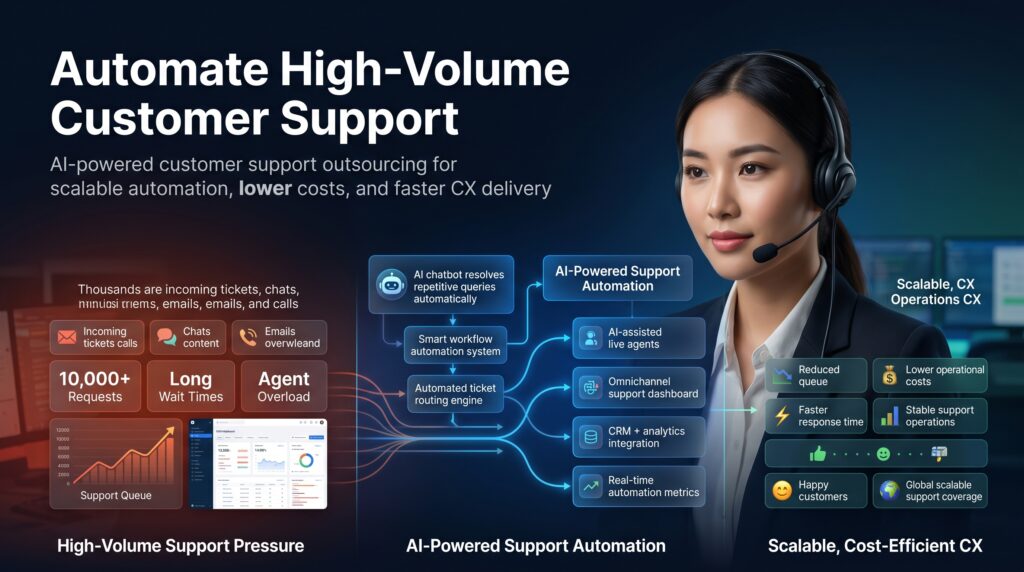
How High-Volume Support Automation Works
The highest-performing support organizations now use hybrid support infrastructure.
Layer 1: AI Automation
AI systems handle repetitive and predictable tasks such as:
- Password resets
- Order tracking
- FAQ responses
- Ticket categorization
- Chat routing
- Knowledge recommendations
AI significantly reduces ticket volume reaching human agents.
Layer 2: Outsourced Human Support
Human agents focus on:
- Escalations
- Technical troubleshooting
- Customer retention
- Compliance-sensitive conversations
- VIP customer management
- High-emotion interactions
This improves customer satisfaction while keeping operations scalable.
Layer 3: Operational Intelligence
Advanced support systems use:
- Sentiment analysis
- QA automation
- Workforce analytics
- SLA monitoring
- Predictive routing
- Real-time dashboards
This enables continuous optimization across support operations.
Benefits of Customer Support Outsourcing
1. Significant Cost Reduction
Most businesses reduce support operational costs by 30–60%.
Savings typically come from:
- Lower labor costs
- Reduced infrastructure investment
- Shared operational resources
- Lower hiring expenses
- Faster onboarding systems
| Support Model | Avg Monthly Cost Per Agent |
| US In-House | $4,500–$7,000 |
| Nearshore Support | $2,000–$3,500 |
| Offshore Support | $800–$1,800 |
What this means for your business
Lower operational costs improve:
- Profit margins
- Cash flow
- Scaling flexibility
- Budget allocation for growth initiatives
2. Faster Response Times
Modern contact center services provide:
- 24/7 coverage
- Global workforce availability
- Omnichannel support
- Reduced queue times
Companies often see first-response improvements of 2–3x after outsourcing.
What this means for your business
Faster responses improve:
- CSAT
- Customer retention
- Brand trust
- Conversion rates
3. Better Scalability
Internal support teams struggle during:
- Product launches
- Seasonal demand spikes
- Viral growth
- International expansion
Outsourced operations scale significantly faster because infrastructure and staffing systems already exist.
What this means for your business
You can grow without constantly rebuilding support operations.
4. Improved Customer Experience
Modern outsourcing providers invest heavily in:
- QA systems
- AI analytics
- Workforce training
- Omnichannel engagement
- Customer journey optimization
This often produces stronger support consistency than overloaded internal teams.
What this means for your business
Better customer experience improves:
- Retention
- Customer lifetime value
- Upsells
- Brand reputation
Real-World Example: SaaS Support Scaling
A mid-market SaaS company handling 18,000+ monthly tickets faced:
- Slow response times
- Rising churn
- Agent burnout
- Escalating support costs
The company implemented:
- AI chatbot automation
- Tiered outsourcing support
- 24/7 offshore coverage
- Centralized QA monitoring
Results after six months:
- 42% reduction in support costs
- 67% faster first-response times
- 21% improvement in CSAT
- Reduced customer churn
The company used hybrid support workflows integrated with Zendesk and Salesforce.
Mid-Content Strategic CTA
The most successful support organizations are not simply hiring more agents.
They are building scalable customer operations powered by AI, automation, analytics, and global delivery infrastructure.
Explore enterprise-grade customer support outsourcing solutions at Mascallnet
Call Center Outsourcing Pricing
Pricing depends on:
- Geography
- Technical complexity
- Language requirements
- Compliance standards
- Channel coverage
- SLA expectations
Call Center Outsourcing Pricing Breakdown
| Service Type | Typical Cost |
| Shared Offshore Agents | $8–$15/hour |
| Dedicated Offshore Agents | $15–$25/hour |
| Technical Support Teams | $25–$45/hour |
| US-Based Support | $35–$75/hour |
Customer support outsourcing pricing may also include:
- QA management
- AI integrations
- Workforce analytics
- Reporting systems
- Training programs
Businesses should evaluate total operational value, not only hourly pricing.
Industry Use Cases
SaaS & eCommerce
Companies use contact center services for:
- Order support
- Refund processing
- Subscription management
- Technical onboarding
- Live chat support
AI automation significantly improves efficiency in these environments.
Fintech & Digital Banking
Digital banking services require:
- Secure identity workflows
- Fraud escalation
- Compliance-sensitive communication
- Real-time customer support
Hybrid AI + human models are now standard in fintech operations.
Healthcare
Healthcare outsourcing services support:
- Appointment scheduling
- Insurance coordination
- Patient communication
- Billing workflows
- Administrative operations
Security and compliance remain critical priorities.
Why Companies Outsource Customer Support to India
India remains one of the world’s largest outsourcing hubs because of:
- Large English-speaking workforce
- Strong technical talent pool
- Mature outsourcing infrastructure
- 24/7 operational readiness
- Competitive operational costs
Businesses that outsource customer support to India gain access to scalable operational capacity without massive infrastructure investment.
Modern offshore call center outsourcing services in India now support:
- Omnichannel CX
- AI-assisted workflows
- Technical troubleshooting
- Enterprise QA systems
- Cloud-native operations
India has evolved into a strategic global support infrastructure market rather than a low-cost labor destination.
Step-by-Step Implementation Framework
Step 1: Audit Existing Support Operations
Evaluate:
- Ticket volumes
- Resolution times
- Cost per ticket
- Escalation rates
- Channel performance
Identify where outsourcing creates the highest operational leverage.
Step 2: Select the Right Outsourcing Partner
Evaluate vendors based on:
- Industry expertise
- Security certifications
- Technical capabilities
- QA frameworks
- Scalability
- Technology compatibility
Do not select vendors based solely on lowest pricing.
Step 3: Build the Technology Stack
Modern support operations require:
- CRM integration
- Omnichannel routing
- AI automation
- Analytics dashboards
- Workforce management systems
Common platforms include:
- Zendesk
- Freshdesk
- Salesforce
Step 4: Launch a Pilot Program
Start with:
- One support queue
- Limited channels
- Defined KPIs
- Dedicated QA oversight
Track:
- CSAT
- SLA compliance
- Resolution speed
- Operational savings
Step 5: Scale Gradually
Expand:
- Support coverage
- Languages
- Automation layers
- Workforce capacity
- Technical workflows
The best outsourcing transitions are phased and data-driven.
In-House vs Outsourced Support
| Category | In-House | Outsourced |
| Hiring Speed | Slow | Fast |
| 24/7 Coverage | Expensive | Scalable |
| Infrastructure Cost | High | Lower |
| Workforce Flexibility | Limited | High |
| Global Expansion | Difficult | Easier |
| Scalability | Slower | Faster |
As support demand grows, outsourced operations often become more operationally efficient than internal-only models.
AI vs Human vs Hybrid Support Models
| Model | Strength | Weakness |
| AI Only | Speed and scale | Low empathy |
| Human Only | Relationship quality | Higher cost |
| Hybrid Model | Efficiency + CX balance | Requires orchestration |
The hybrid model delivers the strongest long-term performance.
AI improves operational efficiency.
Human agents maintain trust, empathy, and relationship quality.
Risks and Mitigation
Data Security
Risk
Sensitive customer information exposure.
Mitigation
- SOC 2 compliance
- Encrypted systems
- Access controls
- Security audits
Vendor Dependency
Risk
Overreliance on one provider.
Mitigation
- Multi-vendor strategy
- SLA governance
- Internal operational oversight
Quality Inconsistency
Risk
Brand experience degradation.
Mitigation
- QA scorecards
- AI monitoring
- Continuous training
- Escalation management
Compliance Challenges
Risk
Regulatory violations.
Mitigation
- Industry-specific workflows
- Compliance audits
- Dedicated governance teams
Future Trends in Customer Support Outsourcing
The future of support is automation-first and intelligence-driven.
Key trends include:
- AI copilots for agents
- Predictive support workflows
- Voice AI escalation systems
- Real-time sentiment analysis
- Autonomous ticket routing
- Hyper-personalized customer experiences
The biggest transformation is automating business processes across the entire customer lifecycle.
Businesses are increasingly automating:
- Ticket prioritization
- Workflow management
- QA analysis
- Knowledge generation
- Workforce scheduling
Organizations that combine automation with human expertise will dominate customer experience performance over the next decade.
Decision Clarity
When You Should Outsource
Customer support outsourcing makes sense when:
- Ticket volumes are increasing rapidly
- Internal teams are overloaded
- Support costs are rising too quickly
- Global expansion requires 24/7 coverage
- Response times are declining
- Customer satisfaction is falling
When You Should Not Outsource
Avoid outsourcing if:
- Internal processes are undocumented
- Product knowledge is unstable
- Leadership lacks operational oversight
- Customer workflows are constantly changing
Outsourcing amplifies operational systems. Strong systems produce strong outcomes.
FAQ
What is customer support outsourcing?
Customer support outsourcing is the process of using an external provider to manage customer service operations such as chat, voice, email, and technical support. Businesses use it to scale support efficiently while reducing operational costs.
How much does call center outsourcing pricing cost?
Call center outsourcing pricing typically ranges from $8–$45 per hour depending on support complexity, geography, language requirements, and SLA expectations.
Is customer support outsourcing safe?
Yes. Enterprise outsourcing providers use encrypted infrastructure, compliance frameworks, access controls, and audited security systems to protect customer information.
Why outsource customer support to India?
Companies outsource customer support to India because of its experienced workforce, lower operational costs, strong English proficiency, and mature outsourcing ecosystem.
What are offshore call center outsourcing services?
Offshore call center outsourcing services involve using support teams in another country to manage customer interactions at lower operational cost and greater scalability.
Can AI replace outsourced support teams?
AI can automate repetitive tasks, but human agents remain essential for escalations, retention, compliance-sensitive interactions, and emotionally complex conversations.
Conclusion
Customer support has become a critical growth infrastructure function.
Businesses that rely solely on traditional in-house support models increasingly struggle with:
- Rising costs
- Slow scaling
- Agent burnout
- Customer dissatisfaction
This is why customer support outsourcing and call center outsourcing are becoming essential operational strategies for modern enterprises.
The highest-performing organizations combine:
- AI automation
- Omnichannel support
- Global delivery infrastructure
- Advanced analytics
- Skilled human agents
This hybrid model improves:
- Cost efficiency
- Scalability
- Customer retention
- Operational resilience
- Long-term growth
Companies that modernize support operations now will create a significant competitive advantage over the next decade.