
How to Handle Seasonal Support Traffic for eCommerce & SaaS
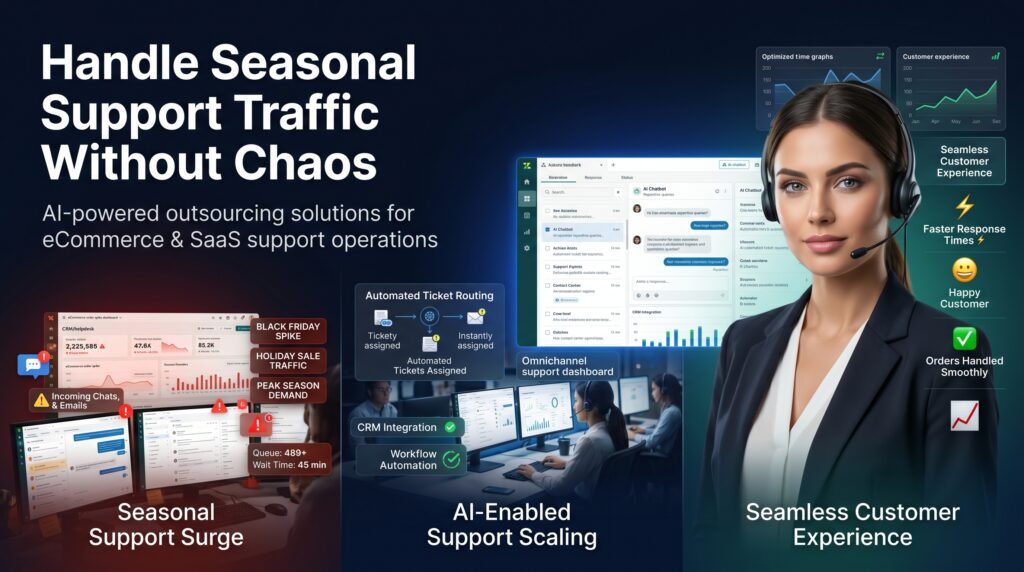
Seasonal Support Traffic Is No Longer a Temporary Problem
For modern eCommerce and SaaS companies, seasonal support demand has become a permanent operational challenge.
Black Friday traffic surges. Flash sales. Subscription onboarding spikes. Product launches. Holiday campaigns. Viral promotions. Renewal cycles.
These events can increase customer support volume by 300–700% within days.
The result is predictable:
- Delayed response times
- Rising customer frustration
- SLA failures
- Escalation overload
- Revenue leakage
- Higher churn
Today’s customers expect instant support, omnichannel communication, and 24/7 availability regardless of demand spikes.
This is why customer support outsourcing has become a strategic growth infrastructure decision rather than simply a cost-cutting tactic.
Leading brands now use call center outsourcing to create scalable customer experience operations that can expand rapidly during high-demand periods without permanently increasing internal headcount.
Many companies also outsource customer support to India to access scalable talent, technical expertise, multilingual capabilities, and lower operational costs.
The modern support ecosystem combines:
- AI-powered automation
- Human support specialists
- Predictive analytics
- Omnichannel engagement
- Global delivery infrastructure
- Intelligent workflow automation
This guide explains how eCommerce and SaaS companies use customer support outsourcing, offshore call center outsourcing services, and AI-driven operations to manage seasonal demand efficiently while improving customer satisfaction and protecting revenue growth.
AI Overview
Seasonal customer support traffic creates operational pressure across staffing, response times, and customer retention for eCommerce and SaaS companies. Organizations increasingly rely on call center outsourcing and scalable contact center services to manage fluctuating support volumes without increasing long-term overhead costs.
Modern customer experience operations combine AI automation, workforce scalability, and global support infrastructure. By automating business processes and deploying hybrid support models, companies improve response speed, maintain SLA performance, and reduce operational costs during peak demand periods.
Businesses that outsource customer support to India gain access to multilingual support teams, 24/7 operations, technical expertise, and cost-efficient scalability. Leading outsourcing providers integrate with enterprise platforms such as Zendesk, Salesforce, Freshdesk, and HubSpot to deliver enterprise-grade customer experience operations.
Key Insights
- Seasonal support traffic can increase ticket volume by 2x–7x within 72 hours
- Businesses using customer support outsourcing reduce operational costs by 30–60%
- Hybrid AI + human support models improve first-response time by up to 70%
- Offshore call center outsourcing services enable rapid workforce scaling
- AI-powered automation reduces average ticket handling time significantly
- Omnichannel contact center services improve CSAT and customer retention
- India remains the leading destination for global customer support outsourcing
Why Seasonal Support Traffic Becomes Dangerous
1. Slow Response Times Increase Churn
Customer expectations are higher than ever.
Consumers now expect:
- Instant responses
- Real-time order updates
- Fast issue resolution
- Personalized communication
- Always-on support availability
When response times increase during peak periods, businesses experience:
- Higher churn
- Lower retention
- Cart abandonment
- Negative reviews
- Lost recurring revenue
For SaaS companies, unresolved onboarding issues directly impact customer activation and subscription retention.
For eCommerce businesses, delayed shipping responses and refund handling reduce customer trust during critical revenue periods.
2. Internal Teams Burn Out Quickly
High-volume periods create:
- Agent fatigue
- Lower productivity
- Escalation bottlenecks
- SLA failures
- Increased attrition
Most internal support teams are not built for rapid elasticity.
Aggressive seasonal hiring creates long-term inefficiencies once demand normalizes.
Customer support outsourcing solves this problem by providing scalable workforce capacity without permanently increasing overhead costs.
3. Revenue Leakage Accelerates
Support performance now directly impacts:
- Revenue retention
- Customer lifetime value
- Brand reputation
- Upsell opportunities
- Subscription renewals
- Repeat purchases
Customer experience is no longer a support function alone.
It is now a core revenue driver.
The Market Shift Toward Outsourcing + AI
The global customer experience industry is rapidly evolving toward hybrid support operations powered by AI and automation.
Modern contact center services now combine:
- AI-driven ticket routing
- Predictive workforce forecasting
- Knowledge automation
- Omnichannel communication
- Human escalation workflows
- Real-time analytics
This is where automating business processes becomes strategically important.
AI systems handle repetitive inquiries instantly while human agents focus on:
- Complex technical issues
- Escalations
- Retention conversations
- High-value customer interactions
Leading providers increasingly build infrastructure on platforms like Amazon Web Services and Google Cloud to deliver secure, scalable, enterprise-grade customer experience operations.
What Is Seasonal Support Outsourcing?
Seasonal support outsourcing is the process of temporarily scaling customer service operations during periods of elevated demand.
Businesses outsource call center services to external support providers capable of rapidly increasing support capacity without requiring long internal hiring cycles.
These outsourced operations typically include:
- Live chat support
- Voice support
- Email support
- Technical support
- Billing assistance
- Subscription management
- Order tracking
- Refund processing
- Escalation handling
Modern offshore call center outsourcing services operate through hybrid delivery models combining:
- AI automation
- Human support teams
- Cloud-based ticketing systems
- Workforce management platforms
- Predictive analytics
- Omnichannel engagement
This enables companies to scale customer support operations within days instead of months.
Benefits of Customer Support Outsourcing
1. Lower Operational Costs
Most businesses reduce operational expenses by 30–60% through customer support outsourcing.
Cost savings come from:
- Lower staffing costs
- Reduced hiring overhead
- Shared technology infrastructure
- Flexible workforce scaling
- Lower training expenses
This becomes especially valuable during temporary seasonal demand spikes.
2. Faster Response Times
Outsourcing providers offer:
- 24/7 customer support
- Follow-the-sun operations
- Overflow management
- Rapid workforce expansion
- Omnichannel communication
Many organizations improve first-response time by 2–3x after implementing scalable outsourced support models.
3. Improved Customer Satisfaction
Modern contact center services operate mature:
- QA frameworks
- Escalation systems
- Workforce optimization programs
- Customer experience monitoring
This improves:
- CSAT scores
- Resolution speed
- SLA consistency
- Customer loyalty
4. Access to Enterprise Technology
Leading outsourcing providers integrate with:
- CRM platforms
- AI automation systems
- Workforce management tools
- Knowledge bases
- Analytics dashboards
Platforms like Zendesk, Freshdesk, Salesforce, and HubSpot are commonly embedded into enterprise support ecosystems.
What This Means for Your Business
Seasonal support traffic is a scalability test.
Businesses that fail during high-demand periods experience:
- Revenue loss
- Customer churn
- Negative reviews
- Lower retention
- Operational instability
Organizations implementing customer support outsourcing gain:
- Faster scalability
- Revenue protection
- Lower fixed costs
- Better operational flexibility
- Improved customer experience
- Global support coverage
For SaaS and eCommerce companies, customer experience directly influences growth velocity and retention economics.
Customer Support Outsourcing Pricing
Call Center Outsourcing Pricing Models
Per-Agent Monthly Pricing
| Support Type | Monthly Cost Per Agent |
| Basic customer support | $800–$1,500 |
| Technical SaaS support | $1,500–$3,500 |
| Multilingual enterprise support | $2,000–$5,000 |
Hourly Pricing
| Delivery Model | Hourly Rate |
| Offshore teams | $8–$25/hour |
| Nearshore teams | $20–$45/hour |
| Onshore enterprise support | $40–$90/hour |
Outcome-Based Pricing
Advanced providers increasingly offer:
- Per-ticket pricing
- Resolution-based contracts
- SLA-based pricing
- Shared-risk agreements
Factors Affecting Customer Support Outsourcing Pricing
Pricing depends on:
- Ticket complexity
- Technical expertise requirements
- Compliance obligations
- Language support
- 24/7 availability
- AI integration depth
- Omnichannel operations
Customer support outsourcing pricing becomes significantly more efficient when businesses experience fluctuating seasonal demand.
Industry Use Cases
eCommerce Support Operations
Peak periods include:
- Black Friday
- Cyber Monday
- Holiday shopping seasons
- Flash sales
- Product launches
Outsourced services include:
- Order tracking
- Refund handling
- Live chat support
- Returns processing
- Omnichannel contact center services
SaaS Support Operations
SaaS companies commonly outsource:
- Customer onboarding
- Technical troubleshooting
- Subscription management
- Renewal support
- Customer success escalation
This improves scalability during rapid growth periods.
Fintech and Digital Banking Services
Fintech organizations increasingly rely on outsourcing providers for:
- Fraud monitoring
- Customer verification
- Account support
- Payment disputes
- Digital banking services
Security and compliance become mission-critical.
Healthcare Support Operations
Healthcare outsourcing services commonly include:
- Appointment scheduling
- Billing support
- Patient communication
- Administrative coordination
- Claims management
Compliance and data security frameworks are essential in healthcare operations.
Why Businesses Outsource Customer Support to India
India remains the dominant destination for offshore call center outsourcing services.
1. Large Skilled Workforce
India offers one of the world’s largest English-speaking customer support talent pools.
2. Lower Operational Costs
Businesses often reduce support expenses by 40–70% compared to North American operations.
3. Strong Technical Expertise
India supports:
- SaaS technical support
- AI-powered support operations
- Enterprise CX management
- Automation infrastructure
- Omnichannel customer engagement
4. Mature Operational Infrastructure
Leading providers operate:
- ISO-certified facilities
- Secure cloud infrastructure
- AI-enabled support systems
- Enterprise-grade security protocols
5. 24/7 Global Coverage
Time-zone advantages allow continuous customer support operations across global markets.
This is why many enterprises outsource customer support to India for scalable global delivery.
Implementation Framework
Step 1: Audit Seasonal Demand
Analyze:
- Ticket volume trends
- SLA failures
- Escalation categories
- Support channels
- Customer behavior patterns
Step 2: Select the Right Vendor
Evaluate:
- Industry expertise
- Technology stack
- Security certifications
- Workforce scalability
- AI integration capabilities
- Compliance infrastructure
Step 3: Build the Technology Stack
Core systems typically include:
- CRM platforms
- Ticketing systems
- Analytics dashboards
- QA monitoring tools
- Workforce management systems
- AI automation platforms
Step 4: Launch a Pilot Program
Start with:
- Limited channels
- Controlled ticket volume
- Defined SLA targets
- Small escalation scope
Step 5: Scale Based on Performance
Expand operations based on:
- CSAT improvement
- SLA stability
- Resolution quality
- Cost efficiency
- Customer retention metrics
In-House vs Call Center Outsourcing
| Factor | In-House Support | Call Center Outsourcing |
| Scalability | Slow | Rapid |
| Seasonal readiness | Limited | High |
| Global coverage | Limited | Extensive |
| Technology investment | High | Shared |
| Workforce flexibility | Low | High |
| Cost structure | Fixed | Variable |
| AI adoption speed | Slower | Faster |
AI vs Human vs Hybrid Support
| Model | Strength | Limitation |
| AI-only support | Speed and scalability | Weak emotional handling |
| Human-only support | Personalized interaction | Expensive scaling |
| Hybrid support | Balanced efficiency and empathy | Requires orchestration |
The future of customer support is hybrid.
AI systems manage:
- FAQ resolution
- Ticket routing
- Workflow automation
- Predictive escalation detection
Human agents manage:
- High-value conversations
- Emotional escalations
- Technical complexity
- Customer retention
This is where automating business processes creates measurable operational leverage.
Risks and Mitigation Strategies
Data Security Risks
Potential risks include:
- Customer data exposure
- Unauthorized access
- Compliance violations
Mitigation strategies:
- Encryption protocols
- Role-based access controls
- Security audits
- ISO-certified infrastructure
Vendor Dependency Risks
Potential risk:
- Overreliance on one outsourcing provider
Mitigation strategies:
- Multi-vendor support models
- SLA governance frameworks
- Internal escalation oversight
Compliance Risks
Potential challenges:
- Regulatory requirements
- International data transfer restrictions
Mitigation strategies:
- Compliance training
- Secure cloud infrastructure
- Continuous audit programs
Future Trends in Customer Support Outsourcing
AI-Driven Customer Experience
AI copilots are transforming:
- Ticket resolution speed
- Agent productivity
- Personalization quality
- Workforce forecasting
Automation-First Operations
The next generation of support operations will prioritize:
- Automating business processes
- AI-assisted quality assurance
- Predictive customer service
- Intelligent routing
- Conversational AI
Outcome-Based Outsourcing
Providers are increasingly measured by:
- CSAT performance
- Retention metrics
- Revenue impact
- SLA compliance
- Resolution speed
Customer support is evolving from a cost center into a growth engine.
Case Study
An international eCommerce retailer experienced a 420% increase in support volume during the holiday season.
Challenges included:
- Slow response times
- Refund backlog growth
- Rising cart abandonment
- Customer dissatisfaction
The company implemented:
- Offshore customer support outsourcing
- AI-powered ticket routing
- 24/7 omnichannel support
- Workforce forecasting systems
Results within 90 days:
- 58% lower operational costs
- 67% faster first-response time
- 41% reduction in escalations
- 22% increase in CSAT
- Improved holiday conversion rates
Strategic CTA
Scaling seasonal support operations requires more than additional staffing.
It requires scalable infrastructure, AI-powered operations, and globally distributed customer experience systems.
Explore enterprise-grade customer support outsourcing, AI-powered contact center services, and offshore support infrastructure at: Mascallnet
Decision Clarity
You Should Outsource If:
- Ticket volume fluctuates heavily
- SLAs are declining
- Customer wait times are increasing
- Internal teams are overloaded
- 24/7 support is required
- Seasonal demand is unpredictable
You Should Avoid Outsourcing If:
- Operations involve highly sensitive internal IP
- Support workflows are undocumented
- Customer interactions require niche internal expertise
Key Decision Triggers
- Rapid SaaS growth
- Seasonal eCommerce demand spikes
- Rising support costs
- Global expansion
- Declining customer satisfaction
FAQ
What is customer support outsourcing?
Customer support outsourcing is the process of hiring an external provider to manage customer service operations such as live chat, voice support, email support, and technical assistance.
How much does call center outsourcing pricing cost?
Call center outsourcing pricing typically ranges from $8–$25 per hour offshore and $40–$90 per hour onshore depending on complexity, compliance requirements, and support channels.
Is customer support outsourcing safe?
Yes. Reputable providers use secure cloud infrastructure, encryption, role-based access controls, and compliance monitoring systems to protect customer data.
Why outsource customer support to India?
Businesses outsource customer support to India because of lower operational costs, strong English-speaking talent pools, technical expertise, and scalable 24/7 operations.
What industries benefit most from outsourcing?
eCommerce, SaaS, fintech, healthcare, logistics, and subscription businesses benefit significantly because they experience fluctuating customer interaction volumes.
Can AI replace outsourced customer support teams?
AI improves operational efficiency but does not fully replace human support teams. Most enterprises now use hybrid models combining AI automation with trained human agents.
Conclusion
Seasonal support traffic has become one of the most important operational challenges for modern eCommerce and SaaS companies.
Businesses that fail to scale customer experience operations during peak demand periods experience:
- Revenue leakage
- Customer churn
- Negative brand sentiment
- Lower retention
- Operational instability
Organizations implementing customer support outsourcing and strategic call center outsourcing gain:
- Faster scalability
- Lower operational costs
- Better SLA performance
- Improved customer satisfaction
- Global support coverage
- Revenue protection during peak periods
The future belongs to hybrid support ecosystems powered by AI, automation, and globally distributed operations.
For businesses managing unpredictable customer demand, outsourcing is no longer just a staffing decision.
It is a competitive growth strategy.