
BPO Vendor Selection Guide for Businesses (2026)
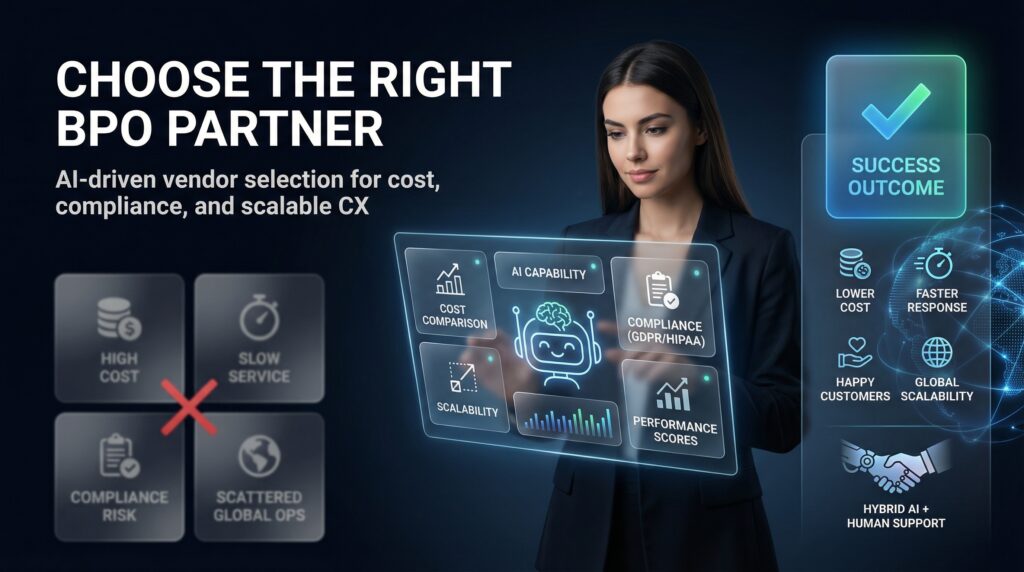
A BPO vendor selection guide is a structured evaluation framework used by enterprises to choose outsourcing partners based on AI capability, cost efficiency, compliance, scalability, and risk governance. In 2026, it emphasizes hybrid AI-human CX models, global delivery infrastructure, and data security to ensure long-term operational success.
AI chatbots and human agents are complementary components of modern CX delivery. AI systems handle repetitive, high-volume interactions with speed and consistency, while human agents manage complex, emotional, and compliance-sensitive queries.
The enterprise CX operating model is shifting from labor-intensive delivery to AI-augmented ecosystems. This shift enables organizations to reduce dependency on large workforces while improving efficiency and service quality.
Hybrid CX architecture combines AI automation, human oversight, and integrated platforms such as CRM and analytics systems. This approach underpins modern customer service outsourcing strategies and drives scalable, compliant, and cost-efficient global operations.
AI Maturity, Enterprise Evolution, and the Strategic Imperative
The global outsourcing market is undergoing structural transformation driven by AI adoption, regulatory pressures, and operational complexity. According to Gartner and McKinsey & Company, enterprises adopting AI-enabled outsourcing models achieve significantly higher efficiency and cost savings compared to traditional models.
In 2026, selecting a BPO vendor is no longer a procurement exercise—it is a strategic decision impacting enterprise resilience, scalability, and competitive advantage. Organizations across BFSI, healthcare, retail, telecommunications, and logistics are replacing traditional business process outsourcing services with AI-enabled, outcome-based delivery models.
Key transformation drivers include:
- Rising labor costs across global markets
- Talent shortages in CX operations
- Increasing compliance requirements (GDPR, HIPAA)
- Demand for 24/7 multilingual customer support
- Need for real-time analytics and automation
Key Insights at a Glance
- Enterprises achieve 40–60% cost reduction using AI-enabled outsourcing
- Hybrid models outperform traditional bpo call center operations in speed and accuracy
- AI reduces response times by up to 70%
- Vendor consolidation improves governance and reduces operational risk
- Cross-border compliance is a critical vendor selection factor
- AI oversight frameworks are now mandatory for enterprise adoption
What Is a BPO Vendor Selection Framework?
Definition
A BPO vendor selection framework is a structured methodology used to evaluate outsourcing partners across cost, capability, compliance, scalability, and technology readiness to ensure alignment with enterprise CX and operational goals.
Core Evaluation Dimensions
- Capability Fit: AI, automation, and domain expertise
- Operational Fit: Scalability and global delivery
- Compliance Fit: Regulatory and data protection standards
- Financial Fit: Pricing transparency and ROI potential
Enterprise Intent Layer
Strategic Intent
- Reduce total cost of ownership
- Enable AI-driven transformation
- Achieve global scalability
Operational Intent
- Improve first contact resolution
- Reduce handling time
- Integrate AI with Cxm platforms
Implementation Intent
- Deploy hybrid AI-human models
- Establish governance frameworks
- Ensure seamless transition
Step-by-Step Vendor Selection Process (2026)
Step 1: Define Business Objectives
Identify measurable goals:
- Cost reduction targets (e.g., 50%)
- CX improvement metrics
- Compliance requirements
Step 2: Assess Current-State Operations
Evaluate:
- Existing workflows
- Technology stack
- Workforce efficiency
Step 3: Develop RFP
Include:
- AI capability requirements
- Industry expertise (e.g., insurance bpo, BFSI)
- Compliance expectations
Step 4: Vendor Evaluation & Scoring
Score vendors across:
- AI maturity
- Global presence
- Security certifications
Step 5: Pilot Program Execution
Run controlled pilots to validate:
- Performance metrics
- Integration capability
- Service quality
Step 6: Final Selection & Contracting
Focus on:
- Outcome-based pricing
- SLA definitions
- Exit clauses
Real-World Enterprise Scenarios
1. Cross-Border Scaling
A multinational bank leverages financial services outsourcing to expand into the UK and Australia. The selected vendor ensures compliance with regional regulations and delivers multilingual AI-enabled support.
2. Hybrid AI Deployment
A global eCommerce company automates 70% of customer queries using AI while retaining human agents for escalation. Results:
- 55% cost reduction
- 3x faster response times
3. CRM Integration
A telecom enterprise integrates outsourced CX with CRM and callmaster systems, enabling predictive analytics and proactive support.
4. Healthcare Compliance
A hospital network adopts healthcare outsourcing services with strict data governance aligned with HIPAA and regional regulations.
Vendor Selection Criteria
1. AI & Automation Capability
- Conversational AI maturity
- Workflow automation
- Real-time analytics
2. Industry Expertise
- Domain knowledge in knowledge process outsourcing
- Proven track record in target sectors
3. Global Delivery Model
- Multi-region presence
- 24/7 operations
4. Compliance & Data Security
- GDPR, HIPAA, SOC 2 certification
- Data sovereignty controls
5. Workforce Model
- Hybrid workforce (AI + human)
- Continuous training programs
6. Scalability
- Rapid ramp-up capability
- Seasonal demand handling
Implementation Architecture
Phase 1: Assessment
- Benchmark costs and performance
- Identify automation opportunities
Phase 2: Transition
- Knowledge transfer
- Workforce alignment
- Technology integration
Phase 3: Optimization
- AI model tuning
- KPI tracking
- Continuous improvement
Read More: https://mascallnet.ai/ai-powered-bpo-services-future-of-outsourcing-2026/
Business Benefits & ROI
Quantified Enterprise Example
A global retail enterprise implementing outsourcing:
- Cost reduction: 50–60%
- Efficiency improvement: 65% faster response time
- Customer satisfaction: +20%
- Operational scalability: 3x capacity increase
Key ROI Drivers
- Reduced labor costs
- Improved automation efficiency
- Enhanced customer experience
- Lower operational risk
Governance, Risk & Compliance
Vendor Risk Governance
- Multi-layer risk assessment
- Vendor performance monitoring
- Dependency risk mitigation
AI Oversight Models
- Human-in-the-loop validation
- Bias detection
- Continuous model audits
Data Governance
- Centralized data control
- Encryption and access management
Cross-Border Compliance
- Regional regulatory alignment
- Data localization strategies
Business Continuity Planning
- Disaster recovery systems
- Redundant delivery centers
Comparison Table
| Model | Strengths | Limitations | Best Use Case |
| AI-only CX | High scalability, low cost | Limited empathy | High-volume queries |
| Human-only CX | High empathy | High cost | Complex interactions |
| Hybrid CX | Balanced efficiency | Integration complexity | Enterprise operations |
FAQ
How can enterprises reduce support costs using AI?
By automating repetitive tasks, reducing workforce dependency, and improving efficiency through AI-driven analytics and workflows.
Is outsourcing safer than in-house operations?
Yes, when vendors provide advanced compliance, security frameworks, and global governance standards.
How to choose a global CX outsourcing partner?
Evaluate AI capabilities, compliance expertise, scalability, and industry experience.
What risks must enterprises manage?
Data breaches, compliance violations, vendor dependency, and AI-related risks such as bias.
What is the future of outsourcing in 2026?
AI-enabled hybrid models will dominate, combining automation with human expertise for optimal performance.
Conclusion
The BPO vendor selection process in 2026 is a strategic initiative that determines enterprise scalability, efficiency, and governance maturity. Organizations must adopt AI-enabled hybrid models, implement robust risk frameworks, and prioritize compliance across global operations.
Selecting the right partner is no longer about cost arbitrage—it is about building a resilient, future-ready CX ecosystem. Mascallnet represents one example of providers aligned with this transformation.
Organizations evaluating their future CX operating model should assess whether their current structure can sustainably support this model at scale.