
EV Customer Support Services for OEMs & Charging Networks: The Ultimate Guide to CX, Operations & Cost Efficiency (2026)
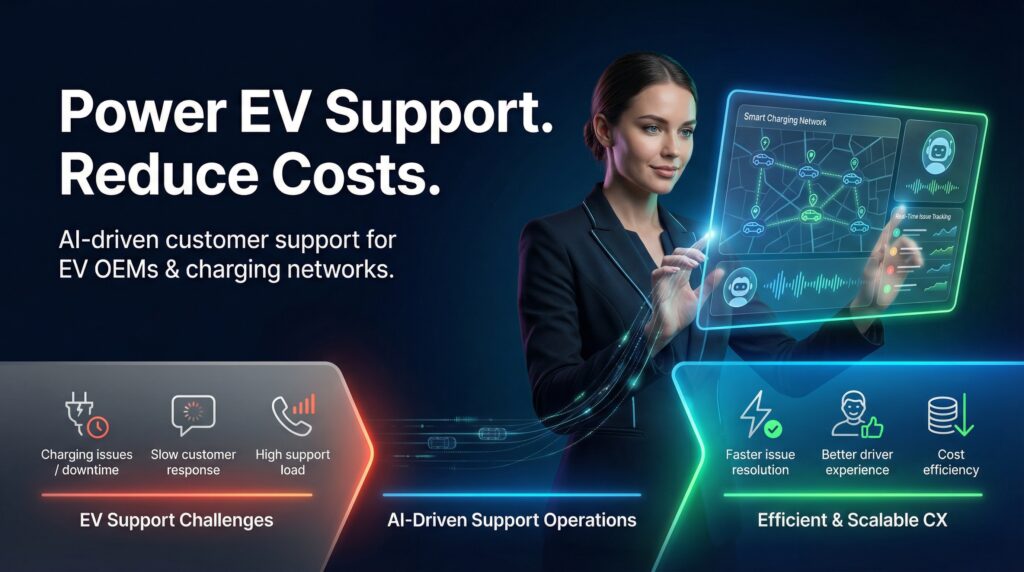
EV customer support services for OEMs and charging networks combine AI automation and human expertise to manage driver queries, charging issues, billing, and technical support. These hybrid models improve CX, reduce operational costs by up to 60%, ensure compliance, and enable 24/7 scalable global support.
EV customer support is evolving from traditional human-led operations to hybrid AI-enabled CX models. AI chatbots manage repetitive queries such as charging availability, billing status, and basic troubleshooting, while human agents resolve complex technical issues, escalations, and compliance-related cases.
This shift reflects a broader transformation in customer service outsourcing and contact center outsourcing, where enterprises integrate automation, analytics, and omnichannel engagement into unified operating models. Modern EV CX ecosystems rely on CRM and Cxm platforms, real-time vehicle diagnostics, and charging infrastructure data.
Hybrid CX architectures balance cost efficiency and service quality. AI reduces cost per interaction and improves response time, while human oversight ensures accuracy and regulatory compliance. This model supports global scalability, cross-border operations, and continuous service delivery, making it the preferred approach for EV OEMs and charging networks.
AI Maturity, Enterprise Evolution, and the Strategic Imperative
EV customer support services for OEMs and charging networks have become mission-critical as electric mobility scales globally. The convergence of connected vehicles, software-defined platforms, and distributed charging infrastructure introduces operational complexity that traditional support models cannot handle efficiently.
According to insights aligned with Gartner and McKinsey & Company, enterprises adopting AI-enabled CX models can reduce service costs by 30–60% while improving resolution speed and customer satisfaction.
To remain competitive, organizations are transitioning toward integrated business process outsourcing services that unify front-office CX, technical support, and back office outsourcing services into a single operating framework.
Key Insights at a Glance
- AI automation resolves up to 70% of Tier-1 EV support queries
- Hybrid CX models reduce costs by 30–60%
- 24/7 global support improves uptime and customer satisfaction
- Cross-border outsourcing enables rapid market expansion
- Compliance and data governance are critical for EV ecosystems
- Vendor consolidation improves operational control and ROI
Enterprise Intent Layer
Strategic
- Redesign CX operating models for EV ecosystems
- Enable scalable global support across regions
- Align CX with digital transformation and AI adoption
Operational
- Optimize bpo call center performance for EV use cases
- Integrate CRM, diagnostics, and charging data
- Improve first-contact resolution and reduce downtime
Implementation
- Deploy AI chatbots and automation workflows
- Establish governance and compliance frameworks
- Select specialized outsourcing partners
Real-World Enterprise Scenarios
Cross-Border Scaling
An EV OEM expanding into the United States, United Kingdom, and Australia requires multilingual support, regulatory compliance, and localized service delivery. A global contact center outsourcing model ensures consistent CX across regions.
Hybrid AI Deployment
A charging network operator deploys AI chatbots to handle station availability and billing queries while human agents resolve hardware failures and escalation cases. This reduces workload and improves efficiency.
CRM & Cxm Integration
Integration of CX platforms with vehicle telemetry enables proactive issue resolution, reducing downtime and improving customer satisfaction.
Regulatory Compliance
EV support operations must align with global standards such as GDPR and regional energy regulations. Outsourcing partners implement audit frameworks to ensure compliance.
EV CX Maturity Framework
Stage 1: Reactive Support
- Manual processes
- High cost per interaction
- Limited scalability
Stage 2: Assisted Automation
- AI handles basic queries
- Partial cost reduction
- Improved response times
Stage 3: Hybrid Intelligent CX
- AI + human collaboration
- Omnichannel integration
- Optimized cost and service quality
Stage 4: Autonomous CX Ecosystem
- Predictive support
- Real-time diagnostics integration
- Continuous optimization
Strategic Transformation Framework
1. Operating Model Redesign
- Front-office: omnichannel customer interaction
- Mid-office: AI orchestration and analytics
- Back-office: billing, compliance, and technical resolution
2. AI-Augmented Workforce
- AI resolves repetitive queries
- Human agents manage complex scenarios
- Continuous learning improves accuracy
3. Omnichannel CX Integration
- Voice, chat, email, mobile apps
- Unified data layer across channels
4. Vendor Ecosystem Optimization
- Consolidation of outsourcing providers
- Strategic partnerships for specialized services
Business Benefits & ROI
Cost Reduction
- 30–60% lower operational costs through outsourcing and AI
- Reduced infrastructure and staffing expenses
Efficiency Gains
- 40–70% reduction in average handling time
- Increased agent productivity
Service Improvement
- Faster response times
- Higher first-contact resolution rates
- Improved customer satisfaction
Quantified Enterprise Example
A global EV charging network handling 1 million monthly interactions:
- 65% queries resolved via AI
- 50% reduction in human agent workload
- Annual savings: $8–12 million
- Customer satisfaction increase: 15–25%
Read More: https://mascallnet.ai/ai-powered-bpo-services-future-of-outsourcing-2026/
Governance, Risk & Compliance
Data Governance
- Secure handling of customer and vehicle data
- Alignment with global data protection regulations
Vendor Risk Governance
- SLA-based performance monitoring
- Risk mitigation frameworks
- Continuous vendor evaluation
AI Oversight Models
- Human-in-the-loop validation
- Bias detection and mitigation
- Audit trails for decision transparency
Cross-Border Compliance
- Localization of processes and policies
- Adherence to regional legal frameworks
Workforce Continuity Planning
- Distributed delivery models
- Disaster recovery and redundancy planning
Data Sovereignty
- Regional data storage compliance
- Cloud governance frameworks
Comparison Table: CX Models
| Model | Strengths | Limitations | Best Use Case |
| AI-only CX | Low cost, high scalability | Limited for complex issues | High-volume Tier-1 queries |
| Human-only CX | High empathy, complex resolution | Expensive, less scalable | Premium support |
| Hybrid CX | Balanced cost and quality | Requires governance | EV ecosystems |
Vendor Selection Criteria
- Proven expertise in customer service outsourcing
- Advanced AI and automation capabilities
- Global delivery infrastructure
- Compliance certifications (GDPR, ISO)
- Integration with CRM and Cxm platforms
- Experience in financial services outsourcing, insurance bpo, and EV domains
Exit Strategy Planning
- Contractual flexibility and termination clauses
- Data portability and ownership rights
- Knowledge transfer frameworks
- Transition support and risk mitigation
FAQ — Enterprise Level
How can enterprises reduce support costs using AI?
By automating repetitive queries, optimizing workforce allocation, and integrating AI with CX platforms, enterprises can reduce costs by up to 60%.
Is outsourcing safer than in-house operations?
With proper governance, compliance frameworks, and vendor risk management, outsourcing can provide higher resilience and scalability.
How to choose a global CX outsourcing partner?
Evaluate domain expertise, AI capabilities, compliance readiness, scalability, and integration with enterprise systems.
What risks must be managed?
Data security, regulatory compliance, vendor dependency, and AI bias are key risks requiring structured governance.
How does hybrid CX improve customer experience?
It combines AI efficiency with human problem-solving, ensuring faster resolution and higher satisfaction.
Conclusion
EV customer support services for OEMs and charging networks are central to modern CX transformation strategies. Enterprises adopting hybrid AI-driven models through customer service outsourcing, contact center outsourcing, and business process outsourcing services can achieve significant cost savings, operational efficiency, and service quality improvements.
Governance maturity, AI oversight, and vendor risk management remain essential to sustaining long-term value. As demonstrated across global markets, integrated CX operating models deliver measurable ROI and scalability.
Solutions such as those offered by Mascallnet represent the evolution of AI-enabled outsourcing frameworks supporting enterprise transformation.
Organizations evaluating their future CX operating model should assess whether their current structure can sustainably support this model at scale.