
CRM-Integrated Call Center Outsourcing Services in Australia: Boost Sales, CX & ROI
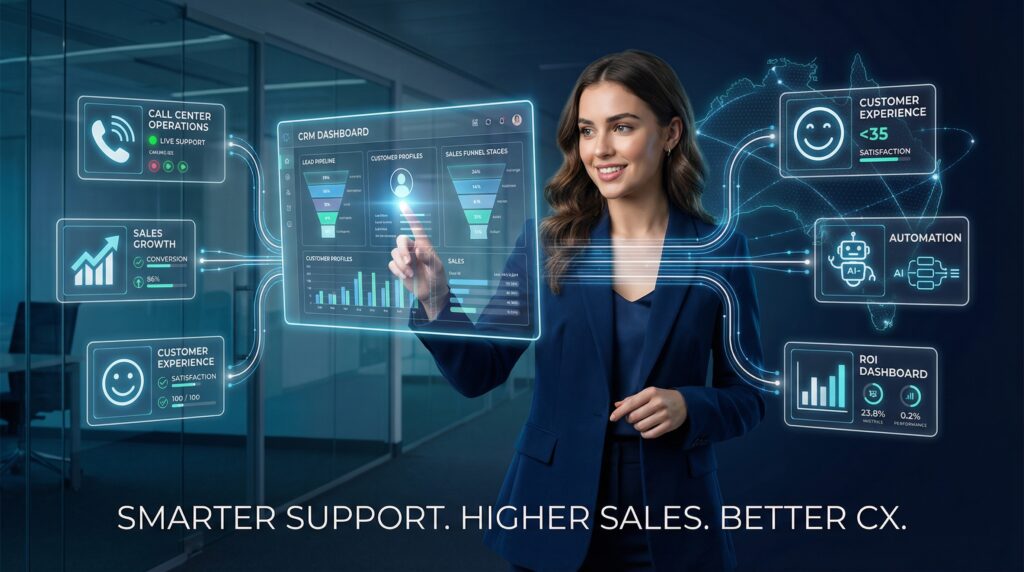
CRM-integrated call center outsourcing services in Australia combine AI automation, human agents, and centralized CRM platforms to deliver scalable, data-driven customer experience (CX). This model improves efficiency, reduces costs, ensures regulatory compliance, and enables real-time personalization across omnichannel customer interactions for global enterprises.
CRM-integrated call center outsourcing services in Australia represent a hybrid CX model that combines AI chatbots and human agents within a unified CRM ecosystem. AI handles high-volume, repetitive interactions such as FAQs, order tracking, and account queries, while human agents manage complex, sensitive, or high-value interactions.
The operating model has shifted from siloed customer service outsourcing to integrated, intelligence-driven systems where CRM platforms act as a centralized data hub. This enables real-time customer insights, consistent service delivery, and advanced analytics across all touchpoints.
Hybrid CX architecture integrates automation, analytics, and human expertise to deliver faster response times, improved accuracy, and scalable 24/7 support. Enterprises adopting this model achieve measurable gains in cost efficiency, customer satisfaction, and operational resilience while maintaining compliance, governance, and data security across global operations.
AI Maturity, Enterprise Evolution, and the Strategic Imperative
CRM-integrated call center outsourcing services in Australia are rapidly becoming a core component of enterprise transformation strategies. Organizations are replacing fragmented contact center outsourcing and legacy systems with unified, AI-enabled ecosystems that integrate CRM, automation, and analytics. This shift is accelerating globally, as highlighted by Gartner Customer Service Research, which identifies AI-driven customer service transformation as a top enterprise priority.
This shift is driven by measurable business pressures:
- Rising labor and infrastructure costs in developed markets
- Increasing demand for real-time, personalized CX
- Global workforce shortages impacting service delivery
- Regulatory complexity in sectors such as BFSI and healthcare
- Need for scalable, 24/7 omnichannel support
Australia offers a mature outsourcing environment with strong regulatory frameworks, advanced digital infrastructure, and alignment with Western compliance standards, making it a strategic hub for global CX delivery.
Key Insights at a Glance
- Enterprises reduce support costs by 25–45% using AI-enabled outsourcing
- AI automation resolves 60–80% of Tier-1 queries
- CRM integration improves customer retention by 15–25%
- Hybrid CX models outperform traditional bpo call center structures in scalability
- Omnichannel CX increases conversion rates by 20–30%
- AI-driven analytics improve decision-making accuracy by 40%
What Is CRM-Integrated Call Center Outsourcing?
CRM-integrated call center outsourcing is a service model where external providers deliver customer support using integrated CRM platforms, AI tools, and omnichannel communication systems.
Core Components
- CRM Platform: Centralized customer data and interaction history
- AI Automation: Chatbots, voice bots, and workflow automation
- Human Agents: Skilled professionals handling complex interactions
- Analytics Layer: Real-time performance tracking and insights
This model enhances traditional customer service outsourcing by enabling personalization, automation, and data-driven decision-making.
Enterprise Intent Layer
Strategic Objectives
- Redesign CX operating models for scalability and efficiency
- Consolidate vendors under unified outsourcing frameworks
- Enable global service delivery with localized compliance
Operational Objectives
- Improve first-contact resolution (FCR)
- Reduce average handling time (AHT)
- Optimize workforce productivity using AI
Implementation Objectives
- Integrate CRM with outsourcing platforms
- Deploy AI-driven automation
- Establish governance and compliance frameworks
Real-World Enterprise Scenarios
1. Cross-Border CX Scaling
A global retail enterprise uses Australia-based outsourcing to serve APAC customers. CRM integration enables unified customer profiles, reducing response time by 40% and improving conversion rates.
2. BFSI Hybrid Model
Banks leverage financial services outsourcing with AI chatbots handling balance inquiries and human agents resolving disputes. CRM ensures audit trails and regulatory compliance.
3. Healthcare Compliance
Healthcare providers using healthcare outsourcing services integrate CRM systems to maintain secure patient records while delivering 24/7 support.
4. eCommerce Omnichannel CX
Retail brands integrate CXM platforms with outsourced teams to unify voice, chat, and email support, improving customer satisfaction and retention.
Strategic CX Transformation Framework
1. Operating Model Redesign
Enterprises transition from siloed models to integrated ecosystems:
- AI automation layer
- Human interaction layer
- CRM data layer
- Analytics and reporting layer
2. Technology Stack Integration
- Cloud-based CRM platforms
- API-driven integrations
- AI and machine learning engines
- Omnichannel communication tools
3. Workforce Transformation
- AI-augmented agents
- Remote and distributed workforce models
- Continuous skill development
4. Vendor Consolidation
- Strategic outsourcing partnerships
- Unified SLAs and KPIs
- Centralized governance
Business Benefits & ROI
Enterprise Case Example
A global telecommunications company implemented CRM-integrated outsourcing and achieved:
- 35% cost reduction
- 50% faster response times
- 20% increase in CSAT scores
- 30% reduction in agent workload
ROI Drivers
- Automation of repetitive tasks
- Reduced infrastructure costs
- Improved workforce efficiency
- Enhanced customer retention
Read More: https://mascallnet.ai/ai-powered-outsourcing-how-intelligent-contact-centers-drive-growth/
Governance, Risk & Compliance Framework
1. Data Governance
- Centralized CRM ensures data integrity
- Role-based access control
- Encryption and secure storage
2. Vendor Risk Management
- SLA monitoring and performance tracking
- Risk mitigation frameworks
- Continuous vendor audits
3. AI Oversight Models
- Human-in-the-loop systems
- Bias detection and mitigation
- Continuous model validation
4. Cross-Border Compliance
- Alignment with global data protection laws
- Data residency compliance
- Industry-specific regulations
5. Business Continuity Planning
- Distributed workforce strategies
- Disaster recovery systems
- Redundancy across locations
Comparison Table: CX Delivery Models
| Model | Strengths | Limitations | Best Use Case |
| AI-only CX | Low cost, high scalability, 24/7 support | Limited human empathy | High-volume repetitive queries |
| Human-only CX | Personalized, complex issue handling | High operational cost | Premium customer segments |
| Hybrid CX | Balanced efficiency and experience | Requires integration and governance | Enterprise global operations |
Vendor Selection Criteria (Step-by-Step)
Step 1: Assess Technology Capabilities
- CRM integration
- AI and automation maturity
Step 2: Evaluate Industry Expertise
- BFSI, retail, healthcare, telecom
- Experience in insurance bpo and regulated sectors
Step 3: Review Compliance Standards
- Data security certifications
- Regulatory adherence
Step 4: Analyze Scalability
- Global delivery capabilities
- Workforce flexibility
Step 5: Validate Performance Metrics
- SLAs, KPIs, and reporting frameworks
Implementation Architecture
Core Architecture Layers
- Customer interaction channels (voice, chat, email)
- AI processing layer
- CRM data layer
- Human agent escalation
- Analytics and reporting
Workflow Example
- Customer initiates interaction
- AI resolves or escalates
- CRM logs interaction
- Agent resolves complex issues
- Analytics tracks performance
Exit Strategy Planning
- Define contractual exit clauses
- Ensure data portability and ownership
- Maintain knowledge transfer protocols
- Avoid vendor lock-in through modular systems
Why Australia for Call Center Outsourcing?
- Strong regulatory environment
- Skilled workforce
- Advanced digital infrastructure
- Time zone advantage for global operations
- High data security standards
FAQ — Enterprise Level
How can enterprises reduce support costs using AI?
By automating repetitive queries, optimizing workforce allocation, and reducing infrastructure costs, enterprises can achieve up to 40% cost savings.
Is outsourcing safer than in-house operations?
Outsourcing can be secure when vendors implement strong governance, compliance, and data protection frameworks.
How to choose a global CX outsourcing partner?
Evaluate CRM integration, AI capabilities, compliance standards, scalability, and industry expertise.
What risks must be managed?
Data breaches, vendor dependency, compliance failures, and service disruptions are key risks.
What industries benefit most?
BFSI, healthcare, retail, telecom, and logistics sectors benefit due to high interaction volumes and compliance requirements.
Conclusion
CRM-integrated call center outsourcing services in Australia provide a scalable, AI-driven, and governance-focused solution for modern enterprise CX challenges. By integrating CRM platforms, automation, and human expertise, organizations achieve cost efficiency, improved service quality, and global scalability.
Enterprises adopting this model gain competitive advantages through faster response times, enhanced personalization, and data-driven decision-making.
Mascallnet represents a relevant example of providers enabling CRM-integrated, AI-powered outsourcing aligned with enterprise transformation strategies.
Organizations evaluating their future CX operating model should assess whether their current structure can sustainably support AI-driven, CRM-integrated customer experience at enterprise scale without increasing cost, risk, or operational complexity.