
AI Call Monitoring for NBFC Collections: Compliance, PTP & Agent Quality
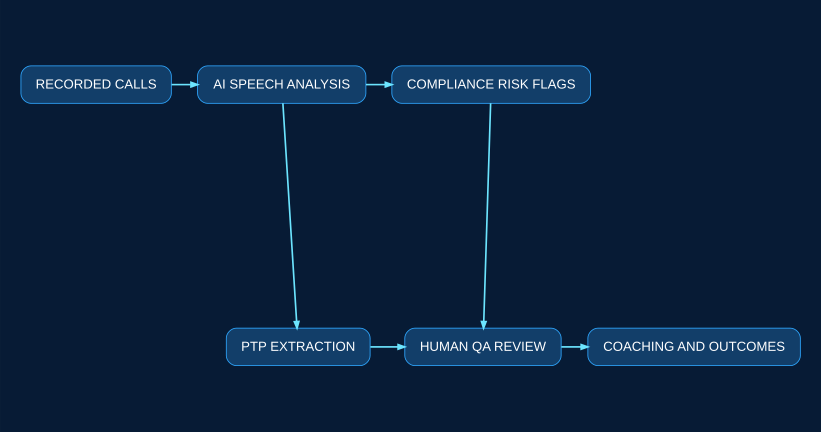
AI call monitoring for NBFC collections uses speech analytics, rules-based checks and human review to help lending teams examine collection conversations, identify potential conduct risks, understand promise-to-pay (PTP) outcomes and improve agent quality. It can expand review coverage, but it does not replace an NBFC’s compliance obligations, a documented recovery policy or accountable human decisions.
For a collections head, the practical question is not simply whether software can transcribe calls. It is whether the system can reliably connect what was said, what the agent did, what the borrower agreed to and what happened by the promised date—while preserving evidence that a reviewer can verify.
What AI call monitoring should do in an NBFC collections operation
A useful AI call monitoring workflow turns recorded conversations into structured, reviewable signals. Depending on the telephony, recording, language and data setup, it may include:
- Conversation transcription: create searchable text from recorded calls, with language and transcription-confidence indicators.
- Script and disclosure checks: identify whether required introductions, identity checks, disclosures or approved wording appear to have been followed.
- Conduct-risk flags: surface language that may indicate threats, intimidation, humiliation, inappropriate pressure or privacy concerns for human review.
- PTP extraction: capture a stated payment date, amount and commitment status when the conversation supports it.
- Disposition and intent tagging: distinguish a genuine payment commitment from a request for a callback, a dispute, inability to pay or a wrong-party contact.
- Quality coaching: show reviewers the relevant call segment, reason for the flag and scorecard criterion so that coaching is specific.
- Trend analysis: identify repeated patterns by campaign, product, team, agent or time period, subject to valid data and access controls.
These are capabilities to evaluate, not a claim that every platform provides them accurately out of the box. Performance can vary by accent, code-switching, background noise, recording quality, vocabulary and the quality of the rules or models configured for the process.
Why compliance monitoring matters in loan recovery
Collections conversations can create conduct, customer-experience and reputational risk. A small sample of manually reviewed calls may not reveal a recurring issue across a large campaign. AI-assisted review can help prioritise calls for inspection, but the lender still needs a clear policy, trained staff, escalation ownership and evidence of corrective action.
Regulatory update (checked October 2026): RBI’s 12 August 2022 recovery-agent circular was withdrawn as part of the regulator’s consolidation of directions on 28 November 2025. For NBFCs, use the current RBI Master Directions index and the applicable NBFC Responsible Business Conduct Directions (including current amendments) rather than citing the withdrawn circular as if it were the current instrument. The consolidated NBFC directions include requirements covering recovery-agent engagement, training, borrower notice and authorisation, grievance handling, confidentiality, and restrictions on intimidation, harassment and calling hours. Applicability can differ by regulated entity and product; verify the current RBI text and obtain legal/compliance advice for your specific model. This article is operational guidance, not legal advice.
In operational terms, a monitoring programme should be configured against the NBFC’s current approved policies and applicable regulatory requirements. The model should flag possible exceptions; a trained reviewer should confirm the context, record the finding, decide the action and document closure.
Examples of issues a review workflow can flag
- Potentially threatening or humiliating language.
- Repeated contact patterns that may breach policy or applicable calling-hour controls.
- Disclosure or identity-verification steps that appear to be missing.
- Statements that may misrepresent the lender’s authority, legal action or consequences.
- Disclosure of loan or borrower information to an unauthorised third party.
- Inconsistent statements about amount due, payment date, settlement or next steps.
Speech analytics cannot determine every violation from words alone. Sarcasm, context, poor transcription or an incomplete recording can create false positives and false negatives. Reviewers should have access to the relevant audio, transcript, policy version and surrounding context wherever permitted.
PTP analysis: distinguish a promise from a prediction
Promise-to-pay (PTP) analysis identifies payment commitments discussed during a collection interaction and tracks what happens after the commitment becomes due. It is useful only when the commitment is captured consistently and reconciled with payment and account data.
A robust PTP record should, where available, include the account reference, call identifier, commitment date, promised amount, due date, agent, disposition, source evidence, confidence or review status, and the eventual payment outcome. The system should not infer a firm commitment from vague language such as “I will try” unless the organisation’s documented rules explicitly classify it that way.
A practical PTP classification model
| Classification | Meaning | Recommended next step |
|---|---|---|
| Confirmed PTP | A clear commitment with a stated amount or due date, as defined by policy. | Record the evidence and schedule the approved follow-up. |
| Conditional commitment | Payment depends on salary, a transfer, a dispute resolution or another condition. | Capture the condition; do not report it as an unconditional promise. |
| Callback requested | The borrower requests contact at another time but has not committed to pay. | Schedule the callback under policy; keep it separate from PTP. |
| Dispute or hardship | The borrower disputes the balance or explains an inability to pay. | Route to the appropriate dispute, hardship or customer-support workflow. |
| Broken PTP | A previously recorded commitment is due but the defined payment condition was not met. | Validate account data and apply the approved next-step policy. |
| Kept PTP | The commitment was fulfilled under the organisation’s defined measurement rule. | Reconcile payment evidence and include it in the outcome report. |
Important: a PTP that is not yet due should not be classified as broken. Reconcile promises with the core lending or collection system, account for partial payments and rescheduled commitments, and preserve an audit trail when records are corrected.
How to measure PTP performance without misleading the team
Agree on definitions before comparing agents, vendors or campaigns. One possible operational measure is:
Kept PTP rate = PTP commitments fulfilled by the due date ÷ PTP commitments due during the measurement period × 100
This is an illustrative formula, not a universal industry standard. An organisation should define how it treats partial payments, revised dates, multiple promises on one account, reversals, and promises that fall outside the reporting window. The denominator should contain only commitments that are actually due under the chosen rule.
Do not use the kept PTP rate alone to judge agent performance. A high rate can reflect differences in portfolio age, customer circumstances, product type, campaign assignment or the way promises are classified. Review it alongside verified payment outcomes, complaint signals, quality scores, repeat contact, dispute rates and adherence to approved conduct rules.
Agent quality scorecards: what should be measured?
A useful scorecard separates mandatory control failures from coaching opportunities. If every issue is blended into one average, a serious conduct concern can be hidden by good performance on routine criteria.
| Scorecard area | Example review question | How to use the result |
|---|---|---|
| Identification and verification | Were required identity and account checks completed before sensitive details were discussed? | Escalate confirmed control failures under policy. |
| Accuracy | Did the agent communicate the correct amount, due date and next step? | Correct misinformation and improve knowledge access. |
| Conduct and tone | Was the interaction respectful and free from prohibited pressure? | Human-review high-risk flags promptly. |
| Policy and disclosures | Were applicable required statements and process steps followed? | Track by policy version and campaign. |
| PTP quality | Was the commitment explicit, accurately recorded and reconciled? | Improve classification and follow-up quality. |
| Resolution and next step | Was the query, dispute or requested follow-up routed correctly? | Reduce avoidable repeat contacts and missed actions. |
| Documentation | Does the CRM record match the conversation and outcome? | Improve auditability and downstream reporting. |
Set a separate critical-failure path for issues that require immediate review. A model-generated flag should never automatically trigger disciplinary action without the organisation’s defined validation and appeal process.
Manual QA vs AI-assisted monitoring vs a hybrid model
| Approach | Where it works | Main limitation |
|---|---|---|
| Manual sampling | Nuanced judgement, complex disputes and policy interpretation. | Coverage depends on available reviewer capacity and sample design. |
| AI-assisted screening | Prioritising large call volumes, finding patterns and locating relevant call segments. | Transcription errors, false positives, false negatives and model drift. |
| Hybrid QA | Automated screening plus human validation, coaching and governance. | Requires clear ownership, reviewer capacity, calibrated rules and feedback loops. |
For most regulated collections environments, the decision should not be framed as “AI or humans”. AI can expand the number of interactions screened; humans remain essential for context, disputed findings, exceptions, coaching and accountability. A pilot should test whether the combined workflow improves coverage and reviewer efficiency without increasing unresolved false alerts or customer harm.
Implementation checklist for an NBFC
- Define the control objective. Decide which risks, policies and operational outcomes the system must help monitor.
- Map the approved scorecard. Document each criterion, severity, evidence requirement, owner and escalation route.
- Validate the data path. Confirm recording availability, call and account identifiers, timestamps, access permissions and reliable links to outcomes.
- Test real language conditions. Include relevant languages, accents, code-switching, noise and different collection scenarios in the evaluation set.
- Run a labelled pilot. Have trained reviewers independently label a representative sample, then compare model flags with reviewer findings.
- Measure error, not just coverage. Track false positives, missed critical issues, transcription confidence, reviewer agreement and time to close a finding.
- Set governance and access. Define who can listen to calls, view transcripts, export data, change rules and approve model updates. Apply retention and deletion rules consistent with applicable obligations.
- Close the loop. Assign coaching or corrective action, document completion, and recheck whether the issue recurs.
What does AI call monitoring cost?
There is no single reliable price for every NBFC collections environment. Total cost depends on recorded minutes, number of languages, transcription and analysis requirements, integration with telephony or CRM systems, data hosting and security requirements, review workflow, implementation effort and support model.
When comparing providers, ask for a cost model that separates setup and integration, recurring platform fees, usage-based charges, storage, custom scorecard configuration, support and any human review service. Confirm whether the quoted price covers all recorded calls or only selected interactions.
Evaluate the business case using your own baseline. A simple model is:
- QA cost per reviewed call = total QA operating cost ÷ calls reviewed.
- Critical-issue detection rate = confirmed critical issues identified ÷ confirmed critical issues in the evaluated sample.
- False-positive rate = alerts reviewed and found not to be issues ÷ all alerts reviewed.
- PTP kept rate = kept commitments ÷ commitments due, using the documented definition.
Compare these measures before and after the pilot using comparable cohorts and review rules. Do not attribute a change in collections performance to AI monitoring alone if staffing, portfolio mix, payment policies or contact strategy changed at the same time.
Questions to ask an AI call monitoring vendor
- Can reviewers open the exact audio segment behind each flag?
- How are false positives, missed issues and low-confidence transcriptions measured?
- Can scorecards and rules be version-controlled and approved before release?
- How are Hindi, English, regional languages and code-switched conversations evaluated?
- Can PTPs be reconciled against payment outcomes without exposing unnecessary borrower data?
- What are the access controls, audit logs, retention settings and data-export restrictions?
- Can the NBFC independently review findings, model changes and audit evidence?
- What happens when the system is unavailable or a recording is missing?
- How are vendor staff, subcontractors and incident reporting covered in the contract?
- Can the provider demonstrate performance on a representative sample from our own environment?
A provider should be willing to discuss limitations and show evidence from a controlled evaluation. A dashboard demonstration alone does not establish accuracy, compliance or business value.
How Mas Callnet fits into the evaluation
Mas Callnet works across contact-centre and business-process services. For lenders evaluating AI-enabled customer operations, the right starting point is to map the collection workflow, required controls, call data and business outcomes before selecting the technology or operating model. Explore our digital banking services and contact center services to understand the broader operating context.
Where automation is part of the plan, assess how it will fit into existing systems, review ownership and escalation workflows. Our page on automating business processes provides additional context. For organisations evaluating a broader operating model, see our guide to customer support outsourcing.
Next step: If you are evaluating AI call monitoring for NBFC collections, prepare a representative call sample, your approved QA scorecard and the PTP fields you track today. Request a consultation with Mas Callnet to discuss the evaluation scope, integration questions, control ownership and measurable pilot criteria before committing to a rollout.
Frequently asked questions
1. What is AI call monitoring for NBFC collections?
It is the use of speech analytics and automated checks to review collection conversations, identify possible policy or conduct issues, extract relevant details and prioritise calls for human review.
2. Can AI call monitoring guarantee RBI compliance?
No. AI can help identify possible exceptions and create review evidence, but compliance depends on applicable requirements, approved policies, implementation, human oversight and corrective action.
3. What does RBI say about recovery-agent calls?
RBI’s earlier 12 August 2022 circular was withdrawn during the 28 November 2025 consolidation. NBFC teams should consult the current RBI Master Directions and amendments applicable to their entity and product, including the NBFC Responsible Business Conduct Directions. Confirm requirements with the compliance or legal team before changing operating policy.
4. Does the same RBI circular apply to every microfinance loan?
Microfinance products may be subject to separate directions and specific applicability rules. Confirm the current RBI directions and amendments for the exact regulated entity and loan category rather than relying on a general summary.
5. What is PTP analysis in collections?
PTP analysis records a borrower’s stated payment commitment and checks whether the agreed conditions were fulfilled. It should distinguish confirmed commitments from conditional statements, callbacks, disputes and hardship cases.
6. How is the kept PTP rate calculated?
A common operational formula is commitments fulfilled by their due date divided by commitments due during the period, multiplied by 100. Define treatment of partial payments, revised promises and reversals before reporting.
7. Can AI identify abusive or threatening language?
It can flag language patterns for review, but context, transcription errors and language variation can cause false positives or missed issues. A human reviewer should validate consequential findings.
8. Should every collection call be scored automatically?
Broader screening can improve visibility where recordings and systems support it, but organisations should test accuracy and capacity first. Critical alerts still need a defined human-review and escalation process.
9. What data is needed for PTP analytics?
Typically, a call identifier, account reference, timestamp, transcript or recording, extracted commitment details and reconciled payment outcome are needed. Access should be limited to the data required for the use case.
10. How should an NBFC evaluate a vendor?
Use a representative pilot. Measure critical-issue detection, false alerts, reviewer agreement, PTP data quality, integration effort, security controls and the time required to close findings. Require evidence rather than relying on a product demonstration.
Conclusion
AI call monitoring is most valuable when it links conversation evidence to operational decisions. For NBFC collections, that means identifying potential conduct risks, capturing PTP commitments accurately, reconciling outcomes and coaching agents through a controlled review process. The technology should make problems easier to find and verify—not turn an automated score into an unquestioned verdict.