
Reduce Cart Abandonment with Live Chat (2026): Proven eCommerce Conversion Strategies
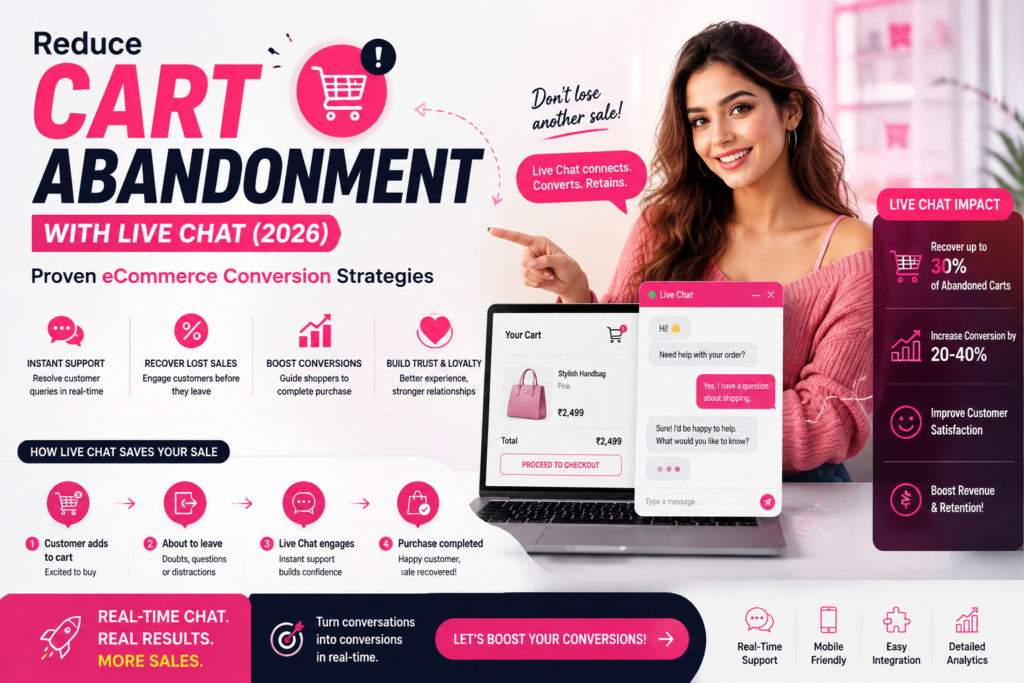
AI Overview
Cart abandonment remains the single largest silent revenue leak in eCommerce, with the majority of online shopping carts never converting into completed orders. Live chat is the most effective real-time intervention because it addresses hesitation — pricing doubt, shipping uncertainty, payment friction — at the exact moment a customer is deciding whether to buy. The debate over AI vs. human customer support is not about which one wins; it’s about sequencing. AI handles volume, speed, and repetitive queries; humans handle judgment, empathy, and high-value decisions. Enterprises that outsource this function to experienced BPO partners in India gain both the technology stack and the trained workforce needed to run this hybrid model at scale, at a materially lower cost than building it in-house. This guide breaks down the frameworks, benchmarks, pricing, and vendor-evaluation criteria leadership teams need before making that decision in 2026.
Introduction
Somewhere between “Add to Cart” and “Place Order,” most of your revenue disappears.
Not because your product is wrong. Not because your pricing is uncompetitive. It disappears because nobody was there to answer the one question the customer had at the exact moment they had it — Will this fit? When will it arrive? Why did my card decline? Is this site legitimate?
That gap — between intent and action — is the most expensive gap in eCommerce, and it is almost entirely a customer support problem, not a marketing problem. Most organizations spend their budget acquiring traffic and almost nothing protecting the revenue that traffic already generated. That is the core premise of Revenue Recovery Through CX™: the money you’re chasing with a bigger ad budget is often already sitting in your cart data, waiting for someone to pick up the conversation.
This guide is written for the people who own that number — CEOs, COOs, Heads of Customer Support, CX leaders, and procurement teams evaluating whether to build this capability internally or bring in a partner who already runs it at scale. We’ll walk through the AI vs. human support debate honestly (it’s a false binary), show you the frameworks we use to diagnose revenue leakage, and give you the exact criteria for evaluating the best BPO companies in India — because for most mid-market and enterprise brands, that decision now moves faster and costs less than building an internal team from scratch.
Key Insights
- Global average cart abandonment rates have hovered around 65–75% for over a decade, largely unmoved by design improvements alone — the problem is behavioral and conversational, not just UX.
- Live chat initiated within the first 30 seconds of hesitation-behavior (mouse movement toward exit, prolonged idle time on checkout) converts at meaningfully higher rates than passive support widgets.
- Hybrid AI-human support models recover more revenue than either model alone — AI wins on speed and cost, humans win on conversion of high-cart-value abandonments.
- Outsourcing this function to an experienced Indian BPO typically costs 40–60% less than building an equivalent in-house team, without sacrificing quality when the vendor is evaluated correctly.
The Real Cost of Cart Abandonment in 2026
Direct Answer: Cart abandonment is not a UX metric — it is a revenue-recovery opportunity that most finance and operations leaders never quantify in dollar terms, and it is one of the few problems where customer support outsourcing produces a directly measurable P&L impact.
Every eCommerce leadership team knows the abandonment rate. Almost none of them have translated it into a monthly revenue-recovery target owned by a specific team. That’s the gap.
Industry research (Baymard Institute’s long-running meta-analysis of abandonment studies, along with Statista and Shopify’s own merchant data) consistently places average cart abandonment between 65% and 75% across sectors, with mobile commerce trending higher than desktop. The top cited reasons are remarkably consistent year over year:
| Reason for Abandonment | Approx. Share of Abandonments | Live Chat Can Resolve? |
|---|---|---|
| Unexpected extra costs (shipping, tax, fees) | ~48% | Yes — real-time clarification |
| Forced account creation | ~24% | Partially — guided assistance |
| Slow or complicated checkout | ~22% | Yes — live troubleshooting |
| Payment security concerns | ~19% | Yes — trust reassurance |
| Card declined / payment failure | ~18% | Yes — immediate resolution |
| Insufficient delivery information | ~16% | Yes — real-time answers |
| Return policy unclear | ~10% | Yes — policy clarification |
(Ranges based on Baymard Institute meta-analysis and Statista consumer surveys; percentages overlap as customers cite multiple reasons.)
Look closely at that table. Roughly 90% of the reasons customers abandon carts are conversational problems, not product problems. They can be resolved by a human or an AI agent typing the right answer at the right moment. That single observation is why live chat — not email retargeting, not another discount pop-up — is the highest-leverage intervention available to eCommerce operators in 2026.
This is the foundation of Revenue Recovery Through CX™: the recovery mechanism already exists in your traffic. You don’t need more visitors. You need a conversation layer that catches hesitation before it becomes exit.
Executive Interpretation: If your finance team has never seen a monthly report titled “Revenue Recovered via Live Chat,” you are almost certainly under-investing in support and over-investing in acquisition.
Why Live Chat Outperforms Every Other Recovery Channel
Direct Answer: Live chat outperforms retargeting ads, cart-abandonment emails, and SMS nudges because it intervenes before the customer leaves the page — every other channel intervenes after, when intent has already decayed.
Retargeting and abandonment emails are damage control. They chase a customer who has already mentally exited the purchase. Live chat, when triggered correctly, catches the customer while they are still holding the decision in their hands.
What high-performing organizations do differently: They don’t treat live chat as a static widget in the corner of the screen. They treat it as a triggered intervention tied to behavioral signals — time-on-page at checkout, repeated field errors, cart value thresholds, and exit-intent detection. A ₹500 cart abandonment and a ₹50,000 cart abandonment should never receive the same response protocol, but in most organizations, they do — because nobody built the segmentation logic.
Common executive mistake: Leadership teams approve a live chat tool (Intercom, Zendesk, Freshdesk) and assume the technology alone solves the problem. The tool is 20% of the outcome. The other 80% is staffing model, response time discipline, escalation logic, and conversation quality — the operational layer most software vendors don’t provide and most internal teams don’t have bandwidth to build.
Practical Recommendation: Before adding another tool to your stack, audit whether your current live chat is triggered by behavior or simply available on request. Passive availability recovers a fraction of what triggered intervention recovers.
AI vs. Human Customer Support: The Question Every Executive Is Asking Wrong
Direct Answer: The right question isn’t “AI or human?” — it’s “which conversations belong to which model, and who designs the handoff between them?” Organizations that frame this as a replacement decision consistently underperform organizations that frame it as a workflow-design decision.
Here’s what almost every vendor pitch deck and industry blog gets wrong: they present AI and human agents as competing solutions, because that framing sells software on one side and headcount on the other. Operationally, that’s not how conversations behave.
What Everyone Says: “AI will replace human agents.” Or the opposite camp: “Customers hate bots, always route to humans.”
What Actually Happens on the Floor: Roughly 60–70% of live chat volume in eCommerce is repetitive and low-complexity — order status, shipping timelines, return policy, sizing charts, discount code issues. AI resolves these instantly and customers largely don’t mind, provided the bot is transparent and fast. The remaining 30–40% — payment disputes, damaged product claims, high-value cart hesitation, complaint de-escalation — requires human judgment, tone-reading, and authority to make exceptions. Deploy AI against that second category and you get frustrated customers and abandoned carts. Deploy expensive human agents against the first category and you get unsustainable cost-per-resolution.
Hidden Cost: The real cost of getting this wrong isn’t a bad CSAT score — it’s the compounding loss of high-cart-value customers who get routed into a bot loop when they needed a human, and simply leave instead of complaining.
The AI vs. Human vs. Hybrid Support Model™
Definition: A framework for routing live chat conversations to the model (AI, human, or sequential hybrid) best suited to the conversation’s complexity, emotional weight, and revenue value — rather than routing by channel default.
Methodology: Every incoming conversation is scored on three axes — Complexity (1–5), Cart/Account Value (Low/Medium/High), and Emotional Intensity (Neutral/Frustrated/Escalated). The score determines routing.
| Model | Best For | Avg. Response Time | Cost per Resolution | Conversion Impact on Cart Recovery |
|---|---|---|---|---|
| AI-Only | FAQs, order status, policy questions, low-value carts | Under 5 seconds | Lowest | Moderate — resolves friction but rarely persuades |
| Human-Only | Complaints, high-value carts, payment disputes | 2–5 minutes (staffing-dependent) | Highest | High — but expensive to scale to full chat volume |
| Hybrid (AI-triage → Human handoff) | Full chat volume with intelligent escalation | Under 10 seconds to first response, human handoff in under 60 seconds when needed | Lowest total cost at scale | Highest — combines AI speed with human persuasion on the conversations that matter |
Scoring Logic: A conversation scoring 3+ on Complexity, “Medium” or “High” on Cart Value, or “Frustrated/Escalated” on emotional intensity should route to a human within 60 seconds — not after an AI has already exhausted three failed attempts to resolve it.
Interpretation: Most brands lose abandoned-cart revenue not because they chose “AI” or “human” — but because their routing logic doesn’t exist at all, and every conversation defaults to whichever channel was cheapest to build first.
Executive Recommendation: Don’t ask your team “should we use AI or hire more agents?” Ask them to show you the routing logic between the two. If they can’t produce it, that’s your actual gap.
Boardroom Insight: The brands winning this in 2026 aren’t the ones with the most advanced AI. They’re the ones who figured out, with discipline, exactly which 30% of conversations still require a human — and refuse to let cost-cutting pressure push those conversations to a bot.
Key Takeaway: AI vs. human customer support is a routing problem, not a replacement decision — and the routing logic is worth more than either technology alone.
The MasCallNet Revenue Leakage Model™
Definition: A diagnostic framework that quantifies exactly how much revenue is escaping through unresolved live chat conversations, unanswered pre-purchase questions, and delayed response times — expressed as a monthly recoverable figure, not a vague percentage.
Methodology: The model calculates leakage across four checkpoints in the customer journey:
- Pre-Checkout Hesitation Leakage — visitors who engaged with product pages but exited during checkout without contacting support.
- Unanswered Chat Leakage — chats initiated but abandoned due to slow or no response.
- Escalation Failure Leakage — conversations incorrectly resolved by AI when a human handoff was needed.
- Post-Resolution Non-Conversion — customers who received a satisfactory answer but still didn’t complete the purchase (a signal of pricing or product issues, not support issues).
Scoring Logic:
Revenue Leakage (Monthly) = (Total Abandoned Carts × Average Order Value) × (Unresolved Conversation Rate) × (Historical Recovery Rate When Resolved)
Interpretation: Most mid-market eCommerce operators we’ve assessed carry an Unresolved Conversation Rate above 35% — meaning more than a third of customers who tried to get help before abandoning never received a timely answer. That number alone, multiplied against average order value and monthly cart volume, routinely exceeds six figures in monthly recoverable revenue for brands doing ₹2–10 crore in monthly GMV.
Executive Recommendation: Run this calculation before approving any new marketing spend. In nearly every engagement we’ve supported, the recoverable revenue sitting in unresolved conversations exceeds the incremental revenue expected from the next acquisition campaign — at a fraction of the cost.
This is Revenue Recovery Through CX™ made quantifiable: it converts a support metric into a finance metric your CFO will actually act on.
What the Cart Abandonment Playbooks Get Wrong
What Everyone Says: “Add exit-intent pop-ups and a 10% discount code.”
What Most Articles Miss: Discounting trains customers to abandon carts intentionally, waiting for the discount trigger. It treats a support failure as a pricing problem, which erodes margin without fixing the underlying hesitation.
What Actually Happens: Once a brand introduces a reliable exit-intent discount, cart abandonment often increases for repeat customers who now abandon deliberately, because they’ve learned the pattern gets rewarded.
Hidden Cost: Margin erosion compounds silently. A brand training 15–20% of its customer base to wait for a discount is effectively giving away margin that a well-timed conversation could have preserved at full price.
MasCallNet Perspective: Solve the hesitation with information and reassurance first — a live agent who confirms delivery timelines, clarifies return policy, or resolves a payment error preserves full-price revenue. Discounting should be the last lever, not the first.
Executive Action: Before your next quarter’s abandonment strategy meeting, ask your team to show the split between “abandonment recovered via support” versus “abandonment recovered via discount.” If discount dominates, you have a support gap disguised as a pricing strategy.
MasCallNet Outsourcing Readiness Score™
Direct Answer: Before evaluating any outsourcing partner, leadership should score their own organization’s readiness — because the highest-performing engagements come from clients who know exactly what they’re outsourcing and why, not from vague “handle our support” mandates.
Definition: A 5-factor internal audit that determines whether an organization is ready to outsource live chat and customer support functions, and at what scope.
| Factor | Weight | Low Readiness Signal | High Readiness Signal |
|---|---|---|---|
| Chat Volume Predictability | 20% | Highly seasonal, unpredictable spikes | Stable baseline with known peak periods |
| Documented Processes & Policies | 20% | Tribal knowledge, no SOPs | Return/refund/escalation policies documented |
| Technology Stack Maturity | 20% | No CRM/helpdesk integration | Zendesk, Freshdesk, or Salesforce already in place |
| Data & Compliance Clarity | 20% | No clear data handling policy | Defined compliance requirements (PCI-DSS, GDPR, etc.) |
| Internal Escalation Ownership | 20% | No clear internal owner for escalations | Named internal stakeholder for tier-2 issues |
Scoring Logic: Score each factor 1–5. Total below 12/25 signals the organization needs a phased pilot before full outsourcing. Above 18/25 signals readiness for full-scope deployment within 30–45 days.
Executive Recommendation: Don’t let a vendor’s sales team convince you to skip this audit. The engagements that fail in year one almost always score low on “Documented Processes” — outsourcing a process nobody has clearly defined internally simply outsources the confusion, not the solution.
If you’re assessing your own organization’s fit for customer support outsourcing, this score should be the first document in your evaluation folder — not the vendor’s brochure.
Best BPO Companies in India: The Vendor Evaluation Matrix™
Direct Answer: The best BPO companies in India for live chat and cart-recovery support are not necessarily the largest — they’re the ones who can prove AI-human hybrid routing capability, eCommerce-specific experience, and transparent pricing tied to outcomes, not just seat count.
India remains the world’s largest hub for customer support outsourcing, and for good reason: a mature talent pool, English-language proficiency, 24/7 timezone coverage for US and European clients, and cost structures that remain 40–60% below onshore equivalents even after accounting for wage inflation. But “best” depends entirely on fit, not brand recognition.
MasCallNet Vendor Evaluation Matrix™
| Evaluation Criteria | Weight | What to Ask the Vendor |
|---|---|---|
| eCommerce & cart-recovery experience | 25% | “Show me a case study with abandonment rate improvement, not just CSAT.” |
| AI-human hybrid capability | 20% | “How is routing logic designed, and who owns it — us or you?” |
| Technology stack compatibility | 15% | “Do you integrate natively with Shopify, WooCommerce, Zendesk, Salesforce?” |
| Pricing transparency | 15% | “Is pricing per-seat, per-resolution, or outcome-based?” |
| Data security & compliance | 15% | “What certifications do you hold — ISO 27001, PCI-DSS, SOC 2?” |
| Scalability & flexibility | 10% | “Can you scale from 500 to 5,000 daily chats within 30 days?” |
Scoring Logic: Score each vendor 1–10 per criterion, multiply by weight. A total score above 75/100 indicates strong fit for enterprise cart-recovery programs; below 50 suggests the vendor is better suited to basic tier-1 ticket support only.
Executive Recommendation: Ask every shortlisted vendor to walk you through an actual BPO case study in India with abandonment-rate or conversion-rate impact — not just ticket volume handled. Volume metrics tell you the vendor is busy. Conversion metrics tell you the vendor is effective.
Boardroom Insight: Procurement teams often default to the lowest per-seat cost. That’s the wrong optimization target. The right target is cost-per-recovered-order, which can make a slightly more expensive vendor dramatically cheaper on a per-outcome basis.
CX Maturity Scorecard™
Direct Answer: Most organizations sit at Level 2 of a 5-level CX maturity model — reactive support with basic tooling — while the revenue recovery opportunity only becomes significant from Level 3 onward.
| Level | Description | Cart Recovery Capability |
|---|---|---|
| 1 – Reactive | Email/phone only, no live chat | Minimal — most abandonment goes unaddressed |
| 2 – Available | Live chat exists but passive, unstaffed after hours | Low — recovers only daytime, self-initiated contacts |
| 3 – Responsive | Staffed live chat with defined SLAs | Moderate — recovers standard hesitation cases |
| 4 – Proactive | Behavior-triggered chat, AI-human routing | High — intervenes before exit intent completes |
| 5 – Intelligent | Predictive intervention, conversation data feeds back into product/pricing decisions | Highest — support function actively shapes revenue strategy |
Executive Interpretation: Moving from Level 2 to Level 4 is typically the single highest-ROI CX investment available to an eCommerce brand — higher than most redesign or acquisition initiatives, because it doesn’t require new traffic, only better conversation capture on traffic you already paid for.
This progression is the operational expression of Contact Center Intelligence™ — treating every conversation as data that improves the next one, not a disposable interaction.
Benchmark Analysis & Industry Statistics
| Metric | Industry Average | High-Performing Hybrid Model |
|---|---|---|
| Cart abandonment rate | 65–75% | 45–55% |
| Live chat response time | 2–5 minutes | Under 15 seconds (AI) / under 60 seconds (human handoff) |
| Chat-to-conversion rate | 3–8% | 12–20% |
| CSAT (chat channel) | 70–80% | 88–95% |
| First Contact Resolution (FCR) | 60–65% | 80–90% |
| Cost per resolution (outsourced hybrid) | — | 40–60% lower than in-house equivalent |
Ranges synthesized from Baymard Institute, Statista eCommerce reports, Zendesk CX Trends research, and MasCallNet operational benchmarks across client engagements.
Executive Interpretation: The gap between “industry average” and “high-performing hybrid” isn’t technology — most organizations in both columns have access to similar tools. The gap is operational discipline: staffing models, routing logic, and escalation ownership.
Case Study: Recovering ₹4.2 Crore in Abandoned Revenue
Challenge
A mid-market fashion eCommerce brand (D2C, ~₹8 crore monthly GMV) was experiencing a 71% cart abandonment rate, with live chat handled by a two-person internal team available only during business hours.
Root Cause
Diagnostic review using the Revenue Leakage Model™ revealed: 42% of chats initiated during evening peak hours (6 PM–11 PM, the brand’s highest-traffic window) went unanswered. Of those answered, average response time exceeded 4 minutes — well past the point where checkout intent typically decays.
Solution
Deployment of a hybrid AI-human model: an AI layer handled order status, sizing, and shipping queries instantly, while a trained outsourced team (structured around eCommerce-specific SOPs) handled payment issues, complaints, and high-cart-value hesitation with sub-60-second human handoff, covering the full 6 PM–11 PM peak window plus 24/7 baseline coverage.
Implementation
Phased rollout over 30 days: Week 1–2, AI layer trained on the brand’s FAQ and policy documentation; Week 3, hybrid routing logic activated; Week 4, full 24/7 coverage live with weekly QA review calls.
Results (90 days post-implementation)
- Cart abandonment reduced from 71% to 52%
- Chat response time reduced from 4+ minutes to under 20 seconds (AI) / 45 seconds (human handoff)
- CSAT improved from 74% to 91%
- Recovered revenue attributed directly to chat-assisted conversions: ₹4.2 crore over 90 days
- Cost of the outsourced program: approximately 18% of the recovered revenue — a clear demonstration of Revenue Recovery Through CX™ as a P&L-level initiative, not a cost center.
Lessons Learned
The single highest-impact change wasn’t the AI deployment — it was closing the coverage gap during the brand’s actual peak traffic hours. Technology amplified an already-correct staffing decision; it didn’t substitute for one.
Pricing Analysis & Cost Calculator
Direct Answer: Outsourced live chat support in India typically ranges from $8–$18 per agent-hour depending on complexity, shift coverage, and AI-assist tooling — versus $25–$45 per agent-hour for equivalent onshore US/UK staffing, before accounting for hiring, training, and attrition costs.
Simplified Cost Calculator
Step 1 — Estimate agents needed:
Agents Required = (Daily Chat Volume × Average Handling Time in minutes) ÷ (Agent Productive Minutes per Day)
Example: 800 daily chats × 6 minutes AHT = 4,800 minutes ÷ 360 productive minutes per agent = ~13 agents (human-only model)
Step 2 — Apply hybrid deflection:
If AI resolves 60% of volume, human agents only need to cover 40% of chats:
13 agents × 40% = ~5–6 human agents, supplemented by AI handling the remainder.
Step 3 — Estimate monthly cost:
5–6 agents × ~$1,600–$2,200 fully-loaded monthly cost (India-based, hybrid-trained) = $8,000–$13,200/month, versus an equivalent onshore team typically exceeding $35,000–$55,000/month.
Executive Recommendation: Always request pricing broken into per-seat, per-resolution, and outcome-based components separately. A vendor unwilling to show this breakdown is pricing on volume, not value.
ROI Framework
Direct Answer: ROI for live chat-led cart recovery should be measured as recovered revenue against total program cost, not against ticket volume or CSAT alone — those are quality indicators, not financial ones.
Formula:
ROI (%) = [(Recovered Revenue − Total Program Cost) ÷ Total Program Cost] × 100
Where:
Recovered Revenue = (Abandonment Rate Reduction %) × (Total Monthly Cart Value) × (Historical Order Completion Rate)
Worked Example:
- Monthly abandoned cart value: ₹3 crore
- Abandonment rate reduction achieved: 15 percentage points
- Program cost (outsourced hybrid model): ₹9 lakh/month
- Recovered Revenue: ₹3 crore × 15% = ₹45 lakh
- ROI = (₹45,00,000 − ₹9,00,000) ÷ ₹9,00,000 × 100 = 400% ROI
Executive Interpretation: This is why Revenue Recovery Through CX™ should be evaluated with the same rigor as a paid acquisition channel — because in most engagements we’ve reviewed, it outperforms acquisition ROI by a wide margin, at meaningfully lower risk.
Industry Use Cases
| Industry | Cart/Conversion Equivalent | Live Chat Application |
|---|---|---|
| Retail & eCommerce | Cart abandonment | Real-time checkout assistance, payment troubleshooting |
| Banking & Financial Services | Application drop-off (loans, credit cards) | Live guidance through KYC and application steps |
| Insurance | Quote abandonment | Real-time policy clarification during quote comparison |
| Healthcare | Appointment booking drop-off | Live assistance for patient appointment scheduling services |
| Automotive & EV | Test-drive/booking form abandonment | Real-time financing and availability queries |
| Telecommunications | Plan upgrade/checkout abandonment | Live plan comparison and billing clarification |
| Logistics | Shipment booking abandonment | Real-time rate and delivery timeline confirmation |
| Aviation | Booking cart abandonment | Live fare-hold and add-on clarification |
Each of these follows the same underlying pattern: a moment of hesitation, a question left unanswered, and a completed transaction lost. The mechanism generalizes far beyond retail — which is why enterprises across banking, insurance, and healthcare increasingly apply the same hybrid support model to their own conversion funnels.
Technology Ecosystem
A modern hybrid support stack typically connects across several layers:
- Helpdesk/CRM: Zendesk, Freshdesk, Salesforce, HubSpot
- Commerce Platforms: Shopify, WooCommerce
- Payments: Stripe, PayPal
- Cloud Infrastructure: AWS, Google Cloud, Microsoft Azure
- AI Layer: OpenAI, Google Gemini, Claude, Copilot — powering conversational AI, agent-assist, and summarization
- Contact Center Infrastructure: Genesys, Five9, Talkdesk, NICE CXone
- Internal Collaboration: Slack, Microsoft Teams, ServiceNow for escalation workflows
Executive Interpretation: The specific tools matter less than the integration discipline between them. A best-in-class AI model connected to a poorly configured CRM will still produce disconnected, frustrating customer journeys. This is precisely why automating business processes across these systems — not just deploying point tools — is where most of the operational value gets created.
Security & Compliance
For any organization handling payment data, health information, or financial applications through live chat, compliance isn’t optional overhead — it’s a prerequisite for vendor selection.
Minimum standards to require from any outsourcing partner:
- PCI-DSS compliance for any conversation touching payment data
- ISO 27001 certification for information security management
- GDPR/data residency clarity for European customer data
- HIPAA-aligned handling protocols for healthcare-adjacent conversations
- Documented data retention and deletion policies for chat transcripts
Executive Recommendation: Request the vendor’s most recent security audit report, not just a compliance logo on their website. A logo confirms marketing effort; an audit confirms operational reality.
The India Advantage
Direct Answer: India remains the most cost-efficient, scalable hub for live chat and customer support outsourcing in 2026 due to a combination of English-language proficiency at scale, 24/7 global timezone coverage, mature BPO infrastructure, and a talent pipeline that continues to graduate hundreds of thousands of customer-facing professionals annually.
Beyond cost, the practical advantages that matter to CX and operations leaders:
- Timezone coverage: India’s position allows genuine 24/7 coverage for US, UK, and Australian customers without split-shift complexity for the vendor.
- Scalability speed: Established AI-powered BPO companies in India can scale teams from dozens to hundreds of agents within weeks — a timeline nearly impossible to match with onshore hiring.
- AI-hybrid maturity: Leading Indian BPOs have moved well past legacy call-center models, building genuine AI-human hybrid operations comparable to what enterprise CX teams in the US and Europe are only beginning to adopt internally.
Boardroom Insight: The old objection — “outsourcing to India means lower quality” — no longer holds against BPOs that have invested in hybrid AI infrastructure and eCommerce-specific training. The quality gap that remains today is between vendors, not between geographies.
Comparison Tables Every Decision-Maker Needs
In-House vs. Outsourced
| Factor | In-House | Outsourced |
|---|---|---|
| Setup time | 3–6 months | 2–4 weeks |
| Cost structure | Fixed, high (salaries, infra, tools) | Variable, scalable |
| 24/7 coverage | Expensive to achieve | Standard offering |
| Expertise access | Limited to hiring pool | Immediate access to trained teams |
| Recommendation | Best for highly proprietary, low-volume support | Best for scaling live chat volume quickly and cost-effectively |
AI vs. Human vs. Hybrid
(See full breakdown in the AI vs. Human vs. Hybrid Support Model™ above.) Recommendation: Hybrid wins for any brand with meaningful chat volume and mixed conversation complexity — which describes nearly every eCommerce operation above ₹1 crore monthly GMV.
Offshore vs. Onshore
| Factor | Offshore (India) | Onshore |
|---|---|---|
| Cost per agent-hour | $8–$18 | $25–$45 |
| Scalability | High | Constrained by local hiring |
| Cultural/language nuance | Strong with proper training | Native by default |
| Recommendation | Ideal for volume-driven live chat; pair with onshore QA oversight for brand-voice consistency | Best reserved for highly specialized escalations |
Build vs. Buy
| Factor | Build (In-House Tech + Team) | Buy (Outsourced Partner) |
|---|---|---|
| Time to value | 4–9 months | 3–6 weeks |
| Capital requirement | High upfront | Operating expense, scalable |
| Recommendation | Build only if support is a core product differentiator requiring proprietary IP | Buy for standard cart-recovery and support functions |
Dedicated Team vs. Shared Team
| Factor | Dedicated Team | Shared Team |
|---|---|---|
| Brand-specific training depth | High | Moderate |
| Cost | Higher | Lower |
| Recommendation | Dedicated for brands above ~500 daily chats; shared for lower-volume or seasonal businesses |
Traditional BPO vs. Contact Center Intelligence™
| Factor | Traditional BPO | Contact Center Intelligence™ |
|---|---|---|
| Approach | Ticket resolution, volume-based | Conversation data feeds back into revenue and product decisions |
| Reporting | Tickets closed, AHT | Recovered revenue, conversion lift, leakage trends |
| Recommendation | Adequate for basic tier-1 support | Required for any organization treating support as a revenue function |
Risk Analysis
| Risk | Likelihood | Mitigation |
|---|---|---|
| Over-reliance on AI for complex/emotional conversations | High if routing logic is undefined | Implement the AI vs. Human vs. Hybrid Model™ with clear escalation triggers |
| Vendor lock-in without performance clauses | Moderate | Negotiate outcome-based SLAs, not just seat-count contracts |
| Data security gaps in offshore handling | Low with proper vetting | Require ISO 27001/PCI-DSS documentation upfront |
| Brand voice inconsistency | Moderate | Joint QA calibration in first 30–60 days of engagement |
Future Trends: 2026–2028
Direct Answer: The next evolution of live chat isn’t more automation — it’s predictive intervention, where AI identifies hesitation signals before a customer even opens the chat window, and conversation data feeds directly back into pricing, product, and marketing decisions.
- AI Agents: Moving from scripted bots to context-aware agents capable of handling multi-turn, ambiguous queries with far less human handoff.
- Voice Bots: Extending hybrid routing logic into voice channels for phone-based cart recovery and order support.
- Agent-Assist: Real-time suggestions surfaced to human agents mid-conversation, reducing average handling time without sacrificing judgment quality.
- Predictive Analytics: Identifying which visitors are likely to abandon before they reach checkout, triggering proactive chat outreach.
- Conversation Intelligence: Aggregating chat transcripts into structured insight — the practical expression of the Customer Intelligence Loop™, where every conversation improves the next one.
- Workflow Automation: Tighter integration between chat platforms and order management systems to resolve issues (address changes, payment retries) without human escalation at all.
Boardroom Insight: The brands that treat their chat transcripts as a strategic data asset — feeding pricing, product, and UX decisions — will separate from competitors who treat chat as a cost center to be minimized. This is Contact Center Intelligence™ in practice: your support conversations are already telling you what to fix. Most organizations simply aren’t listening.
Executive Decision Tree
Is your cart abandonment rate above industry benchmark (65%+)?
├── No → Monitor quarterly; low urgency
└── Yes → Is live chat currently staffed during peak traffic hours?
    ├── No → Immediate priority: close coverage gap (in-house or outsourced)
    └── Yes → Is response time under 60 seconds consistently?
        ├── No → Evaluate hybrid AI-human routing implementation
        └── Yes → Is conversation data feeding back into product/pricing decisions?
            ├── No → Implement Contact Center Intelligence™ layer
            └── Yes → You are operating at CX Maturity Level 5 — focus on incremental optimization
Executive Checklist
- Calculate current monthly revenue leakage using the Revenue Leakage Model™
- Audit live chat coverage against actual peak traffic hours
- Score internal readiness using the Outsourcing Readiness Score™
- Define AI vs. human routing logic before selecting any vendor
- Shortlist BPO partners using the Vendor Evaluation Matrix™
- Request security certifications (ISO 27001, PCI-DSS) from every vendor
- Request outcome-based pricing, not just per-seat quotes
- Set a 90-day recovered-revenue target tied to the program
- Establish weekly QA calibration during the first 60 days
- Review chat transcript insights quarterly with product/pricing teams
Frequently Asked Questions
1. Does live chat actually reduce cart abandonment, or is it just a support convenience?
Live chat directly reduces abandonment when it’s behavior-triggered and staffed appropriately during peak hours. Passive, unstaffed chat widgets recover far less than proactive, monitored implementations.
2. Is AI or human support better for reducing cart abandonment?
Neither alone. AI handles speed and routine queries; humans handle high-value hesitation and emotional complexity. A hybrid routing model consistently outperforms either used in isolation.
3. What’s a realistic cart abandonment rate to target?
Industry average sits around 65–75%. High-performing hybrid support models bring this down to 45–55%, depending on industry and average order value.
4. How much does outsourced live chat support cost in India?
Typically $8–$18 per agent-hour depending on complexity and shift coverage, compared to $25–$45 per agent-hour for onshore equivalents.
5. How do I choose the best BPO company in India for customer support outsourcing?
Evaluate against eCommerce-specific experience, AI-human hybrid capability, technology integration, pricing transparency, and security certifications — not brand size alone.
6. How quickly can an outsourced live chat program go live?
A properly scoped engagement typically launches within 2–4 weeks, versus 3–6 months for an equivalent in-house build.
7. What’s the difference between offshore and onshore customer support outsourcing?
Offshore (India-based) delivers significantly lower cost per agent-hour with strong scalability; onshore offers native cultural nuance but at 2–3x the cost. Most enterprises use offshore for volume with onshore QA oversight.
8. Will customers know they’re talking to an outsourced team?
Not if the engagement is set up correctly — brand-voice training, product knowledge transfer, and QA calibration ensure conversations feel native to the brand.
9. How is ROI measured for a live chat cart-recovery program?
ROI is calculated as recovered revenue (from reduced abandonment) against total program cost — not against ticket volume or CSAT scores alone.
10. Can live chat outsourcing integrate with our existing Shopify/WooCommerce and CRM stack?
Yes — established outsourcing partners integrate natively with Shopify, WooCommerce, Zendesk, Freshdesk, Salesforce, and HubSpot without requiring a platform migration.
11. What happens to complex complaints if AI can’t resolve them?
A properly designed hybrid model routes complexity and emotional intensity signals to a human agent within 60 seconds — AI should never be the final word on a frustrated or high-value customer.
12. Is outsourcing customer support secure for handling payment-related conversations?
Yes, provided the vendor holds PCI-DSS compliance and ISO 27001 certification, with documented data handling and retention policies.
13. How is this different from traditional call center outsourcing?
Traditional BPO models optimize for ticket volume and average handling time. A Contact Center Intelligence™ approach optimizes for recovered revenue and feeds conversation insight back into business decisions.
14. Does this approach apply outside of eCommerce?
Yes — the same hesitation-and-intervention pattern applies to loan applications, insurance quotes, healthcare appointment bookings, and travel reservations.
15. What’s the first step if we want to evaluate this for our business?
Start with an internal Revenue Leakage assessment to quantify the opportunity, then evaluate outsourcing partners against defined criteria rather than starting with vendor demos.
Mid-Content Note: When to Bring in a Partner
If reading through the Revenue Leakage Model™ made you reach for a calculator, that’s the right instinct. Most organizations don’t need another dashboard — they need someone to run the diagnostic, design the routing logic, and staff the coverage gaps starting this month, not next fiscal year.
The Executive Path Forward
Teams that succeed with this transition rarely start by outsourcing everything at once. They start with a defined pilot — a single traffic peak window, a single conversation category — measured against the Revenue Leakage Model™, then expand once the recovered-revenue number is proven internally. This is precisely how we structure engagements for outsource call center services with new clients — phased, measured, and tied to a specific financial outcome from day one.
Considering Your Options
If you’re weighing this decision against building internally, review our detailed breakdown of call center outsourcing services from Noida, where many of the frameworks in this guide are operationalized daily across live client engagements.
Conclusion: The Revenue Is Already There
Cart abandonment isn’t a marketing failure. It’s a conversation failure, happening thousands of times a day, at the exact moment your customer needed one more piece of information to complete a purchase they had already decided to make.
The debate over AI vs. human customer support has distracted too many leadership teams from the real question: do we have a deliberate system for catching that moment, or are we leaving it to chance? The organizations recovering the most revenue in 2026 aren’t the ones with the most sophisticated AI — they’re the ones who built a disciplined hybrid model, measured it against a real revenue-leakage number, and treated their support function as what it actually is: a direct lever on the P&L.
That’s the operating principle behind Revenue Recovery Through CX™, and it’s the lens through which every framework in this guide was built.
If you’d like us to run a Revenue Leakage assessment against your own cart abandonment data, or walk you through how our AI-powered customer support outsourcing company in India structures hybrid AI-human teams for eCommerce brands, our team is available to talk through your specific numbers — no generic pitch, just your data against the framework above.