
Fraud Detection & Order Verification Services for eCommerce (2026): Prevent Fraud, Chargebacks & Order Losses
AI Overview
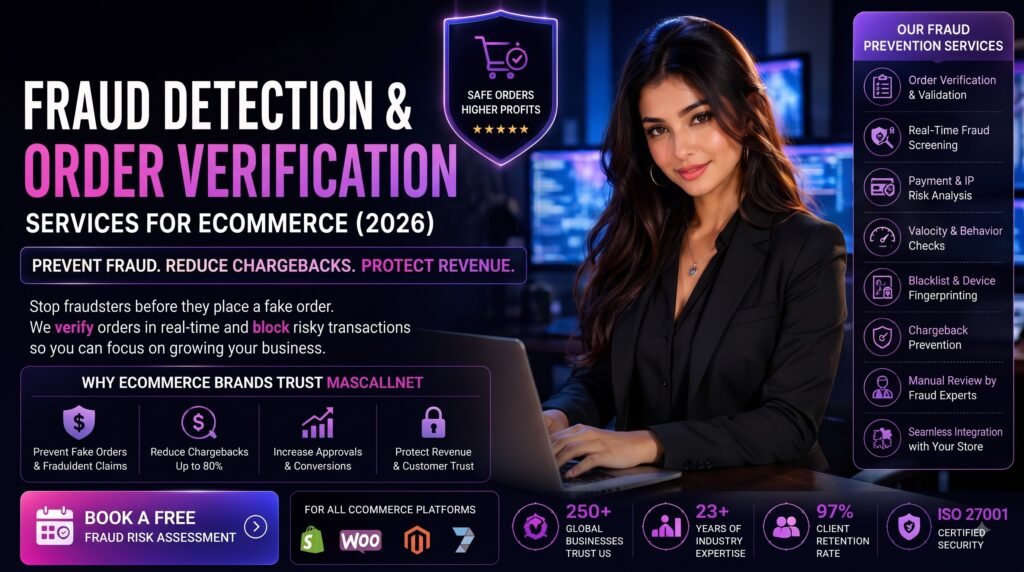
eCommerce fraud is projected to cost merchants over $107 billion globally by 2029, according to Juniper Research, with chargebacks, false declines, and order verification gaps eating directly into net margin. Fraud detection and order verification services use a combination of machine learning risk engines, device fingerprinting, behavioral analytics, and trained human verification specialists toscreen orders in real time before shipment. The most effective programs use a hybrid model: AI flags anomalies at scale, while human reviewers resolve ambiguous, high-value, or emotionally sensitive cases that automation misreads. Enterprises that treat fraud prevention as a revenue recovery function — not just a security cost center — recover 3–6% of previously lost revenue within two quarters. This guide covers frameworks, pricing, ROI models, vendor evaluation criteria, and the operational realities most articles on this topic overlook.
Introduction
Most eCommerce leaders discover their fraud problem the expensive way — through a chargeback notice, a payment processor warning, or a quarterly finance review that shows “shrinkage” they can’t fully explain.
Here’s what rarely gets said out loud in vendor pitches: fraud detection is not primarily a technology problem. It’s a decision-quality problem. Every order your system flags is a judgment call — is this a genuine customer with a new device, or an organized fraud ring testing stolen card numbers? Get that judgment wrong in either direction, and it costs you. Approve fraud, and you eat the chargeback. Decline a real customer, and you lose the sale, the customer, and often their future lifetime value.
We’ve built and operated verification teams for eCommerce, BFSI, and logistics clients handling millions of orders annually. The pattern is consistent: companies that treat fraud prevention purely as a software purchase plateau quickly. Companies that treat it as a revenue recovery function — combining AI risk scoring with skilled human judgment — consistently outperform on both fraud loss reduction and order approval rates.
This guide reflects that operating reality. Not theory. Not vendor marketing. What we’ve seen work, what we’ve seen fail, and the frameworks in between.
Category thesis: This is fundamentally a story about Revenue Recovery Through CX™ — every fraudulent order stopped, every false decline reversed, and every legitimate customer verified quickly is revenue your business has already earned but hasn’t yet realized.
Key Insights for Decision-Makers
- Global eCommerce fraud losses are projected to exceed $107 billion by 2029 (Juniper Research), up from an estimated $48 billion in 2023.
- False declines — legitimate orders wrongly rejected — cost merchants roughly 2.5x more revenue than actual fraud losses (Aite-Novarica Group estimates).
- Fully automated fraud engines typically resolve 70–85% of orders with confidence; the remaining 15–30% require human judgment to avoid revenue leakage in either direction.
- Merchants using a hybrid AI-plus-human verification model report chargeback ratios 30–45% lower than those relying on automation alone.
- Order verification response time directly affects cart abandonment — every additional hour of manual review delay increases abandonment risk during high-value and international orders.
The Market Reality in 2026
Direct Answer: Fraud attempts against eCommerce businesses have shifted from opportunistic to organized — fraud rings now use AI themselves, running automated card-testing scripts, synthetic identities, and account takeover attacks at industrial scale, faster than most in-house teams can adapt.
Why It Matters: The economics of fraud have changed. It used to cost a fraudster meaningful time and effort to test stolen card data manually. Automated bot networks now test thousands of card combinations per hour against checkout pages, and generative AI tools help fraudsters create convincing fake identities and social-engineering scripts. Your fraud team is no longer fighting individuals — it’s fighting infrastructure.
Framework: Three forces are converging simultaneously:
- Attack sophistication — AI-assisted fraud, synthetic identity fraud, friendly fraud (first-party fraud disguised as chargebacks).
- Regulatory pressure — card networks (Visa, Mastercard) tightening chargeback ratio thresholds, with penalties escalating faster than before.
- Customer expectation — buyers expect frictionless checkout, meaning verification has to be nearly invisible to legitimate customers while still stopping bad actors.
| Market Force | 2023 Baseline | 2026 Reality | Business Implication |
|---|---|---|---|
| Card-not-present fraud share | ~72% of total fraud | ~80%+ of total fraud | eCommerce bears disproportionate risk |
| Average chargeback cost (incl. fees, labor, lost goods) | 2.5x order value | 3–4x order value | Chargebacks are far costlier than the lost sale alone |
| Friendly fraud share of total disputes | ~40% | 50%+ | Fraud detection must now include intent analysis, not just identity |
| Manual review capacity needs | Static teams | Elastic, 24/7 coverage | In-house teams increasingly outsource peak/overflow volume |
Executive Interpretation: If your fraud strategy hasn’t changed in the last 18 months, you are almost certainly under-protected — not because your tools got worse, but because the threat model evolved past them.
Boardroom Insight™: Most boards ask “how much fraud are we losing?” The better question is “how much legitimate revenue are we accidentally declining?” — because in our experience, that number is usually larger and far more fixable.
Summary: Fraud attacks are more automated, more sophisticated, and more costly than they were even two years ago, and static, tool-only defenses are falling behind.
Key Takeaway: The fraud landscape has industrialized — your response needs to be equally systematic.
What Fraud Detection & Order Verification Actually Means
Direct Answer: Fraud detection and order verification is the combined process of evaluating an eCommerce transaction’s legitimacy — checking payment validity, buyer identity, delivery risk, and behavioral signals — before an order is confirmed, packed, or shipped, in order to prevent chargebacks, stolen-goods loss, and reputational damage.
It operates across three layers:
- Pre-transaction screening — real-time risk scoring at checkout using device fingerprinting, IP/geolocation analysis, velocity checks (how many orders from this card/device/address recently), and payment method validation.
- Order-level verification — manual or semi-automated review of flagged orders: confirming shipping/billing address mismatches, contacting the customer for confirmation, cross-referencing order history.
- Post-transaction monitoring — chargeback management, dispute representment, and feedback loops that retrain fraud models based on confirmed outcomes.
Most vendors sell layer one. Few execute layer two well. Almost none close the loop on layer three. That gap is where most of the preventable loss hides.
Related capability: This function overlaps significantly with broader customer support outsourcing operations, since verification calls, order confirmation outreach, and dispute resolution are fundamentally customer interactions requiring trained agents, not just software.
Why This Problem Is Getting Worse, Not Better
Direct Answer: Fraud is growing faster than in-house teams can scale because fraud tactics evolve weekly while internal hiring, training, and tooling cycles operate on a quarterly or annual cadence.
Why It Matters: A mid-sized eCommerce brand processing 50,000 orders a month typically has 2–4 people dedicated to fraud and order review — often part-time, often generalists. Fraud rings, by contrast, run 24/7, test constantly, and share tactics across dark-web forums faster than most enterprises share knowledge internally.
Framework — The Three Gaps That Compound Losses:
- Coverage gap: In-house teams work business hours; fraud attempts spike overnight and on weekends when review capacity is lowest.
- Expertise gap: Recognizing synthetic identity fraud or friendly fraud patterns takes specialized training most internal hires don’t receive.
- Volume gap: Seasonal spikes (holiday, flash sales) create review backlogs that either delay legitimate orders or force teams to approve orders without adequate scrutiny.
Table: Cost of Inaction
| Gap Type | Typical Business Consequence | Annual Revenue Impact (mid-size merchant) |
|---|---|---|
| Coverage gap | Fraud concentrated in unreviewed windows | 15–20% of total fraud loss |
| Expertise gap | Missed synthetic/friendly fraud patterns | 10–25% higher chargeback ratio |
| Volume gap | Rushed reviews during peak season | 2–3x normal fraud rate during Q4 |
Executive Interpretation: These aren’t technology failures — they’re staffing and operating-model failures. This is precisely why the highest-performing fraud programs pair automated tooling with an outsourced, elastic verification layer rather than trying to solve coverage and volume with fixed internal headcount.
Boardroom Insight™: Leadership teams often approve six-figure fraud software budgets while under-resourcing the human review layer that actually closes 20–30% of unresolved cases. The software catches the obvious fraud; the humans catch the expensive, ambiguous fraud.
MasCallNet Perspective: We’ve seen brands cut fraud losses by double digits simply by extending review coverage to 24/7 — without changing their fraud-scoring software at all.
Executive Action: Audit your current review coverage against your actual order volume by hour and day-of-week before approving any new fraud tooling budget.
How Fraud Detection & Order Verification Works
Direct Answer: Effective order verification follows a five-stage operating sequence: risk scoring, triage, human review, customer verification contact, and resolution feedback — with each stage designed to resolve legitimate orders fast and isolate genuinely suspicious ones for deeper scrutiny.
Framework — The Five-Stage Verification Sequence:
- Risk Scoring (0–2 seconds): AI engine scores every order using 50+ signals — device ID, IP reputation, AVS/CVV match, order velocity, historical customer data.
- Triage (automated): Orders are bucketed — auto-approve (low risk), auto-decline (extremely high risk, rare), or route to human review (ambiguous, moderate-to-high risk, or high order value).
- Human Review (minutes to hours): Trained specialists examine flagged orders — cross-checking social presence, prior order history, delivery address risk, and behavioral consistency.
- Customer Verification Contact (as needed): For high-value or ambiguous orders, a verification call, SMS, or email confirms the order directly with the customer — often resolving false-positive flags within minutes.
- Resolution & Feedback Loop: Confirmed fraud and confirmed-legitimate outcomes feed back into the risk model, continuously improving future scoring accuracy.
Table: Stage-by-Stage Ownership
| Stage | Best Handled By | Typical SLA |
|---|---|---|
| Risk Scoring | AI/ML engine | Real-time (<2 sec) |
| Triage | Automated rules engine | Instant |
| Human Review | Trained verification specialists | 15 min – 4 hrs |
| Customer Contact | Human agents (call/SMS/email) | Same-day |
| Feedback Loop | Combined AI + analyst oversight | Continuous |
Executive Interpretation: The businesses winning on both fraud reduction and approval rates are the ones that treat stage 3 and 4 — human review and customer contact — as a core operating capability, not an afterthought bolted onto software.
Boardroom Insight™: A order flagged and left unreviewed for 24 hours doesn’t just risk fraud — it risks losing a legitimate, impatient customer to a competitor. Speed of resolution matters as much as accuracy of decision.
Summary: Verification works best as a coordinated sequence of machine speed and human judgment, not a single automated gate.
Key Takeaway: The fastest fraud-prevention wins come from fixing stage 3 (human review capacity), not from buying stage 1 (better AI) again.
The MasCallNet Revenue Leakage Model™
Definition: A diagnostic framework quantifying how much revenue an eCommerce business is losing across three channels — confirmed fraud, chargebacks, and false declines — to identify where intervention will produce the fastest recovery.
Methodology:
Total Revenue Leakage =
  (Confirmed Fraud Losses)
+ (Chargeback Costs × 3.5 multiplier for fees/labor/goods)
+ (False Decline Value × Recovery Probability)
Scoring Logic:
| Leakage Category | Formula Input | Weight in Total Score |
|---|---|---|
| Confirmed Fraud | Fraud $ / Total Revenue | 30% |
| Chargeback Cost | Chargebacks × 3.5 | 40% |
| False Declines | Declined legitimate orders × AOV | 30% |
Interpretation:
- Leakage Score under 1.5% of revenue: Well-managed program, focus on optimization.
- 1.5%–3%: Moderate leakage, review process typically needs a human-review capacity upgrade.
- Above 3%: Significant leakage — usually indicates either under-resourced manual review or overly aggressive auto-decline rules causing false positives.
Executive Recommendation: Run this model quarterly, not annually. Fraud patterns shift seasonally, and a leakage score calculated in January tells you very little about your Q4 exposure.
This model is the practical foundation of what we call Revenue Recovery Through CX™ — the discipline of treating every prevented false decline and every stopped fraud attempt as recovered revenue, not just avoided cost.
The Hidden Truth About Fraud Losses
What Everyone Says: “We need better fraud detection software to stop losing money to chargebacks.”
What Most Articles Miss: Chargebacks are usually the visible symptom. The larger, invisible cost is false declines — legitimate high-value customers rejected by overly cautious automated rules, who simply take their business elsewhere without complaint.
What Actually Happens: In our engagements, we consistently see auto-decline thresholds set conservatively after a bad fraud quarter, and then never revisited. Six months later, the business is quietly declining 3–5% of genuinely good orders — a loss that never shows up on a fraud report because it isn’t fraud. It’s a missed sale.
Hidden Cost: A brand doing $20M in annual online revenue with even a 2% false decline rate is turning away roughly $400,000 in legitimate revenue annually — often more than their actual confirmed fraud losses.
MasCallNet Perspective: Fraud prevention and revenue growth are not competing priorities — they’re the same function measured incorrectly. Any fraud program that only reports “fraud stopped” without also reporting “false declines recovered” is only showing you half the picture.
Executive Action: Request a false-decline audit from your current fraud vendor or team this quarter. If they can’t produce one, that itself is the answer.
AI vs. Human vs. Hybrid Verification Model™
Direct Answer: AI excels at speed and pattern-matching across massive order volumes; human reviewers excel at contextual judgment, ambiguity resolution, and empathetic customer verification — the hybrid model combining both consistently outperforms either approach alone.
This is the same debate playing out across every corner of customer operations — the AI vs. human question isn’t about which one wins; it’s about designing the handoff correctly.
Table: AI vs. Human vs. Hybrid Comparison
| Capability | AI-Only | Human-Only | Hybrid Model |
|---|---|---|---|
| Speed at scale | Excellent (milliseconds) | Poor (hours) | Excellent for 70–85% of volume |
| Ambiguous case resolution | Weak — over/under-flags | Strong | Strong — routed to specialists |
| Cost per order reviewed | Very low | High | Moderate, optimized |
| False decline rate | Higher without tuning | Lower, but inconsistent | Lowest — combined signals |
| Adaptability to new fraud tactics | Fast with retraining data | Fast with experienced analysts | Fastest — human insight retrains AI |
| Customer experience on flagged orders | Impersonal, can feel punitive | Personalized, reassuring | Best — fast + personal when needed |
| 24/7 coverage | Native | Requires shift staffing | Achievable via outsourced teams |
Executive Interpretation: Businesses that go “AI-only” to cut costs typically see short-term savings and medium-term revenue leakage as false declines climb. Businesses that go “human-only” can’t scale during peak seasons. The hybrid model isn’t a compromise — it’s the only model that scales and protects revenue simultaneously.
Boardroom Insight™: The real competitive advantage isn’t choosing AI or humans — it’s how fast your organization can route the right case to the right resource. That routing logic is the actual intellectual property, not the AI model itself.
MasCallNet Perspective: Every fraud program we’ve helped build or optimize converges on the same architecture within 12 months: AI for triage, trained specialists for the 15–30% requiring judgment, and a feedback loop connecting the two. This mirrors how the broader AI-powered customer support outsourcing discipline has matured — automation for volume, human expertise for value.
Summary: The AI vs. human debate is a false choice — the winning model is a coordinated hybrid, not a competition.
Key Takeaway: Design your fraud program around the handoff between AI and humans, not around picking one over the other.
Fraud Prevention Maturity Model™
Direct Answer: Organizations progress through four maturity stages — Reactive, Rules-Based, Predictive, and Intelligence-Led — and most eCommerce brands are stuck between stage one and two, well below where fraud sophistication now demands.
| Stage | Characteristics | Typical Fraud Loss Rate | Next Step |
|---|---|---|---|
| 1. Reactive | Fraud handled after chargebacks arrive; no pre-shipment screening | 1.5–2.5% of revenue | Implement real-time risk scoring |
| 2. Rules-Based | Static rules (block country X, flag order >$500); minimal human review | 1–1.8% | Add trained human review layer |
| 3. Predictive | ML-based scoring, dynamic thresholds, dedicated review team | 0.5–1% | Build feedback loop and 24/7 coverage |
| 4. Intelligence-Led | Hybrid AI + human model, continuous retraining, cross-channel identity signals | 0.2–0.5% | Optimize for false-decline reduction |
Executive Interpretation: Moving from Stage 2 to Stage 3 typically produces the largest ROI jump of any transition — because it’s the point where human judgment starts systematically feeding back into automated scoring.
Boardroom Insight™: Most vendors sell you Stage 3 technology while your organization is operationally still at Stage 1 or 2. Technology maturity and operational maturity are not the same thing — and buying ahead of your operational capability wastes budget.
Executive Recommendation: Assess your true stage honestly before any technology purchase. A Stage 4 tool run by a Stage 1 team performs like a Stage 1 program.
In-House vs. Outsourced vs. Contact Center Intelligence™
Direct Answer: In-house teams offer control but struggle with scale and coverage; traditional outsourced BPOs offer scale but often lack fraud-specific expertise; a Contact Center Intelligence™ model combines dedicated fraud specialists, AI tooling, and continuous analytics — delivering both scale and precision.
Table: In-House vs. Traditional Outsourcing vs. Contact Center Intelligence™
| Factor | In-House | Traditional BPO | Contact Center Intelligence™ |
|---|---|---|---|
| Setup time | 3–6 months (hiring, training) | 4–8 weeks | 2–4 weeks |
| 24/7 coverage | Rare, costly | Yes | Yes, with fraud-trained shifts |
| Fraud-specific expertise | Varies widely | Often generic | Specialized, continuously trained |
| Cost structure | High fixed cost | Lower, volume-based | Lower, outcome-linked |
| Scalability for peak season | Difficult, slow | Moderate | Elastic, same-week scaling |
| Feedback loop into fraud models | Inconsistent | Rare | Built-in by design |
| Data/analytics reporting | Manual, internal tools | Basic dashboards | Real-time analytics + benchmarking |
Table: Offshore vs. Onshore Verification Teams
| Factor | Onshore | Offshore (e.g., India-based) | Recommendation |
|---|---|---|---|
| Cost per verification | High | 40–60% lower | Offshore for volume review |
| Language/cultural fit | Native | Trained multilingual teams available | Match to customer base |
| Time zone coverage | Limited without shifts | Naturally enables 24/7 via follow-the-sun | Offshore advantage |
| Domain expertise | Builds slowly | Builds fast with dedicated fraud vertical teams | Verify vendor specialization |
Table: Build vs. Buy
| Factor | Build In-House | Buy (Outsource/Partner) |
|---|---|---|
| Time to operational capability | 4–9 months | 2–6 weeks |
| Upfront investment | High (hiring, tooling, training) | Low, subscription/outcome-based |
| Access to cross-industry fraud pattern data | Limited to own data | Broader, pooled pattern recognition |
| Risk if wrong hire/vendor | High (single point of failure) | Lower (contractual SLAs, redundancy) |
Executive Interpretation: The “build vs. buy” decision isn’t really about cost — it’s about time-to-protection. Every month spent building an internal team is a month of continued, quantifiable revenue leakage.
Boardroom Insight™: Most “in-house vs. outsource” debates in boardrooms are actually control-vs-speed debates in disguise. The businesses that resolve this fastest set clear data-ownership and escalation protocols with their outsourcing partner — control is a contractual design choice, not an inherent trade-off.
MasCallNet Vendor Evaluation Matrix™
Definition: A structured scorecard for evaluating fraud detection and order verification vendors/partners across the criteria that actually predict long-term performance — not just sales-pitch differentiators.
Table: Vendor Scorecard (Score each 1–5)
| Criterion | What to Ask | Weight |
|---|---|---|
| Fraud-specific domain training | Do agents receive dedicated fraud/identity training, or generic CX training? | 20% |
| AI + human integration | Is there a documented feedback loop between review outcomes and the risk engine? | 20% |
| 24/7 elastic capacity | Can they scale review capacity within days for seasonal spikes? | 15% |
| Data security & compliance | PCI-DSS, SOC 2, GDPR-aligned data handling? | 15% |
| Reporting transparency | Real-time dashboards on fraud, chargebacks, false-decline rate? | 15% |
| Industry-specific experience | Track record in your vertical (retail, BFSI, healthcare, logistics)? | 10% |
| Integration ecosystem | Native integration with Shopify, WooCommerce, Stripe, PayPal, Salesforce, Zendesk? | 5% |
Scoring Logic: Total weighted score above 4.0/5 = strong long-term partner candidate. Below 3.0/5 = high implementation risk regardless of pricing.
Executive Recommendation: Never evaluate a fraud/verification vendor on pricing alone — the cheapest vendor with weak feedback-loop discipline will cost more in false declines and repeat fraud within two quarters than the savings on the contract.
Industry Benchmarks & Statistics
Direct Answer: Best-in-class eCommerce fraud programs in 2026 operate at fraud loss rates below 0.5% of revenue, chargeback ratios under 0.65% (below card network monitoring thresholds), and false decline rates under 2% — most mid-market merchants are still well outside these benchmarks.
| Metric | Underperforming | Industry Average | Best-in-Class |
|---|---|---|---|
| Fraud loss (% of revenue) | >2% | 0.8–1.2% | <0.5% |
| Chargeback ratio | >1% | 0.65–0.9% | <0.5% |
| False decline rate | >5% | 2–4% | <1.5% |
| Order review turnaround | >12 hrs | 2–6 hrs | <1 hr |
| Manual review coverage | Business hours only | Extended hours | True 24/7 |
Benchmarks synthesized from Juniper Research, Aite-Novarica Group fraud studies, and Visa/Mastercard published chargeback threshold guidance.
Executive Interpretation: If your chargeback ratio is approaching 0.9–1%, you are close to card network monitoring program thresholds — breaching them triggers penalty fees and processing restrictions that compound the original revenue loss.
Case Study: Recovering Revenue at Scale
Challenge: A multi-category eCommerce retailer processing roughly 40,000 orders monthly was experiencing a chargeback ratio of 1.3% — above card network monitoring thresholds — while simultaneously seeing customer complaints about orders being “randomly cancelled.”
Root Cause: Investigation revealed two compounding issues: an aggressive auto-decline rule installed after a prior fraud spike (causing high false declines), and a two-person internal review team unable to clear the backlog of ambiguous orders within 24 hours — leading staff to bulk-approve orders under time pressure during peak periods, which is where the actual fraud was slipping through.
Solution: Implementation of a hybrid verification model — refined AI risk scoring thresholds calibrated against 12 months of historical order data, combined with a dedicated, trained 24/7 verification team handling flagged and ambiguous orders, plus same-day customer verification outreach for high-value orders.
Implementation: Phased rollout over five weeks — model recalibration in week one, team onboarding and fraud-pattern training in weeks two–three, parallel-run validation in week four, and full cutover by week five.
Results (within two quarters):
- Chargeback ratio reduced from 1.3% to 0.55%
- False decline rate reduced from 4.8% to 1.6%, recovering approximately $310,000 in previously lost legitimate revenue
- Order review turnaround improved from 14 hours average to under 90 minutes
- Customer complaints related to order cancellation dropped by 68%
Lessons Learned: The chargeback problem and the false-decline problem were never separate issues — they were two symptoms of the same root cause: an under-resourced, time-pressured review process. Fixing capacity fixed both metrics simultaneously.
Full documented engagements are available in our BPO case studies.
Pricing Analysis & Cost Calculator
Direct Answer: Outsourced fraud detection and order verification services typically range from $0.35–$1.50 per order reviewed depending on order complexity, volume tier, and required coverage (business-hours vs. 24/7), with enterprise volume-based contracts often reducing per-order cost by 30–50%.
Table: Typical Pricing Models
| Model | Structure | Best For |
|---|---|---|
| Per-order review fee | Fixed fee per order screened/reviewed | Predictable volume businesses |
| Percentage of transaction value | % fee scaling with order value | High-AOV businesses (luxury, electronics) |
| Dedicated team / seat-based | Fixed monthly cost per agent/shift | High-volume, consistent order flow |
| Outcome-based / hybrid | Base fee + performance incentive on fraud reduction | Enterprises prioritizing accountability |
Simple Cost Calculator Framework:
Monthly Verification Cost =
  (Monthly Orders Requiring Review × Per-Order Rate)
+ (Dedicated Analyst Hours × Hourly Rate, if applicable)

Example:
50,000 monthly orders
× 20% requiring human review (10,000 orders)
× $0.75 per-order review rate
= $7,500/month verification cost

Compare against:
Estimated monthly fraud + chargeback + false-decline loss
without adequate review = $45,000–$70,000 (typical mid-market exposure)
Executive Interpretation: In nearly every engagement we’ve scoped, the cost of proper verification coverage is a fraction — typically 10–20% — of the revenue currently being lost to fraud, chargebacks, and false declines combined.
ROI Framework
Original Formula:
Fraud Prevention ROI =
[(Prevented Fraud Loss + Recovered False-Decline Revenue) − Program Cost]
÷ Program Cost × 100
Table: Illustrative ROI Calculation
| Component | Monthly Value |
|---|---|
| Prevented fraud loss (vs. baseline) | $18,000 |
| Recovered false-decline revenue | $26,000 |
| Total program cost | $9,000 |
| Net monthly benefit | $35,000 |
| ROI | ~389% |
Executive Interpretation: Because false-decline recovery is usually larger than fraud-loss prevention alone, any ROI model that excludes it dramatically understates the business case for investment.
Boardroom Insight™: If your fraud program’s ROI is calculated using only “fraud stopped” and not “revenue recovered,” you are presenting the board with an incomplete — and understated — business case. This is the core mechanic behind Revenue Recovery Through CX™: quantifying the full revenue impact, not just the loss-prevention piece.
Industry Use Cases
Direct Answer: Fraud detection and order verification requirements differ meaningfully by industry — retail/eCommerce faces card-testing and account takeover, BFSI faces synthetic identity and application fraud, healthcare faces insurance and identity fraud, and logistics faces address manipulation and reshipping fraud schemes.
| Industry | Primary Fraud Risk | Verification Priority |
|---|---|---|
| Retail & eCommerce | Card testing, stolen card use, account takeover | Real-time device/behavior scoring + human review for high-AOV orders |
| Banking & Financial Services | Synthetic identity, application fraud | Identity document verification, multi-factor confirmation |
| Insurance | Claims fraud, staged incidents | Cross-referencing claims history and behavioral inconsistency |
| Healthcare | Insurance fraud, identity misuse | Patient identity verification integrated with patient appointment scheduling workflows |
| FMCG/Retail distribution | Bulk order fraud, reseller abuse | Order pattern and velocity analysis |
| Automotive & EV | High-value order fraud, financing fraud | Enhanced identity and payment verification for large-ticket transactions |
| Logistics | Reshipping fraud, address manipulation | Delivery address risk scoring + carrier data cross-check |
| Telecommunications | SIM swap, account takeover | Multi-channel identity confirmation |
Executive Interpretation: Generic fraud tooling applied uniformly across industries underperforms. Vertical-specific pattern recognition — built from experience across multiple industries — consistently outperforms single-industry-trained models.
Technology Ecosystem
Direct Answer: A well-architected fraud detection and verification stack integrates commerce platforms, payment processors, CRM/support tools, cloud infrastructure, and increasingly, generative AI systems for pattern analysis and agent assistance.
| Layer | Representative Platforms |
|---|---|
| eCommerce Platforms | Shopify, WooCommerce |
| Payment Processing | Stripe, PayPal |
| CRM & Support | Salesforce, Zendesk, Freshdesk, HubSpot, Intercom |
| Contact Center Infrastructure | Genesys, Five9, Talkdesk, NICE CXone |
| Workflow & Collaboration | ServiceNow, Slack, Microsoft Teams |
| Cloud Infrastructure | Amazon Web Services, Google Cloud, Microsoft Azure |
| AI/Generative Layer | OpenAI, Google Gemini, Claude, Microsoft Copilot |
Executive Interpretation: The value isn’t in owning every platform — it’s in the integration layer between them. A verification specialist who can see order data (Shopify), payment signals (Stripe), and customer history (Salesforce/Zendesk) in one unified view resolves ambiguous cases dramatically faster than one working across disconnected systems.
This integrated operating model is the foundation of what we describe internally as our Contact Center Intelligence™ layer — treating every order verification interaction as a data point that improves the next decision, not an isolated transaction.
Security, Compliance & Data Protection
Direct Answer: Any fraud detection and order verification partner handling payment and identity data must operate under PCI-DSS compliance for payment data, SOC 2 controls for data handling, and regional data protection regulations (GDPR, and applicable data localization requirements) relevant to your customer base.
Executive Checklist for Compliance Due Diligence:
- PCI-DSS compliance certification current and verifiable
- SOC 2 Type II report available for review
- Data encryption in transit and at rest
- Clear data residency and localization commitments
- Documented access control and agent-level audit trails
- Incident response and breach notification protocols defined contractually
Boardroom Insight™: Compliance certifications are necessary but not sufficient. Ask your vendor how agent-level access is audited — a compliant system with poorly governed agent behavior is still a data risk.
The India Advantage
Direct Answer: India has become a preferred hub for fraud detection and order verification services because it combines large-scale, English-proficient talent pools, mature BPO infrastructure, 24/7 time-zone coverage advantages for Western markets, and cost efficiency of 40–60% versus onshore alternatives, without compromising service quality when the right partner is selected.
What separates strong providers from the rest isn’t geography — it’s specialization. Among the best BPO companies in India, the differentiator increasingly is whether the provider has built dedicated fraud-and-verification expertise, versus generalist customer support teams handling fraud review as a side task.
What High-Performing Organizations Look For:
- Dedicated fraud-vertical training programs, not generic CX onboarding
- Delivery centers built for secure, compliant data handling (not just cost arbitrage)
- Proven integration experience with major eCommerce and payment platforms
- Transparent, real-time reporting rather than periodic manual reports
Our own delivery operations, including our AI-powered contact center in Noida, are built around this specialization model — combining trained fraud and verification specialists with AI-assisted tooling rather than treating fraud review as generic ticket handling.
Risk Analysis
Direct Answer: The primary risks in fraud detection and order verification programs are over-automation (leading to false declines), under-resourced review capacity (leading to fraud leakage), vendor lock-in without data portability, and compliance gaps in offshore data handling — each manageable with the right contractual and operational safeguards.
| Risk | Likelihood if Unmanaged | Mitigation |
|---|---|---|
| Over-aggressive automation | High | Regular threshold recalibration using false-decline data |
| Review capacity shortfall during peak season | High | Contract for elastic scaling clauses in advance |
| Vendor data lock-in | Moderate | Require data portability and export rights contractually |
| Compliance/data residency gaps | Moderate | Verify certifications and data handling location explicitly |
| Over-reliance on single fraud signal (e.g., IP only) | Moderate | Require multi-signal risk scoring architecture |
Common Executive Mistakes:
- Approving a fraud tooling budget without auditing current review capacity first
- Measuring success only by “fraud stopped” instead of tracking false declines equally
- Locking into long-term vendor contracts without a data-portability clause
- Treating fraud review as a cost center to minimize rather than a revenue function to optimize
Future Trends Through 2027
Direct Answer: The next 18–24 months will bring AI-generated synthetic fraud at greater scale, increased use of behavioral biometrics for verification, tighter integration between conversation intelligence and fraud scoring, and growing adoption of hybrid human-AI verification as the default operating model rather than the advanced option.
- AI Agents & Voice Bots: Increasingly used for first-line customer verification contact, escalating to human agents for ambiguous responses.
- Agent Assist: Real-time prompts helping human reviewers spot fraud patterns faster, reducing training time for new analysts.
- Predictive Analytics: Shifting from “detect fraud after the fact” to “predict fraud probability before checkout even completes.”
- Conversation Intelligence: Verification calls analyzed for tone, hesitation, and inconsistency patterns — adding a signal layer beyond transactional data.
- Workflow Automation: Seamless routing between AI risk engines, human review queues, and CRM systems reducing resolution time further.
- Customer Intelligence Loop: Every verified order, dispute, and resolved case feeding back into a continuously improving risk model — the practical expression of what we call the Customer Intelligence Loop™.
Boardroom Insight™: The organizations that will win this decade’s fraud battle aren’t the ones with the newest AI model — they’re the ones with the tightest feedback loop between AI decisions and human-verified outcomes.
Executive Decision Tree
Should you build in-house, partner with a BPO, or adopt a hybrid intelligence model?
START: What is your current chargeback ratio?

├── Below 0.5% AND stable order volume
│     → Optimize existing process; focus on false-decline reduction
│
├── 0.5%–1% OR seasonal volume spikes
│     → Evaluate outsourced elastic review capacity
│     → Consider hybrid AI + human model
│
└── Above 1% OR approaching card network thresholds
      → Immediate priority: dedicated fraud-specialist partner
      → Parallel: recalibrate AI thresholds using false-decline data
      → Escalation: executive review of current vendor performance
Executive Interpretation: Most companies wait until they breach card network thresholds before acting. By then, penalty fees and processing restrictions are already compounding the original loss — earlier intervention is materially cheaper.
Executive Checklist
Before your next fraud prevention budget cycle, confirm:
- You know your current chargeback ratio, fraud loss %, and false-decline rate — not just one of the three
- Your review team has documented 24/7 coverage or a plan to achieve it
- Your fraud thresholds have been recalibrated in the last 6 months
- You have a false-decline audit on file
- Your current vendor/team provides real-time reporting, not periodic summaries
- Your compliance certifications (PCI-DSS, SOC 2) are current and verified
- You’ve evaluated at least one hybrid AI + human verification partner against your in-house baseline
- Your ROI model includes recovered false-decline revenue, not just prevented fraud
Frequently Asked Questions
1. What is the difference between fraud detection and order verification?
Fraud detection is the automated risk-scoring process that flags suspicious transactions. Order verification is the follow-up process — often involving human review or direct customer contact — that confirms whether a flagged order is genuinely fraudulent or a false positive.
2. How much does outsourced fraud detection typically cost?
Most providers charge $0.35–$1.50 per order reviewed, or a seat/team-based monthly fee for dedicated coverage, with enterprise volume discounts of 30–50% common at scale.
3. Can AI alone handle eCommerce fraud detection?
AI can resolve 70–85% of orders confidently, but the remaining ambiguous cases — often the highest-value and highest-risk ones — require human judgment to avoid both fraud leakage and false declines.
4. What is a false decline, and why does it matter?
A false decline is a legitimate order incorrectly rejected as fraudulent. It matters because it often costs merchants more in lost revenue than actual fraud, and it damages customer trust.
5. How quickly can an outsourced verification team be operational?
With an experienced partner, teams can typically be trained and operational within 2–4 weeks, compared to 3–6 months for building an equivalent in-house team.
6. What chargeback ratio triggers card network monitoring programs?
Visa and Mastercard generally begin monitoring merchants approaching a 0.9–1% chargeback ratio, with escalating penalties beyond that threshold — programs and exact thresholds vary by network and should be confirmed directly with your payment processor.
7. Is offshore fraud verification safe from a compliance standpoint?
Yes, when the provider maintains PCI-DSS and SOC 2 compliance, documented data residency practices, and agent-level access controls. Compliance depends on the provider’s practices, not the location alone.
8. How does fraud detection integrate with platforms like Shopify or WooCommerce?
Most modern fraud and verification solutions offer native or API-based integrations with major eCommerce platforms, payment processors like Stripe and PayPal, and CRM systems like Salesforce or Zendesk, enabling a unified view of order and customer risk data.
9. What’s the biggest mistake companies make with fraud prevention budgets?
Investing heavily in fraud-scoring software while under-resourcing the human review layer that resolves ambiguous, high-value cases — leaving 15–30% of order volume inadequately reviewed.
10. How often should fraud detection thresholds be recalibrated?
At minimum quarterly, and immediately after any significant change in order volume, product mix, or after a confirmed fraud pattern shift.
11. What industries need order verification most urgently?
Retail/eCommerce, BFSI, healthcare, automotive/EV (due to high-ticket transactions), and logistics all face elevated fraud exposure requiring dedicated verification processes.
12. Does order verification slow down the checkout experience?
Well-designed programs minimize friction for the 70–85% of low-risk orders, applying additional verification steps only to the smaller subset of genuinely ambiguous or high-risk transactions.
13. What’s the ROI of investing in proper fraud detection and verification?
Organizations typically see 200–400%+ ROI when accounting for both prevented fraud losses and recovered false-decline revenue, based on the combined-impact ROI model outlined above.
14. How do we choose between building an in-house team and outsourcing?
Evaluate time-to-protection, current chargeback trajectory, seasonal volume variability, and internal fraud expertise. Businesses facing near-term chargeback threshold risk generally benefit more from an experienced outsourced partner than from building in-house from scratch.
15. What should we look for in a fraud detection and verification partner?
Fraud-specific training (not generic CX training), a documented AI-human feedback loop, elastic 24/7 capacity, verifiable compliance certifications, and transparent real-time reporting — as outlined in the vendor evaluation matrix above.
Ready to Scale Your Customer Support?
If you’re auditing your current fraud exposure while reading this, that instinct is worth acting on. Most businesses don’t have a clear, current answer to their chargeback ratio, false-decline rate, and review coverage gaps side by side — and that blind spot is exactly where revenue quietly disappears.
Ready to Build a More Scalable Customer Support Operation?
Our team works directly with COOs, CX leaders, and operations executives to assess fraud and order verification readiness — not through a generic sales call, but through a structured review of your actual order and dispute data. Contact our team to schedule that conversation.
See How Much You Could Save With Customer Support Outsourcing
Using the ROI framework outlined above, we can help you model your specific fraud prevention ROI potential based on your order volume, current chargeback ratio, and average order value — a data-driven starting point before any commitment.
Ready to Find the Right Customer Support Outsourcing Strategy?
To see how our verification specialists and delivery model work in practice, review our customer support outsourcing services or explore documented case studies from businesses we’ve partnered with directly.
Conclusion
Fraud detection and order verification in 2026 is no longer a checkbox security function — it’s a direct lever on realized revenue. The businesses winning this fight aren’t the ones with the most expensive AI tooling; they’re the ones that built the tightest operating loop between automated risk scoring and trained human judgment, and that measure success by recovered revenue, not just prevented loss.
Three things separate mature programs from the rest: honest measurement (tracking false declines as rigorously as fraud losses), adequate review capacity (24/7, not business-hours-only), and a genuine feedback loop connecting every resolved case back into smarter future decisions. This is the operating reality behind Revenue Recovery Through CX™ — treating every verified order and every reversed false decline as revenue your business already earned.
If your current fraud program can’t answer, with confidence, what your false-decline rate is this quarter, that’s the place to start — before the next technology purchase, not after.
We help eCommerce, BFSI, healthcare, and logistics businesses build exactly this kind of hybrid verification operation — trained specialists, AI-assisted tooling, and 24/7 coverage designed around your actual order patterns, not a generic template. Talk to our team about what a readiness assessment would look like for your business.