
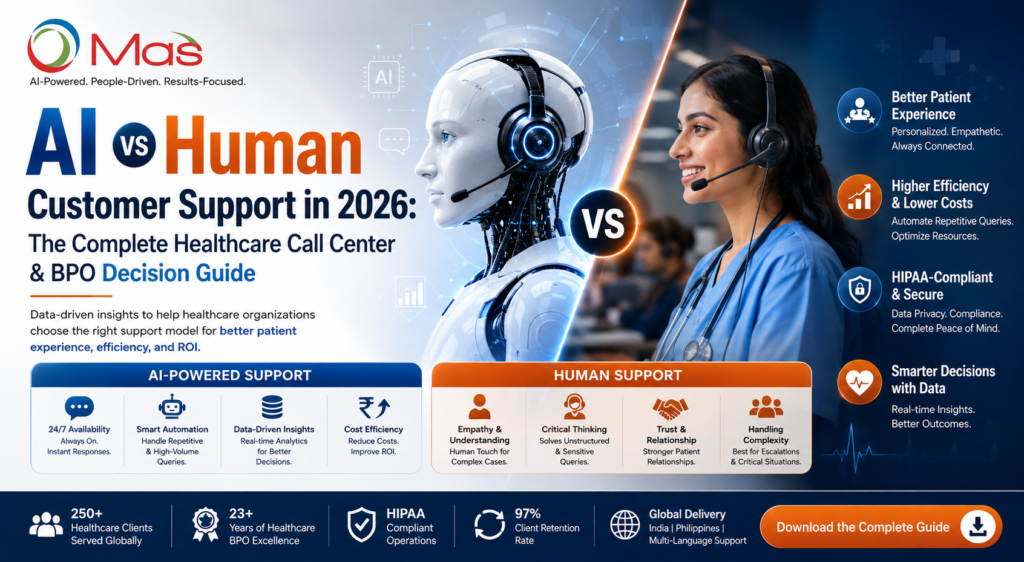
AI vs Human Customer Support in 2026: The Complete Healthcare Call Center & BPO Decision Guide
AI Overview
The debate over AI vs human customer support has moved past “which is better” to “how should they work together.” In 2026, healthcare providers, banks, insurers, and retailers are deploying AI voice agents and chatbots for scheduling, verification, and Tier-1 queries, while routing complex, compliance-sensitive, or emotionally charged conversations to trained human agents. This hybrid model reduces cost per interaction by 40-60%, improves first-call resolution, and extends coverage to 24/7 without proportional headcount growth. For organizations evaluating outsourced support, India remains the dominant sourcing destination due to its talent depth, English proficiency, cost advantage, and rapidly maturing AI-BPO ecosystem. Choosing the right partner requires evaluating technology stack, compliance readiness (HIPAA, PCI-DSS, GDPR), workforce quality, and the vendor’s ability to convert conversations into business intelligence—not just answer volume.
Introduction
Every CEO evaluating customer support strategy in 2026 is asking a variation of the same question: should we automate this, staff this, or outsource this—and to whom?
It’s a fair question, and most of the answers available online are unhelpful. They’re written by AI vendors who insist automation solves everything, or by BPO providers who insist nothing replaces human agents. Neither is being honest with you.
Here’s what fourteen years of operating contact centers across healthcare, banking, insurance, and retail has taught us: the AI vs human debate is the wrong debate. The organizations winning on cost, customer experience, and revenue retention in 2026 aren’t choosing a side. They’re building a system where AI absorbs volume and humans absorb complexity—and where every conversation, regardless of channel, becomes reusable business intelligence rather than a closed ticket.
We call this Contact Center Intelligence™—the discipline of treating customer conversations as a strategic data asset, not a cost center to be minimized. This article exists to give you the frameworks, benchmarks, and evaluation criteria to make this decision with the same rigor you’d apply to any seven-figure operational investment—because for most mid-market and enterprise organizations, that’s exactly what it is.
If you’re evaluating whether to build an AI support layer in-house, outsource to a BPO partner, or select between the growing field of AI-powered BPO companies in India, this is the resource we wish existed when we were making these decisions ourselves.
Key Insights for Decision-Makers
- AI resolves 60-75% of Tier-1 healthcare and retail queries without human involvement when deployed correctly—but only 20-30% of insurance and billing disputes, where human judgment remains non-negotiable.
- The average enterprise loses 3-9% of recoverable revenue annually to support-related failures: missed callbacks, abandoned calls, unresolved billing confusion, and appointment no-shows.
- Hybrid AI-human models reduce cost per resolved interaction by 40-60% compared to fully human-staffed operations, without the CSAT collapse associated with pure automation.
- India-based AI-powered BPO providers now offer response times and compliance certifications (HIPAA, SOC 2, ISO 27001) that were exclusive to onshore providers as recently as 2022.
- Organizations that treat customer conversations as intelligence data—not just resolved tickets—see measurably better forecast accuracy and retention outcomes. This is the core of Contact Center Intelligence™.
The Market Reality: Industry Trends & Data
Direct Answer: The customer support outsourcing market is undergoing its most significant structural shift since the offshore BPO boom of the early 2000s—driven not by cost arbitrage alone, but by AI-native operating models that make quality and speed simultaneously achievable.
Why It Matters
For twenty years, the BPO conversation centered on labor cost. In 2026, that’s no longer the primary variable. Gartner projects that by 2027, over 80% of customer service organizations will have deployed generative AI technology to enhance agent productivity and customer self-service. Grand View Research values the global contact center outsourcing market in the tens of billions and growing at a double-digit CAGR, with AI-augmented delivery models capturing a disproportionate share of new contracts.
Simultaneously, McKinsey’s research on generative AI in customer care consistently shows productivity gains of 30-45% for agents using AI-assisted tools, and Deloitte’s global outsourcing surveys show that “access to AI/automation capability” has overtaken “cost reduction” as the top-cited reason enterprises select outsourcing partners.
Framework: The Three Forces Reshaping Support
| Force | What’s Changing | Business Consequence |
|---|---|---|
| AI-native delivery | Voice AI and LLM-based agents now handle full conversations, not just IVR menus | Tier-1 headcount needs are shrinking; Tier-2/3 expertise needs are growing |
| Compliance convergence | HIPAA, PCI-DSS, and GDPR-grade compliance is now standard even in offshore delivery | Offshore is no longer synonymous with compliance risk |
| Intelligence extraction | Conversations are mined for sentiment, churn signals, and revenue leakage | Support functions are becoming strategic data sources, not cost centers |
Table: Market Snapshot (2026)
| Metric | Data Point | Source Type |
|---|---|---|
| Global contact center outsourcing market growth | Double-digit CAGR through 2030 | Industry research (Grand View Research category) |
| Enterprises citing AI capability as top outsourcing driver | Majority, surpassing cost reduction | Deloitte Global Outsourcing Survey trend |
| Customer service leaders piloting/deploying GenAI | Majority of surveyed organizations | Gartner customer service research trend |
| Average AI-driven agent productivity uplift | 30-45% | McKinsey generative AI research trend |
| Healthcare no-show rate industry average | 18-30% without proactive reminder systems | Healthcare operations benchmarks |
Executive Interpretation
If your outsourcing evaluation criteria still lead with hourly rate, you’re benchmarking against 2018, not 2026. The providers worth shortlisting differentiate on AI-human orchestration quality, not headcount cost alone.
Boardroom Insight™
The organizations that will struggle most in the next three years aren’t the ones with outdated support technology—they’re the ones with modern technology and no strategy for what to do with the data it generates. Buying AI tools without a Contact Center Intelligence™ discipline just produces faster, cheaper noise.
Summary
The support outsourcing market has shifted from a labor-cost decision to a capability decision, with AI orchestration and compliance maturity now determining vendor competitiveness.
Key Takeaway
In 2026, the right question isn’t “what does an agent cost per hour”—it’s “how intelligently does this partner combine AI and human judgment to protect revenue and experience.”
What Is AI Customer Support, Human Support, and Hybrid Support?
Direct Answer: AI customer support uses conversational AI—voice bots, chatbots, and AI agents—to independently resolve routine customer queries without human involvement. Human customer support relies on trained agents to manage conversations requiring judgment, empathy, or accountability. Hybrid support combines both, using AI for triage, deflection, and augmentation while reserving human agents for complexity and escalation.
Framework: The Three Support Models Defined
| Model | Definition | Best Suited For |
|---|---|---|
| Pure AI Support | Fully automated resolution via voice AI/chatbot with no human touchpoint | FAQs, order status, appointment confirmations, password resets |
| Pure Human Support | 100% agent-handled interactions, no automation | Legal disputes, clinical escalations, high-value accounts, crisis situations |
| Hybrid (AI + Human) | AI handles first contact and routine resolution; humans handle complexity, with AI assisting agents in real time (agent-assist, summarization, sentiment flags) | Healthcare, insurance, banking, retail, telecom—essentially every regulated or relationship-driven industry |
Why It Matters
Most vendors sell you a single model because it’s the one they’ve built. A trustworthy partner will tell you that your query mix—not vendor preference—should determine the model. A healthcare provider fielding appointment scheduling calls has a fundamentally different automation ceiling than one fielding post-surgical complication calls.
Table: AI Extraction Reference
| Term | Plain Definition |
|---|---|
| AI Voice Agent | Software that conducts a live, real-time phone conversation using speech recognition, natural language understanding, and speech synthesis |
| Agent Assist | AI that listens to a live human-handled call and surfaces suggested responses, compliance flags, or knowledge base articles in real time |
| Conversation Intelligence | Analysis of call/chat transcripts to extract sentiment, intent, compliance adherence, and churn risk |
| Contact Center Intelligence™ | MasCallNet’s framework for converting every customer interaction into structured, reusable business intelligence rather than a closed, forgotten ticket |
Executive Interpretation
Leadership teams that define “AI support” as a single monolithic capability make poor sourcing decisions. Define it by use case, not by technology label.
Boardroom Insight™
Vendors who tell you “AI can handle 90% of your volume” are usually describing your simplest use case, not your actual query mix. Ask for the breakdown by intent category before you believe the number.
Summary
AI, human, and hybrid support are not competing philosophies—they are tools matched to different conversation types, and most enterprises need all three simultaneously.
Key Takeaway
The right question is never “AI or human”—it’s “which conversations belong to which model, and who orchestrates the handoff.”
Why This Decision Matters More Than Leadership Realizes
Direct Answer: Support model decisions directly determine revenue retention, patient/customer trust, compliance exposure, and operating margin—not just service cost. This is the essence of Support-Led Revenue Growth, and it’s why this decision belongs in the boardroom, not just the operations team.
What MasCallNet Has Observed
Across healthcare, BFSI, and retail engagements, we consistently see the same pattern: leadership treats support as a cost line until a failure in that function shows up in revenue, churn, or a compliance audit. By then, the cost of fixing it is 3-5x higher than the cost of designing it correctly upfront.
Common Executive Mistakes
- Benchmarking against cost-per-call instead of cost-per-resolved-outcome. A cheap call that doesn’t resolve the issue generates a callback, a complaint, or a lost customer—all of which cost more than the “savings.”
- Treating AI deployment as a technology project instead of an operations redesign. Bolting a chatbot onto an unchanged workflow rarely improves anything measurable.
- Underestimating compliance exposure in regulated industries. Healthcare and BFSI leaders often assume outsourcing shifts liability. It doesn’t—it shifts execution, not accountability.
What High-Performing Organizations Do Differently
They map their query volume by complexity and compliance sensitivity before choosing a model, they measure success in recovered revenue and retained customers (not just AHT and cost-per-call), and they select partners who can prove conversation-to-outcome tracking, not just call-handling capacity.
Practical Recommendation
Before your next budget cycle, request a breakdown of your last 90 days of support interactions by intent category and resolution channel. This single exercise reveals more about your automation opportunity than any vendor pitch will.
Summary
Support decisions carry revenue, compliance, and trust consequences well beyond their line-item cost—executive ownership of this decision is non-negotiable.
Key Takeaway
Every unresolved or mishandled customer interaction is a small, compounding revenue leak—and revenue leaks are a board-level problem.
How AI, Human, and Hybrid Support Actually Work
Direct Answer: A well-architected hybrid support operation routes every inbound interaction through an intent-classification layer, resolves qualifying interactions via AI, escalates the remainder to trained human agents (often with AI-generated context already attached), and feeds every outcome back into a shared intelligence layer that improves both the AI and the human workforce over time.
Framework: The Contact Center Intelligence Layer™
Inbound Interaction (voice, chat, email, WhatsApp)
        ↓
Intent & Sentiment Classification (AI)
        ↓
   ┌─────────────┴─────────────┐
   ↓                           ↓
AI Resolution Path      Human Escalation Path
(FAQs, scheduling,      (with AI-prepared context:
verification, status)    transcript summary, sentiment,
   ↓                     account history, suggested resolution)
   ↓                           ↓
   └─────────────┬─────────────┘
                 ↓
     Outcome Logged to Intelligence Layer
   (resolution type, CSAT, revenue impact,
    compliance flags, churn signals)
                 ↓
     Feeds: Forecasting | QA | Agent Coaching |
     Product/Ops Feedback | Revenue Recovery Alerts
This is what we mean by Contact Center Intelligence™—the interaction doesn’t end when the call ends. It becomes an input into forecasting, coaching, and revenue protection.
Table: Where Each Model Fits Operationally
| Interaction Type | Recommended Model | Why |
|---|---|---|
| Appointment scheduling/rescheduling | AI-first | High volume, low ambiguity, structured data (date, time, provider) |
| Insurance eligibility verification | AI with human fallback | Structured but occasionally requires payer-specific judgment |
| Billing disputes | Human-first, AI-assisted | Emotionally charged, requires negotiation and account context |
| Clinical symptom triage | Human-only (with AI documentation support) | Liability and safety-critical; AI supports, never decides |
| Order status/tracking | Pure AI | Fully structured, zero ambiguity |
| Retention/win-back calls | Human-first, AI-informed | Relationship-driven; AI provides churn-risk scoring beforehand |
Executive Interpretation
The architecture matters more than the technology vendor. A brilliant AI model with poor routing logic will misclassify sensitive conversations and damage trust faster than it saves money.
Boardroom Insight™
Most AI deployment failures aren’t AI failures—they’re routing failures. The AI worked exactly as designed; it was simply asked to handle a conversation it was never suited for.
Summary
Effective support operations aren’t AI-powered or human-powered—they’re intelligently routed and continuously learning from every outcome.
Key Takeaway
The value isn’t in the AI or the human agent alone—it’s in the orchestration layer connecting them and the intelligence loop that improves both over time.
Business Impact Analysis
Direct Answer: Poorly designed support operations create measurable damage across four dimensions—revenue, retention, compliance exposure, and brand trust—while well-designed hybrid operations convert support from a cost center into a Revenue Recovery Through CX engine.
Table: Business Impact by Dimension
| Dimension | Impact of Poor Support Design | Impact of Optimized Hybrid Support |
|---|---|---|
| Revenue | 3-9% of recoverable revenue lost to missed callbacks, no-shows, unresolved billing confusion | Recovered through proactive AI outreach + human retention specialists |
| Retention | Elevated churn from slow resolution and inconsistent service | Improved NPS/CSAT through faster, more consistent resolution |
| Compliance | Fines, audit failures, reputational damage from mishandled sensitive data | Reduced exposure through AI-enforced scripting and real-time compliance flags |
| Brand Trust | Public complaints, social escalation, patient/customer distrust | Higher trust through consistent, empathetic, timely responses |
MasCallNet Perspective
Every one of these impacts is measurable, and yet most organizations only track average handle time and CSAT—two metrics that tell you almost nothing about revenue impact. This is precisely why we built the Revenue Leakage Model™ (next section)—because “good service” and “profitable service” are not the same thing, and leadership needs to see both.
Summary
The real cost of under-investing in support architecture shows up in revenue, retention, and compliance—not in the support budget line where it’s usually measured.
Key Takeaway
Support quality is a revenue variable, not just a service metric—and it should be reported to the board that way.
The Uncomfortable Truths Nobody Tells You
What Everyone Says
“AI will replace human agents.” Or the opposite extreme: “Customers hate AI and demand human interaction.” Both statements are marketing positions, not operational realities.
What Most Articles Miss
The real constraint isn’t customer preference for AI or humans—it’s conversation complexity matching. Customers don’t resist AI; they resist AI that fails to resolve their issue and forces them to repeat themselves to a human afterward. That repetition—not the AI itself—is what destroys trust.
What Actually Happens
In live deployments, we consistently see the same failure pattern: organizations deploy AI for cost savings, measure success by deflection rate (how many calls the AI kept away from humans), and never measure repeat-contact rate (how many customers had to call back because the AI didn’t actually solve anything). Deflection without resolution is a hidden liability, not a win.
Hidden Cost
A missed callback or a poorly escalated billing dispute in healthcare doesn’t just cost the transaction—it often triggers a delayed payment, a patient complaint to the provider directly, or in the worst cases, a compliance incident. These costs rarely appear in a contact center’s KPI dashboard, which is exactly why they go unaddressed for years.
MasCallNet Perspective
We evaluate AI deployments by resolution rate, not deflection rate. A call that’s automated but unresolved is worse than a call that’s handled slowly by a human, because it damages trust while still consuming operational resources downstream.
Executive Action
Ask your current vendor—or any vendor you’re evaluating—for their repeat-contact rate within 7 days of an AI-handled interaction. If they can’t produce this number, they aren’t measuring what actually matters.
Summary
The AI vs human debate is a distraction from the real metric that matters: whether the customer’s problem was actually solved the first time, regardless of channel.
Key Takeaway
Measure resolution, not deflection—deflection without resolution is a cost you haven’t discovered yet.
MasCallNet Revenue Leakage Model™
Definition: A diagnostic framework that quantifies revenue lost due to support-related failures—missed callbacks, appointment no-shows, unresolved billing disputes, abandoned calls, and delayed escalations.
Methodology: We calculate leakage across five categories, each weighted by frequency and average transaction value:
| Leakage Category | How It’s Measured | Typical Range (Healthcare) |
|---|---|---|
| Missed/abandoned calls | Abandoned call volume × average booking value | 2-5% of scheduling revenue |
| No-show appointments | No-show rate × average visit value (without proactive reminders) | 18-30% no-show rate |
| Unresolved billing disputes | Disputes unresolved after first contact × average invoice value | 4-8% of billing revenue |
| Delayed escalations | Escalations exceeding SLA × churn probability × customer lifetime value | 3-6% of at-risk accounts |
| Repeat-contact inefficiency | Repeat contacts within 7 days × cost per contact (hidden operational drag) | 15-25% of total contact volume |
Scoring Logic: Each category is scored 0-20 based on severity (frequency × financial impact), producing a composite Revenue Leakage Score out of 100. A score above 60 indicates significant, recoverable revenue currently being lost through support operations.
Interpretation:
| Score Range | Interpretation |
|---|---|
| 0-30 | Well-controlled; minor optimization opportunities |
| 31-60 | Moderate leakage; a hybrid AI-human redesign typically recovers 20-40% |
| 61-100 | Severe leakage; immediate architectural intervention required |
Executive Recommendation: Run this diagnostic before any vendor selection process. Most organizations discover their leakage is concentrated in one or two categories (most commonly no-shows and repeat contacts)—which dramatically narrows what your AI deployment actually needs to prioritize.
This is Revenue Recovery Through CX in practice: the leakage model doesn’t just describe a problem, it prioritizes the fix by dollar impact.
MasCallNet Outsourcing Readiness Score™
Definition: A pre-engagement assessment that determines whether an organization is structurally ready to outsource or automate support functions, and which functions should move first.
Methodology: Scored across five dimensions:
| Dimension | Weight | Key Question |
|---|---|---|
| Process documentation maturity | 20% | Are workflows documented well enough to train an external team or AI model? |
| Data/systems accessibility | 20% | Can a partner securely access CRM, EHR, or ticketing systems in real time? |
| Compliance clarity | 20% | Are HIPAA/PCI/GDPR requirements defined and auditable? |
| Query volume predictability | 20% | Is volume stable/forecastable enough to right-size staffing and AI training data? |
| Internal change readiness | 20% | Does leadership have a change management plan for staff transition and QA oversight? |
Scoring Logic: Each dimension scored 1-5; total out of 25.
Interpretation:
| Score | Readiness Level | Recommendation |
|---|---|---|
| 20-25 | High readiness | Proceed with full outsourcing/hybrid deployment |
| 12-19 | Moderate readiness | Start with a pilot function (e.g., appointment scheduling) before full transition |
| Below 12 | Low readiness | Address documentation and compliance gaps internally first |
Executive Recommendation: Never outsource your most chaotic process first. Pilot with your most structured, highest-volume, lowest-ambiguity workflow (typically scheduling or order status), prove the model, then expand.
MasCallNet Vendor Evaluation Matrix™: Choosing the Best BPO Companies in India
Direct Answer: The best BPO companies in India for 2026 are distinguished not by size or legacy brand recognition, but by AI-native delivery capability, industry-specific compliance certification, transparent reporting, and demonstrated conversation-to-outcome tracking.
Why It Matters
India remains the world’s largest customer support outsourcing destination, but the market has bifurcated. Legacy voice-only BPOs are losing ground to AI-integrated providers who can demonstrate measurable resolution quality, not just seat capacity.
Framework: The Six-Criteria Evaluation Matrix
| Criterion | What to Evaluate | Red Flag |
|---|---|---|
| AI-Human Orchestration | Do they have a real, demonstrable routing architecture, or is “AI” a marketing label on a basic IVR? | Can’t explain their escalation logic in specific terms |
| Industry Compliance | HIPAA (healthcare), PCI-DSS (payments), RBI guidelines (BFSI), GDPR (global) | Generic “we’re compliant” claims without certification evidence |
| Technology Integration | Native integration with Salesforce, Zendesk, Freshdesk, HubSpot, ServiceNow, or your existing stack | Requires you to rebuild your CRM workflows around their tool |
| Reporting Transparency | Real-time dashboards showing resolution rate, not just call volume | Monthly PDF reports with vanity metrics only |
| Scalability & Redundancy | Multi-site delivery, documented business continuity plan | Single-location dependency |
| Reference-ability | Verifiable case studies with measurable outcomes | Testimonials without data |
Table: Vendor Scorecard Template (Use This When Evaluating Any Provider)
| Criterion | Weight | Vendor A Score (1-10) | Vendor B Score (1-10) | Notes |
|---|---|---|---|---|
| AI-Human Orchestration | 25% | |||
| Compliance Certification | 20% | |||
| Technology Integration | 20% | |||
| Reporting Transparency | 15% | |||
| Scalability | 10% | |||
| Reference-ability | 10% | |||
| Weighted Total | 100% |
Executive Interpretation
Most procurement processes default to a cost comparison spreadsheet. Score vendors on this matrix instead, and cost becomes a secondary filter applied only to shortlisted candidates who already meet your quality bar. For a deeper look at how one AI-powered BPO company in India structures its delivery model against these criteria, review the provider’s methodology directly rather than relying on marketing claims alone.
Boardroom Insight™
The “best BPO company” is not a universal answer—it’s the provider whose scorecard results best match your specific compliance, integration, and complexity profile. Anyone who tells you there’s a single best provider for every industry hasn’t managed a real contract.
Summary
Selecting a BPO partner in India requires structured, weighted evaluation across orchestration capability, compliance, integration, transparency, scalability, and verifiable outcomes—not a rate card comparison.
Key Takeaway
Score vendors on capability first, negotiate on price second—reversing this order is how most outsourcing contracts underperform.
MasCallNet AI vs Human vs Hybrid Decision Matrix™
Definition: A scoring framework that determines the optimal support model for a given interaction type based on four variables: volume, ambiguity, emotional sensitivity, and compliance risk.
Methodology:
| Variable | AI-Favorable Signal | Human-Favorable Signal |
|---|---|---|
| Volume | High, repetitive | Low, variable |
| Ambiguity | Low, structured (dates, IDs, statuses) | High, requires interpretation |
| Emotional sensitivity | Low (transactional) | High (health, financial distress, complaints) |
| Compliance risk | Low (no judgment calls required) | High (liability, regulatory nuance) |
Scoring Logic: Score each interaction type 1-4 on each variable. Totals of 4-8 favor AI-first deployment; 9-12 favor hybrid with AI assist; 13-16 favor human-first with AI documentation support only.
Interpretation Table:
| Interaction Example | Score | Recommended Model |
|---|---|---|
| Appointment confirmation | 5 | AI-first |
| Insurance eligibility check | 8 | AI-first with human fallback |
| Billing dispute | 12 | Hybrid, human-led with AI context |
| Clinical complaint/adverse event | 15 | Human-only, AI for documentation |
Executive Recommendation: Apply this scoring to your top 20 interaction types by volume before signing any AI or outsourcing contract. This produces an evidence-based automation roadmap instead of a vendor-driven one.
Table: AI vs Human vs Hybrid — Full Comparison
| Factor | AI Support | Human Support | Hybrid Support |
|---|---|---|---|
| Availability | 24/7/365, instant | Shift-dependent | 24/7 via AI, human-backed during business hours or on escalation |
| Cost per interaction | Lowest | Highest | Moderate, optimized by volume routing |
| Handling of ambiguity | Poor to moderate | Strong | Strong (routed appropriately) |
| Empathy/emotional nuance | Weak | Strong | Strong where it matters |
| Consistency | Very high | Variable by agent | High, with human oversight |
| Compliance risk (unsupervised) | Moderate to high if misapplied | Low (trained, accountable) | Low (AI flags, human decides) |
| Scalability | Instant, near-infinite | Constrained by hiring/training | High, elastic |
| Best fit | High-volume, low-ambiguity queries | Complex, sensitive, high-value interactions | Full operational coverage across all interaction types |
Recommendation: For any organization handling more than 500 monthly support interactions across mixed complexity, hybrid is the only model that avoids both the cost inefficiency of pure human staffing and the trust erosion of pure automation.
MasCallNet CX Maturity Scorecard™
Definition: A five-stage model describing how organizations evolve from reactive support to intelligence-driven customer experience.
| Stage | Characteristics | Typical Metrics |
|---|---|---|
| 1. Reactive | Support exists only to close tickets; no proactive outreach | High AHT, no leakage visibility |
| 2. Structured | Documented processes, basic IVR/chatbot deployed | Moderate CSAT, siloed reporting |
| 3. Automated | AI handles Tier-1 volume; human agents handle escalations | Improved FCR, reduced cost per interaction |
| 4. Integrated | AI and human workflows share data; agent-assist is live | Real-time sentiment tracking, proactive retention |
| 5. Intelligence-Driven | Every interaction feeds forecasting, product, and revenue teams | Predictable revenue impact, measurable CLV improvement |
Scoring Logic: Self-assess your organization against the characteristics column; most enterprises entering an outsourcing evaluation sit at Stage 2 or 3.
Executive Recommendation: Don’t select a vendor to help you stay at your current stage—select one who has demonstrably helped clients move from Stage 2/3 to Stage 4/5. This is the practical definition of Contact Center Intelligence™ maturity.
Scalability Framework
Direct Answer: Scalable support operations are built on elastic staffing models, AI-first triage for volume spikes, and modular workflows that can absorb 3-5x volume increases (seasonal, post-launch, or crisis-driven) without a proportional cost or quality decline.
Framework: Scalability Readiness Checklist
- AI handles baseline Tier-1 volume with no marginal cost increase for additional queries
- Human workforce can flex up within 5-10 business days via a partner’s bench capacity
- Knowledge base and AI training data are updated continuously, not quarterly
- Multi-channel coverage (voice, chat, WhatsApp, email) is unified under one intelligence layer
- Reporting shows real-time volume trends, enabling proactive staffing decisions
MasCallNet Perspective
Organizations that scale support well treat volume spikes as a data problem first, staffing problem second. If you can predict the spike (open enrollment in insurance, holiday season in retail, EV recall notices in automotive), your AI system should already be trained on the expected query patterns before the spike hits—not reacting to it in real time. Learn more about how outsourced call center services are structured to absorb volume surges without service degradation.
Benchmark Analysis & Industry Statistics
Direct Answer: Organizations operating hybrid AI-human support consistently outperform pure-human or pure-AI models across resolution rate, cost per interaction, and CSAT stability.
Table: Industry Benchmark Index
| Metric | Pure Human | Pure AI | Hybrid (Best-in-Class) |
|---|---|---|---|
| First Contact Resolution (FCR) | 65-75% | 45-60% (query-dependent) | 78-88% |
| Cost per interaction (relative index) | 100 (baseline) | 15-25 | 40-55 |
| Average handle time (voice) | 6-9 minutes | Under 2 minutes (AI-resolved) | 3-5 minutes (blended) |
| CSAT stability across volume spikes | Declines under pressure | Stable but shallow | Stable and consistent |
| 24/7 coverage cost | Very high (shift premiums) | Baseline | Moderate |
| Compliance error rate (regulated industries) | Variable by agent training | Low if scripted correctly | Lowest (AI-flagged, human-verified) |
Executive Interpretation
The hybrid column isn’t a compromise between the other two—it consistently outperforms both on FCR, which is the single metric most correlated with customer retention and repeat-contact reduction.
Boardroom Insight™
If your current benchmarks don’t separate “AI-resolved” from “AI-attempted-then-escalated,” you don’t actually know your automation rate—you know your deflection attempt rate. These are very different numbers, and vendors rarely volunteer the distinction.
Case Study: A Mid-Size Hospital Network
Challenge: A multi-location hospital network was losing an estimated 22% of scheduled appointments to no-shows, and its five-person scheduling team was unable to answer roughly 30% of inbound calls during peak hours, resulting in patients calling competing providers.
Root Cause: Scheduling staff were manually handling appointment confirmations, reschedules, and reminder calls with no after-hours coverage. There was no proactive reminder system beyond a single automated SMS with no two-way response capability.
Solution: Deployment of an AI voice agent for appointment scheduling, confirmation, and rescheduling, integrated with the hospital’s existing EHR-linked scheduling system, with automatic escalation to human staff for insurance-related questions or complex rebooking scenarios. This was scoped using the Outsourcing Readiness Score™ and prioritized based on the Revenue Leakage Model™, which identified no-shows and missed calls as the two highest-impact categories.
Implementation: A 6-week phased rollout: Week 1-2, AI trained on historical call transcripts and scheduling logic; Week 3-4, parallel run with human oversight; Week 5-6, full deployment with human escalation paths live for insurance and complex cases.
Results:
- Missed call rate during peak hours dropped from 30% to under 4%
- No-show rate declined from 22% to 11% through two-way AI reminder calls with rebooking capability
- Scheduling staff redeployed to insurance verification and patient retention outreach—functions previously under-resourced
- Estimated recovered visit revenue: mid-six figures annually, based on average visit value applied against the no-show reduction
Lessons Learned: The AI didn’t reduce headcount—it reallocated it to higher-value work. The most significant result wasn’t cost savings; it was recovered revenue that had been silently leaking for years, invisible in the previous KPI dashboard because “calls answered” was being tracked, not “appointments actually kept.”
This is Contact Center Intelligence™ in its clearest form: the AI didn’t just answer calls faster—it surfaced a revenue pattern the organization didn’t know it had a problem with.
For a deeper look at how healthcare providers structure these engagements end-to-end, see our healthcare BPO services guide for US hospitals.
Pricing Analysis
Direct Answer: Outsourced customer support pricing in 2026 typically falls into three models—per-agent/seat pricing, per-interaction pricing, and outcome-based pricing—with AI-hybrid engagements increasingly priced on a blended per-resolution basis rather than pure headcount.
Table: Pricing Model Comparison
| Pricing Model | How It Works | Best For | Watch-Out |
|---|---|---|---|
| Per-seat/FTE | Fixed monthly cost per agent, regardless of volume | Predictable, stable volume operations | Poor fit for seasonal spikes; you pay for idle capacity |
| Per-interaction | Cost scales with call/chat/ticket volume | Variable-volume operations | Can incentivize vendors toward volume over resolution quality |
| Outcome-based (per resolution) | Cost tied to resolved issues, not raw volume | Organizations prioritizing quality over throughput | Requires clear, mutually agreed resolution definitions upfront |
| Hybrid AI-human blended | AI interactions priced near-marginal cost; human escalations priced per interaction/hour | Most 2026 deployments across healthcare, BFSI, retail | Requires transparent reporting to verify the AI/human split actually delivered |
MasCallNet Perspective
We recommend outcome-based or hybrid blended pricing for any organization with more than 1,000 monthly interactions. Per-seat pricing quietly rewards vendors for keeping agents busy, not for resolving your customers’ problems efficiently—an incentive misalignment most procurement teams never examine.
Cost Calculator: Estimating Your Support Cost Reduction
Direct Answer: Use this formula to estimate potential savings from shifting to a hybrid AI-human model.
MasCallNet Support Cost Formula™
Current Monthly Cost = (Total Interactions × Fully-Loaded Cost per Human Interaction)

Projected Hybrid Cost =
   (AI-Eligible Interactions × AI Cost per Interaction)
 + (Human-Required Interactions × Fully-Loaded Cost per Human Interaction)

Estimated Monthly Savings = Current Monthly Cost − Projected Hybrid Cost
Worked Example
| Variable | Value |
|---|---|
| Total monthly interactions | 10,000 |
| Fully-loaded cost per human interaction | $4.50 |
| AI-eligible interaction share (based on Decision Matrix scoring) | 60% (6,000 interactions) |
| AI cost per interaction | $0.90 |
| Human-required interactions | 4,000 |
Current Monthly Cost: 10,000 × $4.50 = $45,000
Projected Hybrid Cost: (6,000 × $0.90) + (4,000 × $4.50) = $5,400 + $18,000 = $23,400
Estimated Monthly Savings: $21,600 (48%)
Executive Interpretation
The savings percentage will vary based on your actual AI-eligible query share—which is exactly why the AI vs Human Decision Matrix™ should be applied to your real interaction data before you commit to a contract or budget projection.
ROI Framework
Direct Answer: ROI on a hybrid support transformation should be measured across three timeframes—immediate cost savings (0-6 months), operational efficiency gains (6-18 months), and revenue recovery/retention improvement (12-24 months)—not just the first category, which most vendors lead with.
MasCallNet Revenue Acceleration Framework™
Definition: A three-horizon model for measuring the full financial return of a support transformation initiative.
Methodology:
| Horizon | What to Measure | Formula |
|---|---|---|
| Horizon 1: Cost Efficiency (0-6 months) | Direct cost reduction from AI deployment | (Old Cost − New Cost) / Old Cost |
| Horizon 2: Operational Efficiency (6-18 months) | Reduced AHT, improved FCR, reduced repeat contacts | (Old Repeat-Contact Rate − New Repeat-Contact Rate) × Cost per Contact |
| Horizon 3: Revenue Recovery (12-24 months) | Recovered leakage from Revenue Leakage Model™ categories | Reduction in no-shows/disputes/churn × average transaction/customer value |
Scoring Logic: Total ROI = Horizon 1 savings + Horizon 2 efficiency gains + Horizon 3 recovered revenue, expressed as a percentage of total program investment over 24 months.
Interpretation: Programs achieving less than 100% ROI by month 18 typically have a routing or adoption problem (AI deployed but under-utilized, or human escalation paths poorly designed), not a fundamentally flawed strategy.
Executive Recommendation: Require any vendor proposal to show projected returns across all three horizons, not just Horizon 1 cost savings. A proposal that only discusses cost reduction is not accounting for Revenue Recovery Through CX—the largest and most durable return category.
Industry Use Cases
Direct Answer: While healthcare is the primary focus of AI-powered patient support in 2026, the same hybrid architecture applies across every relationship-driven, high-volume industry—with the query mix, compliance requirements, and escalation triggers changing by sector.
Table: Industry Applications
| Industry | Primary AI Use Cases | Primary Human-Required Use Cases |
|---|---|---|
| Healthcare | Appointment scheduling, reminders, prescription refill requests, insurance eligibility checks | Clinical triage, billing disputes, adverse event reports |
| Banking & Financial Services | Balance inquiries, transaction status, fraud alert confirmations | Loan disputes, fraud investigation, hardship negotiations |
| Insurance | Policy status, claims status updates, renewal reminders | Claims denial appeals, coverage disputes |
| Retail & eCommerce | Order status, returns initiation, product FAQs | Complex returns, loyalty escalations, high-value complaints |
| Telecommunications | Plan changes, outage status, billing inquiries | Contract disputes, retention negotiations |
| Automotive & EV | Service scheduling, recall notifications, charging status queries | Warranty disputes, safety-related complaints |
| Logistics | Shipment tracking, delivery rescheduling | Damaged goods claims, delivery disputes |
| Aviation | Flight status, booking changes, baggage tracking | Compensation claims, service disruption complaints |
MasCallNet Perspective
The pattern is identical across every industry we’ve worked in: structured, high-frequency, low-emotion queries go to AI; anything involving money, health, or fairness goes to a human, supported by AI-prepared context.
Technology Ecosystem
Direct Answer: A modern hybrid support operation integrates conversational AI, cloud infrastructure, CRM/helpdesk platforms, and workflow tools into a single connected system—rather than operating each as an isolated point solution.
Table: Technology Stack Reference
| Layer | Representative Platforms | Function |
|---|---|---|
| CRM / Helpdesk | Salesforce, Zendesk, Freshdesk, HubSpot, ServiceNow | Case management, customer history, ticket routing |
| Contact Center / Telephony | Genesys, Five9, Talkdesk, NICE CXone | Call routing, IVR, workforce management |
| Cloud Infrastructure | Amazon Web Services, Microsoft Azure, Google Cloud | Hosting, scalability, data storage and security |
| Conversational AI / LLMs | OpenAI, Google Gemini, Claude, Microsoft Copilot | Natural language understanding, agent-assist, summarization |
| Internal Collaboration | Slack, Microsoft Teams | Escalation coordination, real-time agent support |
| Messaging / Engagement | Intercom | Chat-based customer engagement |
| Commerce Integration | Shopify, WooCommerce, Stripe, PayPal | Order, payment, and transaction context for retail/eCommerce support |
Executive Interpretation
Integration depth matters more than platform brand. A provider who can natively connect to your existing Salesforce or Zendesk instance will deliver value in weeks; one who requires you to migrate systems will delay ROI by months. Learn more about how automating business processes across these integrated systems reduces manual handoffs and errors.
Security & Compliance
Direct Answer: Any AI or outsourced support partner handling healthcare, financial, or personal data must demonstrate specific, auditable compliance—not general assurances—across HIPAA, PCI-DSS, SOC 2, ISO 27001, and GDPR as applicable to your industry and geography.
Table: Compliance Requirements by Industry
| Industry | Required Standard(s) | What to Verify |
|---|---|---|
| Healthcare (US) | HIPAA | Business Associate Agreement (BAA), encrypted data handling, access logging |
| Banking/Financial Services | PCI-DSS, RBI/local banking guidelines | Cardholder data isolation, transaction audit trails |
| Insurance | State/national data protection regulations | Claims data handling protocols |
| Global/EU customers | GDPR | Data residency, right-to-erasure processes |
| General enterprise | SOC 2, ISO 27001 | Independent audit reports, not self-attestation |
Boardroom Insight™
“HIPAA compliant” is a phrase that appears on nearly every healthcare BPO website. Ask specifically for their Business Associate Agreement terms, their data encryption standards (at rest and in transit), and their staff access control model. The specificity of the answer tells you more than the compliance label itself.
MasCallNet Perspective
Compliance in outsourced healthcare support isn’t a one-time certification—it’s an operational discipline enforced through every call script, every AI training dataset, and every escalation path. We build compliance checkpoints directly into the AI routing logic, so sensitive conversations are automatically flagged for human handling before any risk materializes.
The India Advantage: Why India Leads in AI-Powered Customer Support Outsourcing
Direct Answer: India remains the leading global destination for customer support outsourcing due to its scale of English-proficient talent, cost efficiency relative to onshore delivery, mature BPO infrastructure, and rapidly growing AI engineering talent pool now applied directly to contact center operations.
Table: India Advantage Breakdown
| Factor | Detail |
|---|---|
| Talent scale | Largest English-speaking graduate talent pool globally, supporting complex Tier-2/3 escalations |
| Cost efficiency | 40-60% cost advantage versus onshore US/UK/EU delivery for equivalent service quality |
| AI engineering depth | Rapidly growing AI/ML talent base now embedded directly into contact center technology teams, not just IT departments |
| Time zone coverage | Enables genuine 24/7 coverage when combined with US/EU operating hours |
| Regulatory maturity | Indian BPOs now routinely achieve HIPAA, PCI-DSS, SOC 2, and ISO 27001 certifications previously considered onshore-exclusive |
| Infrastructure resilience | Multi-city delivery models (NCR, Bangalore, Hyderabad, Pune) provide business continuity redundancy |
Executive Interpretation
The old objection to Indian outsourcing—quality inconsistency—has largely been addressed by AI-enforced quality assurance: every AI-assisted call is automatically scored for compliance and resolution quality, removing the variability that once depended entirely on individual agent training.
For organizations evaluating a customer support outsourcing company in India, the differentiator today isn’t geography—it’s whether the provider has built AI-human orchestration into its core delivery model or is still operating a legacy voice-only BPO with an AI feature bolted on. Our facility structure, including our contact center operations in Noida NCR, was purpose-built around this orchestration model rather than retrofitted onto legacy call center infrastructure.
You can review verified outcomes across these engagements in our BPO case studies.
Comparison Tables
In-House vs. Outsourced Support
| Factor | In-House | Outsourced |
|---|---|---|
| Setup speed | Slow (hiring, training, infrastructure) | Fast (weeks, not months) |
| Cost structure | High fixed cost | Variable, scalable cost |
| Compliance ownership | Fully internal | Shared, contractually defined |
| Scalability | Constrained by hiring cycles | Elastic, on-demand |
| AI investment | Requires internal build or licensing | Included in partner’s technology stack |
| Recommendation | Best for highly proprietary, low-volume, core-differentiating interactions | Best for high-volume, standardizable interactions across most functions |
Offshore vs. Onshore Customer Support Outsourcing
| Factor | Offshore (e.g., India) | Onshore |
|---|---|---|
| Cost | 40-60% lower | Baseline |
| Talent availability | Very high (large graduate pool) | Constrained, competitive labor market |
| Time zone coverage | Enables true 24/7 with proper shift design | Limited without premium shift costs |
| Compliance maturity | Now comparable for certified providers | Historically stronger, gap narrowing |
| Cultural/linguistic nuance | Requires deliberate training investment | Naturally aligned |
| Recommendation | Best for scalable, high-volume, cost-sensitive operations with a certified compliant partner | Best for highly nuanced, brand-sensitive, or legally complex interactions |
Build vs. Buy (AI Support Technology)
| Factor | Build In-House | Buy/Partner |
|---|---|---|
| Time to deployment | 6-18 months | 4-8 weeks |
| Upfront investment | High (engineering, data, infrastructure) | Low to moderate (subscription/service model) |
| Ongoing maintenance | Requires dedicated AI/ML team | Included in partner service |
| Customization depth | Unlimited, but resource-intensive | High, within partner’s platform capabilities |
| Recommendation | Build only if support is a core product differentiator; otherwise, buy |
Dedicated Team vs. Shared Team
| Factor | Dedicated Team | Shared Team |
|---|---|---|
| Cost | Higher, fixed | Lower, variable |
| Brand/process familiarity | Deep, exclusive | Moderate, split across clients |
| Scalability during spikes | Limited to dedicated headcount | Higher, draws from shared bench |
| Recommendation | Dedicated for high-touch, complex, brand-critical support; shared for standardized, high-volume support |
Traditional BPO vs. Contact Center Intelligence™
| Factor | Traditional BPO | Contact Center Intelligence™ Model |
|---|---|---|
| Primary metric | Call volume handled | Revenue and retention outcomes protected |
| Data usage | Ticket closed, data discarded | Every interaction feeds forecasting, coaching, and revenue recovery |
| AI role | Basic IVR or absent | Embedded across routing, agent-assist, and analytics |
| Reporting | Monthly volume reports | Real-time outcome dashboards |
| Recommendation | Traditional BPO is becoming a commodity; the Contact Center Intelligence™ model is where differentiated value now sits |
Risk Analysis
Direct Answer: The primary risks in AI-human support deployment are misrouted sensitive conversations, compliance gaps in offshore data handling, over-reliance on deflection metrics, and vendor lock-in through proprietary, non-portable AI training data.
Table: Risk Register
| Risk | Likelihood | Impact | Mitigation |
|---|---|---|---|
| Sensitive conversation misrouted to AI | Medium | High (compliance, trust) | Enforce hard-coded escalation triggers by keyword/intent/sentiment |
| Offshore data handling gap | Low-Medium (with certified partners) | High | Require BAA, SOC 2/ISO 27001 evidence, not verbal assurance |
| Over-reliance on deflection metrics | High | Medium-High (hidden repeat-contact cost) | Track resolution rate and repeat-contact rate, not just deflection |
| Vendor lock-in (non-portable AI training data) | Medium | Medium | Contractually secure data portability and model transparency rights upfront |
| Agent/AI knowledge base drift | Medium | Medium | Require continuous knowledge base update cadence, not quarterly refreshes |
Executive Action
Build these five risks into your vendor contract as explicit clauses, not assumptions. The organizations that get burned by outsourcing partnerships almost always skipped this step during procurement, not during delivery.
Future Trends: 2026 and Beyond
Direct Answer: The next evolution of customer support is predictive and proactive rather than reactive—AI systems that anticipate a customer’s need (a likely no-show, a probable billing question after a claim denial, a churn risk after a service disruption) and initiate contact before the customer has to.
What’s Coming
- Predictive Analytics-Driven Outreach: AI identifies patterns (e.g., patients who historically no-show after a certain wait time) and triggers proactive human or AI outreach before the appointment is missed.
- Voice Bots with Emotional Intelligence: Sentiment-aware voice AI that recognizes distress or frustration and escalates immediately, rather than completing a scripted flow.
- Agent Assist Becoming Standard, Not Premium: Real-time transcription, summarization, and next-best-action prompts will be baseline expectations, not differentiators.
- Workflow Automation Beyond the Call: AI resolving the downstream task (rebooking, refund processing, claim resubmission) in the same interaction, not just logging a ticket for later action.
- Conversation Intelligence as a Board-Level Report: Sentiment trends, churn signals, and revenue leakage indicators surfaced directly to leadership dashboards, not buried in operations reports.
- Customer Intelligence Loop™ Maturity: Organizations increasingly treating every interaction as an input to product development, pricing, and retention strategy—not just a resolved ticket.
MasCallNet Perspective
The organizations that will lead their categories by 2028 are the ones building their Customer Intelligence Loop™ today—systematically feeding every conversation’s data back into forecasting, product, and revenue functions. This is the natural maturity point of Contact Center Intelligence™, and very few organizations have reached it yet, which is precisely the opportunity.
Executive Decision Tree
Direct Answer: Use this sequence to determine your optimal support model and sourcing strategy.
START: Do you have documented, stable processes for your top 10 query types?
   NO → Address process documentation before outsourcing or automating (Readiness Score < 12)
   YES ↓

Is your monthly interaction volume above 500?
   NO → Consider a lean in-house or small dedicated team; full AI/BPO investment may not yet be justified
   YES ↓

Apply the AI vs Human Decision Matrix™ to your top query types.
   Majority score 4-8 (AI-favorable) → Prioritize AI-first deployment for these queries
   Majority score 9-16 (Human-favorable) → Prioritize hybrid with strong human escalation design
   ↓

Do you operate in a regulated industry (healthcare, BFSI, insurance)?
   YES → Shortlist only vendors with verified HIPAA/PCI-DSS/SOC 2/ISO 27001 certification
   NO → Compliance requirements are lower priority in vendor scoring
   ↓

Run the Vendor Evaluation Matrix™ against your shortlist.
   ↓

Pilot with your highest-volume, lowest-ambiguity function first (typically scheduling or order status).
   ↓

Measure against the Revenue Leakage Model™ and CX Maturity Scorecard™ at 90 days.
   ↓

Expand to additional functions based on pilot results.
Executive Checklist
- Map your last 90 days of support interactions by intent category and current resolution channel
- Run the Revenue Leakage Model™ diagnostic to quantify recoverable revenue
- Complete the Outsourcing Readiness Score™ before engaging any vendor
- Apply the AI vs Human Decision Matrix™ to your top 20 interaction types
- Shortlist vendors using the Vendor Evaluation Matrix™, not a cost-only comparison
- Verify compliance certifications with documentation, not verbal claims
- Confirm technology integration compatibility with your existing CRM/helpdesk stack
- Negotiate outcome-based or hybrid blended pricing rather than pure per-seat pricing
- Define resolution rate and repeat-contact rate as core KPIs, not just deflection rate or AHT
- Pilot with your most structured, highest-volume function before full-scale rollout
- Contractually secure data portability and model transparency rights
- Establish a 90-day review checkpoint against the CX Maturity Scorecard™
Frequently Asked Questions
1. Is AI customer support better than human customer support?
Neither is universally better—each is suited to different conversation types. AI outperforms on speed, availability, and cost for structured, high-volume queries. Humans outperform on judgment, empathy, and complex problem-solving. The best-performing operations combine both.
2. What percentage of customer support can realistically be automated?
Most organizations can automate 40-65% of Tier-1 volume, depending on industry and query complexity. Healthcare scheduling and retail order status queries automate well above this range; billing disputes and clinical concerns automate far below it.
3. Will AI customer support replace human agents entirely?
No credible operational evidence supports this. AI absorbs volume; it doesn’t eliminate the need for judgment-based, compliance-sensitive, or emotionally complex conversations, which continue to require trained humans.
4. How much does outsourced customer support cost in 2026?
Pricing varies by model: per-seat pricing typically ranges based on agent seniority and location, per-interaction pricing scales with volume, and hybrid AI-human blended pricing—the most common 2026 structure—typically delivers 40-55% lower cost per resolved interaction than pure human staffing.
5. What is the best BPO company in India for AI-powered customer support?
The right provider depends on your industry, compliance requirements, and query complexity profile. Evaluate candidates using a structured scorecard (AI-human orchestration, compliance certification, technology integration, reporting transparency, scalability, and reference-ability) rather than relying on brand recognition alone.
6. Is outsourcing customer support to India safe for healthcare data (HIPAA)?
Yes, provided the vendor has a signed Business Associate Agreement, demonstrable encryption standards, access control logging, and independently audited compliance certifications. Verify documentation directly rather than accepting general compliance claims.
7. What is a hybrid AI-human customer support model?
A hybrid model routes interactions through an AI triage layer, resolving structured, high-volume queries automatically while escalating complex or sensitive conversations to human agents, often with AI-prepared context to speed resolution.
8. How long does it take to implement an AI customer support solution?
Typical implementation timelines range from 4-8 weeks for a scoped pilot function (e.g., appointment scheduling) to 3-6 months for full multi-channel, multi-function deployment, depending on system integration complexity.
9. What is the difference between offshore and onshore customer support outsourcing?
Offshore outsourcing (e.g., India) typically offers 40-60% cost savings with comparable quality when the vendor is properly certified; onshore outsourcing offers stronger inherent cultural/linguistic alignment but at a significantly higher cost and with more constrained talent availability.
10. How do I measure ROI on a customer support outsourcing or AI investment?
Measure across three horizons: immediate cost savings (0-6 months), operational efficiency gains like reduced repeat-contact rate (6-18 months), and recovered revenue from reduced leakage—no-shows, disputes, churn (12-24 months). Vendors who only discuss cost savings are omitting the largest ROI category.
11. What industries benefit most from AI-powered call center services?
Healthcare, banking and financial services, insurance, retail/eCommerce, telecommunications, and logistics see the strongest returns due to high interaction volume combined with a significant share of structured, repeatable query types.
12. Can AI handle emotionally sensitive conversations, like a patient in distress?
AI should not independently handle emotionally sensitive or safety-critical conversations. Properly designed systems detect distress signals (through sentiment/keyword analysis) and immediately escalate to a trained human agent, using AI only for documentation support afterward.
13. What is the biggest mistake companies make when adopting AI customer support?
Measuring success by deflection rate (calls kept away from humans) instead of resolution rate (problems actually solved). This creates a hidden cost in repeat contacts and customer frustration that rarely appears in standard KPI dashboards.
14. How do I choose between building an AI support system in-house versus partnering with a BPO provider?
Build in-house only if customer support is a core, differentiating capability for your business and you have dedicated AI/ML engineering resources. For most organizations, partnering delivers faster time-to-value (weeks versus months) at significantly lower upfront investment.
15. What compliance certifications should I require from an outsourced customer support provider?
At minimum: HIPAA compliance (with signed BAA) for healthcare, PCI-DSS for payment handling, SOC 2 and ISO 27001 for general data security, and GDPR compliance for organizations serving EU customers.
16. How does AI customer support impact customer satisfaction (CSAT)?
When deployed correctly—handling only appropriate query types with clear escalation paths—AI improves CSAT through faster response times and 24/7 availability. When deployed poorly (forcing complex issues through automated flows), it damages CSAT through repeat-contact frustration.
17. What is “Contact Center Intelligence” and how is it different from a traditional call center?
Contact Center Intelligence™ treats every customer conversation as reusable business data—feeding forecasting, coaching, product decisions, and revenue recovery efforts—rather than treating each interaction as a closed, disposable ticket, which is how traditional call centers typically operate.
Ready to See Where Your Support Operation Stands?
Most organizations don’t need another vendor pitch—they need an honest diagnostic. If you’d like to see how your current support operation scores against the Revenue Leakage Model™ and Outsourcing Readiness Score™, our team can walk through the assessment with you directly, using your own interaction data. No commitment, no generic sales deck—just a clear picture of where the recoverable revenue and efficiency actually sit in your operation. Speak with our team to get started.
If your organization is further along and evaluating specific vendors, apply the Vendor Evaluation Matrix™ in this guide to your shortlist before your next procurement conversation. We’re glad to share how we score against these same criteria—including our compliance documentation, technology integrations, and verified case studies—so you can compare us on the same basis as anyone else on your list.
For leadership teams building a full business case, our team can help model the three-horizon ROI framework outlined above against your actual volume and cost data, so your board sees projected returns grounded in your numbers, not industry averages. This is typically the fastest path from “we’re considering outsourcing” to a defensible, board-approved decision.
Conclusion
The AI vs human customer support debate has produced a lot of noise and very little operational clarity. The organizations that will win their categories over the next several years aren’t the ones that pick a side—they’re the ones that build the orchestration discipline to deploy both intelligently, and the intelligence layer to learn from every conversation that happens along the way.
For healthcare providers specifically, this means AI handling the scheduling, reminder, and verification volume that consumes disproportionate staff time today, while your clinical and billing teams focus entirely on the conversations that require human judgment. For enterprise buyers evaluating outsourcing partners in India, this means moving past rate-card comparisons and evaluating providers on AI-human orchestration capability, compliance rigor, and their ability to prove resolution outcomes—not just call volume handled.
This is the operating philosophy behind Contact Center Intelligence™: every interaction is an opportunity to protect revenue, retain trust, and generate the data your business needs to get better—not just a ticket to close.
If you’ve read this far, you’re clearly evaluating this decision with the seriousness it deserves. We’d welcome the opportunity to walk through your specific situation and show you, with your own data, exactly where the opportunity sits. Contact our team to begin the conversation.