
eCommerce Customer Support Outsourcing (2026): The Complete Guide to 24/7 AI-Powered Customer Service
AI Overview
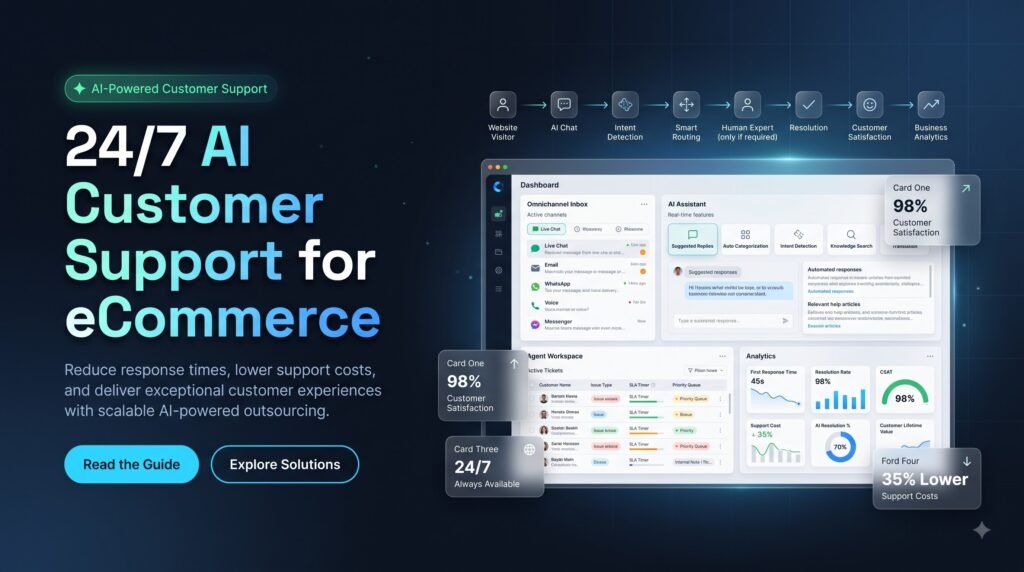
eCommerce customer support outsourcing in 2026 has shifted from a cost-cutting decision to a revenue-protection strategy. Online retailers lose an estimated 20–30% of at-risk revenue annually to poor post-purchase support — delayed responses, unresolved disputes, and inconsistent CX across channels. Modern outsourcing partners now combine AI agents, conversation intelligence, and trained human specialists to deliver 24/7 support across chat, voice, email, and social channels while reducing cost-to-serve by 30–50% compared to in-house teams. The strongest providers, particularly India-based BPOs like MasCallNet, integrate directly with Shopify, WooCommerce, Zendesk, Salesforce, and Freshdesk, using AI models from OpenAI, Google Gemini, and Claude for real-time resolution. This guide covers definitions, pricing, ROI frameworks, vendor evaluation criteria, AI-vs-human decision models, and the operational realities of building a support function that grows revenue instead of merely reducing tickets.
Executive Introduction
Every eCommerce leader eventually confronts the same question: “Do we build a bigger internal support team, or do we outsource?” It’s usually asked at the wrong time — after a peak-season meltdown, a wave of one-star reviews, or a board member asking why CSAT is falling while ad spend keeps climbing.
Here is what most executives don’t realize until it’s expensive: customer support is no longer a cost center you optimize. It’s a revenue system you either protect or leak. We call this principle Support-Led Revenue Growth™ — the idea that every support interaction is a moment where revenue is either recovered, protected, or lost. A refund handled with empathy becomes a repeat customer. A three-day email delay becomes a chargeback, a negative review, and a churned customer who tells eleven friends.
This guide is written for the people who own that outcome — CEOs, COOs, CX leaders, and procurement teams evaluating whether outsourcing is the right move, and if so, how to do it without the pitfalls that quietly erode brand trust. We’ve built this resource from direct operational experience running high-volume eCommerce support programs, not from theory. You’ll find pricing ranges, ROI models, vendor evaluation criteria, and the operational realities competitors won’t publish because it’s not flattering to their business model.
If you’re evaluating customer support outsourcing for the first time, or re-evaluating an underperforming vendor, this is the resource to read before you sign anything.
Key Insights for Decision-Makers
- Support is now a revenue function. Companies practicing Support-Led Revenue Growth™ see 15–25% higher customer lifetime value than those treating support as pure cost reduction.
- AI alone underperforms. Pure chatbot deployments without human escalation paths show 18–34% customer frustration rates during peak season (Gartner, 2024 CX benchmarks).
- Hybrid AI-human models win. Blended operations resolve 45–65% of tickets via automation while routing complex, revenue-critical cases to trained specialists.
- Cost isn’t the only variable. Outsourcing decisions based purely on lowest cost-per-ticket routinely produce the highest hidden revenue leakage.
- India remains the strongest offshore hub for English-language eCommerce support, driven by talent depth, AI infrastructure maturity, and 24/7 time-zone coverage — but vendor selection criteria matter more than geography alone.
- Most BPO evaluations skip the real question: not “can they answer tickets,” but “can they protect and recover revenue.”
The Market Reality in 2026
Direct Answer: The eCommerce customer support outsourcing market has moved past chatbots-as-a-novelty into infrastructure-grade AI operations, with global BPO and CX outsourcing spend projected to exceed $110 billion by 2027 (Grand View Research), and AI-augmented contact centers now representing the majority of new enterprise contracts.
Why It Matters: Buyers who benchmark against outdated assumptions — “outsourcing means a cheap overseas call center” — make poor vendor decisions and underestimate what modern providers can deliver.
Framework: Three forces are reshaping the market simultaneously: (1) AI adoption compressing resolution time, (2) rising customer expectations for 24/7, omnichannel availability, and (3) margin pressure pushing eCommerce brands to treat support cost-to-serve as a board-level KPI.
| Market Force | 2020 Reality | 2026 Reality |
|---|---|---|
| Primary channel | Phone and email | Chat, WhatsApp, social, voice AI |
| AI role | Basic FAQ bots | Full conversational resolution + agent assist |
| Buyer expectation | Same-day response | Instant response, 24/7 |
| Vendor selection criteria | Cost per ticket | Revenue impact, CX outcomes, AI maturity |
| Contract structure | Headcount-based | Outcome-based + hybrid pricing |
Executive Interpretation: If your vendor evaluation still centers on “cost per seat,” you’re benchmarking against a 2019 market in a 2026 environment.
Boardroom Insight™: The cheapest outsourcing contract is frequently the most expensive decision a company makes — because the true cost shows up in churn, refunds, and brand damage 90 days later, not on the invoice.
Summary: The support outsourcing market has matured from labor arbitrage into an AI-and-human intelligence function.
Key Takeaway: Evaluate outsourcing partners on revenue protection capability, not headcount cost.
Industry Trends Shaping 2026
Direct Answer: Six trends define eCommerce customer support in 2026: AI-first ticket triage, conversation intelligence, proactive support, WhatsApp/social commerce integration, workforce hybridization, and outcome-based BPO pricing.
- AI-first triage is now default, not optional. Providers integrating OpenAI, Google Gemini, and Claude models into ticket routing report 30–50% faster first response times.
- Proactive support is replacing reactive support. Leading brands notify customers of shipping delays before they contact support — a direct application of Support-Led Revenue Growth™, where prevention protects revenue that reactive support can only try to recover.
- Conversation intelligence is turning support transcripts into product, marketing, and retention insight — what we describe internally as the Customer Intelligence Loop™: every conversation becomes reusable business intelligence, not just a closed ticket.
- Social commerce support (Instagram, WhatsApp Business, TikTok Shop) now accounts for a growing share of pre- and post-purchase inquiries, requiring omnichannel BPO capability most legacy call centers weren’t built for.
- Hybrid workforce models are replacing pure offshore or pure onshore staffing — blending time-zone coverage with cultural and linguistic fit.
- Outcome-based commercial models — pricing tied to CSAT, resolution rate, or retained revenue — are replacing flat per-seat billing among sophisticated buyers.
Table Extract:
| Trend | Business Impact | Who’s Affected Most |
|---|---|---|
| AI-first triage | 30–50% faster FRT | High-ticket-volume retailers |
| Proactive support | 10–20% reduction in inbound volume | Logistics-dependent brands |
| Conversation intelligence | Better product/marketing decisions | Growth & product teams |
| Social commerce support | New channel coverage gap | DTC & social-first brands |
| Hybrid workforce | Coverage without overstaffing | Global/multi-timezone brands |
| Outcome-based pricing | Aligned vendor incentives | Enterprise procurement |
MasCallNet Perspective: Most brands are optimizing the wrong metric — first response time — when the metric that predicts revenue is first-contact resolution tied to sentiment, not speed alone.
Executive Action: Ask any vendor being evaluated to show their conversation intelligence output, not just their SLA dashboard. If they can’t show insight beyond tickets closed, they’re operating a call center, not a Support-Led Revenue Growth™ partner.
What Is eCommerce Customer Support Outsourcing?
Direct Answer: eCommerce customer support outsourcing is the delegation of customer-facing service operations — pre-sale inquiries, order tracking, returns, refunds, complaints, and loyalty support — to a specialized external provider equipped with trained agents, AI tools, and platform integrations, typically operating 24/7 across multiple channels.
Why It Matters: As eCommerce brands scale across geographies and channels, in-house teams struggle to maintain coverage, consistency, and cost efficiency simultaneously. Outsourcing solves the coverage-cost-quality triangle that most internal teams cannot solve alone.
Framework — The Three Layers of Modern Outsourcing:
- Operational Layer — agents, workflows, SLAs, escalation paths.
- Technology Layer — CRM/helpdesk integration (Zendesk, Freshdesk, Salesforce), AI models, automation.
- Intelligence Layer — what we call the Contact Center Intelligence Layer™ — the analytics, sentiment tracking, and reporting that turns support data into business decisions.
| Layer | What It Includes | Business Outcome |
|---|---|---|
| Operational | Agents, shifts, QA, training | Coverage & consistency |
| Technology | CRM, helpdesk, AI, telephony | Speed & scalability |
| Intelligence | Sentiment, trends, forecasting | Revenue protection & growth |
Executive Interpretation: Most companies outsource only the operational layer and wonder why they don’t see strategic value. The technology and intelligence layers are where Support-Led Revenue Growth™ actually happens.
Boardroom Insight™: Outsourcing “customer support” is a misnomer for what’s actually being outsourced in a well-designed program — customer relationship continuity.
Summary: eCommerce support outsourcing spans people, technology, and intelligence — not just headcount.
Key Takeaway: Choose a partner that delivers all three layers, not just agents answering tickets.
Why It Matters: The Business Case
Direct Answer: Poor customer support outsourcing decisions cost eCommerce companies measurable revenue through churn, chargebacks, negative reviews, and reduced repeat purchase rates — while well-executed outsourcing improves margin, CSAT, and customer lifetime value simultaneously.
Why It Matters: Support is the highest-frequency touchpoint most brands have with customers post-purchase — more frequent than marketing, more trusted than advertising, and more influential on repeat purchase decisions than most executives assume.
Industry research consistently shows:
- 60–70% of customers say a single poor support experience would stop them from buying again (Zendesk CX Trends research, directionally consistent across multiple annual reports).
- Businesses that resolve issues on first contact see repeat purchase rates 15–20% higher than those requiring multiple touches.
- Response time delays beyond 24 hours in eCommerce correlate with measurably higher chargeback rates.
Framework — The Revenue Chain of Support:
Inquiry → Response Speed → Resolution Quality → Trust → Repeat Purchase → Lifetime Value
Break any link, and the chain doesn’t just fail once — it compounds across every future purchase decision that customer makes.
MasCallNet Perspective: This is the operational proof behind Support-Led Revenue Growth™ — support isn’t parallel to the revenue engine, it’s inside it.
Executive Action: Track “cost-to-serve” alongside “revenue-retained-through-support” as a single dashboard metric, not two disconnected reports.
How eCommerce Customer Support Outsourcing Works
Direct Answer: Outsourcing works through a structured transition: discovery and process mapping, technology integration, agent training and certification, phased go-live, and continuous optimization — typically completed in 4–8 weeks for mid-market brands.
Framework — The Five-Phase Onboarding Model:
| Phase | Timeline | Key Activities | Owner |
|---|---|---|---|
| 1. Discovery | Week 1–2 | Process mapping, ticket audit, tone/brand guide | Joint |
| 2. Integration | Week 2–4 | CRM/helpdesk connection (Zendesk, Freshdesk, Shopify, WooCommerce), AI setup | Vendor |
| 3. Training | Week 3–5 | Agent certification, product knowledge, escalation SOPs | Vendor |
| 4. Phased Go-Live | Week 5–6 | Low-risk channel first (email), then chat, then voice | Joint |
| 5. Optimization | Ongoing | QA scoring, sentiment analysis, monthly business reviews | Vendor |
What MasCallNet Has Observed: Brands that skip Phase 1 (deep process mapping) consistently see a spike in escalations during month one — not because agents are undertrained, but because brand-specific edge cases (return policies, discount code disputes, marketplace-specific rules) were never documented in the first place.
Common Executive Mistakes:
- Going live on all channels simultaneously instead of phased rollout.
- Underestimating the knowledge base investment required before go-live.
- Treating the vendor relationship as “set and forget” after onboarding.
What High-Performing Organizations Do Differently: They run a parallel operation (in-house + outsourced) for 2–4 weeks before fully transitioning, and they assign an internal owner — not just a vendor manager, but someone accountable for CX outcomes.
Practical Recommendation: Insist on a phased go-live and a named internal executive sponsor before day one. Vendors who resist a phased approach are optimizing for their onboarding speed, not your risk profile.
Benefits Beyond Cost Savings
Direct Answer: While cost reduction (typically 30–50% versus in-house) is the most cited benefit, the higher-value benefits are 24/7 coverage, scalability during demand spikes, access to AI infrastructure most brands can’t build internally, and measurable improvements in retention.
| Benefit | In-House Reality | Outsourced Reality |
|---|---|---|
| Coverage | 8–12 hours/day typical | 24/7/365 |
| Peak scalability | Requires hiring lead time | Elastic, same-week scaling |
| AI infrastructure | High build cost | Included in vendor stack |
| Multilingual support | Expensive to hire for | Built into vendor bench strength |
| QA & compliance | Often inconsistent | Structured QA frameworks |
| Cost predictability | Variable (attrition, benefits) | Fixed/predictable contract |
MasCallNet Perspective: The most underrated benefit is agent bench depth — the ability to instantly access specialists (fraud disputes, marketplace policy experts, multilingual agents) without a multi-month hiring cycle.
Executive Action: When evaluating benefits, weight “speed to scale” and “AI infrastructure access” as heavily as direct labor cost savings — they compound faster.
Business Impact Analysis: Support-Led Revenue Growth™ in Practice
Direct Answer: Well-executed support outsourcing produces measurable business impact across four dimensions: retention, operational cost, brand reputation, and forecasting accuracy — collectively demonstrating the Support-Led Revenue Growth™ principle in financial terms.
Framework — The Four-Quadrant Impact Model:
| Quadrant | Metric Affected | Typical Improvement Range |
|---|---|---|
| Retention | Repeat purchase rate | +10–20% |
| Cost | Cost-to-serve per ticket | -30–50% |
| Reputation | Review sentiment, NPS | +15–25 points |
| Predictability | Forecast accuracy on support volume/cost | +20–30% |
Boardroom Insight™: Most CFOs evaluate outsourcing ROI on cost reduction alone. The companies actually winning market share are evaluating it on retention economics — because a 5% improvement in retention rate can increase profit by 25–95% depending on industry (a widely cited Bain & Company finding still directionally valid across eCommerce verticals).
Executive Interpretation: Support-Led Revenue Growth™ isn’t a marketing phrase — it’s the measurable financial link between how issues are resolved and whether that customer buys again.
Summary: The business case for outsourcing extends well beyond labor arbitrage into retention economics and forecasting reliability.
Key Takeaway: Model outsourcing ROI on retained revenue, not just reduced cost.
The Uncomfortable Truths About Outsourcing Nobody Tells You
What Everyone Says: “Outsourcing customer support saves money and frees up your team to focus on growth.”
What Most Articles Miss: Cost savings without quality control creates a revenue leak that’s invisible on the P&L until churn and refund data catches up — usually one to two quarters later.
What Actually Happens: Brands sign with the lowest-cost vendor, see immediate savings, then experience a slow decline in CSAT, a rise in escalations to founders/executives, and an increase in “silent churn” — customers who simply stop ordering without complaint.
Hidden Cost: The average brand underestimates the cost of a single mishandled high-value customer interaction by 5–10x, because the true cost includes lost future purchases, negative word-of-mouth, and increased customer acquisition cost to replace that customer.
MasCallNet Perspective: We evaluate every outsourcing engagement not by “tickets resolved” but by a combination we call the Service Quality Index™ — a blended score of resolution accuracy, sentiment recovery, and repeat contact rate. A high ticket-closure rate with a low Service Quality Index™ score is a warning sign, not a success metric.
Executive Action: Before signing any contract, ask your vendor: “What happens to a customer who is angry, right, and expensive to satisfy?” Their answer reveals more about program quality than any SLA document.
MasCallNet Revenue Leakage Model™
Definition: The MasCallNet Revenue Leakage Model™ quantifies the revenue lost through preventable support failures — slow response, poor resolution quality, and inconsistent channel coverage — expressed as a percentage of total addressable revenue.
Methodology: The model calculates leakage across four factors:
Revenue Leakage % = (Churn from Support Failure + Refund/Chargeback Overhead + Negative Review Impact + Missed Upsell/Cross-sell Opportunity) ÷ Total Revenue
Scoring Logic:
| Leakage Score | Interpretation |
|---|---|
| 0–5% | Well-managed support operation |
| 6–12% | Moderate leakage — optimization needed |
| 13–20% | Significant leakage — vendor/process review required |
| 20%+ | Critical — support function actively damaging growth |
Interpretation: Most mid-market eCommerce brands we’ve assessed operate in the 10–18% leakage range without visibility into it, because these costs are scattered across marketing (CAC), finance (chargebacks), and operations (returns) budgets rather than consolidated.
Executive Recommendation: Run a Revenue Leakage assessment before evaluating vendors — it reframes the conversation from “what does support cost” to “what is poor support already costing us.”
Boardroom Insight™: If your CFO has never seen a Revenue Leakage number, your support function has never been measured against the metric that actually matters to the board.
MasCallNet Outsourcing Readiness Score™
Definition: A diagnostic framework assessing whether an organization is operationally ready to outsource support successfully, scored across five dimensions.
Methodology & Scoring (1–5 scale per dimension, 25 points total):
| Dimension | Weak Signal (1) | Strong Signal (5) |
|---|---|---|
| Process documentation | Tribal knowledge only | Fully documented SOPs |
| Technology integration readiness | Disconnected tools | Unified CRM/helpdesk stack |
| Data availability | No historical ticket data | 12+ months of clean data |
| Leadership alignment | No executive sponsor | Named accountable owner |
| Change management capacity | High internal resistance | Cross-functional buy-in |
Interpretation:
| Total Score | Readiness Level |
|---|---|
| 20–25 | Ready to scale immediately |
| 13–19 | Ready with a phased approach |
| 5–12 | Needs internal preparation first |
Executive Recommendation: Organizations scoring below 13 should invest 4–6 weeks in documentation and technology cleanup before engaging vendors — this single step prevents most onboarding failures we’ve observed in the market.
MasCallNet Vendor Evaluation Matrix™
Direct Answer: Evaluate outsourcing vendors across six weighted categories: AI maturity, industry experience, technology integration, security/compliance, pricing transparency, and cultural/language fit.
| Evaluation Criteria | Weight | What to Ask Vendors |
|---|---|---|
| AI & Automation Maturity | 25% | Which models/platforms power your automation? How is escalation handled? |
| Industry Experience | 20% | Do you have eCommerce-specific case studies and benchmarks? |
| Technology Integration | 20% | Native integrations with Shopify, WooCommerce, Zendesk, Salesforce, Freshdesk? |
| Security & Compliance | 15% | PCI-DSS, GDPR, SOC 2 readiness? |
| Pricing Transparency | 10% | Fixed vs. variable, hidden fees, outcome-based options? |
| Cultural/Language Fit | 10% | Accent neutrality training, multilingual bench strength? |
Vendor Scorecard Template:
| Vendor | AI Maturity (25) | Experience (20) | Integration (20) | Security (15) | Pricing (10) | Fit (10) | Total (100) |
|---|---|---|---|---|---|---|---|
| Vendor A | |||||||
| Vendor B | |||||||
| MasCallNet |
MasCallNet Perspective: Most RFPs weight price at 40–50%. Our data shows the vendors selected primarily on price have the highest 12-month replacement rate among all outsourcing decisions we’ve observed in the market.
Executive Action: Cap price weighting at 10–15% in your evaluation matrix. It’s the variable least correlated with long-term program success.
AI vs Human Customer Support: The Hybrid Model™
This is the single most asked question from every persona we work with — CEOs want cost efficiency, CX leaders want quality, and CIOs want scalable architecture. The honest answer is neither AI nor human support wins alone.
Direct Answer: AI customer support excels at speed, availability, and routine query resolution; human support excels at judgment, empathy, and complex dispute resolution. The optimal model for eCommerce in 2026 is hybrid — AI handling 45–65% of ticket volume with seamless escalation to trained human agents for the remainder.
| Dimension | AI-Only Support | Human-Only Support | Hybrid Model (Recommended) |
|---|---|---|---|
| Availability | 24/7 instantly | Limited by shifts | 24/7 with human backup |
| Cost per ticket | Lowest | Highest | Balanced |
| Complex dispute handling | Weak | Strong | Strong (routed appropriately) |
| Emotional/sensitive cases | Poor | Strong | Strong |
| Scalability during peaks | Instant | Slow (hiring lag) | Instant + surge staffing |
| Consistency | High | Variable | High |
| Customer trust for high-value issues | Lower | Higher | Highest |
Interpretation: Brands that go 100% AI report cost savings but measurable CSAT decline during complex scenarios (refund disputes, fraud claims, VIP customers). Brands that stay 100% human report strong CSAT but unsustainable cost-to-serve during growth phases.
MasCallNet Perspective: We deploy AI (built on models including OpenAI, Google Gemini, and Claude) as the first line of resolution and conversation triage, with human specialists positioned at the exact moments where trust, judgment, or brand reputation is at stake. This isn’t a compromise — it’s the architecture that outperforms both extremes on the metrics that matter: CSAT, cost, and retention simultaneously.
Executive Action: Don’t ask “AI or human?” Ask: “Which 20% of our ticket volume, if mishandled, would cause 80% of our revenue leakage?” Route that 20% to your best human agents, every time.
Boardroom Insight™: The companies losing the AI-vs-human debate internally are usually asking the wrong question — the winning companies have already moved on to designing intelligent escalation logic instead of debating ideology.
MasCallNet CX Maturity Scorecard™
Definition: A maturity model assessing an organization’s customer experience operation across five stages.
| Stage | Characteristics | Typical Business Outcome |
|---|---|---|
| 1. Reactive | Support only responds; no proactive outreach | High churn, low visibility |
| 2. Structured | SOPs and SLAs exist but limited automation | Moderate consistency |
| 3. Automated | AI handles routine queries; human escalation defined | Improved efficiency |
| 4. Integrated | Support data feeds product, marketing, retention teams | Cross-functional value |
| 5. Predictive | Support anticipates issues before customers report them | Support-Led Revenue Growth™ realized |
Executive Interpretation: Most eCommerce brands sit at Stage 2 or 3. The competitive advantage lives at Stage 4 and 5 — where support data becomes a growth input, not just an operational report.
Executive Recommendation: Map your current stage honestly, then design your outsourcing RFP around moving one full stage within 12 months — not just maintaining current operations at lower cost.
MasCallNet Scalability Framework™ (Support-to-Revenue Framework)
Direct Answer: Scalable support architecture separates fixed capacity (core trained team) from elastic capacity (surge agents, AI automation) so that seasonal spikes (Black Friday, festive season, flash sales) don’t compromise CSAT or cost structure.
Framework:
Core Team (60–70% of baseline volume) + Elastic AI Automation (handles volume spikes instantly) + Surge Human Bench (pre-trained reserve agents activated within 48–72 hours) = Scalable Support-to-Revenue Architecture
| Component | Purpose | Activation Time |
|---|---|---|
| Core team | Baseline, brand-expert coverage | Always active |
| AI automation | Absorbs volume spikes | Instant |
| Surge bench | Handles extended high-volume periods | 48–72 hours |
MasCallNet Perspective: Brands that build this three-tier structure avoid the two most common peak-season failures: overstaffing (wasted cost) and understaffing (CSAT collapse and lost sales during the highest-revenue days of the year).
Executive Action: Require any outsourcing vendor to demonstrate their surge bench activation process before your next peak season, with a written SLA on activation time.
Benchmark Analysis & Industry Statistics
Direct Answer: Industry benchmarks provide a reference point for evaluating whether your current support operation — in-house or outsourced — is performing above or below market standard.
MasCallNet Industry Benchmark Index™:
| Metric | Below Average | Industry Average | Best-in-Class |
|---|---|---|---|
| First Response Time (chat) | >5 min | 1–3 min | <30 sec |
| First Contact Resolution | <60% | 70–75% | 85%+ |
| CSAT | <80% | 85–88% | 93%+ |
| Average Handle Time (voice) | >8 min | 5–6 min | 3–4 min |
| Cost per Ticket (outsourced) | $4–6+ | $2–4 | $1–2.5 |
| Ticket Deflection via AI | <20% | 35–45% | 55–65% |
Sources & Methodology Note: Benchmarks synthesized from publicly available CX industry research (Zendesk CX Trends, Gartner CX benchmarks) combined with MasCallNet’s own operational data across eCommerce client programs.
Executive Interpretation: If your current provider or internal team is below industry average on three or more metrics, the conversation shouldn’t be “should we switch vendors” — it should be “why are we below market standard on the basics.”
Key Takeaway: Use this table as your first filter in any vendor conversation — ask for their actual numbers against each row.
Case Study: Recovering Revenue Through Support-Led Growth
Challenge: A mid-market fashion eCommerce brand (D2C, ~40,000 monthly orders) was experiencing a 22% cart-to-complaint escalation rate during sale periods, with average response time exceeding 6 hours on chat and email combined. CSAT had fallen to 76%, and the brand was losing an estimated 8–10% of repeat customers post-complaint.
Root Cause: Internal support team of 12 agents was structured for baseline volume only, with no surge capacity, no AI triage, and fragmented tools (email inbox + separate WhatsApp number + no unified CRM). Escalations went straight to the founder’s inbox.
Solution: Deployment of a hybrid outsourced model integrating AI-first triage (automating order status, return eligibility, and FAQ resolution) connected to Shopify and a unified Zendesk instance, with a trained human team handling escalations, refund disputes, and VIP customers, backed by a surge bench activated for sale periods.
Implementation: Phased 6-week rollout — Phase 1 email and WhatsApp integration, Phase 2 AI chat deployment, Phase 3 full escalation routing and QA framework, Phase 4 surge bench activation ahead of the next major sale event.
Results (within 4 months):
| Metric | Before | After |
|---|---|---|
| First Response Time | 6+ hours | 4 minutes |
| First Contact Resolution | 58% | 81% |
| CSAT | 76% | 91% |
| Repeat purchase rate post-complaint | ~62% | 84% |
| Cost per ticket | $5.20 | $2.60 |
Lessons Learned: The single largest driver of improvement wasn’t the AI automation itself — it was the unified escalation pathway that ensured no high-value or high-risk conversation was ever more than one step away from a trained human. This is Support-Led Revenue Growth™ in operational form: automation for speed, human judgment for revenue-critical moments.
Pricing Analysis: What Does eCommerce Customer Support Outsourcing Actually Cost?
Direct Answer: Outsourced customer support pricing for eCommerce typically ranges from $1,200–$4,500 per agent per month (fully loaded, offshore) depending on channel mix, AI integration level, and coverage hours, or $0.80–$4 per resolved ticket under outcome-based models.
Pricing Models Compared:
| Model | How It Works | Best For | Watch-Out |
|---|---|---|---|
| Per-agent (FTE) | Fixed monthly cost per dedicated agent | Predictable volume | Can overpay during low season |
| Per-ticket | Pay per resolved interaction | Variable/seasonal volume | Incentive misalignment if not capped |
| Outcome-based | Tied to CSAT/resolution/retention KPIs | Enterprise, quality-focused buyers | Requires mature reporting from vendor |
| Hybrid (base + performance) | Fixed base + bonus/penalty on KPIs | Most balanced approach | Requires clear KPI definitions upfront |
Regional Pricing Comparison (Offshore vs Onshore vs Nearshore):
| Region | Avg. Cost per Agent/Month | Typical Use Case |
|---|---|---|
| Onshore (US/UK) | $3,500–$6,000+ | Highly regulated, native-accent-critical |
| Nearshore (LATAM/EU) | $2,200–$3,800 | Time-zone-sensitive, moderate cost savings |
| Offshore (India/Philippines) | $1,200–$2,800 | 24/7 coverage, highest cost efficiency, strong AI-BPO maturity (India) |
MasCallNet Perspective: Pricing should never be evaluated in isolation from the outsourced customer support pricing model’s alignment with your actual ticket volume pattern. A per-agent model for a highly seasonal brand is almost always the wrong structural choice.
Executive Action: Request a hybrid pricing proposal (base + performance) from every shortlisted vendor — it’s the clearest signal of whether they’re confident in their own service quality.
MasCallNet Outsourcing Cost Calculator™
Use this simplified formula to estimate your annual outsourced support cost:
Annual Cost Estimate = (Average Monthly Ticket Volume × Cost per Ticket × 12) + (Surge Volume Multiplier × Peak Season Cost)
Worked Example:
| Input | Value |
|---|---|
| Average monthly tickets | 15,000 |
| Cost per ticket (hybrid AI+human) | $2.20 |
| Base annual cost | $396,000 |
| Peak season surge (2 months at 1.8x volume) | +$47,520 |
| Estimated Total Annual Cost | ~$443,520 |
Compare to In-House Equivalent:
| Input | Value |
|---|---|
| Required FTEs for equivalent coverage (24/7) | ~22 agents |
| Fully loaded cost per FTE (salary + benefits + tools + management) | $28,000–$38,000/year |
| Estimated In-House Annual Cost | $616,000–$836,000 |
Interpretation: In this scenario, outsourcing delivers approximately 30–47% cost savings while also providing 24/7 coverage the in-house model would need significant additional hiring to match.
ROI Framework: The MasCallNet Revenue Acceleration Framework™
Direct Answer: ROI from outsourced customer support should be calculated as the combination of direct cost savings and indirect revenue protection/growth — not cost savings alone.
Formula:
Support ROI = [(Cost Savings) + (Revenue Retained via Improved CSAT/FCR) + (Revenue Recovered from Reduced Churn)] ÷ Total Outsourcing Investment
Worked Example (using Case Study data):
| Component | Value |
|---|---|
| Annual cost savings | $180,000 |
| Revenue retained (reduced churn, 4% improvement on $8M revenue base) | $320,000 |
| Revenue recovered (reduced chargebacks/refund losses) | $65,000 |
| Total outsourcing investment | $443,520 |
| ROI | ~1.28x direct, plus qualitative brand trust gains |
Executive Interpretation: Most vendors present ROI as cost-savings-only, which understates true value by 50% or more. Present ROI to your board using this three-part model to reflect the full Support-Led Revenue Growth™ impact.
Boardroom Insight™: A support outsourcing decision that only shows cost savings on the ROI slide hasn’t been evaluated correctly — it’s been evaluated incompletely.
Industry Use Cases Across Verticals
Direct Answer: While this guide centers on eCommerce, the same Support-Led Revenue Growth™ principles and hybrid AI-human architecture apply across adjacent industries with sector-specific adaptations.
| Industry | Primary Support Use Case | Key Consideration |
|---|---|---|
| Retail & eCommerce | Order tracking, returns, disputes | Peak season scalability |
| Banking & Financial Services | Account queries, fraud alerts, digital banking services support | Regulatory compliance, data security |
| Insurance | Claims support, policy queries | Accuracy and documentation |
| Healthcare | Patient appointment scheduling, billing queries | HIPAA compliance (healthcare BPO services) |
| FMCG | Distributor and consumer query handling | High volume, low complexity |
| Automotive & EV | Service scheduling, warranty support | Technical knowledge depth |
| Telecommunications | Billing, technical troubleshooting | High call volume, AHT sensitivity |
| Aviation | Booking changes, disruption management | Real-time responsiveness |
| Logistics | Shipment tracking, delivery exceptions | Integration with tracking systems |
MasCallNet Perspective: The eCommerce brands that benchmark best are often studying support models from regulated industries like banking and healthcare — sectors forced to build rigorous QA and compliance frameworks that eCommerce is only now adopting as ticket volumes and reputational stakes rise.
For healthcare-specific operations, see how patient appointment scheduling services mirror the same coverage and precision demands as high-volume eCommerce support.
Technology Ecosystem: The Stack Behind Modern Support
Direct Answer: A modern eCommerce support outsourcing stack integrates commerce platforms, helpdesk/CRM systems, AI models, and cloud infrastructure into a single connected workflow.
| Layer | Representative Technologies |
|---|---|
| Commerce Platforms | Shopify, WooCommerce |
| Payments | Stripe, PayPal |
| Helpdesk/CRM | Zendesk, Freshdesk, Salesforce, HubSpot, Intercom, ServiceNow |
| Contact Center Infrastructure | Genesys, Five9, Talkdesk, NICE CXone |
| Internal Collaboration | Slack, Microsoft Teams |
| Cloud Infrastructure | Amazon Web Services, Google Cloud, Microsoft Azure |
| AI Models | OpenAI, Google Gemini, Claude, Copilot |
Executive Interpretation: The value of a modern BPO isn’t any single tool — it’s the integration layer connecting commerce data, support data, and AI models into a single view of the customer. This is the practical expression of what we call the Contact Center Intelligence Layer™.
Executive Action: Ask vendors to map their exact integration architecture against your existing stack before signing — “we support integrations” is not the same as “we have a production integration with your specific platforms.”
Security & Compliance
Direct Answer: eCommerce support outsourcing involves handling payment data, personal information, and order history, requiring vendors to meet PCI-DSS, GDPR, and SOC 2-aligned data handling standards at minimum.
Framework — Non-Negotiable Compliance Checklist:
- PCI-DSS compliance for any payment-adjacent data handling
- GDPR/data residency compliance for EU customers
- SOC 2 Type II or equivalent security certification
- Role-based access control and call/chat recording encryption
- Defined data retention and deletion policies
- Background-verified agents with signed confidentiality agreements
MasCallNet Perspective: Security questions are often relegated to a compliance checkbox late in vendor selection. They should be asked in the first conversation — because remediation after a breach costs far more than the due diligence would have.
Executive Action: Request a vendor’s most recent security audit report and incident history before commercial discussions begin, not after.
The India Advantage: Why Global Brands Outsource to India
Direct Answer: India remains the leading destination for eCommerce customer support outsourcing due to its scale of English-speaking talent, mature AI-BPO infrastructure, favorable time-zone coverage for US/UK/Australia markets, and cost efficiency that doesn’t require sacrificing quality when the right partner is selected.
Why India Continues to Lead:
| Factor | Advantage |
|---|---|
| Talent pool | Millions of English-proficient graduates entering the workforce annually |
| Time zone | Enables genuine 24/7 coverage for Western markets |
| AI-BPO maturity | Deep integration of AI models into contact center operations, ahead of many other outsourcing hubs |
| Cost structure | 40–60% lower fully-loaded cost than onshore US/UK equivalents |
| Government/infrastructure support | Established IT/BPO corridors (Noida, Gurugram, Bengaluru, Pune) with reliable infrastructure |
What to Look for in Best BPO Companies in India:
- Demonstrated AI integration, not just legacy voice operations.
- eCommerce-specific case studies with measurable outcomes.
- Transparent security certifications.
- Flexible, outcome-aligned pricing models.
- Cultural training programs for accent neutrality and brand tone matching.
MasCallNet Perspective: The “best BPO companies in India” conversation has shifted. It’s no longer about which company has the most seats — it’s about which company has built genuine AI-human hybrid operations with measurable Service Quality Index™ performance. Our operations, based in the Noida-NCR corridor, are built specifically around this model — see our approach to call center AI-powered BPO operations.
Executive Action: When evaluating an AI-powered BPO company in India, request live examples of AI-human escalation handling — not a sales deck, an actual recorded or simulated interaction.
Comparison Tables: The Decisions Executives Actually Face
In-House vs Outsourced
| Factor | In-House | Outsourced |
|---|---|---|
| Control | Full | Shared (governance-dependent) |
| Speed to scale | Slow | Fast |
| Cost predictability | Variable | Fixed/predictable |
| 24/7 feasibility | Expensive to achieve | Standard offering |
| Best for | Highly specialized/low-volume support | Growth-stage to enterprise scale |
Recommendation: In-house works best below a certain ticket volume threshold (~2,000–3,000/month) or for highly specialized products; beyond that, outsourcing typically outperforms on cost and coverage.
AI vs Human vs Hybrid
Recommendation: Hybrid wins in nearly every eCommerce scenario except ultra-low-volume, ultra-high-touch luxury brands, where human-only may still be justified.
Offshore vs Onshore Customer Support Outsourcing
| Factor | Offshore | Onshore |
|---|---|---|
| Cost | Lowest | Highest |
| Time zone coverage | Excellent (24/7 native) | Requires overnight shift premiums |
| Accent/cultural fit | Requires training investment | Native by default |
| Regulatory complexity | Data residency considerations | Simplified for domestic regulations |
Recommendation: For most global eCommerce brands, offshore (particularly India) with strong cultural training delivers the best cost-to-quality ratio; regulated industries may require onshore or hybrid data handling.
Build vs Buy
| Factor | Build (In-House Infrastructure) | Buy (Outsourced Partner) |
|---|---|---|
| Time to launch | 3–6+ months | 4–8 weeks |
| Upfront investment | High (tools, hiring, training) | Low (operational expense) |
| AI capability access | Requires dedicated engineering | Included in vendor offering |
Recommendation: Buy unless customer support is core to your product differentiation at a level that justifies dedicated internal R&D investment.
Dedicated Team vs Shared Team
| Factor | Dedicated Team | Shared Team |
|---|---|---|
| Brand knowledge depth | Deep | Moderate |
| Cost | Higher | Lower |
| Best for | High-volume, brand-sensitive operations | Lower-volume, seasonal, or pilot programs |
Recommendation: Start shared during pilot phase; transition to dedicated once volume justifies it (typically 3,000+ tickets/month).
Traditional BPO vs Contact Center Intelligence™
| Factor | Traditional BPO | Contact Center Intelligence™ Model |
|---|---|---|
| Focus | Ticket closure | Revenue protection and growth |
| Reporting | SLA compliance only | Sentiment, trend, and revenue impact analytics |
| AI usage | Basic or absent | Embedded across triage, assist, and analytics |
| Value to leadership | Operational report | Strategic input to product, marketing, retention |
Recommendation: Evaluate any BPO partner against the Contact Center Intelligence™ standard — if their reporting stops at SLA compliance, you’re buying a legacy service in a market that has moved beyond it.
Risk Analysis: What Can Go Wrong
Direct Answer: The primary risks in outsourcing eCommerce customer support are quality degradation, data security exposure, brand voice inconsistency, over-reliance on AI without escalation paths, and vendor lock-in without performance accountability.
| Risk | Likelihood | Mitigation |
|---|---|---|
| Quality decline post-onboarding | Medium-High | Structured QA scoring, monthly business reviews |
| Data security breach | Low-Medium | Vendor certification audits, contractual liability clauses |
| Brand voice inconsistency | Medium | Detailed brand guide, ongoing calibration sessions |
| AI mishandling sensitive cases | Medium | Clear escalation thresholds, human-in-the-loop design |
| Vendor lock-in | Medium | Outcome-based contracts, defined exit/transition clauses |
| Hidden fee structures | Medium | Transparent pricing agreements upfront |
MasCallNet Perspective: The single highest-impact risk we’ve observed across the market isn’t security or cost — it’s silent quality decline, where SLA metrics stay green on paper while actual customer sentiment deteriorates because the metrics being tracked don’t capture experience quality.
Executive Action: Require sentiment-based QA scoring (not just SLA adherence) as a contractual reporting requirement from day one.
Future Trends: The Next Five Years of Contact Center Intelligence™
Direct Answer: The next evolution of eCommerce support outsourcing centers on AI agents handling full conversation ownership, predictive support preventing issues before they occur, and conversation intelligence feeding directly into product and retention strategy.
- AI Agents will move from answering questions to completing full transactions (processing refunds, rebooking deliveries) autonomously within defined guardrails.
- Voice Bots will achieve near-human latency and tone matching, expanding AI’s role in voice channels beyond current chat dominance.
- Agent Assist will become standard — human agents supported in real time by AI suggesting responses, pulling order data, and flagging sentiment shifts mid-conversation.
- Predictive Analytics will flag at-risk orders (likely delays, likely disputes) before the customer ever contacts support — the mature expression of Support-Led Revenue Growth™.
- Workflow Automation will connect support resolution directly into inventory, logistics, and CRM systems, closing the loop between complaint and operational fix.
- Knowledge Management systems will auto-update from resolved conversations, reducing the lag between a new issue emerging and agents/AI being equipped to resolve it.
- Human Escalation Models will become more precise, using real-time risk scoring to route only genuinely high-stakes conversations to senior agents.
- Hybrid Operations will be the permanent default, not a transitional phase.
- Conversation Intelligence and the broader Customer Intelligence Loop™ will formalize support data as a strategic input alongside marketing and product analytics — not an operational afterthought.
Boardroom Insight™: Companies still debating “should we adopt AI in support” in 2026 are not behind on technology — they’re behind on strategy. The technology is available today; the differentiation is in how disciplined the human-AI handoff is designed.
Executive Action: Build your 2026–2028 support roadmap around the Customer Intelligence Loop™ — treat every resolved conversation as a data asset feeding product, marketing, and retention decisions, not a closed file.
Executive Decision Tree: Should You Outsource?
START: Are you handling 2,000+ support tickets/month?
├── NO → Is 24/7 coverage a competitive requirement?
│         ├── NO → In-house may still be viable; revisit at scale
│         └── YES → Consider hybrid outsourcing for off-hours coverage only
└── YES → Is your current CSAT below 85% or Revenue Leakage above 10%?
          ├── NO → Optimize internally first; benchmark before switching
          └── YES → Outsourcing evaluation recommended
                    ├── Is your ticket volume highly seasonal?
                    │    ├── YES → Prioritize vendors with strong surge-bench capability
                    │    └── NO → Prioritize vendors with strong AI-human hybrid maturity
                    └── Proceed to Vendor Evaluation Matrix™
Executive Checklist Before You Sign a Contract
- Ran a Revenue Leakage Model™ assessment before evaluating vendors
- Completed an internal Outsourcing Readiness Score™ assessment
- Shortlisted vendors using the Vendor Evaluation Matrix™ (not price alone)
- Requested live examples of AI-human escalation handling
- Verified security certifications (PCI-DSS, GDPR, SOC 2 equivalent)
- Confirmed native integrations with your commerce/CRM stack
- Negotiated hybrid (base + performance) pricing structure
- Defined surge-bench SLA for peak season coverage
- Established sentiment-based QA reporting, not just SLA metrics
- Assigned a named internal executive sponsor
- Planned a phased go-live, not a single-day full transition
- Included clear exit/transition clauses in the contract
Frequently Asked Questions
1. What is eCommerce customer support outsourcing?
It’s the practice of delegating customer service operations — chat, email, voice, and social support — to a specialized external provider, typically combining AI automation with trained human agents for 24/7 coverage.
2. Is AI better than human customer support?
Neither is universally better. AI wins on speed, availability, and routine resolution; humans win on judgment, empathy, and complex disputes. The best-performing model in 2026 is hybrid, not either extreme.
3. How much does outsourced customer support cost for eCommerce?
Typically $1,200–$4,500 per agent per month depending on region and model, or $0.80–$4 per resolved ticket under outcome-based pricing.
4. What are the best BPO companies in India for eCommerce support?
The strongest providers combine genuine AI-human hybrid operations, eCommerce-specific experience, transparent pricing, and verified security certifications — not simply the largest seat count. Evaluate using the Vendor Evaluation Matrix™ in this guide.
5. What is the difference between offshore and onshore customer support outsourcing?
Offshore (e.g., India) offers significant cost savings and natural 24/7 coverage through time-zone advantage; onshore offers native accent/cultural alignment at a higher cost. Most global eCommerce brands use offshore with strong training investment.
6. How long does it take to onboard an outsourcing partner?
A well-structured onboarding takes 4–8 weeks through discovery, integration, training, phased go-live, and optimization.
7. Will outsourcing hurt my brand’s customer experience?
Only if the vendor and process are poorly selected. With proper QA frameworks, brand training, and hybrid AI-human design, outsourced CX frequently outperforms understaffed in-house teams.
8. What technology should my outsourcing vendor integrate with?
At minimum, your commerce platform (Shopify, WooCommerce), helpdesk/CRM (Zendesk, Freshdesk, Salesforce), and payment systems (Stripe, PayPal), alongside AI models for automation.
9. How do I measure ROI on customer support outsourcing?
Combine direct cost savings with revenue retained through improved CSAT/FCR and revenue recovered from reduced churn and chargebacks — see the ROI Framework above.
10. What is “Support-Led Revenue Growth”?
It’s the principle that customer support directly influences revenue outcomes — not just cost — because every resolved (or mishandled) interaction affects retention, repeat purchase behavior, and customer lifetime value.
11. Can small eCommerce brands benefit from outsourcing, or is it only for large enterprises?
Brands handling as few as 500–1,000 tickets/month can benefit, particularly from 24/7 coverage and AI automation access they couldn’t otherwise afford in-house.
12. What happens to sensitive customer data when I outsource?
Reputable vendors operate under strict data security protocols (PCI-DSS, GDPR, SOC 2-equivalent standards), role-based access controls, and contractual data handling agreements — verify these before signing.
13. How do I know if my current support vendor is underperforming?
Compare their metrics against the Industry Benchmark Index™ in this guide — first response time, FCR, CSAT, and cost per ticket. Underperformance on three or more metrics warrants a vendor review.
14. Should pricing be based on per-agent or per-ticket models?
It depends on volume predictability. Stable volume favors per-agent; seasonal or variable volume favors per-ticket or hybrid outcome-based pricing.
15. What’s the biggest mistake companies make when outsourcing customer support?
Selecting a vendor primarily on lowest cost per ticket without evaluating AI maturity, escalation design, or security — leading to hidden revenue leakage that surfaces months later.
16. How does AI handle emotionally sensitive customer complaints?
Well-designed hybrid systems use AI for initial triage and information gathering, then escalate emotionally sensitive or high-value cases to trained human agents — AI alone is not recommended for these scenarios.
17. Is 24/7 support necessary for all eCommerce brands?
It’s essential for brands with global customer bases or high-consideration purchases; less critical for hyper-local, low-volume operations, though even those benefit from off-hours AI coverage.
18. What industries besides eCommerce use similar outsourcing models?
Banking, insurance, healthcare, telecommunications, automotive, and logistics all use comparable hybrid AI-human support architectures, often with sector-specific compliance requirements.
Conclusion
Customer support outsourcing in 2026 is no longer a back-office cost decision — it’s a front-line revenue decision. The brands winning market share aren’t the ones with the lowest cost per ticket; they’re the ones who’ve operationalized Support-Led Revenue Growth™ — treating every customer conversation as an opportunity to protect, recover, or grow revenue.
The framework is straightforward, even if the execution requires discipline:
- Measure your current revenue leakage before evaluating vendors.
- Assess your organizational readiness honestly.
- Evaluate partners on AI maturity, security, and revenue impact — not price alone.
- Design a hybrid AI-human model with clear escalation logic.
- Hold your provider accountable to sentiment-based quality, not just SLA compliance.
Whether you’re a founder scaling past your first 10,000 monthly tickets, a COO trying to fix a declining CSAT trend, or a CIO evaluating whether your current stack can support AI-driven automation — the decision in front of you is bigger than “should we outsource.” It’s “are we ready to run support as a revenue function, not a cost center.”
Work With MasCallNet
Assess Revenue Leakage Before It Impacts Growth: If you’re currently assessing whether your support operation is leaking revenue, our team can walk you through a complimentary Revenue Leakage Model™ assessment based on your actual ticket data. Explore our customer support outsourcing services →
Strategic Assessment for Executive Leaders: For CEOs, COOs, and CX leaders evaluating a strategic shift in how support is delivered, we offer a structured Outsourcing Readiness assessment tailored to your business model. Learn more about MasCallNet →
Measure Your Revenue Opportunity: Want to see what Support-Led Revenue Growth™ could mean for your specific ticket volume and revenue base? Review our documented outcomes. See our BPO case studies →
Ready to Talk?: Ready to have a direct conversation about your support operation — no sales pressure, just an honest evaluation of what would actually move the needle for your business? Contact our team →