
Hyperautomation in Lending Operations (2026): How AI-Powered BPO Is Transforming Underwriting at Scale
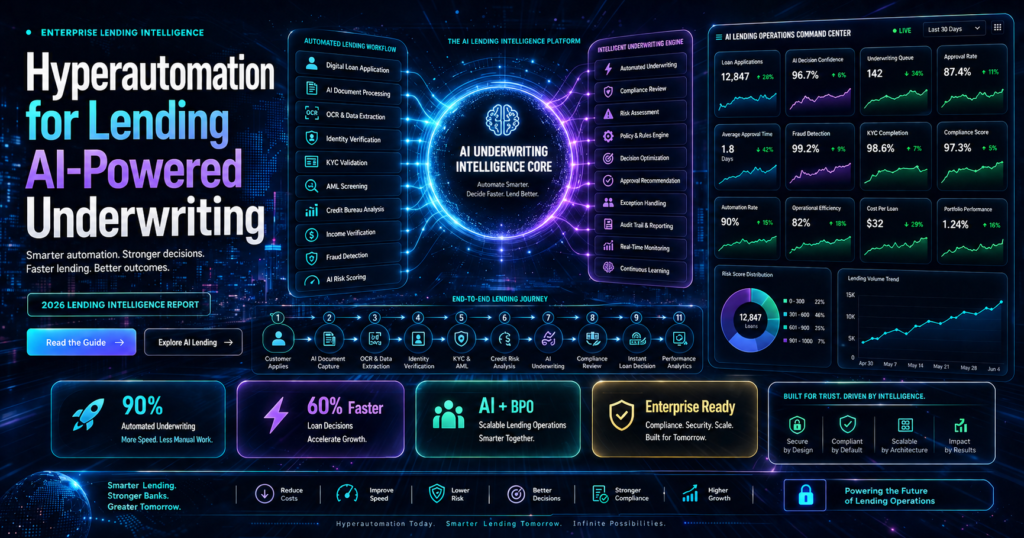
AI Overview
Choosing between AI and human customer support — and selecting the right outsourcing partner in India — is now a board-level decision, not an operational one. In 2026, customer support has evolved from a cost center into a measurable revenue and retention engine. AI agents now resolve a growing share of routine interactions instantly, while human specialists are redeployed toward high-stakes conversations that influence revenue, compliance, and customer lifetime value. Leading Indian BPOs have moved beyond seat-based outsourcing into what is increasingly called Contact Center Intelligence — using every customer conversation as a data asset that improves forecasting, retention, and underwriting decisions. This guide breaks down when to use AI, when to use humans, how to evaluate outsourcing vendors, what outsourced support actually costs in 2026, and how to calculate the real return on a support-led operating model.
Executive Introduction
Most articles on “AI vs human customer support” frame this as a binary choice — as if you’re picking a side in a debate. That framing is outdated, and if a vendor or consultant is still presenting it that way, it’s worth questioning how current their operational experience actually is.
Having worked inside contact center operations across banking, insurance, healthcare, retail, and logistics, the pattern is consistent: organizations that treat support as a cost line lose revenue quietly, every month, without ever seeing it on a P&L. Organizations that treat support as a Support-Led Revenue Growth™ engine — where every conversation either protects or expands revenue — consistently outperform peers on retention, CSAT, and cost-to-serve simultaneously.
This is not theoretical. It’s the difference between a contact center that answers tickets and one that functions as a Contact Center Intelligence™ layer — capturing signal from every interaction and feeding it back into retention, collections, underwriting, and product decisions.
This guide is built for the people who actually have to make this call: CEOs, COOs, CFOs, CIOs, Heads of Customer Support, and procurement teams evaluating whether to build in-house, outsource, or restructure an existing BPO relationship. It answers the question honestly, with real trade-offs, real numbers, and a practical framework for choosing between AI, human, hybrid, and — critically — the right outsourcing partner in India.
Key Insights at a Glance
- AI now resolves 40–65% of routine support volume in mature contact center operations, but resolution rate is a vanity metric unless tied to revenue retention.
- Human-led conversations still drive 70–80% of retention-critical outcomes — cancellations, disputes, collections negotiations, and underwriting exceptions.
- The best BPO companies in India in 2026 are not the cheapest ones — they’re the ones with a documented AI-human handoff architecture, not a chatbot layered on legacy scripts.
- Revenue leakage from poor support experiences is rarely visible in standard reporting — it shows up as churn, chargebacks, and re-contact volume, not as a single measurable loss.
- Offshore-to-India outsourcing remains the most cost-efficient model globally for English-language support, provided the vendor has invested in AI-assisted quality control, not just headcount.
- Support-Led Revenue Growth™ is achieved only when support, collections, and CX operations share the same intelligence layer — not three disconnected vendors.
The Market Reality Executives Are Underestimating
Direct Answer: The real market shift in 2026 is not “AI replacing agents” — it’s that customer expectations have risen faster than most support organizations have adapted, and the gap between the two is now a measurable revenue problem.
Customers now expect an instant, accurate answer for simple issues and a knowledgeable, empowered human for complex ones. When a company delivers the opposite — a slow bot for complex issues and an undertrained agent for simple ones — the cost isn’t just a bad CSAT score. It’s churn, negative word-of-mouth, and increased cost-to-serve from repeat contacts.
Why It Matters: Support has quietly become the most under-leveraged revenue function in most enterprises. Sales and marketing get board-level scrutiny on CAC and pipeline. Support rarely gets the same rigor, despite sitting closer to renewal, retention, and lifetime value than almost any other function.
What Most Analyses Miss: Most comparisons of AI vs. human support focus on cost-per-ticket. That’s the wrong unit of measurement. The right unit is cost-per-retained-customer and revenue-protected-per-interaction. A $2 AI resolution that causes a customer to churn is dramatically more expensive than an $8 human resolution that saves the account.
MasCallNet Perspective: We’ve seen organizations proudly report a 30% drop in cost-per-ticket after AI deployment, while churn quietly rose 4–6% in the same quarter — because the AI was resolving tickets, not resolving problems. The metric looked better. The business got worse.
Executive Action: Before evaluating any AI or outsourcing vendor, define what “resolved” means in terms of customer retention, not ticket closure. This single redefinition changes almost every downstream vendor and technology decision.
Key Takeaway: Cost-per-ticket is a trap. Revenue-per-interaction is the metric that should drive every AI vs. human decision.
Industry Trends Shaping Support Operations in 2026
Direct Answer: Five trends are reshaping how enterprises structure support in 2026: AI-first triage, conversation intelligence as a data asset, outcome-based outsourcing contracts, embedded compliance automation, and the collapse of the line between customer support and revenue operations.
| Trend | What’s Changing | Business Implication |
|---|---|---|
| AI-first triage | AI handles first contact for 60%+ of inbound volume | Human agents shift to complex, high-value conversations |
| Conversation intelligence | Every call/chat becomes structured data | Support data now informs product, credit, and retention decisions |
| Outcome-based BPO contracts | Pricing shifts from per-seat to per-outcome (resolution, retention, recovery) | Vendors are accountable for business results, not activity |
| Compliance automation | RBI, HIPAA, PCI-DSS, GDPR checks embedded in workflow, not manual audit | Reduces regulatory risk while scaling volume |
| Support-Revenue convergence | Support, collections, and retention teams share one intelligence layer | This is the operational core of Support-Led Revenue Growth™ |
Executive Interpretation: The organizations winning this shift aren’t the ones with the most advanced chatbot. They’re the ones that have unified support, collections, and retention data into a single decision-making layer — what we call Contact Center Intelligence™. Every other trend on this list is downstream of that architectural decision.
Boardroom Insight: Most RFPs for outsourcing still ask vendors “How many agents do you have?” The better question in 2026 is “How does your organization turn a customer conversation into a decision that improves retention or recovery?” That question alone will eliminate 80% of vendors from consideration.
Key Takeaway: The contact center of 2026 is a data function first and a service function second.
What Is AI vs Human Customer Support?
Direct Answer: AI customer support uses machine learning, natural language processing, and automation (chatbots, voice bots, agent-assist tools) to resolve or triage customer interactions without a live agent. Human customer support relies on trained agents to handle interactions requiring judgment, empathy, negotiation, or complex problem-solving. Hybrid support — the model used by the highest-performing operations — routes each interaction to whichever resource (AI or human) delivers the best outcome at the lowest risk, with AI supporting the human agent in real time rather than replacing them entirely.
Framework: The Three Models Defined
1. AI-Native Support
Fully automated resolution for high-volume, low-complexity, low-emotional-stakes interactions — order tracking, appointment scheduling, password resets, FAQs, basic troubleshooting.
2. Human-Led Support
Trained agents handle interactions where trust, negotiation, or judgment materially affects the outcome — billing disputes, collections, cancellations, underwriting exceptions, complaint escalations.
3. Hybrid / Augmented Support
AI handles first-contact triage and provides real-time agent-assist (suggested responses, sentiment detection, knowledge retrieval) while humans own the conversation and final decision. This is the dominant model among mature contact centers in 2026.
Why It Matters: Choosing the wrong model for the wrong interaction type is the single biggest driver of customer churn in support-heavy industries. Deploying AI where trust is required destroys confidence. Deploying humans where speed is required wastes cost and creates unnecessary friction.
Boardroom Insight: The question executives should be asking isn’t “AI or human?” — it’s “Which 30% of our interactions are quietly costing us the most revenue, and is a human or an AI better positioned to protect that revenue?”
Summary: AI and human support are not competitors — they are two tools solving fundamentally different problems. Confusing them is where most CX strategies fail.
Key Takeaway: The goal isn’t automation for its own sake — it’s assigning the right resource to the right conversation, every time.
Why This Decision Matters More Than Most Leaders Realize
Direct Answer: The AI-vs-human decision directly affects retention, cost-to-serve, compliance exposure, and brand trust — four variables that compound over time and are extremely expensive to fix retroactively.
What Everyone Says
“AI reduces cost and improves speed.”
What Most Articles Miss
AI reduces average cost. It can simultaneously increase cost-to-serve for your highest-value customers if they’re routed through automation that fails to resolve their issue on the first attempt — leading to repeat contacts, which is one of the most expensive and under-tracked cost drivers in any support operation.
What Actually Happens
In real deployments, first-contact resolution (FCR) often drops in the first 60–90 days after AI implementation, because workflows aren’t tuned yet, and escalation paths aren’t clearly defined. Organizations that don’t plan for this dip abandon good AI investments too early, or worse, push through and damage customer trust during the tuning period.
Hidden Cost
Re-contact volume. A customer who fails to resolve an issue with a bot and then waits on hold to reach a human has now cost the company more than if they’d reached a human immediately — in time, in agent frustration-handling load, and in NPS damage.
MasCallNet Perspective
We measure AI deployments not by automation rate in month one, but by the trendline of re-contact rate across 90 days. If re-contact rate isn’t falling by month three, the AI implementation — not the concept — has failed.
Executive Action
Before signing any AI or BPO contract, require the vendor to report re-contact rate and FCR by channel, not just automation percentage. This one contractual clause exposes weak implementations before they cost you customers.
Key Takeaway: Automation rate is what vendors sell. Re-contact rate is what actually determines whether it’s working.
How Modern Hybrid Support Operations Actually Work
Direct Answer: A well-architected hybrid support operation routes every incoming interaction through a triage layer that scores complexity, emotional intensity, and revenue risk — then sends it to AI, agent-assist, or full human ownership accordingly.
The Operational Flow
- Intake — Customer contacts via voice, chat, email, WhatsApp, or app
- Triage Layer — AI classifies intent, urgency, sentiment, and customer value (using CRM data from platforms like Salesforce, Zendesk, HubSpot, or Freshdesk)
- Routing Decision — Low-complexity/low-risk → AI resolution; high-complexity/high-value/high-emotion → human agent with AI-assist
- Resolution — AI resolves directly, or human agent resolves with real-time AI-suggested responses and knowledge retrieval
- Capture — Interaction data feeds back into the Customer Intelligence Loop™, informing retention scoring, product feedback, and (in lending/financial contexts) underwriting risk signals
- Continuous Tuning — Weekly review of misrouted interactions to refine the triage model
This is the architecture behind what we call Contact Center Intelligence™ — treating every conversation as both a service event and a data event.
Executive Interpretation: Organizations that skip step 5 — capturing interaction data as a reusable asset — are running a call center. Organizations that build step 5 into their architecture are running an intelligence function that happens to also answer the phone. That distinction is the entire difference between a cost center and a Support-Led Revenue Growth™ engine.
Key Takeaway: The routing logic — not the AI model itself — is what separates high-performing hybrid operations from mediocre ones.
The AI vs Human vs Hybrid Model
Direct Answer: AI wins on speed and cost for routine volume. Humans win on trust, negotiation, and complex judgment. Hybrid wins on almost every measurable business outcome when implemented with disciplined routing logic — which is why over 70% of high-performing contact centers now run hybrid by default.
| Dimension | AI-Only | Human-Only | Hybrid (AI + Human) |
|---|---|---|---|
| Cost per interaction | Lowest | Highest | Optimized (blended) |
| Speed | Instant | Variable | Instant for routine, fast for complex |
| Availability | 24/7/365 | Shift-dependent | 24/7/365 |
| Handling ambiguity | Poor | Strong | Strong (human-owned) |
| Emotional intelligence | Very limited | Strong | Strong (human-owned) |
| Consistency | Very high | Variable by agent | High (AI-assisted consistency) |
| Scalability | Instant, near-infinite | Constrained by hiring | High (AI absorbs volume spikes) |
| Compliance risk (scripted disclosures) | Low (if configured correctly) | Moderate (agent variance) | Low (AI-assist ensures compliance) |
| Revenue-sensitive conversations (collections, retention, underwriting exceptions) | Weak | Strong | Strong (human-led, AI-supported) |
| Customer trust in high-stakes moments | Low | High | High |
Executive Interpretation: If your organization is choosing “AI-only” to cut cost, model where that cost reappears — in re-contact volume, churn, or compliance exposure. If you’re choosing “human-only” out of caution, model what that costs in scalability and after-hours coverage. Hybrid isn’t the safe middle ground — it’s the mathematically optimal model for almost every mid-size to enterprise support operation.
Boardroom Insight: The companies still debating “AI or human” in 2026 are asking a 2021 question. The companies pulling ahead are asking, “What percentage of our volume should be hybrid-managed by Q3, and what’s our routing accuracy target?”
Summary: Hybrid isn’t a compromise between AI and human support — it’s a distinct operating model that outperforms both extremes on cost, retention, and scalability simultaneously.
Key Takeaway: The winning question isn’t “AI or human” — it’s “What’s our routing accuracy, and who owns tuning it every week?”
Business Impact Analysis
Direct Answer: Support model decisions impact four measurable business outcomes directly: customer retention, cost-to-serve, revenue predictability, and compliance exposure — and the compounding effect of getting this wrong is larger than most P&L reviews capture.
Impact Breakdown
| Business Outcome | Impact of Poor Support Model | Impact of Support-Led Revenue Growth™ Model |
|---|---|---|
| Retention | Silent churn from unresolved friction | Measurable reduction in preventable churn |
| Cost-to-serve | Rising due to re-contacts and escalations | Declining due to first-contact resolution |
| Revenue predictability | Volatile — support failures surface late | Improved — support data feeds forecasting |
| Compliance exposure | High agent variance = audit risk | Standardized AI-assisted compliance |
| Customer Lifetime Value (CLV) | Erodes silently | Protected and, in mature deployments, expanded |
What High-Performing Organizations Do Differently: They treat the contact center as a forward-looking revenue signal, not a backward-looking cost report. Collections trends, complaint clusters, and repeat-contact themes are reviewed monthly by revenue and product leadership — not just by the support team.
Common Executive Mistakes: Reviewing CSAT and AHT (average handle time) in isolation, without connecting them to churn or recovery data. A support team can hit every internal KPI while revenue quietly leaks out the side door.
MasCallNet Perspective: This is precisely why we built our engagement model around Revenue Recovery Through CX™ — every client engagement starts by identifying where customer conversations are currently failing to protect revenue, before a single agent is deployed or AI workflow is built.
Key Takeaway: If support metrics and revenue metrics live in separate dashboards, you are already leaking revenue you can’t see.
The MasCallNet Revenue Leakage Model™
Definition: A diagnostic framework that quantifies revenue lost through preventable support failures — churn triggered by poor resolution, missed upsell/retention windows, and repeat-contact cost inflation.
Methodology: The model scores four leakage vectors on a 1–10 scale based on operational data (ticket logs, churn timing relative to support contact, re-contact frequency, and escalation patterns):
- Resolution Leakage — Revenue lost when unresolved issues precede cancellation
- Friction Leakage — Revenue lost when repeat contacts erode trust before churn
- Escalation Leakage — Revenue lost when complex cases aren’t escalated fast enough
- Silence Leakage — Revenue lost when at-risk signals in conversations are never captured or acted on
Scoring Logic:
| Score Range | Interpretation |
|---|---|
| 0–3 | Low leakage — support is protecting revenue effectively |
| 4–6 | Moderate leakage — clear improvement opportunity, likely 5–12% preventable churn |
| 7–10 | High leakage — support is actively costing the business measurable revenue every month |
Interpretation: Most organizations that have never formally measured this score fall in the 6–8 range — not because their agents are underperforming, but because no one has connected support data to churn data before.
Executive Recommendation: Run this diagnostic before any AI or outsourcing investment decision. Fixing the wrong stage of leakage — for example, investing in AI speed when the real problem is escalation delay — wastes budget and delays results.
Key Takeaway: You cannot fix revenue leakage you have never measured — and most companies have never measured it.
The MasCallNet Outsourcing Readiness Score™
Definition: A pre-engagement assessment that determines whether an organization is structurally ready to outsource support, and which model (fully outsourced, hybrid dedicated team, or shared team) fits best.
Methodology: Scored across five dimensions, each rated 1–5:
| Dimension | What It Measures |
|---|---|
| Process Documentation | Are workflows, scripts, and escalation paths documented enough to transfer? |
| Data Infrastructure | Is CRM/helpdesk data clean and accessible (Zendesk, Salesforce, Freshdesk, HubSpot)? |
| Volume Predictability | Is support volume stable enough to forecast staffing needs? |
| Compliance Complexity | Does the industry require specialized training (finance, healthcare, insurance)? |
| Internal Change Readiness | Is leadership prepared to manage a vendor relationship, not just headcount? |
Scoring Logic: Total score out of 25.
- 20–25: Ready for full outsourcing with a dedicated team model
- 13–19: Ready for hybrid outsourcing (peak overflow, after-hours, or specific channels)
- Below 13: Fix internal process gaps before outsourcing — otherwise you’ll transfer chaos, not capability
Executive Recommendation: Procurement teams frequently skip this step and go straight to vendor RFPs. This is backwards. A vendor cannot fix a broken internal process — they can only execute it faster, which sometimes makes the underlying problem more visible, more quickly, and more expensive.
Key Takeaway: Outsourcing accelerates whatever process you hand over — good or bad. Get the readiness score right before signing anything.
Best BPO Companies in India: A Vendor Evaluation Framework
Direct Answer: The best BPO companies in India for customer support outsourcing in 2026 are evaluated across five non-negotiable criteria: AI-human integration maturity, industry-specific compliance experience, data security certifications, transparent outcome-based pricing, and demonstrated ability to reduce re-contact rates — not just headcount availability or hourly rates.
What Everyone Says
“India offers the lowest-cost, English-speaking talent pool for outsourcing.”
What Most Articles Miss
Cost is now table stakes — every serious Indian BPO offers competitive pricing. The real differentiator in 2026 is whether the vendor has built AI-human routing infrastructure internally, or whether they’re reselling a generic chatbot license on top of a traditional seat-based model. Ask this question directly in every vendor conversation.
The India BPO Landscape by Category
| Category | Typical Profile | Best Fit For |
|---|---|---|
| Large Global BPOs (e.g., Teleperformance, Concentrix, TTEC, Genpact, WNS, EXL, Infosys BPM) | High scale, deep compliance infrastructure, longer implementation cycles | Large enterprises with 500+ seat requirements, heavy regulatory needs |
| Mid-Market AI-Native BPOs (e.g., MasCallNet) | Faster deployment, tighter AI-human integration, dedicated senior attention, flexible pricing | Growth-stage companies, regional banks, D2C brands, and healthcare/finance clients needing speed and customization |
| Freelance/Micro Outsourcing Platforms | Lowest cost, minimal infrastructure, high turnover | Very small, low-risk, low-volume support needs only |
MasCallNet Vendor Evaluation Matrix™
Score each prospective vendor 1–5 on the following, before signing any contract:
| Evaluation Criterion | Why It Matters |
|---|---|
| AI-human routing maturity | Determines whether hybrid support will actually work day one |
| Industry compliance experience (RBI, HIPAA, PCI-DSS) | Reduces regulatory exposure and onboarding time |
| Data security certifications (ISO 27001, SOC 2) | Non-negotiable for finance, healthcare, and fintech clients |
| Transparent pricing model | Avoids hidden per-minute or per-escalation charges |
| Demonstrated re-contact rate improvement | The single best proxy for real service quality |
| Dedicated account leadership | Determines responsiveness during scaling or issues |
| Technology stack compatibility | Must integrate with your existing CRM/helpdesk without custom development delays |
Scoring Logic: 30–35 = Enterprise-ready partner. 20–29 = Viable with defined limitations. Below 20 = High operational risk.
What Actually Happens
Most procurement teams evaluate BPO vendors almost entirely on cost-per-agent-hour. This is the single most common — and most expensive — mistake in outsourcing decisions. A vendor charging 15% more per hour but delivering a 20% lower re-contact rate is dramatically cheaper on a cost-per-resolved-issue basis.
Hidden Cost
Vendor switching cost. Organizations that choose the cheapest BPO often switch vendors within 12–18 months due to quality issues — absorbing transition costs, retraining costs, and a measurable dip in CSAT during the changeover that rarely gets attributed back to the original vendor decision.
MasCallNet Perspective
We built our model specifically around this gap — combining India’s cost advantage with a Contact Center Intelligence™ architecture from day one, rather than retrofitting AI onto a legacy seat-based operation. Explore how our customer support outsourcing company in India approach differs from traditional per-seat BPO models, or review our BPO case studies for measurable outcomes across industries.
Executive Action
Request re-contact rate data and a documented AI-routing architecture from every shortlisted vendor before requesting pricing. Pricing conversations without this context lead to comparing quotes that aren’t actually comparable.
Key Takeaway: The best BPO in India isn’t the lowest bid — it’s the vendor who can prove, with data, that their model reduces the true cost of a resolved issue, not just the visible cost of an agent hour.
The MasCallNet CX Maturity Scorecard™
Definition: A four-stage maturity model that benchmarks where an organization’s support operation sits today, and what the next stage of investment should be.
| Stage | Characteristics | Primary Risk |
|---|---|---|
| Stage 1: Reactive | Support handles inbound issues with no proactive outreach; metrics limited to AHT and ticket volume | Blind to churn drivers |
| Stage 2: Structured | Documented processes, basic CRM, CSAT tracking | Data exists but isn’t connected to revenue |
| Stage 3: Intelligent | AI triage in place, hybrid routing, support data reviewed by leadership | Approaching Contact Center Intelligence™ |
| Stage 4: Revenue-Integrated | Support data directly informs retention, collections, and product decisions | Full Support-Led Revenue Growth™ model |
Executive Interpretation: Most mid-market companies sit at Stage 2. The jump from Stage 2 to Stage 3 delivers the largest ROI of any stage transition, because it’s where AI triage and hybrid routing first start reducing cost and improving resolution simultaneously.
Key Takeaway: Don’t benchmark your support operation against competitors — benchmark it against these four stages, and invest specifically in closing the gap to the next one.
The Scalability Framework
Direct Answer: Scalable support operations are built on three pillars — elastic capacity (AI + flexible headcount), documented processes that transfer without loss of quality, and data infrastructure that doesn’t require rebuilding at each growth stage.
| Growth Trigger | In-House Constraint | Outsourced/Hybrid Advantage |
|---|---|---|
| Seasonal volume spikes (e.g., retail peak season) | Hiring lag, overtime cost | AI absorbs spike instantly; outsourced overflow team scales within days |
| New market/language expansion | Requires new hiring pipeline | Established BPOs already have multilingual talent pools |
| After-hours/24-7 coverage | Expensive shift premiums | Native in outsourced/AI hybrid models |
| Sudden ticket volume (e.g., product recall, service outage) | Overwhelms internal team, SLA breach risk | Pre-negotiated surge capacity in outsourcing contracts |
Learn more about how to scale customer support for high monthly ticket volume without a proportional increase in cost.
Key Takeaway: Scalability isn’t about having more agents on standby — it’s about having a routing and process architecture that doesn’t break when volume triples overnight.
Benchmark Analysis and Industry Statistics
Direct Answer: Independent research consistently shows AI adoption accelerating across contact centers, hybrid models outperforming pure-play approaches, and outsourcing remaining a dominant strategy for cost and scale — but the gap between top-quartile and median performers is widening.
- Gartner has forecast that by 2026, a majority of customer service organizations will embed generative AI technology into their contact center platforms in some form, up sharply from prior years.
- Deloitte’s Global Outsourcing research consistently finds cost reduction and access to specialized skills as the top two drivers of outsourcing decisions, with speed-to-scale rising steadily in more recent surveys.
- McKinsey’s research on customer care transformation has repeatedly found that organizations integrating AI with clearly defined human escalation paths see materially better CSAT outcomes than those pursuing AI-only automation.
- IDC and Grand View Research both point to double-digit compound annual growth in the conversational AI and contact-center-as-a-service markets through the late 2020s, driven primarily by BFSI, retail, and healthcare adoption.
- The World Economic Forum’s future-of-jobs research consistently frames AI and human roles in customer service as complementary rather than substitutive over the medium term, with human oversight roles growing even as automation expands.
Executive Interpretation: The direction of these findings is consistent across every major research house: automation is scaling fast, but the winners are the organizations pairing it with disciplined human escalation — not replacing humans wholesale.
Key Takeaway: Every major analyst firm points to the same conclusion — hybrid, not AI-only, is the model correlated with the best business outcomes.
Case Study: Hyperautomation in Lending Operations
Challenge
A mid-size digital lending institution was experiencing rising loan-application drop-off during the underwriting verification stage. Applicants were contacting support to check application status, but the average response time exceeded 36 hours, and 22% of applicants abandoned the process entirely after a single unresolved contact.
Root Cause
The underwriting-support handoff was entirely manual. Support agents had no direct visibility into underwriting system status, so every status inquiry required a manual lookup with a separate operations team, creating delay, inconsistent answers, and applicant frustration during the most anxiety-inducing stage of the loan journey.
Solution
A hybrid support and hyperautomation model was designed:
- AI agents handled instant status updates by integrating directly with the underwriting workflow system
- Complex cases (document discrepancies, income verification exceptions) were routed immediately to trained human specialists with full case context pre-loaded via agent-assist tools
- Every interaction was logged into a shared intelligence layer visible to both support and underwriting operations
Implementation
The rollout was staged over 10 weeks: process mapping and documentation (weeks 1–2), AI triage and integration build (weeks 3–6), pilot with 15% of application volume (weeks 7–8), full rollout with continuous routing tuning (weeks 9–10).
Results
- Application drop-off during underwriting fell from 22% to 9% within the first full quarter post-launch
- Average status-inquiry resolution time dropped from 36 hours to under 4 minutes for routine inquiries
- Human specialist caseload shifted toward genuinely complex exceptions, improving underwriting exception resolution quality
- Applicant-reported satisfaction with the loan process improved measurably, directly supporting completed-application revenue — a clear demonstration of Support-Led Revenue Growth™ in a regulated lending environment
Lessons Learned
The single highest-leverage change wasn’t the AI model itself — it was integrating support directly into the underwriting system so AI had real-time data to act on. Hyperautomation in lending operations fails when support and underwriting remain data-siloed; it succeeds when they share one intelligence layer, reinforcing that Revenue Recovery Through CX™ in lending is fundamentally a data integration problem before it is an AI problem.
Pricing Analysis: What Outsourced Support Actually Costs
Direct Answer: Outsourced customer support pricing in India in 2026 typically ranges from $8–$15 per hour for shared/voice-based support, $15–$28 per hour for dedicated agents with domain specialization (finance, healthcare), and outcome-based/hybrid AI-human models priced per resolved interaction rather than per hour — often delivering 30–50% lower effective cost per resolution than pure seat-based pricing.
| Pricing Model | Typical Range (Indicative) | Best Fit |
|---|---|---|
| Shared team, per hour | $8–$15/hour | Low-complexity, high-volume, non-regulated support |
| Dedicated team, per hour | $15–$28/hour | Regulated industries, brand-sensitive support |
| Per-resolution / outcome-based | Varies by complexity, generally 30–50% lower effective cost | Organizations prioritizing measurable results over headcount |
| AI-only automation licensing | Platform-dependent, typically lower fixed cost but requires internal management | Companies with strong internal technical capability |
Executive Interpretation: The cheapest hourly rate is rarely the cheapest total cost of ownership. Factor in re-contact rate, training investment, and management overhead before comparing quotes.
Key Takeaway: Compare cost-per-resolved-issue, not cost-per-hour, when evaluating outsourced customer support pricing.
The Support Cost Calculator
Formula: True Cost of Support (TCS)
TCS = (Agent Hours × Hourly Rate)
    + (Re-contact Rate × Average Re-contact Cost)
    + (Churn Attributable to Poor Support × Average Customer LTV)
    − (AI Deflection Savings)
How to use it:
- Calculate current fully-loaded agent cost (hourly rate × total hours)
- Add re-contact cost: multiply the percentage of tickets requiring a second contact by the average cost of handling a repeat interaction
- Add churn cost: estimate the percentage of churn attributable to poor support experience, multiplied by average customer lifetime value
- Subtract AI deflection savings: volume successfully resolved by AI × average cost saved per deflected ticket
Executive Interpretation: Most organizations only calculate step 1. Steps 2 and 3 are where the real cost — and the real case for a hybrid, intelligence-driven model — becomes visible.
Key Takeaway: If your cost model stops at agent hours, you’re underestimating your true support cost, often by 25–40%.
ROI Framework: The MasCallNet Support-to-Revenue Framework™
Definition: A methodology for calculating the return on investment of any support transformation — AI deployment, outsourcing, or hybrid restructuring — based on retained revenue, not just reduced cost.
Methodology:
Support ROI =
[(Retained Revenue from Reduced Churn) + (Cost Savings from AI Deflection) + (Recovered Revenue from Improved Collections/Recovery)]
÷
(Total Investment in New Model)
Scoring Logic:
| ROI Ratio | Interpretation |
|---|---|
| Below 1.5x | Investment is marginal — reassess model design |
| 1.5x – 3x | Solid, typical result for well-executed hybrid transformation |
| Above 3x | Exceptional — usually indicates high prior revenue leakage now being recovered |
Interpretation: Organizations that calculate ROI using only cost savings consistently undervalue their transformation by 40–60%, because they exclude retained revenue — the largest and most durable component of the return.
Executive Recommendation: Require any AI or BPO vendor proposal to include a projected impact on churn and retained revenue, not just projected cost reduction. This is the clearest signal of whether a vendor understands Support-Led Revenue Growth™ or is simply selling headcount reduction.
Key Takeaway: The real ROI of support transformation lives in retained revenue — cost savings alone tell an incomplete, understated story.
Industry Use Cases
Banking and Financial Services / Lending: AI-driven status updates and document verification triage reduce underwriting drop-off; human specialists handle exceptions and disputes. This is the operational core of hyperautomation in lending operations.
Insurance: AI handles claims status and policy inquiries; human agents manage claims disputes and retention conversations during renewal season.
Healthcare: AI manages patient appointment scheduling and reminder workflows; human agents handle sensitive patient concerns and insurance verification issues. See our detailed healthcare BPO services guide for compliance-specific considerations.
Retail and eCommerce: AI resolves order status, returns, and shipping queries across platforms like Shopify and WooCommerce; humans manage high-value complaint resolution and VIP customer retention, with Stripe/PayPal integration for instant refund processing.
Telecommunications: AI handles plan inquiries and outage status; humans manage churn-prevention calls for customers threatening cancellation.
Logistics: AI provides real-time shipment tracking and delay notifications; humans manage claims for damaged or lost shipments.
Automotive and EV: AI schedules service appointments and provides charging/service status; humans handle warranty disputes and complex technical escalations.
Executive Interpretation: Across every industry, the pattern repeats — AI owns status and routine transactions, humans own trust and money-related decisions. Organizations that reverse this allocation consistently underperform.
Key Takeaway: The AI/human split isn’t industry-specific — it’s interaction-specific, and the pattern holds across every sector we’ve studied.
Technology Ecosystem
A modern hybrid support operation typically integrates:
CRM and Helpdesk: Salesforce, Zendesk, Freshdesk, HubSpot
Cloud Infrastructure: Amazon Web Services, Google Cloud, Microsoft Azure
Contact Center Platforms: Genesys, Five9, Talkdesk, NICE CXone
Workflow and Collaboration: ServiceNow, Slack, Microsoft Teams
Conversational AI Models: OpenAI, Google Gemini, Claude, Microsoft Copilot
Commerce Integration: Shopify, WooCommerce, Stripe, PayPal
Customer Engagement: Intercom
Executive Interpretation: The specific AI model matters less than most vendors imply. What matters is integration depth — whether the AI has real-time access to your CRM, order system, or underwriting platform. An excellent AI model with shallow integration underperforms a modest AI model with deep system access, every time.
Key Takeaway: Evaluate integration architecture before evaluating AI model brand names.
Security and Compliance
Direct Answer: Any outsourcing or AI deployment handling customer data must meet industry-specific compliance standards — RBI guidelines and PCI-DSS for financial data, HIPAA for healthcare data, and ISO 27001/SOC 2 for general data security — verified through vendor audits, not vendor claims.
| Requirement | Applies To | What to Verify |
|---|---|---|
| ISO 27001 | All industries | Independent certification, not self-attestation |
| SOC 2 Type II | All industries, especially SaaS/fintech | Audited over a period of time, not a point-in-time assessment |
| PCI-DSS | Payment handling | Required if agents access payment data directly |
| HIPAA | Healthcare | Required for any patient data handling, including scheduling |
| RBI Guidelines | Banking/lending (India-linked) | Required for any lending or collections process |
Executive Action: Request current audit certificates, not marketing pages, during vendor evaluation. Certifications lapse, and reputable vendors renew and share them proactively.
Key Takeaway: Compliance certifications should be verified documents in your due diligence file, not bullet points on a vendor’s website.
The India Advantage
Direct Answer: India remains the leading destination for English-language customer support outsourcing due to a large skilled talent pool, favorable time-zone coverage for global 24/7 operations, mature BPO infrastructure, and continued cost efficiency relative to onshore alternatives.
What High-Performing Organizations Do Differently: They don’t just outsource to India for cost — they select India-based partners specifically for the combination of cost efficiency and AI-readiness, since many Indian BPOs have invested heavily in hybrid AI-human infrastructure over the past three years to remain competitive against fully automated alternatives.
MasCallNet Perspective: As an AI-powered BPO company based in India, we’ve seen firsthand that the old “India = cheap labor” narrative is outdated. The current advantage is India = cost efficiency + AI-native infrastructure + English-language depth, which is a fundamentally different — and more durable — value proposition. Our Call Center in Noida operates on exactly this model for global clients requiring 24/7 coverage.
Key Takeaway: The India advantage in 2026 isn’t just cost — it’s cost combined with AI-native operational maturity that many onshore alternatives haven’t yet built.
Comparison Tables
In-House vs. Outsourced
| Factor | In-House | Outsourced |
|---|---|---|
| Control | Full | Shared (governed by SLA) |
| Cost | Higher fixed cost | Lower, variable cost |
| Scalability | Slow (hiring cycles) | Fast (contractual scaling) |
| Specialized expertise | Requires internal build | Available immediately |
| Best for | Highly proprietary, low-volume, brand-core interactions | High-volume, scalable, or 24/7 requirements |
Recommendation: Keep strategic/VIP relationship management in-house; outsource high-volume and after-hours support.
Offshore vs. Onshore
| Factor | Offshore (India) | Onshore |
|---|---|---|
| Cost | 40–60% lower | Higher |
| Talent availability | Large, skilled pool | Constrained, competitive |
| Time zone coverage | Excellent for 24/7 | Limited without shift premiums |
| Cultural/accent fit | Strong for English markets, improving continuously | Native fit |
Recommendation: Offshore-to-India for cost-sensitive, scalable operations; onshore for highly localized or legally sensitive interactions requiring in-country presence.
Build vs. Buy
| Factor | Build (In-House AI/Tech) | Buy (Vendor/BPO Partner) |
|---|---|---|
| Time to deployment | Months to years | Weeks |
| Upfront investment | High | Low to moderate |
| Ongoing maintenance | Internal team required | Vendor-managed |
| Best for | Companies with core AI/tech differentiation | Companies where support isn’t a core competency |
Recommendation: Buy for support operations; build only if support technology is a genuine strategic differentiator for your business.
Dedicated Team vs. Shared Team
| Factor | Dedicated Team | Shared Team |
|---|---|---|
| Cost | Higher | Lower |
| Brand/product knowledge depth | Deep | Moderate |
| Flexibility | Lower (fixed capacity) | Higher (elastic capacity) |
| Best for | Complex, brand-sensitive, regulated support | Simple, high-volume, seasonal support |
Traditional BPO vs. Contact Center Intelligence™
| Factor | Traditional BPO | Contact Center Intelligence™ Model |
|---|---|---|
| Focus | Ticket volume and SLA adherence | Revenue protection and retention |
| Data usage | Reporting only | Feeds retention, collections, and product decisions |
| AI role | Bolted-on chatbot | Integrated triage and agent-assist |
| Pricing philosophy | Per seat/hour | Outcome and resolution-oriented |
| Executive visibility | Operational dashboards | Revenue-linked business intelligence |
Recommendation: Evaluate any BPO partner against the Contact Center Intelligence™ column — it represents where the category is heading, not a future aspiration.
Risk Analysis
| Risk | Likelihood if Unmanaged | Mitigation |
|---|---|---|
| Over-automation damaging trust | High | Cap AI resolution scope to defined low-complexity categories; monitor re-contact rate weekly |
| Vendor lock-in | Moderate | Negotiate data portability and knowledge-transfer clauses upfront |
| Compliance failure | Moderate to High (regulated industries) | Require current audit certifications; conduct quarterly compliance reviews |
| Quality degradation during scaling | High | Build QA sampling into contract, not as an afterthought |
| Data security breach | Low but severe impact | Verify ISO 27001/SOC 2, restrict data access by role |
Key Takeaway: Every risk in this table is manageable with contractual and process discipline — the risk isn’t outsourcing or AI itself, it’s outsourcing or automating without governance.
Future Trends: The Human + AI Operating Model
Direct Answer: The next three years will be defined by AI agents handling increasingly complex first-contact resolution, agent-assist tools becoming standard rather than differentiating, and conversation intelligence becoming a board-level data source — not by full replacement of human agents.
- AI Agents will move from scripted bots to context-aware agents capable of multi-step resolution (processing a return, updating an underwriting file, rescheduling a delivery) without human intervention for routine cases.
- Voice Bots will close the gap with chat-based bots in resolution quality, particularly for structured processes like appointment scheduling and status updates.
- Agent-Assist will become the primary interface for human agents — real-time suggested responses, sentiment alerts, and knowledge retrieval embedded directly into the agent’s screen.
- Predictive Analytics will shift support from reactive to proactive — flagging at-risk customers before they contact support at all.
- Workflow Automation will connect support directly into adjacent systems (underwriting, billing, logistics) rather than operating as an isolated function.
- Knowledge Management will be continuously updated by AI based on resolved conversations, rather than manually maintained.
- Human Escalation Models will become more precise, using real-time risk scoring rather than static rules, to determine which conversations require a human.
- Hybrid Operations will become the default operating assumption, not a transitional phase.
- Conversation Intelligence and Customer Intelligence will merge into a single organizational asset feeding retention, collections, underwriting, and product roadmaps simultaneously.
Executive Interpretation: None of these trends eliminate the human role — they redefine it. Human agents in 2028 will handle fewer, higher-stakes conversations, supported by dramatically better context and tooling than today. This is the natural endpoint of Support-Led Revenue Growth™: fewer interactions, each one more consequential and better supported.
Boardroom Insight: The organizations preparing for this shift now — building the data infrastructure, not just piloting a chatbot — will have a multi-year advantage over those who wait for the technology to “mature” before acting.
Key Takeaway: The future of support isn’t fewer humans — it’s fewer, higher-value human conversations, each backed by dramatically better intelligence.
Executive Decision Tree
START: Are your support interactions predominantly high-volume and repetitive?
│
├── YES → Is customer trust/emotion a major factor in these interactions?
│         ├── NO → Deploy AI-first automation
│         └── YES → Deploy hybrid: AI triage + human ownership
│
└── NO → Are these interactions revenue-critical (collections, disputes, retention)?
          ├── YES → Human-led, AI-assisted model (agent-assist tools)
          └── NO → Evaluate case-by-case; likely low-volume, manageable in-house

PARALLEL QUESTION: Do you have internal capacity to build and manage this infrastructure?
├── YES, and it's a core differentiator → Build in-house
└── NO, or it's not core to your differentiation → Outsource to a vendor with
    demonstrated hybrid AI-human architecture (evaluate using the Vendor
    Evaluation Matrix™ above)
Key Takeaway: Every branch of this decision tree leads back to one variable — whether the interaction involves trust and revenue risk, or routine repetition. Get that classification right, and the rest of the decision follows logically.
Executive Checklist
Before finalizing an AI, human, or outsourcing decision, confirm:
- We have measured re-contact rate and resolution rate separately, not combined
- We have run the Outsourcing Readiness Score™ before issuing any RFP
- We have classified our top interaction types by complexity and revenue risk
- We have required re-contact rate data from every shortlisted vendor
- We have verified current compliance certifications (ISO 27001, SOC 2, HIPAA, PCI-DSS as applicable)
- We have calculated True Cost of Support, not just agent hourly cost
- We have defined which interactions will always remain human-owned
- We have a documented AI-human escalation path, not an assumption that “the bot will figure it out”
- We have a 90-day plan to review and retune routing accuracy post-launch
- We have connected support data to churn/retention reporting at the leadership level
Frequently Asked Questions
1. Is AI customer support better than human customer support?
Neither is universally “better” — they solve different problems. AI is better for speed, cost, and availability on repetitive interactions. Humans are better for trust, negotiation, and complex judgment. The highest-performing operations use both, routed deliberately.
2. Will AI eventually replace human customer support agents entirely?
Unlikely in the foreseeable future. Research from major analyst firms consistently shows AI and human roles becoming more complementary, not substitutive, with human agents shifting toward fewer, higher-value conversations rather than disappearing.
3. What percentage of customer support interactions can AI handle?
In mature deployments, AI typically resolves 40–65% of total volume, concentrated in routine, low-complexity, low-emotional-stakes interactions.
4. How do I choose the best BPO company in India for my business?
Evaluate vendors on AI-human routing maturity, industry-specific compliance experience, transparent pricing, security certifications, and demonstrated re-contact rate improvement — not just hourly rates.
5. What does outsourced customer support typically cost in India?
Shared-team voice support typically ranges $8–$15 per hour; dedicated, specialized teams range $15–$28 per hour; outcome-based hybrid models are often priced per resolution and can deliver a lower effective cost per resolved issue.
6. Is offshore outsourcing to India still cost-effective compared to onshore alternatives?
Yes. India continues to offer a substantial cost advantage (typically 40–60% lower) while offering a large skilled talent pool and strong time-zone coverage for 24/7 global operations.
7. What’s the difference between a traditional BPO and an AI-powered BPO?
A traditional BPO focuses on seat-based staffing and SLA adherence. An AI-powered BPO integrates AI triage, agent-assist tools, and conversation intelligence into daily operations, focusing on resolution quality and retention outcomes, not just ticket volume.
8. How long does it take to implement a hybrid AI-human support model?
Typical implementations range from 6–12 weeks for process mapping, AI integration, pilot testing, and full rollout, depending on system complexity and compliance requirements.
9. What industries benefit most from AI-powered customer support outsourcing?
Banking and lending, insurance, healthcare, retail/eCommerce, and telecommunications see the largest measurable impact, due to high interaction volume combined with clear routine-vs-complex interaction splits.
10. How do I measure ROI on a customer support outsourcing or AI investment?
Calculate retained revenue from reduced churn, cost savings from AI deflection, and recovered revenue from improved collections/retention, divided by total investment — not cost savings alone.
11. What is “re-contact rate” and why does it matter more than resolution rate?
Re-contact rate measures how often a customer has to reach out again after an initial interaction. A high resolution rate with a high re-contact rate indicates issues are being closed, not actually solved — a critical distinction most reporting misses.
12. Should collections and customer support be handled by the same team?
In lending and financial services, integrating collections and support data (without merging the teams) significantly improves both recovery rates and customer experience, since agents on either side benefit from shared context.
13. What compliance certifications should I require from an outsourcing vendor?
At minimum: ISO 27001 or SOC 2 for data security, plus industry-specific requirements — HIPAA for healthcare, PCI-DSS for payment handling, and RBI-aligned practices for lending and collections.
14. Can small and mid-size businesses benefit from AI-powered outsourcing, or is it only for enterprises?
Mid-market and growth-stage companies often see the fastest ROI, since they can implement hybrid models without the legacy infrastructure and internal process complexity that slows enterprise rollouts.
15. What is hyperautomation in lending operations?
Hyperautomation in lending refers to combining AI-driven workflow automation, real-time data integration, and human-led exception handling across the loan lifecycle — particularly underwriting — to reduce processing time, drop-off rates, and manual errors while maintaining compliance and human oversight for complex decisions.
Mid-Content Reflection
If you’ve made it this far, you already understand something most support and procurement leaders miss: this decision isn’t really about AI versus human agents. It’s about whether your organization treats customer conversations as a cost to minimize or as a revenue signal to act on. That single mindset shift is what separates companies still debating chatbot vendors from companies already running a genuine Support-Led Revenue Growth™ operation.
Ready to see where your current support model stands? Speak with our team about running a Revenue Leakage and Outsourcing Readiness assessment for your organization — no commitment required, just a clear, data-backed picture of where you stand today.
Conclusion
The debate over AI versus human customer support has outlived its usefulness. The organizations pulling ahead in 2026 aren’t choosing sides — they’re building disciplined hybrid operations where AI absorbs volume and humans protect revenue, backed by a data architecture that turns every conversation into reusable business intelligence.
Choosing the right outsourcing partner in India follows the same logic. The best BPO companies aren’t the cheapest per hour — they’re the ones who can prove, with data, that their model reduces re-contact rates, protects retention, and integrates cleanly with your existing systems. That’s the difference between a traditional call center and genuine Contact Center Intelligence™.
Whether you’re evaluating hyperautomation for lending underwriting, restructuring a customer support function, or comparing outsourcing vendors for the first time, the frameworks in this guide — the Revenue Leakage Model™, the Outsourcing Readiness Score™, the Vendor Evaluation Matrix™, and the Support-to-Revenue ROI Framework™ — are designed to bring board-level rigor to a decision too often made on instinct or price alone.
Support-Led Revenue Growth™ isn’t a slogan. It’s a measurable operating discipline, and it’s available to any organization willing to connect its support data to its revenue outcomes.
If you’re ready to evaluate what this looks like for your business, contact MasCallNet for a practical, data-driven assessment of your current support model — no generic pitch, just an honest read on where you stand and what the highest-leverage next step actually is.