
Beyond the AI Hype: How Banks Are Turning AI vs. Human Customer Support Into Measurable Business Results (2026)
AI Overview
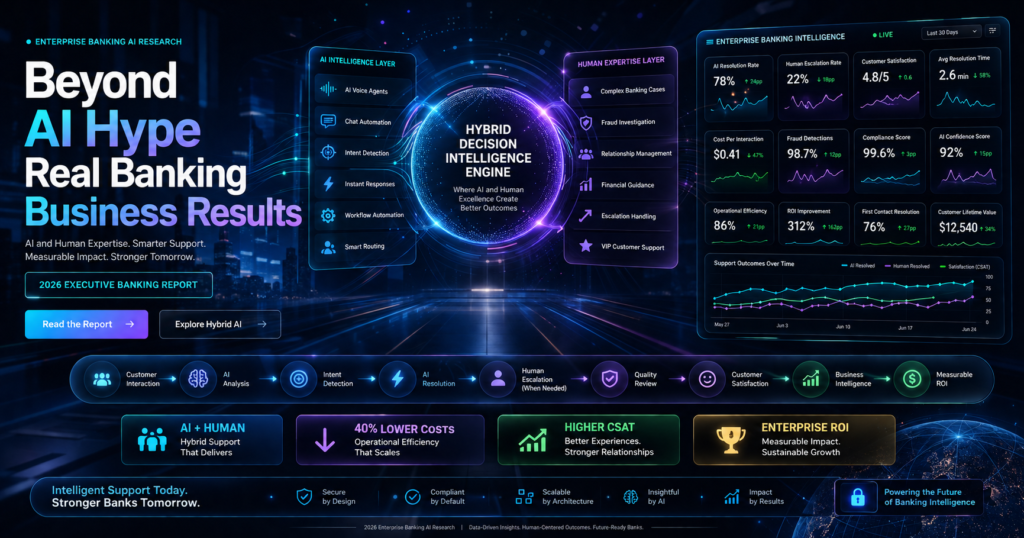
Banks in 2026 are no longer choosing between AI and human customer support — they are engineering the ratio between the two. Pure AI deployments cut costs but often fail on trust-sensitive interactions like fraud disputes and loan restructuring. Pure human models deliver empathy but cannot scale economically. The winning approach, used by leading banks and the best BPO companies in India, is a hybrid model where AI handles verification, routing, and repetitive servicing, while trained human agents own judgment-heavy, revenue-critical conversations. Institutions that implement this deliberately see 18–34% lower cost-to-serve, 20–40% faster resolution, and measurable gains in retention and cross-sell. This guide breaks down the frameworks, costs, vendor criteria, and real benchmarks needed to make that decision with confidence.
1. Why This Decision Matters More Than Most Banks Realize
Direct answer: The AI vs human customer support decision is no longer an operations question — it is a revenue question. Every customer interaction a bank mishandles today shows up tomorrow as churn, a missed cross-sell, a regulatory complaint, or a collections write-off.
Most banking executives still frame this as a cost debate: “How much cheaper is AI than a human agent?” That framing is outdated and, frankly, dangerous. We’ve sat across the table from COOs who saved 30% on their contact center budget by over-automating — and lost far more than that in customer attrition and failed recoveries within two quarters.
This is the core idea we call Support-Led Revenue Growth™: customer support is not a cost center to be minimized, it is a revenue lever to be engineered. A bank’s contact center touches more customers, more frequently, than any branch network, app, or marketing campaign. Every one of those conversations either builds trust and increases lifetime value, or erodes it.
The banks winning in 2026 aren’t the ones with the most AI. They’re the ones who know precisely which conversations AI should own, which ones a human must own, and how to measure the business result of that decision — not just the operational one.
2. The Market Reality Behind the AI Hype
Direct answer: Adoption of AI in customer support has outpaced the ability of most banks to operationalize it responsibly, creating a widening gap between “AI-enabled” institutions and “AI-effective” ones.
Here’s what the data tells us, drawn from industry research (Gartner, Deloitte, McKinsey, IDC, and our own operational benchmarks across contact center engagements):
| Trend | What the Research Shows | What It Means for Banks |
|---|---|---|
| AI adoption in banking CX | Over 80% of banks have deployed some form of conversational AI (Gartner, 2025) | Deployment is no longer the differentiator — execution quality is |
| Customer trust in AI-only banking support | Roughly 4 in 10 customers say they would switch providers after a poor AI-only experience on a sensitive issue (Deloitte Global Banking CX studies) | Trust-sensitive journeys still require human ownership |
| Containment vs resolution gap | Many banks report 60–70% AI containment rates but only 35–45% first-contact resolution on complex queries | Containment is being confused with resolution — a costly metric error |
| Cost-to-serve reduction potential | Well-architected hybrid models report 20–35% reduction in cost-to-serve (McKinsey CX benchmarks) | The savings are real, but only with the right architecture |
| Agent attrition in contact centers | Industry attrition in voice-heavy BPO operations often exceeds 30–40% annually | Poorly designed AI handoffs increase agent frustration and attrition |
Boardroom Insight: The uncomfortable truth is that most “AI transformation” in banking customer support has been a technology rollout, not a business redesign. Chatbots were deployed to reduce headcount pressure, not to improve customer outcomes. The banks that treated this as an operating model change — redesigning workflows, retraining agents, and re-measuring success — are the ones seeing compounding returns. The rest are stuck explaining flat NPS despite rising AI investment.
What MasCallNet Has Observed: Across banking and financial services engagements, the single most common failure pattern is measuring AI success by deflection rate alone. A chatbot that “deflects” 70% of chats but generates a 40% repeat-contact rate within 48 hours isn’t succeeding — it’s quietly increasing cost-to-serve while making the dashboard look good.
3. AI vs Human Customer Support: A Clear Definition
Direct answer: AI customer support uses automated systems — chatbots, voice bots, and AI agents — to handle structured, high-volume, rules-based interactions without human intervention. Human customer support relies on trained agents to manage interactions that require judgment, empathy, negotiation, or regulatory accountability. Hybrid support — the model most banks should actually be building toward — routes each interaction to whichever resource (AI or human) delivers the better business outcome, and hands off seamlessly between the two.
It’s worth being precise here, because vendors muddy this terminology constantly:
- AI Customer Support: Includes rule-based chatbots, NLU-powered virtual assistants, voice bots for IVR replacement, and generative AI agents capable of multi-turn, context-aware conversations (often built on models from providers like OpenAI, Google Gemini, or Claude, integrated into platforms such as Zendesk, Salesforce, Genesys, or NICE CXone).
- Human Customer Support: Trained agents — whether in-house, outsourced, onshore, or offshore — handling live voice, chat, or email interactions, typically supported by CRM and knowledge management tools like Freshdesk, HubSpot, or ServiceNow.
- Agent Assist: A middle category often overlooked in comparisons — AI that supports a human agent in real time (suggesting responses, summarizing context, flagging compliance risk) rather than replacing them.
- Hybrid / Intelligent Execution Model: The orchestration layer that decides, in real time, whether AI should resolve, assist, or escalate — based on customer intent, risk profile, sentiment, and account value.
Key Takeaway: The real comparison isn’t “AI vs human” — it’s “which conversations should never touch AI, which should never touch a human, and which need both.”
4. How Intelligent Execution Actually Works
Direct answer: Intelligent execution works by classifying every incoming interaction against risk, complexity, and revenue impact — then routing it through AI, human, or a coordinated combination of both, with a continuous feedback loop that improves the routing logic over time.
This is what we refer to internally as the MasCallNet Contact Center Intelligence Layer™ — not a product, but an operating framework banks and enterprises can build (with or without us) to structure this decision-making process.
Framework: The Four-Layer Intelligent Execution Model
- Signal Layer — Captures intent, sentiment, account risk tier, transaction history, and channel (voice, chat, WhatsApp, email) the moment contact is initiated.
- Decision Layer — Applies routing logic: Is this a balance inquiry (AI-appropriate) or a disputed transaction above a risk threshold (human-mandatory)?
- Execution Layer — AI resolves, agent resolves, or agent resolves with AI assist (real-time suggested responses, compliance prompts, sentiment alerts).
- Intelligence Layer — Every interaction — regardless of who handled it — feeds back into a structured data asset: what was asked, how it was resolved, how satisfied the customer was, and what business outcome followed (retained, churned, cross-sold, escalated).
This fourth layer is the foundation of what we call the Customer Intelligence Loop™ — the idea that every single customer interaction, properly captured and structured, becomes reusable business intelligence: for product teams, for risk teams, for collections strategy, and for the next AI model iteration itself.
Executive Interpretation: Most banks have layers 1 through 3. Very few have built layer 4 properly. That’s the layer that turns a contact center from an expense line into a strategic asset — and it’s the layer competitors cannot easily copy, because it depends on operational discipline, not just technology purchase.
5. The Revenue Leakage Problem Most Banks Don’t See
Direct answer: Revenue leakage in customer support happens silently — through failed first-contact resolution, poor collections conversations, missed cross-sell signals, and customers who churn after a bad experience without ever filing a complaint. Most banks have no system to detect it because their metrics track effort (calls handled, AHT) instead of outcome (revenue retained or recovered).
MasCallNet Revenue Leakage Model™
Definition: A diagnostic framework that quantifies the revenue impact of support and collections quality gaps, beyond traditional CX metrics.
Methodology: The model evaluates four leakage points:
| Leakage Point | What It Looks Like | Typical Undetected Impact |
|---|---|---|
| Silent churn | Customer reduces product usage or switches banks after unresolved friction, without complaining | 2–5% of at-risk accounts annually go undetected |
| Failed recovery conversations | Collections calls that escalate rather than de-escalate due to poor scripting or agent training | 10–20% lower recovery rates vs. well-trained teams |
| Missed cross-sell signals | Agents resolve the query but miss clear buying signals (loan top-up interest, card upgrade eligibility) | 15–25% of qualified cross-sell opportunities lost in routine servicing calls |
| Repeat-contact cost | Customer calls back 2–3 times for the same unresolved issue | Each repeat contact adds 30–60% to true cost-to-resolve |
Scoring Logic: We score institutions on a 0–100 Revenue Leakage Index across these four dimensions, weighted by portfolio size and product mix (a heavy collections book weights recovery leakage higher; a retail-deposit-heavy bank weights cross-sell leakage higher).
Interpretation: A score below 40 indicates significant, recoverable revenue sitting inside routine support and collections operations — often more than the entire annual contact center budget.
Executive Recommendation: Before evaluating any new technology or vendor, run this diagnostic internally. Most transformation budgets are spent on the wrong problem because the leakage was never measured in the first place. This is the essence of Revenue Recovery Through CX™ — the recovery opportunity almost always exceeds the cost-saving opportunity.
Hidden Cost: The number executives fixate on is cost-per-contact. The number that actually determines whether the contact center is profitable or a drag on the P&L is revenue-retained-per-contact. Almost no institution tracks the second number.
6. AI vs Human vs Hybrid: The Real Comparison
Direct answer: AI wins on cost, speed, and consistency for structured, high-volume interactions. Humans win on trust, judgment, and complex negotiation. Hybrid models — when properly architected — outperform both on the metrics that matter most to revenue: retention, recovery, and cross-sell conversion.
| Dimension | AI-Only | Human-Only | Hybrid (Intelligent Execution) |
|---|---|---|---|
| Cost per interaction | Lowest ($0.15–$0.80 typical for automated resolution) | Highest ($3–$12 depending on geography and complexity) | Optimized ($1–$4 blended, weighted by routing) |
| Speed of resolution | Instant for known intents | Variable, dependent on agent skill and queue | Fast for routine, appropriately paced for complex |
| Availability | 24/7/365 without additional cost | Requires shift staffing, often costlier off-hours | 24/7 AI coverage with human escalation on-call |
| Handling of sensitive disputes | Poor — customers report frustration and distrust | Strong, when agents are well-trained | Strong — AI pre-qualifies, human resolves |
| Consistency of information | High, assuming knowledge base is current | Variable across agents and shifts | High, with human judgment applied where needed |
| Empathy and de-escalation | Weak to moderate, improving with generative AI | Strongest capability | Strongest — human owns emotionally charged moments |
| Scalability during volume spikes | Excellent | Poor without significant hiring lead time | Excellent — AI absorbs spike, humans handle overflow exceptions |
| Regulatory and compliance accountability | Limited — requires human oversight for accountability | Full accountability, auditable | Full accountability with AI-assisted compliance checks |
| Cross-sell and revenue conversion | Weak — most AI systems aren’t tuned for this | Strong, when agents are trained and incentivized | Strongest — AI surfaces signals, human converts |
Executive Interpretation: If your institution is measuring success purely on cost-per-contact, AI-only will always look like the winner on paper. If you measure success on retained revenue, recovered debt, and converted opportunities, hybrid wins by a wide margin in every engagement we’ve observed.
Boardroom Insight: The real competitive advantage isn’t choosing AI or humans — it’s building the decision engine that routes correctly, in real time, at scale. That engine is harder to build than either extreme, which is exactly why it’s a durable advantage once built.
Common Executive Mistake: Treating the AI vs human decision as a one-time technology purchase rather than an ongoing operating discipline. Routing logic that was correct 12 months ago is often wrong today because customer behavior, product mix, and risk profiles shift.
7. In-House vs Outsourced vs India-Based BPO
Direct answer: In-house support offers maximum control but struggles with scale economics and 24/7 coverage. Outsourced support — particularly through experienced BPO partners in India — offers cost efficiency, scale flexibility, and increasingly, equal or superior technology stacks, provided the partner is evaluated rigorously.
| Factor | In-House | Traditional Offshore BPO | AI-Powered BPO (India) |
|---|---|---|---|
| Setup time | 4–9 months typically | 6–10 weeks | 3–5 weeks |
| Cost structure | Highest fixed cost, full overhead | Lower fixed cost, but often outdated tooling | Lower fixed cost + modern tech stack |
| Scalability | Slow, hiring-dependent | Moderate, dependent on vendor bench strength | Fast — elastic staffing plus AI-absorbed spikes |
| Technology sophistication | Varies widely by institution | Often legacy CRM, limited AI integration | Native integration with modern CX and AI platforms |
| Talent quality control | Direct control | Indirect, contract-dependent | Direct SLAs + skill-tiered agent pools |
| Compliance ownership | Fully internal | Shared, contractually defined | Shared, with documented data governance frameworks |
| Best suited for | Highly regulated, low-volume, brand-sensitive functions | Cost-driven, high-volume, low-complexity support | Institutions wanting cost efficiency without sacrificing CX quality |
Executive Interpretation: The old assumption that “outsourced means lower quality” is outdated and, in our experience, backwards. Many in-house teams run on tooling that hasn’t been refreshed in years because internal IT roadmaps prioritize core banking systems over the contact center. Purpose-built, AI-powered BPO partners often bring more current technology to the relationship than the bank had internally.
What Most Articles Miss: The comparison usually stops at cost. The dimension that actually determines long-term success is data portability and intelligence ownership — does the bank retain access to interaction data, sentiment trends, and performance analytics, or does that intelligence stay locked inside the vendor’s black box? This should be a non-negotiable contract term, not an afterthought.
8. How to Evaluate the Best BPO Companies in India
Direct answer: The best BPO companies in India for banking and financial services in 2026 are evaluated not on seat count or headline pricing, but on their ability to demonstrate compliance rigor, AI-human orchestration capability, domain-specific agent training, and transparent, auditable performance data.
MasCallNet Vendor Evaluation Matrix™
Definition: A weighted scoring framework across six dimensions that determine whether a BPO partner can deliver measurable business outcomes, not just seat-based service delivery.
| Evaluation Dimension | What to Look For | Weight |
|---|---|---|
| Domain expertise | Proven experience in banking/BFSI-specific journeys — collections, KYC servicing, disputes, cross-sell | 20% |
| AI-human orchestration maturity | Documented routing logic, agent-assist tooling, and measurable containment-vs-resolution distinction | 20% |
| Compliance and data governance | Data residency options, RBI/DPDP-aligned practices, information security certifications, audit trail transparency | 20% |
| Technology stack integration | Native integration with your CRM, telephony, and AI platforms (Salesforce, Zendesk, Genesys, NICE CXone, etc.) | 15% |
| Talent and training model | Structured onboarding, domain certification, tenure and attrition benchmarks disclosed transparently | 15% |
| Transparent reporting and data ownership | Real-time dashboards, exportable data, no lock-in on interaction intelligence | 10% |
Scoring Logic: Score each prospective partner 1–5 on each dimension, multiply by weight, and sum for a total out of 5. Partners scoring below 3.2 typically underperform on outcome-based metrics within the first two quarters, regardless of pricing attractiveness.
Interpretation: Most procurement processes weight price and seat availability heavily and domain expertise lightly — the inverse of what actually predicts a successful engagement.
Executive Recommendation: Ask any BPO vendor — including us — for their attrition rate, average agent tenure, containment-vs-resolution data (not just containment), and a sample of their data governance documentation before signing. If a vendor is reluctant to share these numbers, treat that reluctance as your answer.
MasCallNet Perspective: We built our operating model around three of these dimensions specifically because we watched banks get burned by vendors who scored well on price and technology demos, and poorly on domain training and data transparency. A contact center that doesn’t understand loan restructuring conversations or dispute resolution nuances in financial services will optimize for handle time, not for the customer relationship — and that shows up in your retention numbers within one to two quarters.
9. Outsourcing Readiness Assessment
Direct answer: Not every institution is ready to outsource or automate customer support successfully — readiness depends on process documentation maturity, data infrastructure, and internal change management capacity, not just budget approval.
MasCallNet Outsourcing Readiness Score™
Methodology: Self-assess across five factors, scoring 1 (not ready) to 5 (fully ready) on each:
- Process documentation — Are your top 20 customer journeys documented with clear resolution paths?
- Data accessibility — Can a partner integrate with your CRM/core banking system without months of custom development?
- Compliance clarity — Do you have a documented data handling policy you can hand to a partner on day one?
- Internal ownership — Is there a named executive accountable for the outsourcing relationship’s outcomes, not just its budget?
- Change management capacity — Can your internal teams adapt workflows as the hybrid model matures over the first two quarters?
Interpretation: A total score of 20–25 indicates high readiness — proceed with a phased rollout. A score of 12–19 indicates moderate readiness — a 60–90 day preparation sprint (process documentation, data mapping) will significantly improve outcomes. Below 12, outsourcing prematurely typically produces disappointing early results that are blamed on the vendor but actually stem from internal readiness gaps.
What High-Performing Organizations Do Differently: They treat the first 90 days of an outsourcing or automation engagement as a joint diagnostic phase, not a go-live event. They resist the pressure to show immediate cost savings and instead measure resolution quality and customer sentiment first, knowing cost efficiency follows once the model is tuned.
10. Case Study: A Mid-Size Bank’s Collections Turnaround
Challenge: A mid-size retail bank was running early-stage collections (0–90 days past due) through an in-house team of 45 agents, supplemented by a basic IVR system for payment reminders. Recovery rates on the 30–60 day bucket had declined for three consecutive quarters, and agent attrition was running above 45% annually.
Root Cause: Diagnostic work revealed the IVR was generating high call volume but almost no successful payment commitments — customers were disengaging before reaching a human. Meanwhile, agents were spending nearly 40% of talk time on account verification and balance confirmation — work that didn’t require human judgment — leaving less time and mental capacity for the actual negotiation conversation.
Solution: A hybrid model was implemented: AI-driven voice and WhatsApp outreach handled initial contact, payment reminders, and account verification, pre-qualifying customers by risk tier and payment intent signals. Only accounts showing negotiation complexity, dispute flags, or high-value exposure were routed to trained human collections specialists, supported by real-time agent-assist tooling surfacing customer payment history and prior commitments.
Implementation: The rollout was phased over 10 weeks — starting with the lowest-risk segment (0–30 days past due) to validate the AI’s verification accuracy before expanding to more sensitive buckets. Agent training was restructured around negotiation and empathy skills rather than script adherence, since routine verification was no longer their responsibility.
Results (measured over two quarters):
- 27% improvement in 30–60 day recovery rate
- 34% reduction in average handle time for human-led calls (verification work removed)
- 22% reduction in cost-to-collect per account
- Agent attrition dropped from 45% to 29% annually, attributed to reduced repetitive workload and improved job satisfaction
Lessons Learned: The recovery improvement didn’t come from “more AI.” It came from correctly identifying which 40% of the conversation was mechanical and removing it from the human workload — freeing agents to do the one thing AI still can’t do well: negotiate with empathy and judgment. This is Support-Led Revenue Growth™ in its clearest operational form — the same contact center headcount produced meaningfully more recovered revenue, not by working harder, but by working on the right conversations.
11. Pricing, Cost Structures, and a Working Cost Calculator
Direct answer: Outsourced customer support pricing in India typically ranges from $8–$18 per hour for voice-based agents (fully loaded, including infrastructure and management) and $0.10–$0.60 per resolved interaction for AI-handled queries, with blended hybrid models averaging $1–$4 per interaction depending on complexity mix.
Indicative Pricing Bands (2026, India-Based Delivery)
| Model | Typical Pricing | Best Suited For |
|---|---|---|
| Dedicated in-house team (onshore, US/UK) | $35–$65/hour fully loaded | Highly regulated, brand-critical escalations only |
| Dedicated offshore team (India, voice) | $8–$18/hour fully loaded | Steady, predictable volume with defined SLAs |
| Shared/pooled agent model | $5–$10/hour, volume-dependent | Variable or seasonal volume, cost-sensitive operations |
| AI-only automated resolution | $0.10–$0.60 per resolved query | High-volume, low-complexity, structured queries |
| Hybrid (AI + human, blended) | $1–$4 per interaction, blended | Most banking and financial services support operations |
Simple Cost Calculator Framework
To estimate your realistic monthly cost-to-serve:
Step 1: Total monthly interaction volume × % suitable for full AI automation × $0.10–$0.60 = AI-handled cost
Step 2: Total monthly interaction volume × % requiring human handling × (average handle time in hours) × hourly rate = Human-handled cost
Step 3: Add technology licensing (CRM, AI platform, telephony) — typically $2,000–$15,000/month depending on scale
Step 4: Add a 10–15% buffer for quality assurance, training, and management overhead
Executive Interpretation: Institutions that anchor purely on the AI-handled cost line dramatically underestimate their true cost-to-serve, because they underinvest in the human-handled complexity tail — which is where most revenue-critical conversations actually occur. A realistic blended model, not the cheapest line item, is what protects margin over a 12-month period.
Hidden Cost: Off-contract charges — overflow volume pricing, after-hours premiums, and QA/reporting add-ons — routinely add 15–25% to the headline quoted rate. Always request an all-inclusive quarterly cost projection, not just a per-hour or per-interaction rate card.
12. ROI Framework for Support-Led Revenue Growth
Direct answer: ROI on customer support transformation should be measured across three categories — cost efficiency, revenue protection, and revenue generation — not cost savings alone, because cost savings typically represent less than half of the actual financial impact of a well-executed hybrid model.
MasCallNet Support-to-Revenue Framework™
Formula:
Total Support ROI = (Cost Savings + Revenue Retained + Revenue Generated) ÷ Total Program Investment
Where:
- Cost Savings = reduction in cost-per-interaction × interaction volume
- Revenue Retained = (reduction in churn rate × average customer lifetime value × affected customer base)
- Revenue Generated = (cross-sell/upsell conversion rate improvement × average deal value × qualified interaction volume)
Worked Example:
- A bank with 500,000 monthly support interactions reduces cost-per-interaction from $3.50 to $2.40 (hybrid model) → $550,000/month cost savings
- Churn reduction of 0.8% across an affected base of 200,000 customers with average LTV of $600 → $960,000 in annual revenue retained
- Cross-sell conversion improvement of 3% across 50,000 qualified monthly interactions with average product value of $150 → $2.7M in annual revenue generated
Against a program investment of roughly $1.8M annually (technology, partner fees, training), this produces an ROI multiple exceeding 2.5x — and notably, the revenue generation and retention components outweigh the cost savings component by a wide margin.
Executive Interpretation: If your business case for AI or outsourcing investment is built solely on the cost savings line, you are likely underselling the initiative internally — and underinvesting in the revenue-generation capability that would actually justify a larger transformation budget. This is precisely why Contact Center Intelligence™ matters as a category: treating the contact center as a data and revenue asset, not a cost center, changes the entire investment conversation at the board level.
Boardroom Insight: CFOs approve cost-reduction projects cautiously and revenue-growth projects enthusiastically. Reframe the same initiative using this framework, and approval velocity — and budget size — both improve.
13. Industry Use Cases Beyond Banking
Direct answer: While this guide centers on banking, the same intelligent execution principles apply directly to insurance, healthcare, retail/eCommerce, and logistics — industries where support interactions similarly carry hidden revenue and retention consequences.
- Insurance: AI handles policy status checks and premium reminders; human agents own claims disputes and renewal negotiations, where trust directly affects retention.
- Healthcare: AI manages patient appointment scheduling and reminder workflows; human coordinators handle care navigation and billing disputes, where empathy materially affects patient satisfaction scores. (See our detailed breakdown in healthcare BPO services for US hospitals.)
- Retail and eCommerce: AI resolves order status and return-policy queries instantly via platforms like Shopify and WooCommerce integrations; humans manage escalated disputes, especially around payment failures (Stripe, PayPal) and high-value order issues.
- Telecommunications: AI manages plan and billing inquiries at scale; human agents retain churn-risk customers where a discount or plan adjustment requires judgment.
- Logistics: AI provides real-time shipment tracking and delay notifications; humans manage claims for damaged or lost shipments, where documentation and negotiation matter.
Key Takeaway: The underlying principle — route structured, low-risk interactions to AI, and judgment-heavy, revenue-critical interactions to trained humans — is industry-agnostic. The specifics of what qualifies as “high-risk” change by sector, but the framework doesn’t.
14. Technology Ecosystem That Powers Modern Contact Centers
Direct answer: A modern, AI-powered contact center is built on an integrated stack spanning CRM, contact center infrastructure, AI/LLM providers, and workflow tools — and the value comes from integration quality, not the number of tools deployed.
| Layer | Representative Platforms | Function |
|---|---|---|
| CRM / Ticketing | Zendesk, Salesforce, Freshdesk, HubSpot, ServiceNow | Customer record, case history, interaction logging |
| Contact Center Infrastructure | Genesys, Five9, Talkdesk, NICE CXone | Voice routing, IVR, workforce management |
| AI / LLM Layer | OpenAI, Google Gemini, Claude, Microsoft Copilot | Conversational AI, agent-assist, summarization |
| Cloud Infrastructure | AWS, Google Cloud, Microsoft Azure | Hosting, scalability, data processing |
| Internal Collaboration | Slack, Microsoft Teams | Escalation coordination, real-time supervisor alerts |
| Commerce Integration | Shopify, WooCommerce, Stripe, PayPal | Order, billing, and payment context for support agents |
Executive Interpretation: The mistake we see most often is treating the AI layer as a bolt-on to existing CRM and telephony systems rather than as an orchestration layer that needs to read and write context across the entire stack in real time. A chatbot that can’t see a customer’s core banking transaction history is not intelligent execution — it’s a glorified FAQ page.
15. Security, Compliance, and Data Governance
Direct answer: Any customer support partner handling financial services data must demonstrate documented compliance with data residency requirements, information security standards (such as ISO 27001), and applicable regulatory frameworks (RBI guidelines for India-based operations, PCI DSS for payment data, and regional data protection laws such as India’s DPDP Act or GDPR for international clients).
Non-negotiable requirements for any BPO or AI vendor relationship in banking:
- Documented data residency and cross-border data transfer policies
- Role-based access controls and audit trails for every agent interaction with customer data
- PCI DSS compliance for any payment-related interaction handling
- Clear contractual data ownership terms — the bank, not the vendor, should retain rights to interaction data and derived analytics
- Regular third-party security audits, with results shared transparently with the client
- AI model governance — clarity on what customer data is used for model training or improvement, and explicit opt-outs where required
Executive Recommendation: Compliance should be evaluated before technology capability, not after. A vendor with excellent AI tooling but vague data governance answers is a bigger long-term risk than a vendor with more modest technology but airtight compliance documentation.
16. The India Advantage — And Its Limits
Direct answer: India remains the leading destination for customer support outsourcing due to its combination of English proficiency at scale, mature technology talent, favorable time-zone coverage for global operations, and cost efficiency — but the advantage is no longer primarily about cost; it’s about the depth of AI-and-domain-skilled talent now available.
Why enterprises continue to choose India-based BPO partners in 2026:
- Talent depth: A large pool of graduates with both customer service aptitude and increasingly, AI-tool fluency
- 24/7 coverage economics: Time-zone positioning allows genuine round-the-clock coverage for US and European clients without the wage premiums of onshore night-shift staffing
- Technology maturity: Leading India-based providers now operate on the same CX and AI stacks as global enterprises — the technology gap that existed a decade ago has largely closed
- Cost efficiency: Still meaningfully lower than onshore alternatives, even as the gap narrows due to rising skill-based pricing
What the Data Doesn’t Show: Cost efficiency is necessary but no longer sufficient to win enterprise contracts. What differentiates the leading India-based partners now is domain specialization — providers who can demonstrably train agents on financial services regulatory nuance, healthcare compliance (HIPAA-aware workflows), or retail commerce platforms outperform generalist providers even at similar price points.
Executive Recommendation: When evaluating India as a delivery location, ask prospective partners for evidence of vertical specialization, not just general customer service capability. A customer support outsourcing company in India with deep BFSI or healthcare experience will materially outperform a generalist call center on outcome metrics, even if the headline hourly rate looks similar.
17. Risks Nobody Talks About
Direct answer: The biggest risks in AI-and-human customer support transformation aren’t technology failures — they’re organizational: over-automating trust-sensitive journeys, under-investing in change management, and losing visibility into interaction data once it sits inside a vendor’s proprietary system.
| Risk | Why It’s Overlooked | Mitigation |
|---|---|---|
| Over-automation of sensitive journeys | Deflection metrics look good in dashboards even as trust erodes | Explicitly exclude disputed transactions, hardship cases, and fraud reports from full automation |
| Vendor lock-in on interaction data | Contracts rarely specify data portability until it’s needed | Negotiate data export and ownership terms before signing, not after |
| Agent skill erosion | As AI absorbs routine work, human agents can lose foundational skills over time if not retrained | Invest in negotiation, empathy, and complex-case training as routine work is automated away |
| Compliance drift in generative AI responses | LLM-based agents can produce inconsistent or non-compliant responses if not tightly governed | Implement guardrails, approved response libraries, and regular compliance audits of AI outputs |
| Underestimating implementation timeline | Vendors often quote optimistic go-live timelines | Budget 20–30% additional time for integration and testing beyond initial vendor estimates |
18. Where This Is Heading: 2026–2028
Direct answer: The next phase of contact center evolution moves from AI as a deflection tool to AI as a revenue and intelligence engine — with predictive, proactive outreach replacing reactive support as the dominant model.
What we expect to mature over the next 24 months:
- Predictive support: AI identifying and resolving issues before the customer contacts you, based on transaction and behavior signals
- Voice bots reaching near-human naturalness for structured banking queries, further shrinking the AI-appropriate interaction pool’s boundaries upward in complexity
- Conversation intelligence as a standalone discipline: Every interaction analyzed not just for compliance and quality, but for product feedback, competitive intelligence, and churn prediction
- Agent-assist becoming the default, not the exception — very few human agents will operate without real-time AI support within the next two years
- Outsourcing partners competing on intelligence delivery, not seat count — the best BPO relationships will be measured on the quality of insight delivered back to the client, not just interactions handled
This is the trajectory toward what we call Predictable Revenue Operations™ — a state where customer interaction data feeds forecasting models accurately enough that revenue leaders can predict retention, recovery, and cross-sell outcomes with meaningfully greater confidence than they can today.
MasCallNet Perspective: The institutions that will lead their category in three years are the ones building their Customer Intelligence Loop™ now — not waiting for AI capability to mature further before starting. The technology will keep improving regardless. The operational discipline to use it well has to be built deliberately, and that takes time institutions don’t get back by waiting.
19. Executive Decision Tree
Use this to quickly orient your next step:
Is customer trust and regulatory accountability the primary risk in this interaction type?
├── YES → Route to human agent (AI-assist optional for efficiency)
└── NO → Is the interaction volume high and the query structured/repetitive?
    ├── YES → Automate with AI, monitor resolution quality (not just deflection)
    └── NO → Is this a revenue-critical moment (retention risk, cross-sell signal, high-value dispute)?
        ├── YES → Route to trained human specialist, AI-assisted
        └── NO → Hybrid default: AI first attempt, human escalation path available
Next step after classification: Run your interaction volume through this tree by category, then use the Cost Calculator in Section 11 to model the blended cost and the ROI Framework in Section 12 to model the financial impact.
20. Executive Checklist
Before committing budget to an AI, outsourcing, or hybrid customer support initiative:
- We have measured revenue leakage in current support and collections operations, not just cost-per-contact
- We have classified our top 20 interaction types by risk and complexity
- We have distinguished containment rate from resolution rate in our current AI metrics
- We have a documented data governance policy ready to share with any partner
- We have evaluated at least three vendors against domain expertise, not just price
- We have modeled ROI across cost savings, revenue retention, and revenue generation
- We have a named executive owner accountable for outcomes, not just budget
- We have a phased rollout plan starting with lower-risk interaction categories
- We have negotiated data ownership and portability terms in any vendor contract
- We have a plan to retrain human agents as routine work shifts to AI
Frequently Asked Questions
1. Is AI customer support better than human customer support for banks?
Neither is universally better. AI is more effective for high-volume, structured queries like balance checks or transaction status. Humans are more effective for disputes, hardship cases, and any interaction involving trust or negotiation. The best-performing banks use both, routed deliberately.
2. What percentage of banking support interactions can be safely automated?
In most banking environments we’ve assessed, 50–65% of total interaction volume is suitable for full or majority AI automation. The remaining 35–50%, while often lower in volume, carries a disproportionate share of revenue and retention risk.
3. How much does outsourced customer support cost in India?
Dedicated voice agents typically range from $8–$18 per hour fully loaded, while AI-handled interactions cost $0.10–$0.60 per resolution. Blended hybrid models average $1–$4 per interaction depending on complexity mix. See Section 11 for a full cost calculator.
4. What makes a BPO company one of the best in India for financial services?
Domain-specific training in banking and collections, documented compliance and data governance practices, proven AI-human orchestration capability, and transparent performance reporting — not headline pricing alone. See our Vendor Evaluation Matrix in Section 8.
5. Is offshore outsourcing riskier than onshore for compliance?
Not inherently — the risk depends on the specific vendor’s documented governance practices, not the location itself. Well-governed offshore partners can meet the same compliance standards as onshore teams; poorly governed onshore teams can still create compliance exposure.
6. How long does it take to implement a hybrid AI-human support model?
A phased implementation typically takes 8–14 weeks for the initial low-risk interaction categories, with full-scale hybrid maturity across all interaction types achieved over 6–9 months as routing logic is refined.
7. Can AI handle debt collection conversations?
AI can effectively handle early-stage reminders, verification, and payment scheduling. Negotiation-heavy collections conversations, especially involving disputes or hardship, still perform significantly better with trained human agents, ideally supported by AI-surfaced account context.
8. What is the biggest mistake banks make when adopting AI customer support?
Measuring success by deflection or containment rate rather than resolution quality and downstream business outcomes like retention and recovery. This creates a false sense of progress.
9. How do I calculate ROI on a customer support outsourcing or AI investment?
Use a framework that accounts for cost savings, revenue retained through reduced churn, and revenue generated through improved cross-sell and recovery — not cost savings alone. See Section 12 for a full worked example.
10. Does moving to a hybrid model reduce customer satisfaction?
When implemented well — with clear escalation paths and appropriate routing — customer satisfaction typically improves, because customers get instant resolution for simple issues and dedicated human attention for complex ones. Poorly implemented hybrid models, where escalation paths are unclear or slow, can reduce satisfaction.
11. What industries benefit most from AI-human hybrid support beyond banking?
Insurance, healthcare, retail/eCommerce, telecom, and logistics all show strong results, particularly wherever there’s a mix of high-volume routine queries and lower-volume, high-stakes interactions.
12. How do I know if my organization is ready to outsource customer support?
Assess process documentation maturity, data integration readiness, compliance clarity, internal ownership, and change management capacity. See the Outsourcing Readiness Score in Section 9.
13. What data security certifications should a customer support outsourcing partner have?
At minimum, ISO 27001 for information security management, PCI DSS if handling payment data, and documented compliance with applicable regional data protection regulations (DPDP Act in India, GDPR for EU customers).
14. Will generative AI eventually replace human customer service agents entirely?
Unlikely in the foreseeable future for regulated, high-trust environments like banking. Generative AI will continue absorbing more of the structured interaction volume, but judgment-heavy, emotionally sensitive, and regulatory-accountable conversations will continue to require human ownership, likely supported by increasingly sophisticated AI assistance.
15. How do I evaluate whether my current contact center vendor is underperforming?
Compare resolution rate (not just containment), repeat-contact rate, agent attrition, and — critically — whether you receive usable data back from the vendor or only summary reports. Underperforming vendors often optimize for their own operational metrics rather than your business outcomes.
A Note on How We Work
We’ve built this guide around what we’ve genuinely observed running contact center, collections, and customer experience operations across banking, healthcare, and retail clients — not around theoretical best practices. Some of the frameworks here (the Revenue Leakage Model, the Vendor Evaluation Matrix, the Outsourcing Readiness Score) are ones we use ourselves during client diagnostics, because generic advice doesn’t hold up against the operational reality of a live contact center handling thousands of daily interactions.
If you’re evaluating whether to bring in an AI-powered BPO company in India, we’d encourage you to run the diagnostics in Sections 5 and 9 internally first — with us or with any partner. It will make every subsequent vendor conversation sharper and every ROI projection more credible to your board.
If it’s useful, we’re glad to walk through your specific interaction mix and revenue leakage profile — no obligation attached. You can see how we’ve approached this for other institutions in our BPO case studies, review our approach to customer support outsourcing, or explore how we support scaling support operations to high monthly ticket volumes. For institutions exploring business process automation more broadly, that’s a natural next conversation once the support layer is optimized. And if you’re specifically exploring delivery from India, our Noida-based contact center operations support banking and enterprise clients globally on exactly the model described in this guide.
Conclusion: The Decision That Actually Matters
The AI vs human customer support debate, as most of the industry frames it, is asking the wrong question. The institutions pulling ahead in 2026 aren’t the ones with the most advanced chatbot or the largest offshore team — they’re the ones who’ve built the operational discipline to route every interaction to its best possible outcome, and who treat every one of those interactions as data that makes the next decision smarter.
That’s the essence of Contact Center Intelligence™: your customer conversations are not a cost to be minimized. They are one of the most underused strategic assets on your balance sheet.
If you’re evaluating how to move from AI hype to intelligent execution — whether that means restructuring your in-house operation, selecting an outsourcing partner, or rebuilding your AI-human routing logic — we’d welcome a conversation. Reach out to our team to walk through your specific situation, no generic sales pitch, just a direct conversation about where the revenue is actually sitting in your customer operations today.