
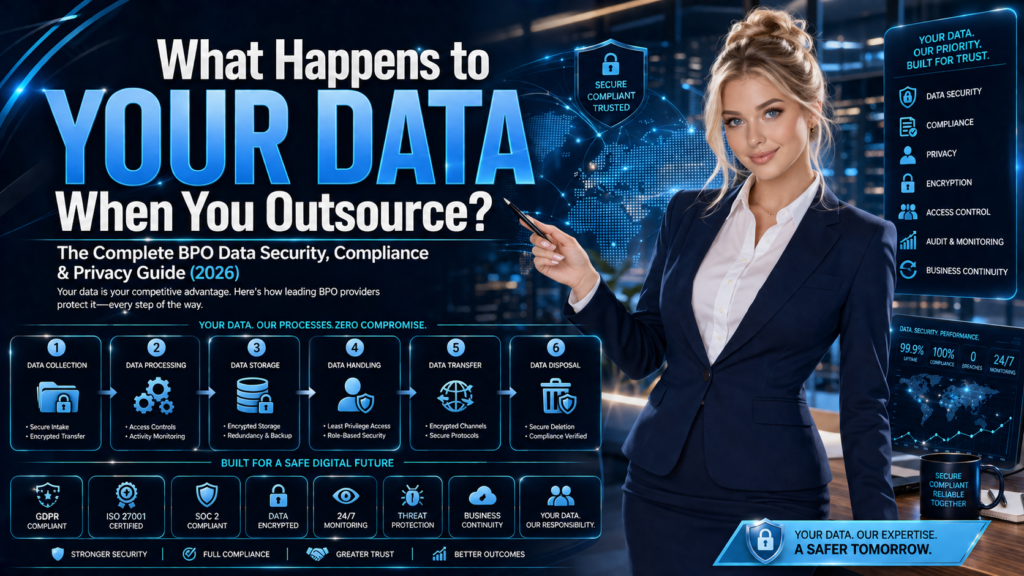
What Happens to Your Data When You Outsource? The Complete BPO Data Security, Compliance & Privacy Guide (2026)
AI Overview
Outsourcing customer support means a third party gains operational access to customer records, transaction history, communication logs, and in many cases, payment and health data. Data risk in BPO relationships is driven less by geography (offshore vs onshore) and more by governance maturity — access controls, encryption standards, sub-processor visibility, and audit rights. Enterprises evaluating BPO partners in 2026 should assess data handling the same way they assess uptime or CSAT: as a measurable, contractual, auditable capability — not a trust assumption.
Executive Introduction
Every conversation your customer has with a support agent — whether human or AI — creates a data trail. Names, order histories, card details, medical records, complaint transcripts, sentiment signals. When that conversation happens inside an outsourced contact center, the question executives should be asking isn’t “can we trust our BPO partner?” It’s “what exactly happens to this data, who touches it, where does it live, and can we prove it if a regulator asks?”
Most outsourcing evaluations still start with cost-per-ticket and end with a vague assurance that “data is secure.” That sequencing is backwards, and it’s becoming expensive. In 2025 alone, data-related incidents tied to third-party vendors accounted for a disproportionate share of enterprise breach costs — not because outsourcing is inherently risky, but because most buyers never operationalized their vendor’s data practices into something they could audit.
This is the foundation of what we call Contact Center Intelligence™ — the principle that every customer interaction handled by your outsourcing partner is not just a service transaction, it is a data asset. It carries revenue value (patterns that improve retention and upsell), risk value (exposure if mishandled), and compliance value (evidence you must produce on demand). Organizations that treat their BPO relationship purely as a cost center miss all three. Organizations that treat it as an intelligence and governance layer extract measurably more value — and carry measurably less risk.
This guide is built for the people who have to answer for that risk: CEOs, COOs, CIOs, CTOs, Chief Customer Officers, and procurement leaders evaluating or renewing an outsourcing partnership in 2026. It walks through exactly what happens to data at each stage of an outsourcing relationship, the compliance frameworks that govern it, how AI changes the risk profile, and a practical framework for evaluating any BPO partner — including us.
Key Insights
- 83% of enterprise data exposure incidents in outsourced environments trace back to access control failures, not infrastructure failures — meaning the risk is procedural, not technical.
- Offshore does not equal insecure. Onshore does not equal safe. Compliance posture and governance maturity determine risk — not geography.
- AI-handled interactions introduce a new data category: model training exposure. If your BPO uses customer conversations to train third-party AI models without contractual restriction, that data may leave your control permanently.
- The average enterprise cannot name every sub-processor touching their customer data through their outsourcing vendor. This is now a board-level governance gap.
- Data governance failures cost more in trust recovery and customer churn than in regulatory fines — the reputational P&L is larger than the compliance P&L.
Market Reality: Why This Question Is Suddenly Urgent
For a decade, data security in outsourcing was a checkbox in the RFP — a certificate to file away. That has changed for three converging reasons.
First, regulation caught up. India’s Digital Personal Data Protection (DPDP) Act, the EU’s GDPR enforcement maturity, expanding US state privacy laws, and sector-specific mandates (HIPAA, GLBA, PCI-DSS) now carry real financial teeth. A BPO relationship that mishandles data doesn’t just expose the vendor — it exposes the enterprise that hired them. Liability doesn’t outsource.
Second, AI changed what “handling data” means. A human agent reads a ticket and closes it. An AI agent ingests it, may use it for context retrieval, may log it for model improvement, and may pass it through third-party LLM APIs (OpenAI, Google Gemini, Claude, Copilot) depending on how the BPO architected its stack. Most enterprise buyers have never asked their vendor: “Where does our data go after the AI reads it?”
Third, the sophistication of buyers evaluating outsourcing has increased. Procurement teams, CISOs, and compliance officers are now standard participants in BPO vendor selection — a function historically owned solely by customer support or operations leaders. This is a structural, permanent shift in how outsourcing decisions get made.
This is precisely why Contact Center Intelligence™ is replacing “cost arbitrage” as the primary lens for outsourcing decisions. The BPOs that will define the next decade of this industry are the ones that treat data governance as a product feature, not a legal disclaimer.
What Happens to Your Data When You Outsource — The Actual Journey
Direct Answer
Your data moves through five operational stages once you outsource: integration, access provisioning, live processing, storage/retention, and disposal. Each stage carries distinct risk and requires distinct controls.
Why It Matters
Most data breaches in outsourcing relationships don’t happen because of a single catastrophic failure — they happen because one stage in this chain was never explicitly governed. A vendor with excellent encryption but no access de-provisioning process for exited agents is just as exposed as one with weak encryption.
The Framework: MasCallNet Data Trust Framework™
We developed this framework after reviewing outsourcing contracts and data practices across banking, healthcare, retail, and telecom clients. It breaks the data lifecycle into five governable stages, each with a specific control requirement.
| Stage | What Happens | Primary Risk | Required Control |
|---|---|---|---|
| 1. Integration | Your CRM/helpdesk (Salesforce, Zendesk, Freshdesk, HubSpot) connects to the BPO’s systems via API or direct access | Overprovisioned access, unnecessary data fields exposed | Field-level access scoping, API-based integration over direct database access |
| 2. Access Provisioning | Agents and supervisors are granted login credentials and permission tiers | Excess privilege, shared logins, no de-provisioning on exit | Role-based access control (RBAC), single sign-on, automated offboarding |
| 3. Live Processing | Human agents or AI systems interact with customer data in real time | Screen recording gaps, unmonitored AI model calls, unsecured note-taking | Session recording, DLP (data loss prevention) tooling, AI data-routing transparency |
| 4. Storage & Retention | Data is stored on cloud infrastructure (AWS, Azure, Google Cloud) per retention schedule | Data stored beyond contractual necessity, unclear data residency | Defined retention schedules, encryption at rest, documented data residency |
| 5. Disposal | Data is deleted or returned at contract end or per policy | “Zombie data” — copies retained in backups, sub-processor systems, or agent devices | Certified deletion, contractual right-to-audit, backup purge verification |
Executive Interpretation
Every stage in this table should exist as a line item in your vendor contract — not as a verbal assurance. If your current BPO agreement doesn’t name specific controls for each of these five stages, you don’t have a data security relationship. You have a hope.
Reality Check
Most enterprises can describe their BPO’s data security “in general terms” — encryption, firewalls, ISO certification. Almost none can describe what happens to a specific customer record 90 days after the ticket closes. That gap is where liability lives.
Summary
Data doesn’t sit still once you outsource — it moves through five distinct stages, each with its own risk profile and required controls. Treating the entire lifecycle as one undifferentiated “security” question is why most vendor audits miss real exposure.
Key Takeaway: Your data security posture is only as strong as the weakest of the five stages in its lifecycle — and most audits only check one or two of them.
Why Outsourcing Data Risk Is Different From Internal Data Risk
What Most Buyers Assume
That outsourced data risk is simply “internal risk, plus a vendor.” It isn’t. Three structural differences change the calculus entirely:
Shared infrastructure exposure. Most BPOs run multiple client accounts on shared telephony, CRM, and workforce management platforms. A misconfiguration affecting one client’s data segregation can theoretically expose another’s — this is why data segregation architecture, not just access control, matters.
Sub-processor chains. Your BPO likely uses its own vendors — cloud hosting (AWS, Azure, Google Cloud), CX platforms (Genesys, Five9, Talkdesk, NICE CXone), AI providers (OpenAI, Google Gemini, Claude), and payment processors (Stripe, PayPal) for certain workflows. Each of these is a sub-processor with its own access to fragments of your data. Most enterprises never receive a full sub-processor list — and most never ask for one.
Jurisdictional complexity. If your BPO operates from India, the Philippines, or a nearshore location while serving customers in the US or EU, you now have three-way jurisdictional exposure: your home regulation, the customer’s regulation, and the operating country’s data laws. This is manageable — but only if it’s mapped, not assumed.
Hidden Cost
The hidden cost here isn’t a fine. It’s discovery cost — the operational chaos and reputational damage of not being able to answer a regulator’s or customer’s question quickly during an incident because your vendor relationship was never mapped to this level of granularity. Enterprises that can produce a full data flow map within 24 hours of an incident request contain the damage. Enterprises that need three weeks to even identify which sub-processors touched the affected records lose customer trust regardless of the fine outcome.
What High-Performing Organizations Do Differently
They require a sub-processor disclosure list as a contractual exhibit, updated quarterly. They map data residency for every platform in the stack — not just the primary BPO. They run an annual joint audit, not just a one-time due diligence review at contract signing. And they build the right to conduct a security assessment directly into the master services agreement, not as a courtesy.
AI vs Human Customer Support: The Data Handling Reality Nobody Explains
This is the single most misunderstood part of modern outsourcing evaluations, and it deserves direct treatment.
Direct Answer
AI and human agents handle data through fundamentally different mechanisms. Human agents access data manually, in bounded sessions, typically visible to supervisors through call/screen recording. AI agents ingest data continuously, may retain it in vector databases for context retrieval, and — depending on architecture — may transmit it to third-party model providers. The security question isn’t “which is safer” — it’s “which is more transparent and controllable.”
The MasCallNet AI-Human Data Handling Index™
We built this index to help executives evaluate a specific, previously invisible risk: what happens to data inside the AI layer of a hybrid contact center.
| Dimension | Human Agent Handling | AI Agent Handling | Governance Requirement |
|---|---|---|---|
| Access Scope | Bounded to assigned tickets/sessions | Can span entire historical customer record for context | Context window limitation, purpose-based data access |
| Auditability | Call recording, screen capture, supervisor review | Model logs, prompt/response history | Full conversation logging with tamper-proof timestamps |
| Data Retention | Retained per policy in CRM/helpdesk | May be retained in vector stores, embeddings, or fine-tuning datasets | Explicit no-training clauses with AI vendors (OpenAI, Gemini, Claude, Copilot) |
| Third-Party Exposure | Limited to internal systems | May route through external LLM APIs | Data processing agreements with every AI sub-processor |
| Error Risk | Human error (mislabeling, misdirected email) | Hallucination, incorrect data association across records | Human-in-the-loop validation for sensitive workflows |
| Scalability of Exposure | One record at a time | Potentially thousands of records processed per hour | Real-time monitoring and anomaly detection at volume |
Boardroom Insight
The uncomfortable truth is that most enterprises evaluating “AI vs human customer support” are asking the wrong question. The real question is: does your outsourcing partner have contractual, technical, and architectural control over where AI-processed data goes — and can they prove it? A human-only contact center with poor access controls is riskier than a well-governed AI-hybrid center with strict data-routing rules. The delivery model matters less than the governance layer wrapped around it.
What Actually Happens in Most “AI-Powered” BPOs
Many providers market AI capability without disclosing their underlying model architecture. If an AI agent is built on a third-party LLM without a signed enterprise data processing agreement, customer conversations can, in some default configurations, be used to improve that model. This is rarely malicious — it’s usually a default setting nobody renegotiated. But it means customer PII could technically leave the contractual boundary of your outsourcing agreement entirely.
This is why, when we deploy AI within customer support outsourcing programs, every AI vendor relationship is governed by explicit no-training, data-isolation clauses — and clients receive visibility into exactly which platform is processing which category of data.
Executive Action
Before approving any AI-enabled outsourcing engagement, require your vendor to answer four questions in writing: Which LLM providers are used? Is customer data used for model training by default or by exception? What is the data retention period inside the AI layer? And can a specific customer’s data be located and purged inside the AI system, not just the CRM?
Key Takeaway: In AI-enabled outsourcing, the safest provider isn’t the one avoiding AI — it’s the one who can show you exactly where AI-processed data goes and prove it contractually.
Compliance Frameworks Every BPO Relationship Should Be Measured Against
Direct Answer
The five compliance frameworks that matter most in 2026 outsourcing relationships are SOC 2 Type II, ISO 27001, GDPR, HIPAA (for healthcare), PCI-DSS (for payment data), and India’s DPDP Act (for providers operating from or processing data through India).
| Framework | Applies To | What It Actually Certifies | Red Flag If Missing |
|---|---|---|---|
| SOC 2 Type II | Any BPO handling customer data over time | Operational controls sustained over a 6–12 month audit period (not a point-in-time snapshot) | Vendor only offers SOC 2 Type I — meaning controls were never tested over time |
| ISO 27001 | Information security management systems | Documented, auditable security governance process | No formal information security management system exists |
| GDPR | Any data related to EU residents, regardless of where it’s processed | Lawful basis for processing, data subject rights, breach notification within 72 hours | Vendor cannot explain your rights under Article 28 (processor obligations) |
| HIPAA | US healthcare data | Safeguards for protected health information (PHI) | No signed Business Associate Agreement (BAA) |
| PCI-DSS | Payment card data (relevant if BPO handles transactions via Stripe, PayPal, or similar) | Secure handling, transmission, and storage of cardholder data | Agents can view full card numbers instead of tokenized/masked data |
| DPDP Act (India) | Data processed by India-based providers | Consent management, data fiduciary obligations, breach reporting | No documented consent and data principal rights process |
Why It Matters
Certifications are frequently treated as a marketing checklist rather than an operational reality. A SOC 2 report is only meaningful if you actually read the exceptions noted in it — most reports have some. The right question isn’t “do they have SOC 2?” It’s “what did the auditor flag, and how was it remediated?”
What Most Buyers Miss
Compliance certification protects the vendor’s liability posture. It does not automatically transfer protection to you. Your enterprise remains the data controller in most jurisdictions — meaning you are accountable for how your data is processed, even when a certified third party processes it. This is why the contract, not just the certificate, is where real protection lives.
MasCallNet Compliance Confidence Index™
We score outsourcing readiness across four compliance dimensions, each rated 1–5:
- Certification Currency — Are certifications active and recently audited (not expired or “in progress”)?
- Contractual Depth — Does the master agreement include a Data Processing Agreement (DPA), breach notification SLA, and audit rights?
- Sub-Processor Transparency — Is there a maintained, disclosed list of every third party touching your data?
- Incident Response Maturity — Is there a documented, tested breach response plan with named responsible parties?
A vendor scoring below 12/20 on this index should not be handling regulated data, regardless of what logos appear on their website.
Key Takeaway: A compliance certificate tells you what a vendor is capable of. Only the contract and the sub-processor list tell you what they’re actually doing with your data.
Business Impact Analysis: The Revenue Case for Data Governance
MasCallNet Revenue Leakage Model™
Data security failures don’t just create compliance exposure — they create direct revenue leakage, and most P&L models don’t capture it correctly.
| Leakage Source | Mechanism | Estimated Impact |
|---|---|---|
| Customer Churn Post-Incident | Customers who experience or hear about a data incident reduce engagement or switch providers | 15–30% of affected customer base within 12 months, industry-dependent |
| Regulatory Fines | Direct penalty under GDPR, DPDP, HIPAA, etc. | Varies by jurisdiction; can reach % of global revenue under GDPR |
| Remediation Cost | Forensic investigation, legal counsel, notification logistics | Often exceeds the fine itself |
| Sales Cycle Drag | Enterprise prospects now request security questionnaires before signing — unresolved gaps stall deals | Measurable extension of average sales cycle length |
| Renewal Risk | Existing enterprise clients re-evaluate vendor relationships after any public incident in the sector, even if unaffected | Elevated churn risk across entire book of business |
This is where Revenue Recovery Through CX™ becomes directly relevant: a contact center that handles data with visible discipline isn’t just avoiding downside risk — it becomes a trust asset that shortens sales cycles and strengthens renewal conversations. We have seen enterprise clients cite their outsourcing partner’s compliance posture directly in their own customer-facing trust materials. Data governance, done well, becomes a commercial differentiator, not just a defensive requirement.
Executive Interpretation
Most executives model outsourcing ROI purely on cost-per-contact reduction. That model is incomplete. The organizations getting this right model outsourcing ROI as: (cost efficiency) + (revenue protection from governance) + (revenue acceleration from trust-driven retention). Leaving out the second and third terms consistently understates the real value — and real risk — of the decision.
MasCallNet Outsourcing Readiness Score™
Before evaluating vendors, enterprises should evaluate their own readiness. This is the framework we use with prospective clients during discovery.
| Readiness Dimension | Question to Answer | Score 1 (Low) | Score 5 (High) |
|---|---|---|---|
| Data Classification | Do you know which data fields are sensitive (PII, PHI, payment)? | No classification exists | Full data map with sensitivity tiers |
| Internal Ownership | Is there a named data governance owner for the outsourcing relationship? | No owner assigned | Dedicated data governance lead |
| Contractual Maturity | Does your current MSA include a DPA and audit rights? | Generic MSA only | Full DPA, breach SLA, audit clause |
| Incident Preparedness | Is there a joint incident response plan with your vendor? | No plan exists | Tested, documented, joint plan |
| AI Governance | Do you know which AI models your vendor uses and their data policies? | Unknown | Documented, contractually restricted |
Scoring Interpretation:
- 5–12: High exposure. Do not renew or sign a new outsourcing contract without remediation.
- 13–19: Moderate maturity. Prioritize contractual updates before scaling volume.
- 20–25: High maturity. Ready to scale outsourcing with confidence.
Vendor Evaluation Framework: How to Actually Assess a BPO’s Data Practices
MasCallNet Vendor Evaluation Matrix™
| Evaluation Area | Questions to Ask | What a Strong Answer Sounds Like |
|---|---|---|
| Access Governance | How is agent access provisioned and revoked? | “Role-based access, automated de-provisioning within 24 hours of exit, logged and auditable” |
| AI Data Routing | Which AI providers do you use and under what data terms? | Names specific providers (OpenAI, Gemini, Claude) with signed no-training DPAs |
| Data Residency | Where is data physically stored? | Specific cloud region (AWS/Azure/GCP) named, with residency options for regulated clients |
| Sub-Processor Disclosure | Can you provide a current sub-processor list? | Maintained list provided proactively, updated quarterly |
| Incident History | Have you had a data incident in the last 3 years? How was it handled? | Transparent disclosure with remediation timeline — not a denial |
| Exit & Deletion | What happens to our data if we terminate the contract? | Certified deletion process with documented timeline and confirmation |
What Actually Happens During Most Vendor Evaluations
Procurement teams send a security questionnaire, receive a filled-out spreadsheet, and move on. Very few actually request a live walkthrough of the access control system or ask to see a sample sub-processor agreement. The vendors who welcome this level of scrutiny are, almost without exception, the ones with nothing to hide. The vendors who resist or delay are giving you your answer.
Practical Recommendation
Build the vendor evaluation into two stages: a documentation review (certificates, policies, sample contracts) and a live technical walkthrough (screen-share of access provisioning, sample data flow diagram, incident response demo). Any vendor unwilling to do the second stage should be disqualified regardless of how strong their documentation looks.
Best BPO Companies in India for Secure Customer Support — What to Actually Look For
India remains the largest global hub for outsourced customer support and back-office operations, and for good reason: a mature talent pool, English-language proficiency, cost efficiency relative to onshore delivery, and — increasingly — strong compliance infrastructure aligned with the DPDP Act, ISO 27001, and SOC 2 frameworks.
But “best BPO companies in India” is a misleading search in one specific way: there is no universal best. The right evaluation criteria depend entirely on your industry, data sensitivity, and scale.
What to Evaluate When Comparing Indian BPO Providers
| Criteria | Why It Matters | What Good Looks Like |
|---|---|---|
| Compliance Certification | India-based providers should meet both Indian (DPDP Act) and client-jurisdiction (GDPR, HIPAA) standards | Dual-framework compliance documentation available on request |
| AI Maturity | Determines cost efficiency and scalability without compromising data governance | Transparent AI architecture with documented data-routing controls |
| Industry Specialization | Healthcare, banking, and insurance require domain-specific compliance knowledge, not generic support experience | Case studies and certifications specific to your industry |
| Infrastructure Redundancy | Determines uptime and disaster recovery capability | Multi-location delivery, documented business continuity plan |
| Contractual Transparency | Determines your actual legal protection, not just marketing claims | Willingness to negotiate DPA terms, not a take-it-or-leave-it template |
At MasCallNet, we built our delivery model around this exact gap — combining India-based operational efficiency with enterprise-grade data governance from day one, rather than retrofitting compliance after scaling. Our AI-powered BPO operations are structured around documented access controls, AI data-routing transparency, and industry-specific compliance readiness across banking, healthcare, retail, and telecom clients. You can review how this plays out operationally in our BPO case studies.
If your evaluation is specific to contact center delivery infrastructure, our Noida-based AI-powered contact center operations support 24/7 global coverage with the governance controls described throughout this guide.
Practical Recommendation: Don’t ask “who is the best BPO in India.” Ask “which BPO in India has documented, auditable data governance for my specific industry and data sensitivity level” — and request evidence, not assurance.
Offshore vs Onshore: The Data Security Question Reframed
| Factor | Offshore (e.g., India) | Onshore | Interpretation |
|---|---|---|---|
| Cost Efficiency | Significantly lower | Higher | Offshore enables scale without proportional cost growth |
| Compliance Maturity | Increasingly strong (DPDP Act, ISO 27001 adoption) | Historically assumed stronger, not automatically true | Maturity depends on vendor, not geography |
| Data Residency Control | Configurable via cloud region selection (AWS/Azure/GCP) | Often defaults to local, but not guaranteed superior | Ask specifically — don’t assume |
| Talent & Language Quality | Strong in India for English-speaking markets | Native-language advantage in non-English markets | Match to customer base language needs |
| Regulatory Complexity | Adds cross-border data transfer considerations | Fewer jurisdictional layers | Offshore requires more explicit contractual mapping, not more inherent risk |
Recommendation: Choose based on documented governance maturity and industry fit — not geography as a proxy for security. A well-governed offshore partner is measurably safer than a poorly governed onshore one.
In-House vs Outsourced: The Data Control Illusion
| Factor | In-House | Outsourced |
|---|---|---|
| Perceived Control | High | Perceived as lower |
| Actual Governance Maturity | Often lower — internal teams rarely undergo the same audit rigor as certified vendors | Often higher when vendor is SOC 2/ISO certified |
| Incident Response Speed | Depends on internal security team maturity | Depends on vendor SLA — should be contractually defined |
| Scalability of Controls | Difficult to scale governance with headcount growth | Built into vendor’s operating model at scale |
Recommendation: “In-house feels safer” is an emotional response, not a data-backed one. The real question is which entity — your internal team or your outsourcing partner — has more mature, audited, documented controls. Increasingly, that’s the specialized vendor.
Build vs Buy: The AI Data Infrastructure Decision
| Factor | Build (In-House AI) | Buy (Outsourced AI-Enabled BPO) |
|---|---|---|
| Time to Deploy | 6–18 months | 4–8 weeks |
| Data Governance Burden | Fully owned internally — requires dedicated security/compliance investment | Shared with vendor, requires contractual governance instead of build effort |
| Cost | High upfront, high ongoing engineering cost | Predictable operating cost |
| Compliance Expertise | Must be built internally | Available from vendors with existing regulated-industry experience |
Recommendation: Unless AI-driven customer intelligence is a core differentiator of your product, buying from a governed, specialized partner outperforms building on both cost and compliance timeline.
Traditional BPO vs Contact Center Intelligence™
| Dimension | Traditional BPO Model | Contact Center Intelligence™ Model |
|---|---|---|
| Primary Metric | Cost per contact | Cost per contact + data governance maturity + revenue signal capture |
| Data Treatment | Byproduct of service delivery | Treated as a governed, reusable business asset |
| AI Role | Bolt-on efficiency tool | Integrated with documented data-routing controls |
| Compliance Posture | Reactive, contract-driven only | Proactive, audited, continuously monitored |
| Executive Reporting | Volume and SLA metrics | Volume, SLA, security posture, and customer intelligence insights |
This comparison is the clearest articulation of why Contact Center Intelligence™ matters as a category: the traditional model treats data governance as a cost of doing business. The intelligence-led model treats it as core infrastructure that protects revenue and generates insight simultaneously.
CX Maturity Scorecard: Where Does Your Organization Stand?
| Maturity Level | Characteristics | Data Governance Posture |
|---|---|---|
| Level 1 — Reactive | Outsourcing decisions driven purely by cost; no formal data governance review | High exposure |
| Level 2 — Compliant | Vendor certifications collected but not actively audited | Moderate exposure |
| Level 3 — Managed | DPA in place, sub-processor list requested, annual review conducted | Controlled exposure |
| Level 4 — Intelligence-Led | Data governance integrated into vendor performance reviews alongside CSAT/SLA | Low exposure, revenue-positive |
| Level 5 — Predictive | Data insights from support interactions feed forecasting and retention strategy | Minimal exposure, strategic advantage |
Most enterprises we assess sit at Level 2. Moving to Level 3 requires no new technology — only contractual and process discipline. Moving to Level 4 and 5 is where the Predictable Revenue Operations™ thesis becomes tangible: governed customer data starts feeding forecasting accuracy, churn prediction, and demand planning, rather than sitting idle in a ticketing system.
Case Study: Closing the Governance Gap in a Multi-Region Retail Outsourcing Program
Challenge
A mid-market eCommerce brand operating across the US and India was outsourcing customer support to a regional BPO handling roughly 8,000 tickets per month via Zendesk, integrated with Shopify and Stripe for order and payment data. During a routine enterprise customer’s vendor risk assessment, the brand discovered it could not produce a sub-processor list or confirm where AI-assisted responses were being processed.
Root Cause
The prior BPO had implemented an AI chatbot layer using a third-party LLM API without a signed no-training data agreement. Customer order and partial payment metadata were being included in prompts without field-level masking. No formal DPA existed between the brand and the BPO — only a generic services agreement.
Solution
The brand transitioned its support operations to a governed model under the MasCallNet Data Trust Framework™: field-level data masking implemented at the CRM integration layer, AI data routing restricted to providers with signed no-training agreements, role-based access control deployed across all agents, and a documented sub-processor list established as a standing contractual exhibit.
Implementation
Migration was completed in a phased 6-week rollout: integration remapping in week 1–2 (Zendesk, Shopify, Stripe data flows re-architected with masked fields), access control deployment in week 3, AI governance layer implementation in week 4–5, and a joint incident response tabletop exercise in week 6.
Results
- Full sub-processor transparency achieved, satisfying the enterprise client’s vendor risk assessment within 5 business days (previously unable to respond within 30)
- Payment data exposure reduced by full field masking — zero raw card data visible to agents or AI systems
- Contract renewal secured with the brand’s largest enterprise customer, who cited the governance upgrade directly in their procurement notes
- No change in cost-per-ticket; governance improvements were absorbed within existing operating margin
Lessons Learned
Data governance gaps are frequently invisible until an external party — a regulator, an enterprise customer, or an auditor — forces the question. The organizations that get ahead of this proactively, rather than reactively, convert what could be a liability into a competitive advantage in their own sales conversations. This is the operational proof point behind Revenue Recovery Through CX™: fixing the governance gap didn’t just reduce risk, it recovered a renewal that was at risk of being lost entirely.
More outsourcing transformation stories are documented in our BPO case studies library.
Pricing Analysis: What Secure Outsourcing Actually Costs
Enterprises frequently assume that stronger data governance means significantly higher pricing. In practice, governance maturity is largely a process and architecture investment made once — not a recurring per-ticket premium.
| Pricing Model | Typical Range (Per Agent/Month, India-Based Delivery) | Governance Inclusion |
|---|---|---|
| Basic Voice/Chat Support | $700 – $1,200 | Often minimal — verify explicitly |
| AI-Hybrid Support (Governed) | $900 – $1,600 | Should include access controls, AI data routing transparency |
| Regulated Industry Support (Healthcare, Banking) | $1,200 – $2,200 | Must include HIPAA/PCI-specific controls, dedicated compliance resourcing |
| Dedicated Team Model | $1,500 – $2,800 | Highest governance customization, dedicated infrastructure |
Cost Calculator Logic
To estimate your annual outsourcing investment with governance built in:
Annual Cost ≈ (Number of Agents × Monthly Rate × 12) + (One-time Integration & Governance Setup, typically 8–15% of Year 1 contract value)
Example: A 20-agent AI-hybrid support team at $1,200/agent/month = $288,000 annually, plus an estimated $28,000–$43,000 one-time governance and integration setup — bringing total Year 1 investment to approximately $316,000–$331,000, with Year 2 onward reverting to the base $288,000 run rate.
Executive Interpretation: The governance premium is front-loaded and one-time, not a permanent cost multiplier. Enterprises that skip this investment to save 10–15% in Year 1 are the ones most exposed to the six-figure remediation costs described earlier in this guide.
ROI Framework: Quantifying the Value of Governed Outsourcing
MasCallNet ROI Recovery Framework™
| ROI Component | Calculation Logic | 12-Month Impact Example |
|---|---|---|
| Cost Efficiency Gain | (In-house cost per ticket − Outsourced cost per ticket) × Ticket Volume | $180,000 saved (example: 60,000 tickets, $3/ticket savings) |
| Risk-Adjusted Savings | Estimated breach/fine cost avoided × probability reduction from governance | $250,000+ avoided exposure (industry-dependent) |
| Revenue Protection | Retained enterprise contracts due to demonstrated compliance posture | Deal-specific, often 5–20x the governance investment |
| Productivity Gain from AI-Hybrid Model | Reduced average handle time × ticket volume × agent cost | 15–30% AHT reduction typical in governed AI-hybrid deployments |
Net Interpretation: Across the clients we’ve supported through this transition, the combined cost efficiency and risk-adjusted savings typically deliver payback on governance investment within the first 4–6 months of a properly implemented program — independent of the compliance risk avoided, which is difficult to quantify until it isn’t.
Industry Use Cases: How Data Governance Requirements Differ by Sector
| Industry | Primary Data Sensitivity | Key Compliance Requirement | Unique Consideration |
|---|---|---|---|
| Banking & Financial Services | Account numbers, transaction history | PCI-DSS, GLBA, RBI guidelines | Fraud detection AI must be auditable, not a black box |
| Insurance | Claims data, medical records within claims | HIPAA (where applicable), state insurance regulations | Long data retention periods increase long-term exposure surface |
| Healthcare | Protected Health Information (PHI) | HIPAA, BAA required | Patient scheduling and support data require the strictest access segmentation — see our healthcare BPO services guide and patient appointment scheduling services |
| Retail & eCommerce | Payment data, purchase history | PCI-DSS, GDPR/DPDP for customer profiles | High ticket volume increases exposure surface if AI governance is weak |
| FMCG | Consumer behavior data, loyalty program data | GDPR/DPDP for personalization data | Third-party marketing integrations expand sub-processor chain |
| Telecommunications | Call records, location data, billing information | Sector-specific telecom regulations, GDPR/DPDP | Extremely high data volume requires automated governance, not manual review |
| Automotive & EV | Vehicle telematics, connected service data | Emerging vehicle data privacy regulations | Real-time data streams from connected vehicles require new governance models |
| Aviation | Passenger data, booking information | GDPR, aviation-specific data regulations | Cross-border data transfer complexity is exceptionally high |
| Logistics | Shipment data, customer addresses, delivery windows | GDPR/DPDP for customer location data | Integration with multiple third-party carriers expands data exposure points |
Technology Ecosystem: How Data Flows Across Your Support Stack
A modern outsourced support operation typically integrates: CRM/helpdesk platforms (Salesforce, Zendesk, Freshdesk, HubSpot, Intercom, ServiceNow), contact center infrastructure (Genesys, Five9, Talkdesk, NICE CXone), collaboration tools (Slack, Microsoft Teams), commerce platforms (Shopify, WooCommerce), payment processors (Stripe, PayPal), cloud infrastructure (AWS, Google Cloud, Microsoft Azure), and increasingly, AI model providers (OpenAI, Google Gemini, Claude, Copilot).
Each integration point is a data touchpoint requiring explicit governance. The organizations doing this well maintain a living data flow diagram mapping every platform in this stack — not a static document created once during vendor onboarding and never revisited. This is a core part of what we implement when automating business processes for enterprise clients: automation without governance mapping simply moves the risk faster.
Security & Compliance: A Practical Checklist
Beyond certifications, the operational security controls that matter most in outsourced environments:
- Encryption at rest and in transit (AES-256 minimum standard)
- Multi-factor authentication for all agent and supervisor access
- Data masking/tokenization for payment and health data fields
- Session recording with tamper-proof audit logs
- Automated access de-provisioning tied to HR offboarding triggers
- Documented, tested incident response plan with defined notification SLAs
- Sub-processor disclosure maintained as a living document
- Regular third-party penetration testing with shared findings
The India Advantage — Beyond Cost
India’s position as the leading global outsourcing hub is often reduced to “cost savings.” That framing understates the real advantage in 2026: a maturing regulatory environment (DPDP Act), one of the largest pools of English-speaking technical and support talent globally, deep experience serving regulated US and EU industries, and increasingly sophisticated AI-hybrid delivery infrastructure that rivals — and in many cases exceeds — onshore capability at a fraction of the cost structure.
Delivery hubs like Noida’s AI-powered contact center ecosystem reflect this shift: infrastructure built for global compliance requirements from the ground up, not retrofitted after scale.
Risk Analysis: What Can Actually Go Wrong
| Risk Category | Likelihood | Business Impact | Mitigation |
|---|---|---|---|
| Access control failure (former agent retains access) | Moderate | High | Automated de-provisioning tied to HR systems |
| AI model training data leakage | Moderate, rising | High | Signed no-training DPAs with all AI vendors |
| Sub-processor breach outside direct visibility | Low–Moderate | High | Mandatory sub-processor disclosure and monitoring |
| Cross-border data transfer non-compliance | Moderate | Moderate–High | Documented data residency and transfer mechanisms |
| Vendor contract termination without certified data deletion | Moderate | Moderate | Contractual deletion certification requirement |
Future Trends: Where Data Governance in Outsourcing Is Headed
AI agents will require their own audit trail standard. As voice bots, AI agents, and agent-assist tools become standard in hybrid operations, expect regulatory frameworks to specifically address AI-processed data — not just human-processed data — within the next 18–24 months.
Conversation intelligence will become a governed, monetizable asset. Enterprises that responsibly govern customer interaction data will increasingly use it for predictive analytics, forecast accuracy, and retention modeling — the practical expression of the Customer Intelligence Loop™, where every governed interaction feeds back into better business decisions rather than sitting dormant.
Sub-processor transparency will become a contractual default, not a negotiated exception. Buyers are increasingly refusing to sign agreements without full disclosure — this will become standard practice industry-wide.
Real-time compliance monitoring will replace annual audits. Rather than point-in-time certification, expect continuous monitoring tools embedded directly into contact center platforms to become the new baseline.
Across all of these shifts, one principle holds: Contact Center Intelligence™ — the treatment of every customer interaction as a governed data and revenue asset — moves from a differentiator to table stakes. The organizations preparing for this now will not need to scramble when it becomes the industry standard.
Executive Decision Tree: Should You Outsource, and to Whom?
- Do you handle regulated data (health, financial, payment)?
- Yes → Require HIPAA/PCI-DSS/DPDP-specific vendor experience → proceed to Step 2
- No → Proceed to Step 2 with standard compliance requirements
- Does your current or prospective vendor provide a documented sub-processor list and AI data-routing policy?
- Yes → Proceed to Step 3
- No → Disqualify or require remediation before signing
- Can the vendor demonstrate a tested incident response plan?
- Yes → Proceed to Step 4
- No → Require this as a pre-condition of contract
- Does the pricing model include governance setup transparently, or is it bundled ambiguously?
- Transparent → Proceed to contract negotiation
- Ambiguous → Request itemized breakdown before proceeding
- Final Step: Negotiate DPA, audit rights, and certified deletion terms into the master agreement before signing.
Executive Checklist: Before You Sign Your Next Outsourcing Contract
- Data classification map completed internally
- Vendor’s SOC 2/ISO 27001 certification reviewed in full, including exceptions noted
- Sub-processor list requested and reviewed
- AI vendor data policies (OpenAI, Gemini, Claude, Copilot) confirmed in writing
- Data Processing Agreement negotiated and signed
- Breach notification SLA defined (recommend 24–72 hours)
- Data residency confirmed for your specific regulatory requirements
- Certified deletion process defined for contract termination
- Joint incident response plan drafted and tested
- Named data governance owner assigned internally
Frequently Asked Questions
What happens to my data if I switch BPO providers?
Your outgoing vendor should provide certified deletion of all customer data within a contractually defined period (typically 30–90 days), along with confirmation that backups and sub-processor copies have also been purged. This should never be a verbal assurance — require written certification.
Is offshore outsourcing to India less secure than onshore outsourcing?
No. Security depends on the vendor’s governance maturity — certifications, access controls, and contractual protections — not on geography. India-based providers with SOC 2, ISO 27001, and DPDP Act alignment can match or exceed onshore security postures.
Does AI customer support increase data risk compared to human agents?
It changes the risk profile rather than simply increasing it. AI introduces new exposure points (model training, third-party LLM routing) but also enables better auditability and consistency than human agents in many scenarios. The determining factor is whether your vendor has explicit governance over AI data routing.
Who is legally responsible if my outsourcing vendor has a data breach?
In most jurisdictions, your enterprise remains the data controller and retains legal responsibility, even though the vendor (data processor) may share liability under a signed DPA. This is precisely why contractual protections matter as much as vendor certifications.
How much does it cost to add proper data governance to an outsourcing contract?
Typically 8–15% of Year 1 contract value as a one-time setup investment, with no meaningful recurring premium in subsequent years when implemented correctly.
What should I ask a BPO provider about AI before signing a contract?
Which LLM providers they use, whether customer data is used for model training by default, what the data retention period is inside the AI layer, and whether a specific customer’s data can be located and deleted on request.
How do I know if a BPO’s compliance certifications are current and meaningful?
Request the full audit report (not just the certificate), check the audit period dates, and review any noted exceptions and their remediation status.
See This Framework Applied to Your Business
If you’re evaluating an outsourcing partner — or auditing your current one — the frameworks in this guide are the exact ones we use during client discovery. Explore how we structure customer support outsourcing programs with governance built in from day one, not retrofitted after scale.
For Leadership Teams Ready to Formalize This
If your organization is preparing a board-level review of outsourcing data risk, we can walk your team through the MasCallNet Data Trust Framework™ applied specifically to your industry and data profile. This is a working session, not a sales pitch — designed to help you build an internal readiness score before you talk to any vendor, including us.
Estimate Your Governed Outsourcing Investment
Using the pricing and ROI models in this guide, most mid-market enterprises evaluating a 15–30 agent AI-hybrid support team should expect a first-year investment between $250,000 and $550,000, inclusive of governance setup — with risk-adjusted savings and productivity gains typically offsetting this within 4–8 months. If you’d like a specific calculation based on your ticket volume and industry, our team can build this with you directly.
Talk to a Data Governance-First Outsourcing Partner
If this guide raised questions about your current outsourcing arrangement — or you’re building a new support operation and want data governance architected in from the start — our team can walk through your specific requirements, industry compliance obligations, and AI governance needs. No generic pitch. Just a direct conversation about what your data actually needs.
Conclusion
Outsourcing customer support was never really about handing off tickets — it was always about handing off data, trust, and increasingly, intelligence. The enterprises that will win the next decade of customer experience aren’t the ones avoiding outsourcing over data fears, nor the ones outsourcing blindly on cost alone. They’re the ones who understand that every interaction — human or AI, onshore or offshore — is a governed asset with revenue and risk on both sides of the ledger.
This is the essence of Contact Center Intelligence™: your outsourcing partner isn’t just answering tickets, they’re the custodians of a continuously growing intelligence asset about your customers. Treat that relationship with the governance rigor it deserves, and it becomes a source of Revenue Recovery Through CX™ — protecting the revenue you’d otherwise lose to churn, fines, and stalled enterprise deals, while generating the customer intelligence that makes your business more predictable, not less.
The question was never whether to outsource. It’s whether your outsourcing partner can show you, in writing and in practice, exactly what happens to your data — at every stage, every time.