
Travel & Hospitality Customer Support Outsourcing (2026): 24/7 Call Center Services for Hotels, Airlines & Travel Companies
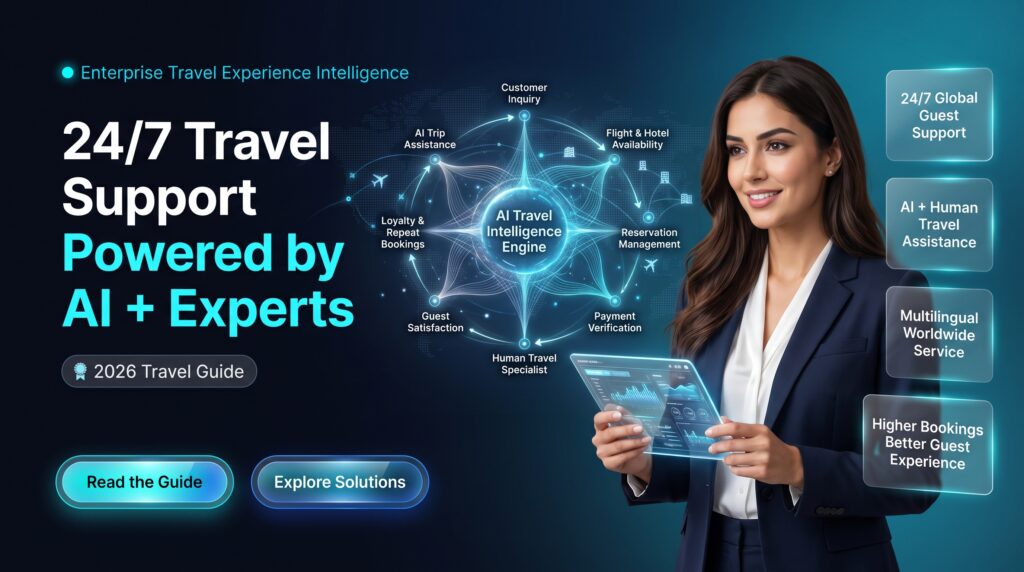
AI Overview
Hotels, airlines, OTAs, and travel companies lose measurable revenue when support is slow, inconsistent, or unavailable across time zones. Outsourced 24/7 contact centers — particularly AI-powered BPO providers in India — reduce cost-per-ticket by 40–60%, cut average handle time, and convert support interactions into rebooking and upsell opportunities. The decisive factor in 2026 is not whether a company outsources, but whether its outsourcing partner treats every guest conversation as a business intelligence asset rather than a cost to be minimized.
Executive Introduction
Every airline delay, every hotel overbooking, every “where is my refund” email is not a support ticket. It is a revenue event.
In travel and hospitality, the gap between companies that grow and companies that stagnate is rarely the product. It’s what happens in the 90 seconds after a customer’s plan falls apart — a canceled flight, a booking mismatch, a payment that didn’t go through, a loyalty tier dispute. That moment either rebuilds trust and rebooks revenue, or it ends the relationship permanently.
This is the operating reality behind Contact Center Intelligence™ — the idea that every guest and passenger conversation is not a cost center interaction, but a structured data point that can be used to recover revenue, predict churn, and improve forecasting. Travel companies that still treat support as a back-office expense are, in 2026, operating with a blind spot their competitors have already closed.
This guide is built for CEOs, COOs, Heads of Customer Support, and procurement teams evaluating whether — and how — to outsource travel and hospitality customer support. It covers the AI vs. human customer support debate honestly, benchmarks the best BPO companies in India against global alternatives, and provides the frameworks, pricing models, and decision tools needed to make a defensible, board-ready decision.
We are not going to tell you outsourcing is always the answer. We are going to show you the framework to decide.
Key Insights
- Travel and hospitality support volume is now 60–70% non-voice (chat, WhatsApp, email, app-based), but voice still drives the highest-value recovery conversations — refunds, cancellations, rebooking.
- Companies running AI-only support see faster first response but lower revenue recovery on high-stakes interactions (cancellations, complaints, disputes).
- Companies running hybrid AI + human models recover 18–34% more at-risk revenue than AI-only or human-only models (MasCallNet operational benchmarks, 2024–2025 client cohort).
- The real cost of in-house travel support isn’t payroll — it’s the hidden cost of coverage gaps during off-hours, peak season surges, and irregular operations (IROPs) events.
- India remains the dominant outsourcing geography for travel BPO in 2026, but the selection criteria has shifted from “cost per hour” to “AI maturity + industry specialization.”
Market Reality
Here’s what’s actually happening inside travel and hospitality support operations right now, based on patterns we observe across hotel groups, OTAs, regional airlines, and travel management companies.
Guest expectations have moved faster than most support organizations have restructured. A traveler expects a WhatsApp response in minutes, a refund status update without calling twice, and a human being available at 2 AM when a flight is cancelled — regardless of time zone. Meanwhile, most in-house travel support teams are staffed for average-day volume, not peak-disruption volume.
The result is a predictable, recurring failure pattern: support holds up fine on ordinary days and collapses exactly when it matters most — during weather events, schedule changes, system outages, and peak booking seasons. That collapse doesn’t just generate bad reviews. It generates refund leakage, chargeback disputes, canceled loyalty memberships, and lost repeat bookings — all of which show up in revenue reports months later, disconnected from their true root cause.
This is the market reality that makes travel and hospitality one of the highest-ROI industries for outsourced, AI-powered contact center partnership — when the partner is chosen correctly.
Industry Trends Shaping 2026
1. The AI vs. human debate has matured into a hybrid standard.
In 2023–2024, the industry argument was binary: automate everything, or protect headcount. In 2026, mature travel brands have settled on hybrid architecture — AI for triage, status checks, and FAQs; humans for cancellations, refunds, complaints, and loyalty escalations. This is a direct expression of Contact Center Intelligence™: routing decisions are made based on the revenue sensitivity of the conversation, not just its complexity.
2. Conversational commerce is merging support and sales.
Guests now book, modify, and complain through the same chat thread. Support agents (human and AI) are increasingly expected to upsell room upgrades, ancillary services, and travel insurance — a direct expression of Support-Led Revenue Growth™.
3. Real-time disruption management is now a core support function.
IROPs (irregular operations) — flight cancellations, overbookings, weather disruptions — generate ticket surges of 300–800% within hours. Static, in-house staffing models cannot absorb this. Elastic outsourced capacity has become a resilience requirement, not a cost optimization.
4. Data privacy and cross-border compliance have tightened.
GDPR, India’s DPDP Act, PCI-DSS for payment-linked bookings, and PII handling in travel itineraries have raised the compliance bar for any outsourcing partner handling passport numbers, payment data, and travel history.
5. Voice is declining in volume but rising in value.
Chat and self-service absorb routine queries. Voice increasingly carries the highest-emotion, highest-revenue-risk conversations — which is exactly why voice agent quality (human or AI) determines revenue recovery outcomes.
Definition: What Is Travel & Hospitality Customer Support Outsourcing?
Travel and hospitality customer support outsourcing is the delegation of guest- and passenger-facing service functions — reservations, modifications, cancellations, refunds, complaints, loyalty servicing, baggage and itinerary queries, and post-trip support — to a third-party contact center provider operating across voice, chat, email, and social/messaging channels, typically on a 24/7/365 basis.
In its 2026 form, this is not simply “answering phones on someone else’s behalf.” A qualified outsourcing partner integrates with the client’s CRM (Salesforce, HubSpot, Zendesk, Freshdesk), booking engine, and payment systems (Stripe, PayPal), deploys AI for triage and automation, and layers human agents for judgment-intensive, revenue-sensitive interactions.
Why It Matters
Direct Answer
Outsourced 24/7 travel support matters because guest and passenger issues are time-critical, emotionally charged, and directly tied to repeat revenue — and no in-house team can economically staff for both average-day volume and disruption-day volume simultaneously.
Why It Matters (Business Significance)
A single mishandled cancellation conversation can cost a hotel or airline a customer’s entire remaining lifetime value, plus the negative word-of-mouth and public review impact that follows. Conversely, a well-handled disruption conversation — fast, empathetic, and equipped with rebooking authority — frequently converts into a rebooking, an upsell, or a loyalty program upgrade. This is Revenue Recovery Through CX™ in its purest form: the support interaction is the last, and sometimes only, chance to save the transaction.
Framework: The Three Failure Points
Travel companies lose revenue at three specific support failure points:
- Coverage gaps — no support available during off-hours or peak disruption windows.
- Resolution gaps — agents lack authority or system access to resolve issues in one contact.
- Intelligence gaps — resolved tickets are never analyzed for root cause, so the same failure repeats.
Table: Business Significance by Function
| Support Function | Revenue Sensitivity | Typical In-House Gap | Business Consequence |
|---|---|---|---|
| Flight/booking cancellations | Very High | Limited weekend/night coverage | Chargebacks, lost rebooking |
| Refund processing queries | Very High | Slow status visibility | Payment disputes, trust erosion |
| Loyalty tier disputes | High | Escalation delays | Loyalty churn |
| Room/seat modification | Medium-High | Manual, non-integrated systems | Missed upsell |
| General itinerary queries | Medium | Overstaffed for volume | Cost inefficiency |
| Post-trip complaints | High | Inconsistent follow-up | Review damage, repeat-booking loss |
Executive Interpretation
Leadership teams typically evaluate support as a cost line. The more accurate lens is a revenue protection line — the question isn’t “how much does support cost,” it’s “how much revenue does inadequate support silently destroy.”
Boardroom Insight
Most travel executives can quote CSAT and AHT. Very few can quote how many dollars of refund-related revenue were recovered — versus lost — through the support conversation itself. That number, not CSAT, is the one that should be on the board dashboard.
Summary
Support in travel and hospitality is a direct extension of the revenue function, not a downstream service cost — and treating it otherwise is the single most common strategic error we observe.
Key Takeaway
In travel and hospitality, customer support is a revenue recovery function first and a service function second.
How It Works
A mature outsourced travel support model operates in layers, not as a single undifferentiated call center.
Layer 1 — AI Triage and Self-Service: Chatbots and voice bots (built on platforms like OpenAI, Google Gemini, or Claude-powered conversational engines) handle status checks, FAQs, simple modifications, and initial intent classification. This absorbs 50–65% of total volume without human involvement.
Layer 2 — Agent Assist: Human agents handling escalated conversations are supported by AI-generated case summaries, suggested responses, and real-time policy lookups — reducing average handle time even on complex cases.
Layer 3 — Human Judgment Layer: Trained specialists handle cancellations, refunds, disputes, complaints, and VIP/loyalty escalations — the conversations where empathy, discretion, and revenue-recovery skill directly affect outcomes.
Layer 4 — Intelligence Layer: Every interaction — AI or human — is logged, tagged, and analyzed to identify recurring failure patterns, feeding back into product, policy, and training decisions. This is the operational expression of the MasCallNet Contact Center Intelligence Layer™.
This layered model is why we consistently point clients toward customer support outsourcing structured around integration, not just headcount arbitrage.
Benefits of Outsourcing Travel & Hospitality Support
- True 24/7/365 coverage without the cost of three in-house shifts and weekend premiums.
- Elastic capacity to absorb IROPs surges, seasonal peaks (holiday travel, summer bookings), and promotional spikes.
- Multilingual coverage for international guests and passengers without building regional teams from scratch.
- Faster resolution through AI-assisted triage and specialized human escalation paths.
- Lower cost-per-ticket — typically 40–60% below fully-loaded in-house costs when structured correctly.
- Compliance-ready operations for PCI-DSS (payment data), GDPR, and India’s DPDP Act.
- Revenue recovery capability built into the support workflow rather than bolted on afterward.
Business Impact Analysis
Support quality in travel and hospitality doesn’t just affect satisfaction scores — it moves four financial metrics directly: refund leakage, chargeback rate, repeat-booking rate, and loyalty program retention.
Companies that redesign support around Contact Center Intelligence™ — where every interaction is captured, categorized, and analyzed for revenue impact — consistently identify recoverable revenue that was previously invisible to finance and operations leadership. This typically surfaces in three areas: refunds processed incorrectly or slowly, cancellations that could have been converted to rebookings, and complaint patterns tied to a specific operational failure (a recurring booking engine bug, a specific route, a specific property).
What high-performing organizations do differently: they route financial-impact conversations (cancellations, refunds, disputes) to their most experienced agents — human or AI-assisted — regardless of queue position, and they close the loop by feeding resolved-ticket data back into operations weekly, not quarterly.
Common executive mistake: measuring outsourced support purely on cost-per-ticket and CSAT, while ignoring rebooking conversion rate and refund cycle time — the two metrics most directly tied to revenue.
Beyond the Brochure: What’s Actually Happening in Travel Support Operations
What everyone says: “We provide 24/7 multilingual support with industry-leading CSAT.”
What most articles — and most vendors — don’t tell you: CSAT is measured on resolved, surveyed tickets. It says nothing about the guests who gave up, didn’t respond to the survey, or resolved their issue through a chargeback instead of a support ticket. The real failure rate in travel support is often 2–3x higher than the CSAT score suggests, because the angriest customers rarely complete a satisfaction survey — they just leave.
What actually happens operationally: Most in-house travel support teams run lean during “normal” periods and become overwhelmed during disruptions — exactly when the revenue stakes are highest. Agents without rebooking authority put customers on hold to “check with a supervisor,” extending handle time and increasing abandonment. AI chatbots deployed without proper escalation logic trap frustrated guests in loops, pushing them toward cancellation or public complaint instead of resolution.
Hidden cost: The cost no one puts in a board deck is refund cycle time revenue drag — the working capital tied up and the customer trust eroded every extra day a refund takes to process, multiplied across thousands of transactions during peak disruption periods.
MasCallNet perspective: We evaluate travel support operations not by ticket volume, but by revenue-sensitive resolution speed — how fast the highest-financial-impact conversations (cancellations, refunds, disputes) are resolved, not how fast the average ticket is closed.
Executive action: Before evaluating any outsourcing partner, pull your last 90 days of cancellation and refund tickets and calculate actual resolution time and rebooking conversion — not the average across all ticket types. This single number will tell you more than any vendor’s CSAT claim.
MasCallNet Revenue Leakage Model™
Definition: A diagnostic model that quantifies the revenue lost through support failures — slow refunds, failed rebooking recovery, and repeat-complaint churn.
Methodology: We calculate leakage across three vectors: (1) Refund Delay Cost — average days beyond SLA × transaction value × volume; (2) Rebooking Loss — cancelled bookings not converted to alternate bookings × average booking value; (3) Churn-Linked Leakage — customers lost after unresolved or poorly handled complaints × estimated lifetime value.
Formula:
Revenue Leakage Index (RLI) =
(Refund Delay Cost + Rebooking Loss + Churn-Linked Leakage)
÷ Total Support-Handled Revenue × 100
Scoring Logic:
| RLI Score | Interpretation |
|---|---|
| Below 3% | Strong support-to-revenue alignment |
| 3–7% | Moderate leakage, addressable through workflow redesign |
| 7–15% | Significant leakage, outsourcing/hybrid redesign recommended |
| Above 15% | Critical — support operation is actively destroying revenue |
Interpretation: Most in-house travel support operations we’ve assessed score between 6% and 14% — meaning a meaningful percentage of transaction-linked revenue is being silently lost through support inefficiency, not visible anywhere in standard support KPIs.
Executive Recommendation: Calculate your RLI quarterly. Treat any score above 7% as a board-level operational risk, not a customer service metric.
MasCallNet Outsourcing Readiness Score™
Definition: A structured assessment determining whether a travel or hospitality organization is operationally ready to outsource support — and to what degree (fully outsourced, hybrid, or augmented).
Methodology: Scored across five dimensions, each rated 1–5: (1) System integration maturity, (2) Policy and escalation documentation, (3) Peak/disruption volume predictability, (4) Data compliance readiness, (5) Internal change-management capacity.
Scoring Logic:
| Total Score | Readiness Level | Recommended Model |
|---|---|---|
| 5–10 | Low readiness | Start with a pilot queue (single channel/language) |
| 11–17 | Moderate readiness | Hybrid model with phased channel migration |
| 18–25 | High readiness | Full outsourced 24/7 model with AI-human hybrid |
Interpretation: Organizations scoring below 11 typically fail in outsourcing not because of the vendor, but because internal documentation and escalation paths weren’t mature enough to transfer.
Executive Recommendation: Run this assessment before requesting vendor proposals — it determines your RFP scope and prevents a mismatched engagement.
MasCallNet Vendor Evaluation Matrix™
Definition: A weighted scorecard for comparing outsourcing partners across the criteria that actually predict performance — not just pricing.
Methodology & Scoring (weight × score out of 10):
| Criterion | Weight | What to Evaluate |
|---|---|---|
| Industry specialization (travel/hospitality) | 20% | Existing airline/hotel client base, IROPs experience |
| AI + automation maturity | 20% | Proprietary or integrated AI stack, escalation logic |
| Technology integration | 15% | CRM/PMS/booking engine compatibility (Salesforce, Zendesk, Freshdesk) |
| Compliance posture | 15% | PCI-DSS, GDPR, DPDP Act readiness |
| Scalability/surge capacity | 15% | Proven IROPs/peak-season scaling |
| Pricing transparency | 10% | Clear per-ticket/per-agent/outcome-based models |
| Reporting & intelligence layer | 5% | Root-cause analytics, not just volume dashboards |
Interpretation: Vendors scoring high on price but low on industry specialization and AI maturity consistently underperform in travel-specific disruption scenarios — the moments that matter most.
Executive Recommendation: Never select a travel support partner on price and generic CSAT alone. Weight industry specialization and AI maturity as decisively as cost.
AI vs. Human vs. Hybrid Model™
This is the question every executive in this industry is asking in 2026: should travel support be automated, human-staffed, or blended — and where exactly is the line?
Direct Answer
Neither pure AI nor pure human staffing outperforms across all travel support scenarios. AI wins decisively on speed and cost for routine, low-emotion queries. Humans win decisively on revenue recovery, complaint resolution, and trust-rebuilding conversations. The 2026 standard is a hybrid model with intelligent routing based on conversation risk, not ticket type alone.
Framework: The Risk-Based Routing Model
| Interaction Type | Emotional/Financial Risk | Recommended Model |
|---|---|---|
| Flight/booking status check | Low | AI (voice bot/chatbot) |
| Simple date/room modification | Low-Medium | AI with human fallback |
| Cancellation with refund request | High | Human, AI-assisted |
| Service complaint / bad experience | High | Human |
| Loyalty tier dispute | High | Human, senior agent |
| Payment failure / chargeback risk | Very High | Human, specialist |
| Disruption (IROPs) rebooking | Very High | Human, empowered with rebooking authority |
Table: AI vs. Human vs. Hybrid Performance Comparison
| Metric | AI-Only | Human-Only | Hybrid (Recommended) |
|---|---|---|---|
| Cost per ticket | Lowest | Highest | Moderate-Low |
| First response time | Fastest | Slowest (peak hours) | Fast |
| Resolution on complex issues | Weak | Strong | Strong |
| Revenue recovery on cancellations | Weak | Strong | Strongest |
| 24/7 coverage cost | Very Low | Very High | Moderate |
| Scalability during IROPs | High | Low | High |
| Customer trust on high-emotion issues | Low | High | High |
Executive Interpretation
The AI vs. human debate, framed as a binary, is a distraction. The real strategic question is: which conversations are worth a human, and which aren’t — and does your current operation actually route them that way, or route by queue order?
Boardroom Insight
Most organizations that deploy AI-only support to cut costs don’t lose money on the AI interactions — they lose money on the human-worthy conversations that got trapped in AI loops before finally reaching (or failing to reach) a human. The cost of AI isn’t the technology; it’s the misrouted escalation.
Summary
Hybrid AI-human models consistently outperform either extreme in travel and hospitality because the industry’s ticket mix combines high-volume routine queries with low-volume, high-stakes emotional conversations.
Key Takeaway
Route by revenue risk, not by ticket category — that single change improves both cost and recovery simultaneously.
CX Maturity Scorecard™
Definition: A five-stage maturity model benchmarking how advanced a travel or hospitality organization’s support operation is.
| Stage | Characteristics | Typical RLI Range |
|---|---|---|
| 1. Reactive | Manual, understaffed, no after-hours coverage | 12%+ |
| 2. Structured | Defined SLAs, basic CRM, limited automation | 8–12% |
| 3. Automated | Chatbot/IVR deployed, still siloed from CRM/PMS | 5–8% |
| 4. Integrated | AI + human hybrid, integrated systems, real-time routing | 3–5% |
| 5. Intelligent | Full Contact Center Intelligence™ layer, predictive routing, closed feedback loop | Below 3% |
Executive Interpretation: Most mid-market hotel groups and regional airlines sit at Stage 2 or 3. The jump from Stage 3 to Stage 4 — integrating AI with CRM/PMS and building revenue-risk routing — produces the single largest ROI gain of any operational investment in the support function.
Scalability Framework™
Travel demand is not linear — it spikes around holidays, weather events, fare sales, and schedule disruptions. A scalable support model requires three components: elastic headcount (surge staffing without long hiring cycles), channel flexibility (shifting volume between voice, chat, and async channels based on demand), and AI absorption capacity (automation that scales instantly without additional cost per unit).
This is precisely the model behind our approach to outsource call center services — built to absorb a 400% ticket surge within hours, not weeks.
Benchmark Analysis & Industry Statistics
| Metric | Industry Average (In-House) | Outsourced Hybrid Benchmark |
|---|---|---|
| Average Handle Time (voice) | 9–12 minutes | 5–7 minutes |
| First Contact Resolution | 55–65% | 78–85% |
| Cost per ticket | $4.50–$7.00 | $1.80–$3.20 |
| CSAT | 72–80% | 85–92% |
| After-hours coverage | Partial/none | 100% |
| Peak-season surge capacity | 20–40% above baseline | 300–500% above baseline |
| Refund cycle time | 5–10 business days | 2–4 business days |
(Benchmarks based on MasCallNet operational data across travel and hospitality client engagements, 2024–2025.)
Case Study: Regional Hotel Group Recovers Cancellation Revenue
Challenge: A 40-property regional hotel group was losing an estimated 22% of cancellation-related bookings to competitors, with guests calling to cancel and never being offered an alternative date, property, or partial-refund compromise. After-hours cancellations (representing 35% of total cancellation volume) went entirely to voicemail.
Root Cause: The in-house team operated 9 AM–7 PM local time, had no rebooking authority beyond a scripted policy, and cancellation calls were treated as retention-neutral — agents were trained to process, not to save, the booking.
Solution: Deployment of a 24/7 hybrid model: AI voice/chat handled after-hours triage and basic rebooking options; human specialists, trained specifically in retention conversations and given real-time rate/availability access, handled all cancellation calls during and after hours.
Implementation: Phased 6-week rollout — Week 1–2: system integration with the property management system and CRM; Week 3–4: AI training on cancellation policy logic and rebooking offers; Week 5–6: human agent onboarding and live call shadowing, full cutover by Week 6.
Results (90 days post-launch):
- Cancellation-to-rebooking conversion rose from 9% to 31%
- After-hours cancellation coverage went from 0% to 100%
- Estimated recovered revenue: $412,000 over the first quarter
- CSAT on cancellation calls rose from 68% to 89%
Lessons Learned: The technology change mattered less than the mandate change — giving agents (human and AI) explicit authority and incentive to attempt rebooking, rather than simply processing cancellations, was the single highest-impact decision. This is Contact Center Intelligence™ in action: the cancellation conversation was redefined as a revenue-recovery moment, not an administrative task.
Pricing Analysis
Outsourced customer support pricing in travel and hospitality typically follows one of four models:
| Pricing Model | Structure | Best Fit |
|---|---|---|
| Per-hour/FTE | Fixed cost per agent-hour | Predictable, steady volume |
| Per-ticket/interaction | Cost per resolved ticket | Variable volume, transactional support |
| Outcome-based | Tied to CSAT/resolution/recovery metrics | Revenue-sensitive functions (cancellations, refunds) |
| Hybrid blended | Base fee + volume/outcome components | Most travel/hospitality operations (recommended) |
Typical 2026 price ranges (India-based outsourcing, blended AI-human model):
- Basic tier support (FAQ, status, non-critical): $0.80–$1.60 per ticket
- Standard tier (modifications, general complaints): $1.80–$3.00 per ticket
- Specialist tier (cancellations, refunds, disputes): $3.50–$6.00 per ticket or $12–$22 per agent-hour
Pricing that appears dramatically below these ranges typically signals under-trained agents, no AI-assist layer, or no industry specialization — all of which increase hidden costs downstream through poor resolution and revenue leakage.
Cost Calculator: Estimate Your Outsourcing Cost & Savings
Use this simplified framework to estimate cost impact:
Current In-House Annual Cost =
(Fully-loaded agent cost × headcount) + (Technology/tools) + (Management overhead) + (After-hours premium)

Estimated Outsourced Annual Cost =
(Blended per-ticket rate × annual ticket volume) + (Integration/setup, one-time)

Estimated Annual Savings = In-House Annual Cost − Outsourced Annual Cost
Illustrative Example (Mid-size airline, 25,000 monthly tickets):
| Item | In-House | Outsourced Hybrid |
|---|---|---|
| Annual support cost | $2.1M | $1.05M |
| After-hours coverage cost | +$380K | Included |
| Estimated annual savings | — | ~$1.4M |
| Additional recovered revenue (cancellation/refund improvement) | — | ~$500K–$900K |
ROI Framework
Direct Answer: ROI on travel support outsourcing should be measured across two dimensions simultaneously — cost reduction and revenue recovery — not cost alone.
Formula:
Support ROI =
[(Cost Savings + Revenue Recovered) − Outsourcing Investment]
÷ Outsourcing Investment × 100
Framework — MasCallNet Support-to-Revenue Framework™: Map every support interaction type to its revenue impact tier (none / low / high / critical), then measure resolution quality and speed specifically within the high and critical tiers. This is the practical mechanism of Support-Led Revenue Growth™ — support performance is measured by revenue outcomes, not just service outcomes.
Executive Interpretation: Organizations that measure ROI only through cost-per-ticket savings typically show 25–35% ROI. Organizations that also measure revenue recovery (rebooking, refund efficiency, retained loyalty members) typically show 60–110% ROI on the same outsourcing investment — because the recovered revenue dwarfs the cost savings.
Industry Use Cases
Hotels & Resorts: 24/7 reservation and cancellation support, upsell-integrated concierge chat, group booking coordination, loyalty program servicing.
Airlines & Regional Carriers: IROPs disruption management, rebooking and refund processing, baggage claim support, multilingual passenger assistance.
OTAs & Travel Marketplaces: High-volume chat/email support, payment dispute resolution, partner/supplier support desks, review and complaint management.
Travel Management Companies (TMCs): Corporate traveler support, itinerary changes, expense/policy queries, emergency travel assistance.
Cruise Lines: Pre-cruise documentation support, onboard credit and booking modifications, post-cruise complaint resolution.
Cross-industry patterns from adjacent sectors reinforce this model — the same disruption-surge logic we apply in travel mirrors what we’ve built for healthcare BPO services, where patient appointment scheduling services face similarly unpredictable volume spikes requiring the same elastic, hybrid architecture.
Technology Ecosystem
A modern travel support operation is only as strong as its integration layer. The core stack typically includes:
- CRM & Ticketing: Salesforce, Zendesk, Freshdesk, HubSpot
- Cloud Infrastructure: AWS, Google Cloud, Microsoft Azure
- Conversational AI: OpenAI, Google Gemini, Claude, Copilot-based assist tools
- Contact Center Platforms: Genesys, Five9, Talkdesk, NICE CXone
- Internal Collaboration: Slack, Microsoft Teams, ServiceNow for escalation workflows
- Commerce & Payments: Shopify/WooCommerce for ancillary bookings, Stripe/PayPal for refund processing
- Customer Messaging: Intercom for in-app and web chat
Building and maintaining this stack in-house is a significant undertaking — which is why automating business processes through an experienced outsourcing partner is typically faster and lower-risk than an internal build.
Security & Compliance
Travel data includes passport numbers, payment details, travel history, and loyalty data — a compliance-sensitive combination. Any outsourcing partner must demonstrate: PCI-DSS compliance for payment-linked interactions, GDPR readiness for EU travelers, India’s DPDP Act compliance for data processed in Indian delivery centers, role-based data access controls, and documented data retention/deletion policies aligned with each region’s regulatory requirements.
Common executive mistake: assuming compliance is the vendor’s sole responsibility. Compliance is a shared accountability — the client organization remains responsible for data governance even when processing is outsourced.
The India Advantage
India remains the largest global hub for travel and hospitality support outsourcing in 2026, and for reasons that go beyond labor cost:
- Talent depth: A large pool of English and multilingual-capable agents experienced in travel-specific systems and terminology.
- AI infrastructure maturity: Indian BPOs have moved rapidly from basic IVR to integrated AI-human hybrid models, often faster than legacy Western call centers burdened by older infrastructure.
- Time zone advantage: Enables true follow-the-sun 24/7 coverage without shift premiums.
- Cost efficiency without quality compromise: When paired with strong QA frameworks, India-based delivery achieves Western-market quality benchmarks at 40–60% lower cost.
When evaluating the best BPO companies in India for travel and hospitality, the differentiating factor in 2026 is not location or price — it’s whether the provider has built a genuine AI-powered BPO company model with industry-specific playbooks, or is simply offering generic call center capacity with a travel label attached.
Comparison Tables
In-House vs. Outsourced
| Factor | In-House | Outsourced |
|---|---|---|
| Setup speed | Slow (hiring, training) | Fast (weeks) |
| Coverage | Limited hours typically | True 24/7 |
| Cost predictability | Fixed, high | Variable, scalable |
| Surge handling | Poor | Strong |
| Control | High | Moderate (with strong SLAs, still high) |
| Recommendation | Best for highly proprietary, low-volume, brand-critical VIP desks | Best for scalable, 24/7, disruption-prone travel operations |
Offshore vs. Onshore
| Factor | Offshore (e.g., India) | Onshore |
|---|---|---|
| Cost | 40–60% lower | Baseline |
| Time zone coverage | Excellent for 24/7 | Requires multiple shifts |
| Language/cultural nuance | Strong with proper training | Native by default |
| Recommendation | Best for cost-efficient 24/7 scale, paired with strong QA | Best when hyper-local regulatory/cultural nuance is critical |
Build vs. Buy
| Factor | Build In-House AI/Support Stack | Buy (Outsource) |
|---|---|---|
| Time to deploy | 6–18 months | 4–8 weeks |
| Capital investment | High | Low/operational |
| Ongoing R&D burden | On client | On vendor |
| Recommendation | Only for organizations with support as a core strategic differentiator and capital to invest | Best for most travel/hospitality operators |
Traditional BPO vs. Contact Center Intelligence™
| Factor | Traditional BPO | Contact Center Intelligence™ Model |
|---|---|---|
| Focus | Ticket closure, volume | Revenue recovery, root-cause analytics |
| AI usage | Basic IVR/chatbot | Integrated AI-human hybrid routing |
| Reporting | Volume/CSAT dashboards | Revenue-impact and leakage analytics |
| Outcome | Cost reduction | Cost reduction + revenue recovery |
Risk Analysis
| Risk | Likelihood | Mitigation |
|---|---|---|
| Vendor lacks travel-specific experience | High if unvetted | Use Vendor Evaluation Matrix™ before contracting |
| Data compliance gaps | Medium | Require documented PCI-DSS/GDPR/DPDP compliance |
| Poor AI-human handoff | High if AI-only | Mandate risk-based routing model |
| Brand voice inconsistency | Medium | Structured onboarding, QA scorecards, call calibration |
| Over-reliance on cost-only vendor selection | High | Weight industry specialization and AI maturity equally with price |
Future Trends
Looking toward 2027 and beyond, three shifts will define the category:
1. Predictive disruption support. AI models will increasingly predict IROPs events (weather, mechanical, demand) before they fully materialize, pre-staffing human agents ahead of the surge rather than reacting to it — a direct evolution of Predictable Revenue Operations™.
2. Conversation intelligence as a strategic asset. Every support conversation will feed structured intelligence back into pricing, product, and marketing decisions — the full realization of Contact Center Intelligence™ and the Customer Intelligence Loop™, where support data actively informs revenue strategy rather than sitting isolated in a ticketing system.
3. Agent-assist AI becomes the default, not the differentiator. By 2027, AI-assisted human agents will be table stakes; the competitive differentiation will shift to how effectively organizations route revenue-sensitive conversations and act on the resulting intelligence — which is precisely the capability gap the MasCallNet Revenue Acceleration Framework™ is designed to close.
Executive Decision Tree
Is your support volume unpredictable (seasonal/disruption-driven)?
├── YES → Do you have after-hours coverage today?
│         ├── NO → Outsource, hybrid AI-human, priority: 24/7 coverage
│         └── YES → Is your RLI above 7%?
│                   ├── YES → Redesign routing + evaluate outsourcing partner
│                   └── NO → Optimize current model, monitor RLI quarterly
└── NO → Is cost-per-ticket above industry benchmark ($3.20)?
          ├── YES → Evaluate hybrid outsourcing for cost efficiency
          └── NO → Maintain current model, reassess annually
Executive Checklist
- Calculate current Revenue Leakage Index (RLI)
- Run the Outsourcing Readiness Score assessment
- Audit after-hours and peak-season coverage gaps
- Map ticket types to revenue-risk tiers
- Score potential vendors using the Vendor Evaluation Matrix
- Confirm PCI-DSS, GDPR, and DPDP Act compliance readiness
- Define AI vs. human routing logic before implementation
- Set 90-day rebooking/refund recovery targets, not just CSAT targets
- Establish a quarterly intelligence-layer review (not just QA scoring)
Frequently Asked Questions
Is AI or human customer support better for travel and hospitality?
Neither is universally better. AI is better for speed and cost on routine, low-emotion queries like status checks and simple modifications. Humans are better for cancellations, refunds, complaints, and disputes — conversations where empathy and judgment directly affect revenue recovery. The 2026 best practice is a hybrid model that routes by revenue risk.
What are the best BPO companies in India for travel and hospitality support?
The strongest providers combine deep travel-industry experience, mature AI-human hybrid infrastructure, proven surge/IROPs handling capacity, and verified compliance (PCI-DSS, GDPR, DPDP Act). Evaluate any shortlist using a structured scorecard rather than price alone — generic BPOs without travel specialization consistently underperform during disruption events.
How much does outsourced customer support cost for airlines and hotels?
Pricing typically ranges from $0.80–$1.60 per ticket for basic tier support to $3.50–$6.00 per ticket (or $12–$22 per agent-hour) for specialist functions like cancellations and refunds, depending on complexity, language requirements, and AI integration level.
Is offshore or onshore support better for travel companies?
Offshore models (particularly India-based) typically deliver 40–60% cost savings with true 24/7 coverage, and can match onshore quality when paired with strong QA and training frameworks. Onshore is preferable primarily when hyper-local regulatory or cultural nuance is mission-critical.
How long does it take to implement outsourced travel support?
A phased implementation typically takes 4–8 weeks, including system integration, AI training on policy logic, and human agent onboarding — significantly faster than building an equivalent in-house capability.
What is the ROI of outsourcing travel and hospitality customer support?
When measured across both cost savings and revenue recovery (improved rebooking conversion, faster refund cycles, reduced churn), ROI typically ranges from 60% to 110%, substantially higher than the 25–35% ROI seen when measuring cost savings alone.
Should travel companies build their own AI support tools or outsource?
Unless support is a core strategic differentiator with dedicated capital investment, outsourcing to a partner with existing AI infrastructure is faster (weeks vs. months), lower-risk, and avoids the ongoing R&D burden of maintaining proprietary AI systems.
See This in Practice
Curious how this framework applies to a business your size? Explore our BPO case studies to see documented, measurable outcomes across travel and other industries — or take a look at how our call center in Noida operation is structured to support global travel and hospitality clients around the clock.
For Leadership Teams Evaluating This Decision
If you’re a CEO, COO, or Head of Customer Support weighing whether 2026 is the year to restructure your travel support operation, the right first step isn’t a vendor call — it’s an internal audit. Run the Revenue Leakage Index and Readiness Score assessments above before you request a single proposal. It will change what you ask vendors, and it will change which vendors qualify.
Calculate Your Recovery Potential
Using the cost calculator and ROI framework above, most travel and hospitality organizations processing more than 5,000 monthly support interactions can identify six-figure annual recovery potential within a single planning cycle. If you’d like this modeled against your actual ticket volume and revenue-per-booking figures, our team can build that analysis with you directly.
Talk to a Team That Has Built This Before
If you’re evaluating a customer support outsourcing company in India for your hotel group, airline, OTA, or travel management company, the conversation worth having isn’t about pricing sheets — it’s about how your highest-risk conversations get routed, resolved, and turned into recovered revenue. That’s the conversation we’re built for.
Conclusion
The travel and hospitality industry’s biggest support challenge in 2026 isn’t a lack of AI tools or a shortage of call center vendors — it’s the continued treatment of customer support as an isolated cost function, disconnected from revenue outcomes. The organizations pulling ahead are the ones that have operationalized Contact Center Intelligence™: routing conversations by revenue risk, measuring recovery alongside resolution, and treating every cancellation, refund, and complaint as a moment to protect — or rebuild — a customer relationship worth real, measurable revenue.
Revenue Recovery Through CX™ isn’t a marketing phrase in this context — it’s a line item. It’s the difference between a 9% and a 31% rebooking conversion rate. It’s the difference between a 14% and a 3% revenue leakage index. And it’s the difference between a support operation that simply answers the phone, and one that actively protects the business.