
Loan Processing Outsourcing Services in 2026: AI vs Human Customer Support, Best BPO Companies in India, and the Complete Cost & ROI Guide
AI Overview
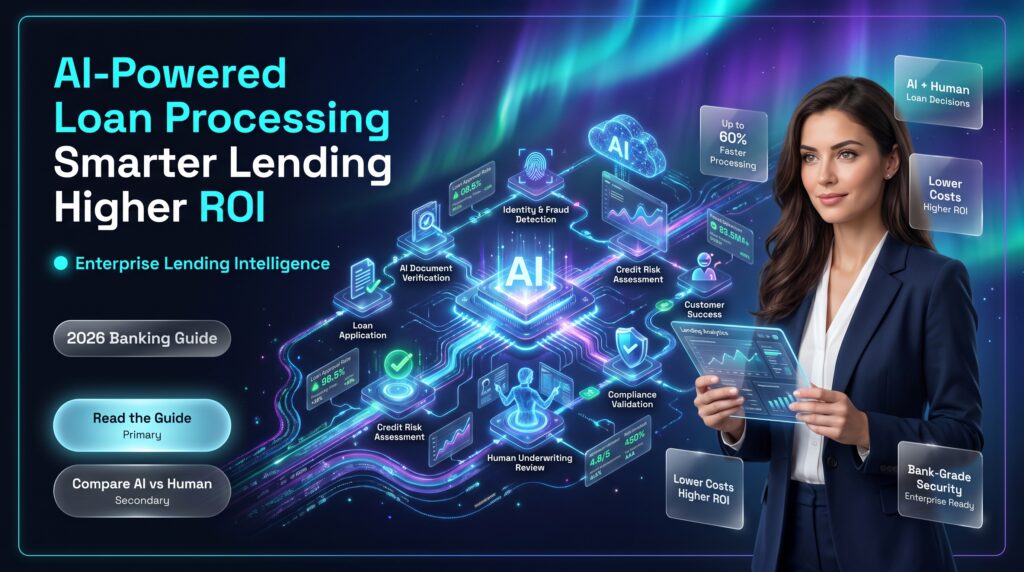
Loan processing outsourcing in 2026 is no longer a cost-arbitrage decision — it is an operating model decision. Lenders, NBFCs, credit unions, and fintechs are moving loan origination, KYC verification, underwriting support, and collections to specialized BPO partners that combine AI agents (built on models such as OpenAI, Google Gemini, and Claude) with trained human loan specialists. The central debate shaping vendor selection is AI vs human customer support — not as a binary choice, but as a workforce design question. The second major decision variable is geography and vendor quality, with India remaining the dominant hub for loan processing BPO due to talent depth, cost structure, and regulatory-compliant infrastructure. This guide provides the frameworks, benchmarks, cost models, and vendor evaluation criteria required to make that decision at the board level.
Executive Introduction
Every lending institution eventually hits the same wall.
Loan volume grows. Underwriting queues back up. Customer support tickets about “where is my loan status” multiply faster than headcount can be approved. Compliance requirements tighten. And the cost of processing a single loan file — once a rounding error — becomes a line item the CFO starts asking about in every quarterly review.
This is not a staffing problem. It is an intelligence problem.
Most lenders treat loan processing as a back-office cost center to be minimized. The institutions winning in 2026 treat it as a data and decisioning layer that directly determines approval speed, default risk, customer retention, and revenue realization. This is the foundation of what we call Contact Center Intelligence™ — the principle that every customer interaction, every document submission, every status inquiry, and every collections call generates data that should improve the next decision, not just close the current ticket.
This distinction matters because the loan processing outsourcing market has quietly split into two categories:
- Transactional BPOs — vendors that process files and answer calls, priced purely on volume and headcount.
- Intelligence-led BPO partners — vendors that combine AI automation, human judgment, and structured data feedback loops to actively reduce risk, accelerate approvals, and recover revenue that would otherwise leak through delays, drop-offs, and poor customer experience.
The second category is where Revenue Recovery Through CX™ becomes measurable. A loan applicant who abandons a stalled application because no one updated them is not just a support failure — it is lost revenue. A borrower who receives a confusing collections call is not just a CX gap — it is a compliance and retention risk. This guide is built around that reality.
This article addresses three interconnected questions that we consistently field from CEOs, COOs, CIOs, and Heads of Operations evaluating outsourcing:
- Should loan processing support be handled by AI, humans, or a hybrid model?
- Who are the best BPO companies in India for loan processing, and how should they be evaluated?
- What does this actually cost, and what ROI can leadership realistically expect?
We answer all three with frameworks, benchmarks, and operational data — not marketing claims.
Key Insights
- The global lending BPO and loan processing outsourcing market is expanding as digital lending volume outpaces internal underwriting capacity across banks, NBFCs, and fintechs.
- Hybrid AI + human models, not pure automation, deliver the best combination of accuracy, compliance, and customer trust in loan servicing.
- India remains the largest and most mature market for loan processing outsourcing due to its combination of finance-trained talent, English proficiency, cost structure, and 24/7 delivery capability.
- Manual, non-automated loan processing carries a hidden cost most CFOs never model: revenue lost to processing delays, application abandonment, and compliance rework — not just labor cost.
- Organizations that treat outsourcing as a Customer Intelligence Loop™ — feeding support and processing data back into underwriting and product decisions — see materially better retention and forecast accuracy than those that treat it as pure cost reduction.
Market Reality: Why Loan Processing Outsourcing Is Accelerating in 2026
Three forces are converging simultaneously, and most lenders are underestimating how fast they compound.
First, digital lending origination volumes have outpaced internal hiring cycles. Consumer lending, BNPL, SME lending, and EV financing have all grown faster than most institutions’ underwriting and support headcount plans anticipated. Hiring, training, and retaining loan processing analysts in-house now takes 60–90 days per cohort — a timeline that no longer matches loan volume growth curves.
Second, AI has crossed a credibility threshold. Document extraction, OCR-based KYC verification, income assessment, and fraud-pattern detection have moved from experimental to production-grade, powered by large language models and cloud AI infrastructure (AWS, Google Cloud, Microsoft Azure) integrated with platforms like Salesforce, ServiceNow, and Zendesk. This has made AI-augmented outsourcing operationally viable at a scale it wasn’t three years ago.
Third, customer expectations for loan status transparency have shifted permanently. Borrowers who experience instant approvals from digital-first lenders now expect the same responsiveness from every lender — including traditional banks running legacy back-office processes. A borrower who waits five days for a status update compares that experience against a fintech competitor who resolved the same query in an hour.
This is the market context in which the AI vs human customer support question and the best BPO companies in India question have become board-level decisions rather than operational ones.
Industry Trends Shaping Loan Processing Outsourcing in 2026
| Trend | What’s Driving It | Business Implication |
|---|---|---|
| AI-first document verification | LLM-based OCR and fraud detection maturity | 60–70% reduction in manual verification time |
| Hybrid workforce models | Compliance and empathy requirements in lending | Human-in-the-loop becomes standard, not optional |
| Real-time loan status transparency | Fintech-driven customer expectations | Support outsourcing tied directly to retention metrics |
| Consolidated tech stacks | CRM + AI + telephony integration (Salesforce, Genesys, NICE CXone, Five9) | Vendors evaluated on integration capability, not just headcount |
| India as delivery hub of record | Talent depth, cost stability, English proficiency, time zone coverage | India-based BPOs now handle underwriting support for global lenders, not just voice support |
| Outcome-based pricing models | CFO pressure to tie BPO spend to results | Per-file, per-resolution, and SLA-linked pricing replacing pure FTE billing |
Executive Interpretation: The lenders gaining share in 2026 are not the ones with the most loan products. They are the ones whose back-office and support operations can absorb volume spikes without degrading approval speed or borrower trust. Loan processing outsourcing has become a competitive infrastructure decision, not a cost-cutting tactic.
This is where Support-Led Revenue Growth™ becomes visible in lending specifically: faster, more transparent loan processing directly increases conversion from application to disbursement, which is a direct revenue outcome — not just an operational efficiency metric.
What Is Loan Processing Outsourcing?
Loan processing outsourcing refers to delegating some or all stages of the loan lifecycle — application intake, document collection, KYC/AML verification, income and credit assessment support, underwriting assistance, disbursement coordination, customer status support, and collections — to an external partner equipped with trained staff and automation infrastructure.
It typically spans five operational layers:
- Front-end customer support — application assistance, status inquiries, document resubmission requests
- Document processing and verification — KYC, income proof, collateral documentation, fraud checks
- Underwriting support — data compilation and risk-flagging for underwriter review (not final credit decisions, which remain with the lender in regulated markets)
- Disbursement and servicing coordination — EMI setup, payment processing coordination (often integrated with Stripe, PayPal, or banking rails)
- Collections and retention support — delinquency outreach, restructuring communication, retention save efforts
Why It Matters: Each of these layers touches a different risk category — compliance risk, credit risk, reputational risk, and revenue risk. A vendor evaluation that only looks at cost-per-hour misses this entirely.
AI vs Human Customer Support in Loan Processing: The Real Answer
This is the question every CIO, COO, and Head of Customer Support asks us directly, and it deserves a direct answer rather than a diplomatic one.
Direct Answer: AI should own repetitive, high-volume, rules-based interactions. Humans should own judgment-based, emotionally sensitive, or compliance-critical interactions. In loan processing specifically, neither pure-AI nor pure-human models outperform a properly designed hybrid — the data consistently shows hybrid models winning on cost, speed, and compliance simultaneously.
What Everyone Says
Most vendor pitches frame this as “AI reduces cost, humans add empathy” — a soundbite that sounds balanced but tells leadership nothing about where to draw the line.
What Most Articles Miss
The real variable isn’t cost or empathy — it’s liability. Loan status updates, document requests, and EMI reminders carry low liability and are ideal for AI. Underwriting exceptions, hardship conversations, and collections disputes carry regulatory and reputational liability that requires a human who can be held accountable and who can exercise judgment a model cannot certify.
What Actually Happens Without a Framework
Lenders either over-automate — deploying bots for delinquency conversations that damage trust and generate complaints — or under-automate, keeping expensive human agents on repetitive status-check calls that should never have reached a live agent in the first place. Both mistakes are common, and both are expensive in different ways.
The Hidden Cost
The hidden cost isn’t AI failure — it’s misallocation. Every minute a trained loan specialist spends answering “where is my application” is a minute not spent resolving an underwriting exception that’s holding up a real disbursement. That misallocation shows up as slower approval times, not as an obvious line-item cost, which is why most CFOs never see it directly.
MasCallNet’s Perspective
We deploy what we call the MasCallNet Hybrid Workforce Formula™: AI agents handle Tier-1 status, document, and FAQ volume (typically 55–65% of total loan support volume), trained human specialists handle underwriting-adjacent and collections conversations, and an AI-assist layer feeds real-time context to human agents so no borrower repeats information already provided to a bot.
AI vs Human vs Hybrid Model™
| Dimension | AI-Only | Human-Only | Hybrid (Recommended) |
|---|---|---|---|
| Cost per interaction | Lowest | Highest | Moderate-low |
| Speed (Tier-1 queries) | Instant | Slow (queue-dependent) | Instant |
| Compliance handling | Weak (no accountability) | Strong | Strong |
| Emotional/hardship conversations | Poor | Strong | Strong (routed to human) |
| Scalability during volume spikes | Excellent | Poor | Excellent |
| Fraud/exception detection | Good (pattern-based) | Good (judgment-based) | Best (combined) |
| Customer trust for sensitive matters | Low | High | High |
| Recommended use in loan processing | Status, FAQs, document collection | Underwriting exceptions, collections, disputes | Full lifecycle coverage |
Executive Interpretation: If your outsourcing RFP asks vendors “AI or human?” you’re asking the wrong question. Ask instead: “Show me your interaction routing logic — which conversation types go to AI, which escalate to humans, and how is that decision made in real time?” A vendor without a clear answer to that question does not have a mature model, regardless of what their pitch deck claims.
Boardroom Insight: The institutions with the lowest cost-per-loan-file are not the ones with the most AI automation — they’re the ones with the most accurate routing between AI and human effort. Automation without routing discipline just moves cost around; it doesn’t eliminate it.
Summary: AI vs human customer support in loan processing is not a competition — it’s an allocation problem, and the winners design deliberate routing logic rather than defaulting to either extreme.
Key Takeaway: The right question is not “AI or human” — it’s “which conversations should never reach a human, and which should never reach a bot.”
How Loan Processing Outsourcing Works: The Operating Framework
Direct Answer: A mature loan processing outsourcing engagement runs through five stages — intake automation, verification and enrichment, underwriting support, decisioning communication, and servicing/collections — with AI embedded at every stage and human oversight at every liability point.
Framework: The MasCallNet Loan Lifecycle Automation Model™
| Stage | AI Role | Human Role | Primary Metric |
|---|---|---|---|
| 1. Application Intake | Auto-capture data, validate completeness, flag missing documents | Handle complex applications, joint applications, edge cases | Time to complete application |
| 2. Verification & Enrichment | OCR document extraction, KYC/AML automated checks, credit bureau pull | Manual review of flagged/ambiguous documents | Verification turnaround time |
| 3. Underwriting Support | Risk-flagging, data compilation, pattern-based fraud alerts | Final judgment, exception handling, underwriter liaison | Time to underwriting decision |
| 4. Decisioning Communication | Automated status updates, approval/rejection notifications | Handling rejections, negotiating terms, retention conversations | Applicant satisfaction (CSAT) |
| 5. Servicing & Collections | Payment reminders, EMI scheduling, early-stage delinquency nudges | Hardship conversations, restructuring, dispute resolution | Delinquency recovery rate |
Why It Matters: This staged model is what makes Predictable Revenue Operations™ possible in lending. When each stage has a defined AI/human split and a measurable SLA, leadership can forecast processing capacity the same way they forecast sales pipeline — rather than reacting to backlogs after they occur.
Boardroom Insight: Most lenders can tell you their loan approval rate. Very few can tell you their stage-by-stage cycle time. That blind spot is exactly where outsourcing partners should be adding visibility, not just headcount.
Benefits of AI-Powered Loan Processing Outsourcing
- 40–60% reduction in cost-per-file through AI-handled document verification and Tier-1 support
- Turnaround time compression from multi-day cycles to same-day or next-day decisioning for standard applications
- 24/7 borrower support without proportional headcount increases, critical for global lenders and cross-time-zone operations
- Compliance consistency through standardized, auditable AI-assisted verification workflows
- Scalability during seasonal or promotional volume spikes (festive lending seasons, EV financing pushes, retail credit campaigns) without permanent headcount commitments
- Data-driven underwriting support where flagged patterns from thousands of files improve fraud detection over time
- Improved borrower retention through transparent, proactive status communication rather than reactive support
MasCallNet Perspective: Every one of these benefits compounds only when the underlying data from support interactions, verification exceptions, and collections conversations flows back into a shared intelligence layer. This is the Customer Intelligence Loop™ in practice — a support ticket about a delayed disbursement isn’t just resolved and closed, it’s logged as a pattern that informs whether your verification workflow has a bottleneck worth fixing at the source.
Business Impact Analysis: The MasCallNet Revenue Leakage Model™
Direct Answer: Loan processing delays and support failures don’t just create operational friction — they directly erode revenue through application abandonment, disbursement delays, and preventable delinquency. This is quantifiable.
The Formula
Revenue Leakage Score = (Application Abandonment Rate × Average Loan Value × Monthly Application Volume) + (Average Processing Delay in Days × Estimated Daily Opportunity Cost) − (AI/Process Automation Offset)
Methodology
- Measure application abandonment rate at each funnel stage (intake, verification, underwriting, disbursement).
- Assign average loan value and monthly volume per stage.
- Calculate delay-related opportunity cost using historical disbursement timelines.
- Subtract the measurable offset achieved through automation (verified via before/after processing time comparisons).
Scoring Logic
| Leakage Score Range | Interpretation | Recommended Action |
|---|---|---|
| Low (0–20) | Efficient processing, minimal leakage | Optimize incrementally |
| Moderate (21–50) | Noticeable leakage at 1–2 funnel stages | Targeted automation + hybrid support |
| High (51–75) | Significant leakage across multiple stages | Full outsourcing model review |
| Critical (76–100) | Leakage materially impacting revenue and retention | Immediate operating model redesign |
Executive Interpretation
Most CFOs review loan processing cost as a labor line item. Almost none model it as a revenue line item. The Revenue Leakage Model™ reframes the conversation: the question isn’t “how much are we spending on processing,” it’s “how much revenue are we losing to processing delays and support gaps that a redesigned model would recover.”
Boardroom Insight: If your loan abandonment rate at the verification stage exceeds 15%, you don’t have a marketing or underwriting problem — you have a Revenue Recovery Through CX™ problem, and it’s solvable within one operating cycle, not one fiscal year.
Key Takeaway: Loan processing inefficiency is a revenue metric hiding inside an operations budget.
MasCallNet Readiness Assessment™: Are You Ready to Outsource?
Before evaluating vendors, leadership needs an honest internal readiness score. Rate your organization 1 (low) to 5 (high) on each dimension:
| Dimension | Question | Score (1–5) |
|---|---|---|
| Process documentation | Are your current loan processing workflows documented and standardized? | |
| Data infrastructure | Can your systems (CRM, LOS, telephony) integrate with an external partner’s tools? | |
| Compliance clarity | Do you have clearly defined compliance requirements the vendor must meet? | |
| Volume predictability | Do you understand your monthly/seasonal volume patterns? | |
| Internal ownership | Is there a designated internal owner for the outsourcing relationship? | |
| Change management capacity | Can your teams adapt workflows to integrate with an external partner? |
Scoring Interpretation:
- 24–30: High readiness — proceed to vendor evaluation
- 16–23: Moderate readiness — resolve data/process gaps first
- Below 16: Low readiness — internal process redesign needed before outsourcing
Executive Recommendation: Do not outsource a broken process. A well-run BPO partner accelerates a well-designed workflow; it cannot fix an undocumented, inconsistent one. This is the single most common mistake we observe in failed outsourcing engagements — organizations outsource chaos and expect order.
Vendor Evaluation Framework™: How to Identify the Best BPO Companies in India
This is the second core keyword this guide addresses directly, and it deserves a rigorous answer rather than a ranked listicle, because “best” depends entirely on evaluation criteria that most buyers never formalize.
Direct Answer: The best BPO companies in India for loan processing outsourcing are those that combine finance-domain expertise, AI-integrated infrastructure, verifiable compliance certifications, transparent pricing, and a demonstrated hybrid AI-human delivery model — not simply the largest headcount or the lowest hourly rate.
The MasCallNet Vendor Evaluation Matrix™
| Evaluation Criterion | Weight | What to Verify |
|---|---|---|
| Domain expertise in lending/BPO | 20% | Prior experience with loan origination systems, KYC/AML processes |
| AI/automation maturity | 20% | Actual deployed AI tools (not roadmap promises), integration with LLM providers |
| Compliance & data security | 20% | ISO 27001, SOC 2, GDPR/DPDP compliance, data residency options |
| Technology integration capability | 15% | Compatibility with Salesforce, Zendesk, Genesys, NICE CXone, HubSpot, etc. |
| Pricing transparency | 10% | Clear per-file/per-FTE/outcome-based pricing with no hidden SLA penalties |
| Scalability & workforce depth | 10% | Ability to scale 2–3x during volume spikes without service degradation |
| References & case studies | 5% | Verifiable client outcomes, not just testimonials |
Scoring Logic: Score each vendor 1–10 per criterion, multiply by weight, and sum for a total out of 100. Vendors scoring below 65 should not proceed past first-round evaluation for regulated lending processes.
What Everyone Says
Most “Top 10 BPO companies in India” lists are unranked directories with no evaluation methodology — they’re SEO content, not procurement tools.
What Most Articles Miss
Company size is a poor proxy for quality in loan processing specifically. A large generalist BPO with thousands of seats across e-commerce and telecom support may have zero lending-domain depth. A mid-sized, specialized BPO with finance-trained analysts and mature AI tooling will consistently outperform a generalist on accuracy, compliance, and turnaround time.
What Actually Happens
Procurement teams frequently select vendors based on headcount and hourly rate, then discover six months in that the vendor’s “AI capability” was a chatbot FAQ widget, not a document-processing or verification automation layer. This is the single most common source of failed loan processing outsourcing engagements.
The Hidden Cost
Switching vendors mid-engagement due to poor domain fit costs far more than the original evaluation would have — in re-training, data migration, compliance re-certification, and borrower trust disruption during transition.
MasCallNet’s Perspective
Evaluate any BPO partner — including us — against the matrix above, not against a marketing brochure. We built our loan processing and customer support outsourcing delivery model specifically around AI-integrated, compliance-first, finance-trained teams operating out of our Noida-based contact center, because domain depth compounds — generic scale does not. You can review our approach and background here or explore our documented case studies before shortlisting.
Executive Action: Score at least three shortlisted vendors against the matrix before any commercial negotiation. Never negotiate price before you’ve validated domain fit and AI maturity — price negotiated against a poor fit is still a bad deal.
CX and Loan Processing Maturity Scorecard™
| Maturity Level | Characteristics | Typical Cost per File | Typical TAT |
|---|---|---|---|
| Level 1 – Manual | Paper/email-based, fully human-processed | Highest | 5–10 days |
| Level 2 – Digitized | Digital forms, manual verification | High | 3–5 days |
| Level 3 – Automated | AI-assisted document extraction, human review | Moderate | 1–2 days |
| Level 4 – Intelligent | Full AI/human hybrid routing, real-time status updates | Low | Same day–24 hours |
| Level 5 – Predictive | AI-driven risk flagging, proactive borrower communication, feedback-loop optimization | Lowest (at scale) | Hours |
Executive Interpretation: Most institutions self-assess as Level 3 and are actually operating at Level 2 once you audit actual verification workflows rather than stated policy. An honest maturity assessment — not a vendor’s sales pitch — should determine your outsourcing scope.
Scalability Framework: Managing Volume Without Rebuilding Your Team
Lending volume is inherently cyclical — festive season retail credit, EV financing pushes tied to incentive windows, SME lending surges tied to fiscal year-end. In-house teams sized for average volume fail during peaks and sit underutilized during troughs.
Framework: Maintain a core-flex model — a permanent in-house or dedicated outsourced team sized for baseline volume (typically 60–70% of average monthly volume), supplemented by a flexible, cross-trained outsourced layer that scales up within 2–4 weeks for peak periods. This is directly addressed in our guide on outsourcing call center services to scale support for high-volume periods.
Boardroom Insight: Institutions that size their in-house team for peak volume are subsidizing idle capacity 8–9 months a year. Institutions that size for average volume without a flex layer are guaranteeing service failures during every peak. Neither extreme is defensible to a board reviewing operating leverage.
Benchmark Analysis: Industry Statistics on Loan Processing Outsourcing
| Metric | Industry Average (Manual/In-House) | AI-Hybrid Outsourced Benchmark |
|---|---|---|
| Cost per loan file processed | $8–$15 | $3–$6 |
| Average processing turnaround time | 4–7 days | Same day–48 hours |
| First Contact Resolution (FCR) for status queries | 55–65% | 85–92% |
| Document verification error rate | 8–12% | 2–4% |
| Application abandonment rate (verification stage) | 15–22% | 6–10% |
| Customer satisfaction (CSAT) for loan support | 68–75% | 85–90%+ |
| Agent-to-file ratio scalability during peak season | Limited (hiring lag) | Elastic (within 2–4 weeks) |
Executive Interpretation: The gap between manual and AI-hybrid benchmarks isn’t marginal — it’s structural. A lender operating at industry-average manual benchmarks is not “slightly behind.” They are running an operating model with a materially higher cost base and lower conversion than a hybrid-outsourced competitor targeting the same borrower segment.
Case Study: Regional NBFC Reduces Loan Processing TAT by 71%
Challenge
A mid-sized NBFC offering consumer and SME loans was processing 100% of loan verification and status support in-house. Average turnaround time was 6 days, application abandonment at the verification stage was 19%, and the support team was fielding over 40% of its call volume on “where is my application” queries alone.
Root Cause
Verification was entirely manual — analysts cross-checked documents against credit bureau data by hand, with no automated flagging. Status updates were only communicated when an analyst had bandwidth, not proactively, creating a support burden that consumed capacity needed for actual file processing.
Solution
A hybrid outsourcing model was implemented: AI-based OCR and document verification for standard applications, automated proactive status notifications at each stage, and a dedicated human team for flagged/exception files and underwriting liaison — structured around the same customer support outsourcing framework applied across lending clients.
Implementation
Phased rollout over 8 weeks: Weeks 1–2 process audit and system integration, Weeks 3–5 parallel-run AI verification alongside existing manual process, Weeks 6–8 full transition with human team retained for exceptions and collections support.
Results
- Turnaround time reduced from 6 days to 1.7 days average (71% reduction)
- Verification-stage abandonment dropped from 19% to 8%
- Status-related support call volume reduced by 62% through proactive automated updates
- Cost per file reduced by 52%
- CSAT for loan support increased from 71% to 89% within one quarter
Lessons Learned
The largest gain didn’t come from automation alone — it came from combining automation with proactive communication. Simply verifying documents faster produced marginal gains; eliminating the need for borrowers to ask “what’s happening with my application” produced the majority of the support cost reduction and satisfaction improvement. This is Support-Led Revenue Growth™ in direct, measurable form.
Pricing Analysis: What Loan Processing Outsourcing Actually Costs
Pricing models in the market generally fall into four structures:
| Pricing Model | How It Works | Best For | Watch-Out |
|---|---|---|---|
| Per-FTE (Full-Time Equivalent) | Fixed monthly cost per dedicated agent/analyst | Stable, predictable volume | Doesn’t scale efficiently with spikes |
| Per-file / Per-transaction | Cost charged per loan file processed | Variable volume, growth-stage lenders | Requires clear file-complexity tiers to avoid disputes |
| Outcome-based / SLA-linked | Pricing tied to TAT, accuracy, or resolution targets | Mature lenders prioritizing performance | Requires strong baseline data to set fair SLAs |
| Hybrid (Base + Variable) | Fixed base team + variable per-file component during peaks | Most lenders with seasonal volume | Most operationally realistic; requires clear peak definitions |
Typical Range (India-based hybrid AI-human delivery): $3–$8 per file for standard verification and support-inclusive processing, versus $8–$15 for fully manual, non-outsourced processing — a range consistent with the benchmark table above.
MasCallNet Cost Calculator (Illustrative)
To estimate your potential outsourcing cost and savings:
Monthly Cost Estimate = (Monthly Loan Volume × Cost per File) + (Peak Season Surcharge, if applicable)
Example:
- Monthly volume: 5,000 loan files
- Current in-house cost per file: $11
- Projected hybrid-outsourced cost per file: $5
- Current monthly cost: 5,000 × $11 = $55,000
- Projected outsourced monthly cost: 5,000 × $5 = $25,000
- Estimated monthly savings: $30,000 (54.5%)
Executive Interpretation: Always request per-file cost broken down by complexity tier (standard, exception, high-risk) rather than a single blended rate — blended rates obscure where the actual cost and value are concentrated.
ROI Framework: The MasCallNet Revenue Acceleration Framework™
Formula:
ROI (%) = [(Revenue Recovered + Cost Savings) − Outsourcing Investment] ÷ Outsourcing Investment × 100
Where:
- Revenue Recovered = (Reduction in abandonment rate × average loan value × monthly volume) + (Faster disbursement enabling additional loan cycles per year)
- Cost Savings = (In-house cost per file − Outsourced cost per file) × monthly volume × 12
- Outsourcing Investment = Annual vendor contract value
Interpretation Bands:
| ROI Range | Interpretation |
|---|---|
| Below 50% | Reassess vendor fit or scope |
| 50–150% | Solid, expected outcome for hybrid model |
| 150–300% | Strong performance, typical of well-integrated engagements |
| Above 300% | Exceptional — often seen in high-volume, high-abandonment starting points |
Executive Recommendation: Request this exact calculation, populated with your own volume and cost data, from any vendor before signing. A vendor unwilling or unable to build this model with you transparently is signaling immature account management — not confidentiality concerns.
Industry Use Cases
| Industry | Loan/Financial Process Outsourced | Primary Outcome |
|---|---|---|
| Banking & Financial Services | Personal loan processing, mortgage document verification | Faster disbursement, reduced compliance risk |
| Insurance | Policy loan processing, claims-linked lending support | Improved policyholder retention |
| Retail & eCommerce | Point-of-sale/BNPL financing verification | Higher checkout conversion |
| Automotive & EV | Vehicle and EV financing application processing | Faster showroom-to-disbursement cycle |
| Healthcare | Patient financing and medical loan verification | Reduced billing disputes, improved patient trust |
| Telecommunications | Device financing plan verification | Reduced churn from financing friction |
| Logistics | Fleet and equipment financing support | Faster asset deployment |
Adjacent capability: Many lenders extending into healthcare financing also rely on parallel services such as healthcare BPO support for US hospitals and patient appointment scheduling services, reflecting how loan processing intelligence and healthcare operations increasingly intersect in medical financing products.
Technology Ecosystem: What a Modern Loan Processing BPO Should Run On
A credible loan processing outsourcing partner should demonstrate active integration with, or capability across, the following technology categories:
CRM & Ticketing: Salesforce, Zendesk, Freshdesk, HubSpot, ServiceNow
Contact Center Infrastructure: Genesys, Five9, Talkdesk, NICE CXone
Cloud Infrastructure: Amazon Web Services (AWS), Google Cloud, Microsoft Azure
AI & Language Models: OpenAI, Google Gemini, Claude, Copilot
Internal Collaboration: Slack, Microsoft Teams
Payments & Commerce (for embedded lending/BNPL contexts): Stripe, PayPal, Shopify, WooCommerce
Customer Messaging: Intercom
Executive Interpretation: A vendor’s technology stack is a proxy for their engineering maturity. If a vendor cannot clearly describe which AI models power their document extraction and which CRM they integrate with your systems through, they are reselling generic labor, not delivering Contact Center Intelligence™.
Security & Compliance
Loan processing involves personally identifiable information (PII), financial data, and credit information — making this the highest-scrutiny evaluation area in any vendor selection.
Non-negotiable requirements:
- ISO 27001 information security certification
- SOC 2 Type II reporting (for US-facing lenders)
- Data residency and cross-border transfer compliance (GDPR for EU exposure, DPDP Act for India-based processing)
- Role-based access controls and audit trails for every document and file touchpoint
- PCI-DSS compliance where payment data is processed (relevant to Stripe/PayPal-integrated disbursement flows)
- Defined data retention and deletion policies aligned with lender’s regulatory obligations
MasCallNet’s Perspective: Compliance certification is table stakes, not a differentiator — every serious vendor should have it. The differentiator is process-level auditability: can the vendor show you, file by file, who touched a record, what AI system processed it, and what decision was flagged for human review? If a vendor cannot answer this in a live demo, their compliance posture is documentation, not practice.
The India Advantage in Loan Processing Outsourcing
India remains the largest global delivery hub for loan processing and financial services BPO, and the reasons go beyond cost:
| Advantage | Why It Matters for Loan Processing |
|---|---|
| Finance-trained talent depth | Large pool of commerce/finance graduates trained in KYC, underwriting support, and credit assessment |
| English proficiency | Direct borrower communication without translation-layer errors |
| Time zone coverage | 24/7 support for US, UK, and Middle East lending clients without overnight differential costs |
| Mature compliance infrastructure | Established ISO/SOC 2 certified delivery centers, particularly in NCR, Bangalore, and Hyderabad |
| Cost structure | 40–60% lower delivery cost than US/UK in-house equivalents, without proportional quality trade-off when vendors are properly vetted |
| AI adoption speed | Indian BPOs have moved faster than many Western counterparts in deploying LLM-based automation into live operations |
MasCallNet operates as an AI-powered BPO company based in India, delivering loan processing and customer support outsourcing from our Noida, NCR contact center, combining India’s talent and cost advantages with AI-integrated delivery infrastructure.
Comparison Tables
In-House vs Outsourced
| Factor | In-House | Outsourced |
|---|---|---|
| Cost structure | Fixed, high | Variable, 40–60% lower |
| Scalability | Slow (hiring cycles) | Fast (weeks) |
| Domain expertise access | Limited to internal hires | Access to specialized, trained teams |
| Compliance ownership | Fully internal | Shared, contractually defined |
| Recommendation | Best for core credit decisioning | Best for verification, support, and servicing volume |
AI vs Human vs Hybrid
(See detailed table and analysis above in the AI vs Human Customer Support section.) Recommendation: Hybrid, with clearly defined routing logic.
Offshore vs Onshore
| Factor | Onshore | Offshore (India) |
|---|---|---|
| Cost | Highest | 40–60% lower |
| Time zone coverage | Business hours only (unless shift premium paid) | Natural 24/7 coverage |
| Regulatory alignment | Simplest for domestic-only compliance | Requires clear data governance agreements |
| Recommendation | Regulatory-critical final decisioning | Verification, support, servicing, and collections support |
Build vs Buy
| Factor | Build (In-House Team) | Buy (Outsource) |
|---|---|---|
| Time to operational capacity | 3–6 months | 4–8 weeks |
| Upfront investment | High (hiring, tech, training) | Low-moderate |
| Long-term control | Full | Contractually governed |
| Recommendation | Buy for scaling volume; build only for proprietary credit-decisioning IP |
Dedicated Team vs Shared Team
| Factor | Dedicated Team | Shared Team |
|---|---|---|
| Cost | Higher | Lower |
| Focus/quality consistency | Higher | Variable |
| Best for | High-volume, ongoing operations | Low-volume, seasonal, or pilot programs |
Traditional BPO vs Contact Center Intelligence™
| Factor | Traditional BPO | Contact Center Intelligence™ Model |
|---|---|---|
| Primary goal | Ticket/file closure | Ticket closure + reusable business intelligence |
| Data usage | Siloed per interaction | Fed back into underwriting, product, and CX decisions |
| Pricing logic | Headcount-based | Outcome and intelligence-linked |
| Long-term value | Diminishing (pure labor arbitrage) | Compounding (data improves every cycle) |
| Recommendation | Adequate for low-stakes, low-volume support | Required for lending, financial services, and any regulated, high-value process |
Risk Analysis
| Risk | Likelihood | Impact | Mitigation |
|---|---|---|---|
| Vendor lacks lending-domain expertise | High if not screened | High (compliance, accuracy) | Use Vendor Evaluation Matrix™ before shortlisting |
| Over-automation damages borrower trust | Medium | Medium-High (reputational) | Enforce human routing for hardship/collections conversations |
| Data security gap in cross-border processing | Medium | Critical | Contractual data residency and audit rights |
| Poor process documentation before outsourcing | High | High (delays, rework) | Complete Readiness Assessment™ first |
| Underestimating peak volume needs | Medium | Medium | Build core-flex scalability into contract terms |
Future Trends: AI and Human Operations Beyond 2026
- AI agents will handle increasingly complex multi-step verification workflows, not just single-query responses, reducing the volume of files requiring human touch entirely.
- Voice bots integrated with lending CRMs will manage a growing share of routine status and reminder calls, freeing human capacity for exception handling.
- Agent assist tools will surface real-time borrower history and risk flags to human agents mid-conversation, reducing average handle time (AHT) while improving accuracy.
- Predictive analytics will shift collections from reactive delinquency outreach to proactive risk-based intervention before a payment is missed.
- Workflow automation will connect loan processing systems directly to CRM, telephony, and payment platforms, eliminating manual handoffs between systems like Genesys, Salesforce, and Stripe.
- Knowledge management systems will centralize compliance and product knowledge so both AI and human agents draw from a single verified source, reducing inconsistent borrower communication.
- Human escalation models will become more precisely codified — not “escalate when the bot fails,” but “escalate by defined conversation category,” reducing borrower frustration from failed bot attempts.
- Conversation and customer intelligence will formalize what we call the Customer Intelligence Loop™ — every loan support interaction systematically informing underwriting risk models, product design, and retention strategy, not just closing individual tickets.
Boardroom Insight: The lenders who win the next cycle will not be the ones with the most advanced AI model — every serious vendor will have access to comparable models via OpenAI, Google Gemini, Claude, or Copilot within 12–18 months. The differentiator will be who has built the cleanest data and routing infrastructure around those models. Infrastructure discipline, not model access, becomes the moat.
Executive Decision Tree: Should You Outsource Loan Processing?
Is your monthly loan volume growing faster than your hiring pipeline can support?
├── YES → Is your current process documented and standardized?
│         ├── YES → Proceed to Vendor Evaluation Matrix™ — outsource is viable now
│         └── NO  → Complete process documentation first, then proceed to outsourcing
└── NO  → Is your cost-per-file above industry benchmark ($8–$15 manual)?
          ├── YES → Outsourcing likely delivers cost savings even without volume pressure
          └── NO  → Monitor abandonment rate and CSAT quarterly; revisit in 6 months
Executive Checklist Before Signing a Loan Processing Outsourcing Contract
- Completed internal Readiness Assessment™ score above 16
- Vendor scored against the full Vendor Evaluation Matrix™, not just price
- AI capability verified through live demo, not brochure claims
- Compliance certifications (ISO 27001, SOC 2, DPDP/GDPR alignment) independently confirmed
- Clear routing logic defined for AI vs human handling of conversation types
- Pricing model matched to volume predictability (per-FTE, per-file, or hybrid)
- ROI model built jointly with vendor using your actual volume and cost data
- SLA terms defined for TAT, accuracy, and escalation response time
- Data security and residency terms contractually locked, not verbally agreed
- Pilot phase (60–90 days) defined before full-volume transition
Frequently Asked Questions
Is AI better than human customer support for loan processing?
Neither is universally better — AI outperforms humans on speed, cost, and consistency for repetitive queries like status checks and document requests, while humans outperform AI on judgment-based, compliance-sensitive, and emotionally charged conversations like hardship negotiations and disputes. The highest-performing lenders use a hybrid model with clearly defined routing between the two.
What are the best BPO companies in India for loan processing outsourcing?
The best providers combine finance-domain expertise, verified AI/automation capability, strong compliance certifications, and transparent pricing — not simply the largest headcount. Evaluate any shortlisted vendor, including MasCallNet, against a structured scorecard like the Vendor Evaluation Matrix™ in this guide rather than relying on unranked “top 10” lists.
How much does loan processing outsourcing cost?
Costs typically range from $3–$8 per file for AI-hybrid outsourced processing versus $8–$15 per file for fully manual in-house processing, depending on file complexity, volume, and geography. Pricing models include per-FTE, per-file, outcome-based, and hybrid structures.
Is it safe to outsource loan processing to India?
Yes, when the vendor holds verified certifications (ISO 27001, SOC 2 Type II) and contractually defined data residency and access-control terms. Security risk in outsourcing comes from inadequate vendor vetting, not from geography itself.
How long does it take to transition loan processing to an outsourced partner?
A well-managed transition typically takes 6–8 weeks, including process audit, system integration, parallel-run testing, and phased cutover — faster for support/status functions, longer for underwriting-support integration.
Can outsourcing improve loan approval rates, not just reduce cost?
Indirectly, yes. Faster verification and proactive communication reduce application abandonment, which increases the effective conversion rate from application to disbursement — a direct revenue outcome, even though approval criteria themselves remain unchanged.
Ready to See This Applied to Your Loan Volume?
If your team is processing loan applications manually, watching turnaround times stretch past three days, or fielding support volume that’s crowding out actual underwriting capacity — the frameworks in this guide are designed to be applied directly to your data, not read in the abstract.
Educational next step: Explore how our AI-powered customer support outsourcing model applies specifically to lending and financial services support volume.
Strategic next step: Review our documented BPO case studies to see measurable outcomes from similar engagements before making an evaluation decision.
Assessment-based next step: Request a free Readiness Assessment™ scoring session — we’ll walk through your current process against the framework in this guide and tell you honestly whether outsourcing will move the needle, before any commercial conversation.
Consultative next step: Talk to our team about your specific loan volume, compliance requirements, and current cost-per-file — we’ll build the ROI model in this guide using your actual numbers, not illustrative ones.
Conclusion
Loan processing outsourcing in 2026 is not a labor arbitrage decision — it is an operating model decision with direct, measurable revenue consequences. The AI vs human customer support debate resolves clearly in favor of hybrid models that route repetitive, low-liability interactions to AI and judgment-based, compliance-sensitive interactions to trained humans. The best BPO companies in India are not defined by size or price alone, but by verified domain expertise, real AI integration, and compliance rigor — evaluated through a structured framework, not a marketing pitch.
Every framework in this guide — the Revenue Leakage Model™, the Readiness Assessment™, the Vendor Evaluation Matrix™, and the Revenue Acceleration Framework™ — points to the same underlying thesis: Contact Center Intelligence™. Loan processing and borrower support are not cost centers to be minimized in isolation; they are intelligence assets that, when properly designed, directly recover revenue, accelerate approvals, and compound in value with every processed file. Institutions that continue to evaluate outsourcing purely on cost-per-hour will keep losing ground to those evaluating it on cycle time, conversion, and compounding data value. That gap is the one worth closing first.