
AI Voicebots for Loan Repayment Reminders in India (2026): Benefits, Costs & Implementation
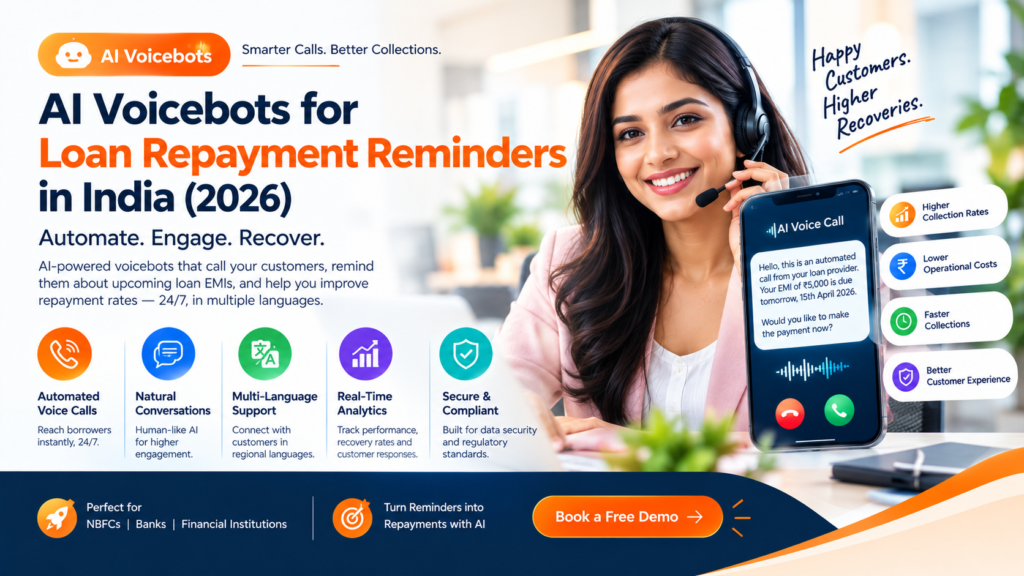
Quick answer: AI voicebots for loan repayment reminders use automated, conversational phone calls to remind borrowers about upcoming EMIs, confirm whether a payment has been made, capture a stated payment intention, and route exceptions to a human team. For Indian lenders, the best starting point is usually pre-due and early-stage reminders—not fully automated handling of disputes, hardship or complex recovery cases.
For banks, NBFCs and digital lenders, the business case is not simply making more calls. It is reaching the right borrower at the right time, using accurate account data and approved language, while measuring whether reminders lead to verified payments without increasing complaints or contact fatigue.
What is an AI voicebot for loan repayment reminders?
An AI loan repayment voicebot is a voice-based automation system that calls borrowers using approved account information and a defined conversation flow. Depending on the design, it can speak in supported languages, recognise simple spoken responses, answer approved questions, record a promise-to-pay (PTP), and trigger a follow-up task in the lender’s CRM or loan management system.
It is different from a prerecorded robocall. A conversational voicebot can respond to what a borrower says, but it should operate within controlled limits. It should not invent loan terms, negotiate unauthorised settlements, make threats, or independently decide how to handle a dispute.
Where voicebots fit in the repayment journey
| Stage | Suitable voicebot task | Recommended handling |
|---|---|---|
| Pre-due reminder | State the upcoming due date and approved amount; direct the borrower to the official payment channel. | Automate with current account data and a clear opt-out/escalation path where applicable. |
| Due date | Ask whether the borrower has already paid or needs the official payment instructions. | Check payment status before initiating another reminder. |
| Early overdue | Confirm payment intention, record a requested callback, or capture a simple reason for delay. | Use stricter attempt controls and route uncertainty, vulnerability or dissatisfaction to a person. |
| Payment dispute or wrong party | Recognise that the person disputes the account, says the number is incorrect, or reports a payment already made. | Stop the routine reminder flow and create a human-owned case. |
| Hardship, complaint or complex recovery | Offer a transfer or callback by an authorised team. | Do not let the bot pressure the borrower or make unapproved commitments. |
The important design choice is to separate a reminder programme from a recovery programme. A voicebot can support simple, repeatable servicing. It should not become an uncontrolled substitute for trained staff or the lender’s complaint-handling process.
Benefits of AI voicebots for EMI reminders
1. More consistent coverage of due-date cohorts
A rules-based campaign can schedule eligible accounts by due date, product, language and contact policy. This helps operations teams avoid relying entirely on manual dialling capacity. The useful measure is not calls attempted; it is the share of eligible borrowers reached accurately and the verified repayment outcomes that follow.
2. Lower repetitive workload for human agents
Routine reminders and simple status checks can be handled automatically, leaving agents more time for disputes, hardship, complex queries and cases requiring judgement. Savings are not automatic: they depend on call duration, connection rate, platform charges, integration effort, human escalations and how much agent capacity is genuinely redeployed.
3. Consistent scripts and interaction records
Approved prompts, version control and structured call outcomes can make it easier to review what was said and what happened next. Record retention, access permissions, customer notification and recording practices should be set by the lender’s policy and applicable requirements—not left to default vendor settings.
4. Language and availability options
Where the selected speech technology has been tested for the target language and accent, a voicebot can deliver reminders in that language at scale. Do not assume that performance in English transfers to Hindi, Hinglish or every regional language. Test number reading, dates, amounts, interruptions, noisy calls and common borrower expressions before launch.
5. Better visibility into borrower intent
Structured outcomes can distinguish “already paid”, “will pay on date”, “needs payment link”, “wrong number”, “disputes amount”, “requests callback” and “cannot pay now”. These are operational signals, not guaranteed predictions. The system should preserve the borrower’s actual response and confidence level instead of converting an uncertain answer into a definite promise.
What should an effective loan reminder voicebot do?
- Validate the account feed: use a reliable, time-stamped feed for due date, amount, payment status, language and contact eligibility.
- Check suppression rules: exclude paid accounts, disputed accounts, wrong numbers, accounts under a complaint hold and any other restricted cohort.
- Identify itself clearly: use the lender-approved identity and wording. Never impersonate a person or conceal the purpose of the call.
- Protect account privacy: verify identity proportionately before disclosing account-specific information. Do not reveal debt details to family members or other people who answer.
- Keep the conversation narrow: provide approved reminder information, capture a response, and route out-of-scope questions to a human.
- Direct payments to official channels: use lender-approved payment instructions. Do not ask borrowers to disclose PINs, OTPs, passwords or full payment credentials to the voicebot.
- Write back to systems: log the outcome and timestamp to the CRM or loan system, and reconcile payment status before scheduling another contact.
- Monitor and improve: review samples, complaints, failed recognitions, wrong-party contacts and unexpected outcomes; pause campaigns when control thresholds are breached.
AI voicebot vs human agent vs hybrid model
| Model | Best fit | Main limitation |
|---|---|---|
| AI voicebot | High-volume, predictable pre-due reminders and simple status capture. | Speech errors, limited judgement and the risk of mishandling unusual situations. |
| Human agent | Disputes, hardship, complex questions, negotiation within policy and complaint resolution. | Capacity planning, repetitive work and variable interaction quality. |
| Hybrid | Automated first contact with clear, monitored escalation to trained agents. | Requires well-designed routing, shared case history and clear ownership. |
For most lenders evaluating the technology for the first time, a controlled hybrid model is the safer starting point. Automate the narrow task first; expand only after evidence shows that the bot is accurate, the borrower experience is acceptable, and the control framework works.
AI voicebot cost in India: what determines the total price?
There is no single reliable price that applies to every lender. A quote can vary substantially depending on the vendor, language coverage, call duration, concurrency, telephony charges, integration scope, speech and AI usage, recording retention, reporting and support requirements. Compare the full cost of a completed, eligible reminder—not only a quoted per-minute rate.
| Cost component | Questions to ask vendors |
|---|---|
| Platform and setup | Is there a one-time implementation fee, monthly platform fee or minimum commitment? |
| Voice and telephony | Are calls billed per minute, connected call or another unit? Are failed attempts, retries and carrier charges included? |
| AI and speech usage | Are speech recognition, text-to-speech, language models and concurrency charged separately? |
| Integration | What is required to connect the loan management system, CRM, payment status and suppression lists? |
| Quality and compliance | Are call sampling, audit exports, complaint workflows, retention and access controls included? |
| Human escalation | Who pays for transferred calls, callbacks and cases that the bot cannot resolve? |
| Change and exit | What does it cost to update scripts, add a language, export records or migrate away? |
A simple total-cost formula
Monthly total cost = platform and support fees + setup/integration amortisation + telephony charges + AI/speech usage + human escalation cost + quality/compliance overhead.
Cost per eligible account = monthly total cost ÷ number of eligible accounts processed.
Cost per verified repayment attributable to the campaign = monthly campaign cost ÷ incremental verified repayments, using a defensible comparison group or baseline.
The final measure is the most commercially meaningful, but it is also the easiest to misstate. A borrower may have paid without the call. Use a holdout group or a suitable matched comparison, account for payment timing and seasonality, and avoid claiming causation from simple before-and-after totals.
How to estimate ROI without overstating results
Start with a baseline period and measure the same eligible population before and after the pilot. If possible, keep a comparable holdout group that receives the existing process. Track verified repayment outcomes alongside customer-protection measures.
- Cost per eligible account and cost per connected conversation.
- Right-party contact rate, using a clearly documented definition.
- Promise-to-pay rate and promise-kept rate, with promises validated against payment records.
- Incremental on-time or early repayment rate versus the comparison group.
- Human escalation rate and cost per resolved exception.
- Wrong-party contact, repeat-contact, complaint and opt-out rates.
- Speech recognition failures, incorrect amount/date statements and CRM write-back errors.
Illustrative example—not MasCallNet performance data: suppose a lender spends ₹1,20,000 per month on an eligible reminder programme. If a properly designed test estimates 100 additional verified repayments attributable to the programme, the estimated campaign cost per incremental repayment is ₹1,200. If the test instead finds only 30 incremental repayments, that figure becomes ₹4,000. The arithmetic is simple; proving that repayments were incremental is the difficult part.
Compliance and borrower protection in India
Automation does not remove the lender’s responsibility for its customer treatment, outsourced activity or recovery process. The exact obligations depend on the lender type, product, communication purpose and applicable rules. Have compliance and legal teams approve the campaign before production.
RBI requirements for recovery-related contact
The Reserve Bank of India’s instructions on regulated entities employing recovery agents state that regulated entities remain responsible for their agents and prohibit intimidation, harassment, privacy intrusion, misleading representations and persistent calls, including calls before 8:00 a.m. or after 7:00 p.m. for recovery of overdue loans, subject to the scope of the applicable directions. Lenders should confirm which requirements apply to the specific reminder campaign and product, and configure controls accordingly.
Digital lending and outsourced service providers
The RBI has consolidated and updated digital-lending requirements over time, so lenders should use the current directions applicable to their entity type and product rather than rely on an older circular alone. Start with the RBI Master Directions index and have compliance counsel confirm the current provisions before launch. Contractual oversight, permitted data use, access controls, auditability and incident handling should be explicit.
TRAI and automated voice communications
Before launch, have the telecom provider and compliance team classify the campaign and confirm the applicable requirements under TRAI’s Telecom Commercial Communications Customer Preference Regulations and relevant directions. Registration, consent, customer preferences, number/resource configuration and communication category can affect how a campaign must be operated. Do not assume that every repayment reminder is treated the same as a promotional call; classification should be confirmed for the actual use case.
Minimum operational controls
- Approved scripts, voice identity, languages and campaign purpose.
- Contact windows, attempt limits, cooldowns and suppression rules.
- Verified source data and immediate suppression after a confirmed payment.
- Proportionate identity checks and no disclosure to unauthorised third parties.
- Clear human escalation for disputes, vulnerability, complaints, wrong-party contacts and low-confidence speech recognition.
- Access control, encryption, vendor due diligence, retention schedules and audit logs.
- Call quality sampling, incident response, complaint monitoring and a documented kill switch.
- Regular review by the regulated entity; outsourcing does not transfer its regulatory accountability.
Implementation plan: a controlled 6-week pilot
| Phase | Work to complete | Exit condition |
|---|---|---|
| Week 1: Scope | Select one product and one pre-due or early-stage cohort; define exclusions, baseline and success metrics. | Operations, compliance, legal and IT approve the use case. |
| Week 2: Design | Approve scripts, language, identity checks, escalation paths, contact policies and failure handling. | Test scenarios and control matrix signed off. |
| Week 3: Integrate | Connect account eligibility, due-date data, payment status, suppression and CRM outcome write-back. | Reconciliation tests pass; paid and restricted accounts are suppressed. |
| Week 4: Test | Test accents, dates, amounts, interruptions, wrong parties, disputes, low confidence and system outages. | No unresolved critical defects; human fallback works. |
| Week 5: Limited launch | Run a small, monitored cohort with a comparison group and daily exception review. | Quality, complaint and contact-policy thresholds remain within agreed limits. |
| Week 6: Evaluate | Reconcile repayments, costs, contact outcomes and complaints; document failures and fixes. | Go, revise or stop decision based on evidence. |
Do not scale solely because the bot connects successfully or the number of calls rises. Scale when the repayment effect is credible, the cost model is complete, and borrower-protection indicators remain acceptable.
How to evaluate an AI voicebot provider
Ask vendors to demonstrate a realistic call using synthetic data and show the complete audit trail from eligibility through call outcome and payment reconciliation.
- Can the bot state only the current, approved due date and amount?
- How does it handle a borrower saying “I already paid”, “this is the wrong number”, “I dispute this amount” or “I cannot pay now”?
- Can you configure call windows, retries, suppression, language and escalation without a code change?
- What is the speech-recognition performance for your actual languages and borrower population?
- Can your team export recordings or transcripts, outcome codes, timestamps and script versions subject to policy?
- Where is customer data processed and stored, who can access it, and how is it deleted at contract end?
- What is the full commercial model, including setup, telephony, AI usage, transfers, minimums and exit costs?
- Can the lender pause the campaign immediately and independently audit vendor performance?
For a broader operating model, review MasCallNet’s banking and financial services offering and its business process automation services. A voicebot should be evaluated as part of the full customer-operations process—not as an isolated dialler.
Frequently asked questions
Can an AI voicebot call borrowers before their EMI due date?
It can be designed for pre-due reminders, subject to the lender’s policies, communication classification and applicable telecom and financial-sector requirements. Compliance should approve the campaign purpose, script, contact rules and data use before launch.
Can a voicebot speak in Hindi and regional Indian languages?
Some platforms support multiple languages, but quality varies by language, accent, audio conditions and model. Test with representative speech samples and verify that dates, amounts and borrower intent are recognised correctly before rollout.
Can the bot record a promise to pay?
Yes, if the workflow is designed to capture the borrower’s stated date and intention, communicate clearly, and write the result to the system of record. A PTP should not be treated as a payment; verify it against actual transaction data.
Should the voicebot handle overdue recovery as well as reminders?
Start with a narrow reminder use case. Early-overdue follow-up may be appropriate after additional controls are tested. Disputes, hardship, complaints and complex recovery decisions should route to trained, authorised staff.
What does an AI loan reminder voicebot cost in India?
Cost depends on call minutes, telephony, platform fees, AI and speech usage, language coverage, concurrency, integration, quality controls and human escalation. Request a total-cost model based on your actual monthly eligible-account volume and expected call duration.
How do we measure whether the bot improves repayment?
Use verified repayment records and, where feasible, a holdout or matched comparison group. Track incremental repayment, promise-kept rate, cost per incremental repayment, complaints, wrong-party contacts and human escalation—not just calls completed.
Can the bot share a payment link?
It may direct borrowers to a lender-approved payment channel through an approved message or workflow. Validate the destination, prevent link substitution and never ask borrowers to disclose OTPs, PINs or passwords during the call.
Does outsourcing the voicebot transfer compliance responsibility to the vendor?
No. Applicable RBI directions make clear that regulated entities retain responsibility for outsourced activities. Contracts and operating controls should specify oversight, audit access, incident notification, data handling and remediation.
What happens if the borrower says they have already paid?
The bot should stop routine reminders for that account while the payment status is checked. It should record the claim, create a reconciliation task where necessary, and avoid repeated calls caused by stale data.
When should a lender not automate the call?
Do not run the automated flow when account data is unreliable, the number is unverified, a complaint or dispute requires human review, the borrower is outside the permitted contact cohort, or the bot cannot confidently understand the response. Suppression and escalation are core features, not optional extras.
Discuss a repayment-reminder automation assessment
If your bank, NBFC or lending business is evaluating AI voicebots, start with the workflow, eligible portfolio, current contact policy, system integrations and outcome measures. A short assessment should establish which interactions are suitable for automation, which must remain human-led, and how to test value without compromising borrower treatment.
Discuss your contact-centre and voice automation requirements with MasCallNet.
Editorial note: This article is general operational information, not legal advice. The lender should validate the latest RBI, TRAI and other applicable requirements with its compliance and legal teams before deploying automated calls.