
24/7 Insurance Call Center Services (2026): The Complete Guide to Customer Support, Claims & Policyholder Assistance
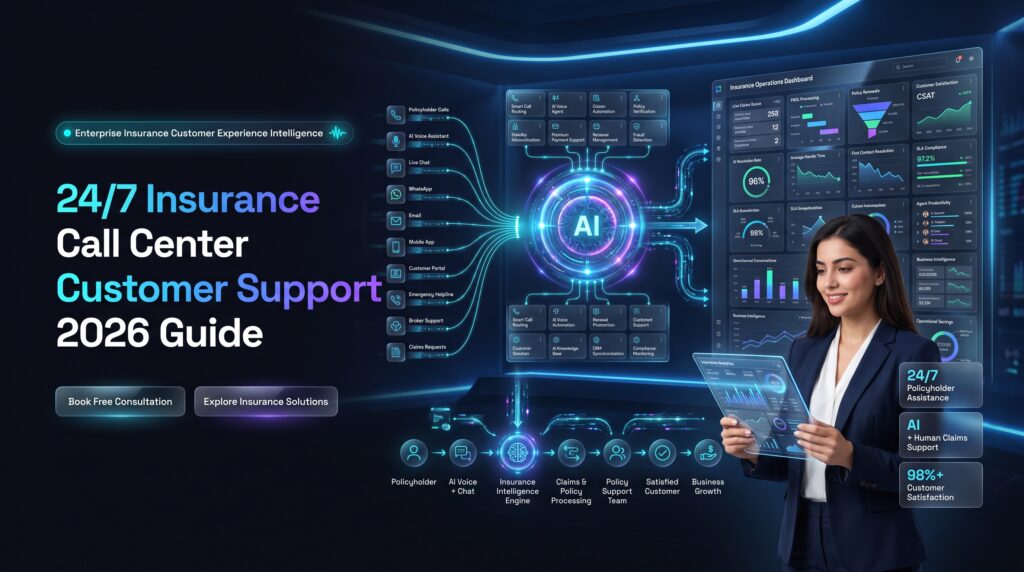
Your policyholder just had a car accident at midnight.
They are shaken. Their car is undriveable. They need help — right now.
They call your insurance company.
What happens next determines everything.
Do they reach a trained, empathetic agent who guides them through the next steps clearly and calmly? Or do they sit on hold for 25 minutes, eventually reach someone reading from a generic script, and hang up wondering why they chose your company in the first place?
That single interaction — that one phone call — influences whether they renew, whether they refer friends, and whether they ever trust your brand again.
This is why 24/7 insurance call center services are not a back-office function. They are a front-line revenue strategy.
This guide covers everything: what these services include, how AI and human agents compare, what it actually costs, how to evaluate outsourcing partners, and why leading insurance companies are moving their contact center operations to specialized BPO providers in India.
Whether you are a carrier, MGA, InsurTech platform, TPA, or reinsurer — read this before making any contact center decision in 2026.
1. What Are 24/7 Insurance Call Center Services?
24/7 insurance call center services are dedicated, round-the-clock customer support operations built specifically for insurance companies — handling everything from policyholder inquiries and billing questions to first notice of loss, claims management, and regulatory complaint resolution.
The keyword here is specifically.
A generic call center that handles insurance on the side is not an insurance call center. The agents answering your policyholder’s FNOL call need to understand what FNOL means, why it matters, how to document it correctly, and how to communicate next steps clearly to someone who is often in a state of distress.
That requires specialized training, insurance-specific technology integrations, compliance infrastructure, and a service culture built around one of the most trust-dependent industries in the world.
In 2026, the best insurance call centers operate across multiple channels simultaneously — voice, live chat, email, SMS, and app-based messaging — with a unified view of every policyholder interaction, regardless of where it started.
![Image: Infographic showing the eight core functions of a 24/7 insurance call center — FNOL, claims status, policy inquiries, billing support, renewals, complaints, digital channels, outbound retention — clean professional design]
Alt text: Eight core functions of a 24/7 insurance call center services operation
Here is what a fully operational insurance contact center covers:
- First Notice of Loss (FNOL) — Initial claims reporting with empathy and accuracy
- Claims status and follow-up — Proactive updates and inbound inquiry handling
- Policy inquiries and coverage questions — Accurate, plain-language explanations
- Billing and payment support — Payment processing, lapse prevention, disputes
- Policy servicing and endorsements — Changes, additions, and document requests
- Renewal and retention management — Inbound and outbound retention conversations
- Regulatory complaint handling — Compliant intake, documentation, and resolution
- Digital channel support — Chat, email, SMS, and app-based policyholder communication
The distinction between a good insurance call center and a great one is simple: great ones treat every interaction as a relationship event, not a transaction.
2. Why Insurance Customer Support Is Broken — And How to Fix It
Most insurance contact centers are built to manage volume.
They measure success by how quickly agents close tickets, how short they keep average handle time, and how much cost they take out of the operation each year. These are the wrong metrics. And the industry is paying for it.
43% of policyholders who switched insurance carriers in the past 12 months cited poor customer service as their primary reason — not price, not coverage, not a competitor’s promotion.
Poor service.
![Image: Horizontal bar chart showing top reasons policyholders switch carriers — Poor customer service 43%, Price 31%, Coverage gaps 16%, Competitor offer 10% — clean, professional chart]
Alt text: Chart showing insurance policyholder churn reasons — poor customer service drives 43% of switching
That is a revenue problem. Recurring, compounding, and entirely preventable.
Here is what is actually going wrong in most insurance contact centers today:
Long Hold Times During the Moments That Matter Most
A policyholder calls to report a burst pipe at 11 PM. They wait 28 minutes. By the time they reach an agent, they are already frustrated, already questioning their carrier relationship, and already mentally calculating whether to switch at renewal.
The claim gets filed. The relationship is quietly damaged.
Agents Without Insurance Domain Knowledge
Generic call center agents working from scripts cannot answer nuanced coverage questions. They cannot handle FNOL with the combination of empathy and precision it requires. They cannot explain a claim denial in a way that maintains the relationship.
Policyholders notice immediately when they are talking to someone who does not really understand what they are asking.
Disconnected Channels Creating Repeated Frustration
A policyholder reports a claim by phone on Monday. They send a follow-up email on Wednesday. They call again on Friday and are asked to repeat everything from the beginning.
This happens constantly in contact centers running disconnected systems. It is one of the most reliable ways to destroy policyholder trust — slowly, interaction by interaction.
Claims Calls That Feel Like Data Entry
The FNOL call is the most emotionally significant moment in a policyholder’s relationship with their carrier. When it is handled like a form-filling exercise — efficient but cold, accurate but robotic — it communicates something damaging: we process your claims. We do not care about your situation.
Policyholders remember that feeling. They remember it at renewal time.
The Fix
The carriers fixing this are doing four things consistently:
- Moving to 24/7 specialized support with insurance-trained agents
- Deploying hybrid AI-human contact center services that balance speed with empathy
- Outsourcing call center services to specialized BPO partners with insurance domain expertise
- Measuring success by retention rate, renewal rate, and customer lifetime value — not just tickets closed
3. Core Services Every Insurance Call Center Must Deliver
Let us be specific. Here is the complete service architecture for a 24/7 insurance contact center that actually serves policyholders and protects carrier revenue.
First Notice of Loss (FNOL)
FNOL is the single most important interaction in insurance customer support.
When a policyholder calls to report a loss — whether it is a minor fender bender or a house fire — three things must happen simultaneously:
Empathetic connection first. The agent acknowledges what the policyholder is going through before asking for a policy number. This sounds small. It is not. Policyholders who feel heard in the first 60 seconds of an FNOL call rate their overall claims experience 2.8 times higher than those who feel processed.
Accurate, complete data capture. Every detail collected correctly, the first time, with no re-contact required. Errors at FNOL create downstream claims complications that cost carriers significantly more to resolve.
Clear next steps communicated. The policyholder leaves the call knowing exactly what happens next, who is responsible, and when to expect contact. Uncertainty after FNOL drives inbound status inquiries — and dissatisfaction.
Carriers whose FNOL interactions consistently score above 4.5/5.0 on satisfaction retain policyholders at rates 3.4 times higher than those scoring below 3.5. The FNOL call is not a cost event. It is a retention event.
Claims Status Management and Follow-Up
After FNOL, policyholders want one thing: to know what is happening with their claim.
A proactive insurance contact center handles this with outbound status updates at defined milestones — adjuster assignment, inspection scheduling, settlement offer, payment processing. This proactive approach reduces inbound status inquiry volume by 35–45%, freeing agent capacity for higher-value interactions.
When policyholders do call for status, agents need real-time claims system access, accurate update capability without escalation, and the judgment to manage expectations when delays occur.
Policy Inquiries and Coverage Questions
Coverage questions are high-frequency, high-stakes. A policyholder who misunderstands their coverage discovers the gap during a claim — the worst possible moment.
Agents handling coverage inquiries need genuine product knowledge across all lines offered, the ability to explain complex terms in plain language, and absolute accuracy. A wrong answer here does not just fail the policyholder. It creates a claims dispute, a potential complaint, and possibly a regulatory issue.
Billing and Payment Support
Missed payments are the leading cause of preventable policy lapses. A specialized billing support team — one that treats a missed payment as a service opportunity rather than a collections event — consistently recovers 12–18% of accounts that would otherwise lapse.
This means outbound payment reminders before due dates, flexible payment arrangement options, empathetic hardship handling, and real-time payment processing across all accepted methods.
Renewal and Retention Management
Renewal calls are not administrative interactions. They are revenue events.
A skilled retention agent who knows the policyholder’s history, coverage profile, and tenure can identify coverage enhancement opportunities, navigate competitive situations, and convert what might have been a cancellation into a multi-line relationship.
This is where customer support outsourcing decisions have the most measurable revenue impact — because outsourced specialists with insurance retention training consistently outperform generalist in-house agents on renewal conversion rates.
Regulatory Complaint Handling
In regulated insurance markets, complaint handling is a compliance obligation with legal consequences. Every complaint interaction requires:
- Formal acknowledgment within jurisdiction-mandated timeframes
- Accurate documentation meeting regulatory standards
- Escalation to appropriate internal teams with full interaction records
- Resolution communication within required response windows
Errors here are not just service failures. They are regulatory violations.
Digital Channel Support — Chat, Email, SMS, and App Messaging
Policyholders under 45 increasingly prefer digital-first interaction — beginning with chat or email before escalating to voice for complex situations. A modern insurance call center manages all channels from a unified queue, with complete interaction history accessible regardless of where the conversation started.
4. AI vs. Human Customer Support: The Real Answer for Insurance
AI vs human customer support is the defining debate in contact center operations right now. Every executive is asking some version of the same question: how much can we automate, and what do we still need humans for?
In insurance, the answer is more nuanced than in most industries — because the regulatory environment, the emotional complexity of claims, and the trust requirements of the policyholder relationship create limits on automation that do not exist in, say, e-commerce or SaaS support.
Here is the honest picture.
What AI Handles Well in Insurance Contact Centers
AI-powered automation performs effectively across a defined set of insurance interaction types:
- Policy document retrieval and delivery
- Claims status inquiries (structured data retrieval)
- Payment processing and confirmation
- Authentication and account verification
- Basic coverage questions with clear, factual answers
- Appointment scheduling for adjuster visits
- Outbound payment reminders and renewal notifications
At mature deployments in insurance contact center services, AI effectively handles 35–50% of total interaction volume — reducing cost significantly while freeing human agents for the interactions that actually require human judgment.
What AI Cannot Handle in Insurance
There are interaction types in insurance where AI, regardless of sophistication, consistently underperforms human agents:
- FNOL for significant claims — especially personal lines involving injury, death, or major property loss
- Regulatory complaints — human oversight is required in most jurisdictions
- Coverage disputes — require judgment, empathy, and regulatory knowledge
- Policyholder distress situations — emotional intelligence cannot be replicated at the level policyholders require
- Renewal conversations for at-risk policyholders — relationship skills determine outcome
- Complex multi-line policy changes — nuance and accuracy requirements exceed current AI reliability
This is not a technology criticism. AI systems including platforms built on OpenAI, Google Gemini, Claude, and Microsoft Copilot are advancing rapidly. But in 2026, the regulatory architecture and relationship requirements of insurance create a clear ceiling on what should be automated.
The Model That Actually Works: Hybrid AI-Human Architecture
The highest-performing insurance contact center services in 2026 use a calibrated three-tier hybrid model:
Tier 1 — AI-Handled (35–50% of volume)
Routine inquiries, status checks, payment processing, authentication, document retrieval. Fast, accurate, available 24/7 at near-zero marginal cost per interaction.
Tier 2 — AI-Assisted Human Agents (40–55% of volume)
Human agents handling moderate-complexity interactions — coverage questions, billing disputes, policy changes — with AI providing real-time information retrieval, suggested responses, and compliance alerts embedded in their desktop interface. Powered by platforms like Genesys, NICE CXone, Five9, and Talkdesk, integrated with Salesforce, HubSpot, Freshdesk, or ServiceNow CRM and case management systems.
Tier 3 — Human Specialist (10–15% of volume)
Complex claims, complaints, retention conversations, and high-value policyholder relationships. Full human attention, with AI handling documentation, compliance monitoring, and post-interaction intelligence extraction. Infrastructure supported by Amazon Web Services, Google Cloud, and Microsoft Azure.
| Model | Cost Per Interaction | First Contact Resolution | CSAT Score | Regulatory Compliance | Handles Complex Claims |
| Pure Human (US In-House) | $11–$19 | 68–74% | 3.8–4.2 | Moderate | Yes |
| Pure AI | $1.50–$3.00 | 52–62% | 3.1–3.6 | At Risk | No |
| Hybrid (India BPO + AI) | $3.50–$7.00 | 84–91% | 4.5–4.9 | High | Yes |
The hybrid model wins on every dimension that matters to insurance executives — cost, quality, compliance, and customer retention.
5. The True Cost of Insurance Call Center Operations
Cost is where most executives have incomplete information — and where they make decisions they later regret.
Let us be specific.
The Real Cost of In-House Insurance Contact Center Operations
Building and operating a 24/7 dedicated insurance contact center in the United States is significantly more expensive than most financial models capture at the outset.
30-agent, 24/7 US-based operation — annual cost breakdown:
| Cost Element | Annual Cost |
| Agent salaries (30 agents × $52,000 average) | $1,560,000 |
| Benefits and payroll taxes (approximately 30%) | $468,000 |
| Management, supervision, and QA | $280,000 |
| Technology — telephony, CRM, QA tools | $180,000 |
| Recruitment and training (35% annual attrition) | $210,000 |
| Facilities and infrastructure | $240,000 |
| Total Annual Operating Cost | $2,938,000 |
For 15,000 monthly interactions, this translates to a cost per interaction of $16.30–$19.50.
And this assumes everything runs smoothly — no catastrophe event surge, no major system upgrade, no compliance incident remediation.
The Cost of Outsourced Call Center Services — India-Based Hybrid Model
A comparable operation with a specialized, AI-native BPO company in India — built specifically for insurance contact center delivery:
| Cost Element | Annual Cost |
| Agent cost (30 FTE equivalent, India-based) | $420,000 |
| AI platform and technology integration | $96,000 |
| Management, QA, and training layer | $84,000 |
| Implementation (Year 1 only) | $48,000 |
| Total Year 1 Cost | $648,000 |
| Year 2+ Annual Cost | $600,000 |
Cost per interaction: $3.30–$5.00.
![Image: Side-by-side bar chart comparing annual costs — US In-House $2.93M vs. India Hybrid BPO $648K Year 1 / $600K Year 2+ — clean financial chart with MasCallNet branding]
Alt text: Annual cost comparison — in-house US insurance call center vs. India BPO outsourced model
Annual saving: $2.29M in Year 1. $2.34M in Year 2 onward.
For a mid-market carrier, this differential represents 3–4 additional technology or product investments annually. It is not a marginal efficiency gain. It is a structural financial advantage.
6. In-House vs. Outsourced Call Center Services: An Honest Comparison
There are legitimate arguments for both models. Here is an objective assessment without the typical vendor bias.
When In-House Makes Sense
- Ultra-premium policyholder segments where carrier-branded, white-glove service is a genuine competitive differentiator and the economics support it
- Highly proprietary, complex product lines where knowledge transfer complexity outweighs cost benefit
- Regulatory environments with restrictions on data transfer or offshore processing
- Interaction volume below 1,500 per month where a small internal team is sufficient
When Outsourcing Call Center Services Makes Sense
- 24/7 coverage requirements that are financially unviable to staff in-house
- Variable or seasonal volume — catastrophe events, open enrollment — requiring rapid scale
- Cost reduction is a strategic priority without compromising service quality
- AI capability investment that exceeds internal IT roadmap and budget
- Agent attrition above 30% annually that is disrupting service quality and training economics
The Complete Comparison
| Dimension | In-House | Outsourced BPO |
| Annual cost (30-agent, 24/7 operation) | $2.9M | $600K–$648K |
| Time to full operation | 6–12 months | 60–90 days |
| 24/7 coverage cost | Very high | Included |
| AI infrastructure | Separate investment required | Included |
| Catastrophe surge capacity | Slow and expensive | Rapid — 24–48 hours |
| Agent attrition rate | 35–45% | 18–24% |
| Insurance domain expertise | Build internally | Day 1 operational |
| Compliance monitoring coverage | 3–8% (manual sampling) | 100% (AI-assisted) |
| Data security certifications | Variable | ISO 27001, SOC 2, PCI DSS |
| Technology integration | Internal IT dependency | Pre-built, API-native |
The Hybrid Outsourcing Approach
Many carriers above $250M in gross written premium use a combined model:
- Internal team manages strategic policyholder relationships, regulatory escalations, and brand-sensitive situations
- Outsourced BPO partner handles volume interactions — FNOL intake, claims status, billing, digital channels — at scale and significantly lower cost
This approach captures the full cost advantage of customer support outsourcing while maintaining internal expertise for the interactions that genuinely require it.
7. Offshore vs. Onshore Customer Support Outsourcing
When executives evaluate offshore vs onshore customer support outsourcing, they often frame it as a quality trade-off. The data does not support that framing — at least not when comparing best-in-class offshore providers against onshore alternatives.
Onshore Outsourcing (US or UK Based)
Advantages: Native language, cultural alignment, no data transfer complexity in certain regulated environments
Disadvantages: Cost per agent 3–4 times higher than offshore, limited 24/7 staffing economics, smaller available talent pools in specialized markets
Best for: Ultra-premium insurance lines, jurisdictions with strict data residency requirements, interactions where regulatory complexity makes offshore training impractical
Offshore Outsourcing — India
Advantages: 58–72% cost reduction versus US in-house, deep English language proficiency at scale, large specialized talent pool, natural 24/7 timezone coverage for US and UK markets, accelerating AI capability investment among tier-1 Indian BPO providers
Disadvantages: Requires robust knowledge transfer program, cultural training investment, strong compliance infrastructure for regulated insurance interactions
Best for: Core insurance contact center operations — FNOL, claims status, billing, renewals, policy inquiries — across most lines of business and most regulatory jurisdictions
Nearshore Outsourcing (Mexico, Philippines, Eastern Europe)
Advantages: Closer timezone alignment with US, reasonable cost reduction (40–55% vs. US in-house)
Disadvantages: Smaller specialized talent pools for insurance, less mature AI infrastructure investment, higher cost than India offshore
| Onshore (US/UK) | Nearshore | Offshore (India) | |
| Annual agent cost (fully loaded) | $52K–$78K | $22K–$36K | $9K–$16K |
| English proficiency (insurance context) | Native | High | High |
| Regulatory training maturity | High | Medium | High (tier-1 providers) |
| 24/7 coverage economics | Poor | Moderate | Excellent |
| AI infrastructure investment | Medium | Low–Medium | High and accelerating |
| Insurance domain expertise availability | Limited | Moderate | Deep |
| Recommendation | Premium/complex lines | Overflow/overflow | Core operations |
The verdict: For the vast majority of insurance contact center interactions, offshore customer support outsourcing to India delivers superior economics without quality compromise — provided you select a provider with genuine insurance domain expertise and AI-native infrastructure.
8. How to Choose the Best Customer Support Outsourcing Company for Insurance
The market for customer support outsourcing companies is crowded. Most vendors will tell you they specialize in insurance. Very few actually do.
Here is how to separate genuine insurance contact center specialists from generalists with an insurance client on their reference list.
Requirement 1: Insurance-Specific Training Curriculum
Ask every vendor: What does your insurance agent training program specifically include?
The right answer covers:
- Line-of-business training across personal and commercial lines
- FNOL protocol with empathy and data accuracy components
- Claims terminology and workflow knowledge
- Regulatory compliance training by jurisdiction (NAIC, FCA, IRDAI, or equivalent)
- Escalation authority training for complex and sensitive situations
If the answer is “we train agents on your specific products” without describing a foundational insurance curriculum — they are not an insurance specialist.
Requirement 2: True 24/7 Quality Consistency
24/7 availability is the minimum requirement. What matters is whether 3 AM quality matches 10 AM quality.
Request CSAT scores and FCR rates broken down by shift, day of week, and time of day. A provider confident in their overnight and weekend performance will share this data immediately. One who hesitates has something to hide in the numbers.
Requirement 3: 100% Compliance Monitoring
Insurance is regulated. Sampling 5% of interactions and hoping the other 95% are clean is not a compliance program. It is a liability.
Your outsourcing partner needs:
- 100% interaction monitoring, AI-assisted
- Real-time agent alerts for compliance deviations
- Jurisdiction-specific regulatory rule libraries
- Documented compliance incident rate below 1%
- ISO 27001 and SOC 2 Type II certification
- HIPAA BAA for health lines
- PCI DSS for billing operations
Requirement 4: Native Technology Integration
Your BPO partner needs to work within your existing technology ecosystem — not build a parallel system your team has to reconcile manually.
Pre-built integrations you should require:
- CRM: Salesforce, HubSpot, Freshdesk, ServiceNow
- Contact Center Platforms: Genesys, NICE CXone, Five9, Talkdesk
- Communication: Intercom, Microsoft Teams, Slack
- Cloud Infrastructure: Amazon Web Services, Google Cloud, Microsoft Azure
- AI Platforms: OpenAI, Google Gemini, Claude, Copilot
Integration timeline should be measured in weeks, not quarters.
Requirement 5: Catastrophe Surge Capacity
For P&C carriers, surge capacity is a non-negotiable requirement. Your partner must demonstrate — with documented examples, not promises — the ability to scale by 200–300% within 24 hours.
Ask for specific events, timelines, volumes handled, and CSAT performance during surge. Any credible provider will have this documentation ready.
Requirement 6: Transparent, Granular Performance Reporting
Weekly and monthly reporting across all meaningful KPIs:
- CSAT and NPS by interaction type and channel
- First Contact Resolution (FCR)
- Average Handle Time (AHT)
- Interaction volume by type, channel, and time of day
- Compliance incident rate
- AI deflection rate and accuracy
- Agent performance distribution
If a vendor is reluctant to commit to this reporting standard — that reluctance is itself important information.
Requirement 7: References From Comparable Insurance Clients
Ask for references from insurance clients of similar size, similar lines of business, and similar complexity. Speak to those clients. Ask specifically about the vendor’s insurance domain knowledge, compliance performance, and behavior during difficult situations — catastrophe events, regulatory audits, executive escalations.
9. Why India Is the Global Leader in Insurance BPO
India’s dominance in call center outsourcing for insurance is not accidental and not temporary. It is structural.
Here is why the best BPO companies in India have become the first choice for global insurance carriers, MGAs, and InsurTech platforms.
Cost Advantage That Changes Financial Models
A fully-loaded insurance contact center agent in the United States costs $52,000–$78,000 annually. In India, at a tier-1 specialized BPO provider, the equivalent fully-loaded cost is $9,000–$16,000 annually.
For a 50-agent operation, this represents $2.1M–$3.1M in annual cost differential — before accounting for AI productivity multipliers that further extend the economics.
This is not a marginal efficiency. It is a transformation of the contact center’s position in the carrier’s P&L.
English Proficiency and Insurance Vocabulary at Scale
India produces approximately 600,000 English-proficient graduates annually in disciplines relevant to BPO operations. Tier-1 Indian BPO providers specializing in insurance have invested significantly in domain-specific training — FNOL protocols, claims terminology, regulatory vocabulary, and the empathetic communication skills that distressed policyholders require.
This is insurance-specialized workforce development. It is not generic call center training with an insurance module added.
Regulatory Training Maturity
Leading Indian BPO companies serving US and UK insurance clients have developed robust regulatory training infrastructure:
- NAIC guidelines and state-specific insurance regulations for US markets
- FCA Treating Customers Fairly (TCF) obligations for UK markets
- HIPAA protocols for health insurance lines
- PCI DSS compliance for billing operations
- GDPR compliance for European policyholder data
This regulatory fluency is not theoretical. It is operationally demonstrated through compliance incident rates that consistently outperform comparable in-house US operations.
AI-Native Infrastructure Investment
India’s BPO sector is investing more aggressively in AI capability than any other outsourcing geography. The combination of low-cost engineering talent and established BPO infrastructure has created a unique environment where AI capability and human expertise develop together — rather than in tension.
Natural Timezone Coverage for Global Insurance Markets
India Standard Time sits 5.5 hours ahead of GMT and 10.5–13.5 hours ahead of US timezones. For US and UK insurance carriers requiring true 24/7 coverage, India-based operations provide natural daytime staffing during US overnight hours — without the overtime premiums that domestic 24/7 staffing requires.
![Image: World map showing timezone coverage — India operations covering US overnight and UK early morning hours — illustrating 24/7 global coverage advantage]
Alt text: India BPO timezone advantage for 24/7 US and UK insurance customer support coverage
10. How MasCallNet Delivers 24/7 Insurance Contact Center Services
![Image: MasCallNet operations center in Noida — modern branded facility, agents on headsets at insurance-specific workstations, real-time analytics dashboard visible on large screens]
Alt text: MasCallNet AI-powered insurance call center operations in Noida, India
MasCallNet is an AI-powered BPO company in India, headquartered in Noida within the NCR technology corridor. We serve insurance carriers, MGAs, InsurTech platforms, TPAs, and reinsurers across US, UK, and global markets.
We are not a generalist BPO company that lists insurance among dozens of industries served. We are a specialized contact center services provider that has built our entire operational model — our training curriculum, our technology stack, our compliance infrastructure, and our AI architecture — around the specific requirements of financial services and insurance.
What MasCallNet Delivers for Insurance Clients
24/7 FNOL Intake and Management
Trained, empathetic agents available every hour of every day. Every FNOL interaction follows a protocol that combines accurate data capture with genuine human connection — because how you handle the first call determines everything that follows.
Claims Status Management
Proactive outbound status updates at defined claims milestones combined with expert inbound inquiry handling. We reduce inbound status inquiry volume by 35–45% through proactive communication — freeing agent capacity for higher-value interactions.
Policy Inquiries and Coverage Support
Agents with genuine insurance product knowledge who can explain coverage accurately and clearly — in plain language, without creating downstream liability through imprecise answers.
Billing Support and Lapse Prevention
Proactive outbound payment reminders, flexible arrangement protocols, and empathetic hardship handling that consistently recovers 12–18% of accounts that would otherwise lapse.
Renewal and Retention Management
Dedicated retention specialists who know your policyholder data, understand your competitive environment, and convert at-risk renewal conversations into renewed and often expanded relationships.
Regulatory Complaint Handling
Compliant, documented, escalated, and resolved within regulatory timeframes. 100% of complaint interactions monitored. Every regulatory requirement met.
Digital Channel Support
Chat, email, SMS, and app-based policyholder communication managed from a unified queue with full interaction history — consistent experience regardless of channel.
Catastrophe Surge Response
Documented 200–300% capacity scaling within 24 hours. When a weather event generates 400% of normal contact volume, your policyholders still reach someone who can help them.
The MasCallNet Technology Architecture
Our operations integrate natively with the platforms your team already uses:
- Contact Center: Genesys, NICE CXone, Five9, Talkdesk
- CRM and Case Management: Salesforce, HubSpot, Freshdesk, ServiceNow
- Communication: Intercom, Microsoft Teams, Slack
- AI Layer: OpenAI, Google Gemini, Claude, Microsoft Copilot
- Cloud Infrastructure: Amazon Web Services, Google Cloud, Microsoft Azure
- Payments: Stripe, PayPal, and insurance-specific payment processors
Our Compliance and Security Architecture
- ISO 27001 — Information security management
- SOC 2 Type II — Service organization controls
- PCI DSS Level 1 — Payment card data security
- HIPAA Business Associate Agreement — Health insurance lines
- 100% interaction monitoring with real-time compliance alerts
- Jurisdiction-specific regulatory training — NAIC, FCA, IRDAI, and applicable state regulations
What Makes MasCallNet Different From Other BPO Companies
| Dimension | Generic BPO | MasCallNet |
| Insurance training | Generic with insurance module | Dedicated insurance curriculum — FNOL, claims, regulatory compliance |
| AI infrastructure | Chatbot overlay on legacy systems | AI-native architecture with human expertise as premium layer |
| Compliance monitoring | 3–8% sampled | 100% AI-assisted, real-time |
| Technology integration | Limited, slow | Pre-built, API-native, 30-day deployment |
| Catastrophe surge | Slow to scale | 200–300% in 24 hours — documented |
| Commercial model | FTE/seat only | FTE, per-interaction, and outcome-based options |
| Performance reporting | Monthly summary | Weekly granular — CSAT, FCR, AHT, compliance rate, channel performance |
11. ROI Framework: What Better Insurance Call Center Support Actually Returns
Executives making this decision need to see returns across three value streams — not just cost reduction.
Value Stream 1: Direct Cost Savings
For a carrier moving a 30-agent operation from US in-house to MasCallNet:
- Year 1 net savings: $2,290,000
- Year 2+ annual net savings: $2,338,000
This is arithmetic, not projection. The cost differential between US in-house and India-based AI-native customer support outsourcing is that definitive.
Value Stream 2: Revenue Retained Through Better Service
This is the value stream most carriers fail to model — and it is frequently larger than the cost savings.
Retention improvement: Carriers who upgrade their FNOL and claims support experience see 4–8 percentage point improvement in renewal rates. For a carrier with $50M in annual premium, a 5-point retention improvement represents $2.5M in retained premium annually.
Lapse prevention: Proactive billing support recovers 12–18% of accounts that would otherwise lapse. For 5,000 monthly payment-related interactions at an average annual premium of $1,200 — that is $360,000–$540,000 in prevented lapse revenue annually.
Cross-sell conversion: AI-assisted agents during renewal and service calls convert cross-sell opportunities at 2–3 times the rate of agents without AI prompting.
Value Stream 3: Risk Cost Avoided
Compliance incident reduction: 100% monitoring versus 5% sampling prevents regulatory incidents averaging $85,000–$340,000 per event in fines, remediation, and reputational cost.
Litigation reduction: Policyholders receiving empathetic, accurate FNOL handling escalate to formal complaints and litigation at significantly lower rates. A 20% reduction in post-denial litigation escalations represents $200,000–$800,000 in avoided legal cost for a mid-market carrier.
3-Year ROI Model — Mid-Market Carrier, 15,000 Monthly Interactions
| Value Stream | Year 1 | Year 2 | Year 3 |
| Cost savings | $1,175,000 | $1,220,000 | $1,268,000 |
| Revenue retained | $640,000 | $820,000 | $1,040,000 |
| Risk cost avoided | $280,000 | $340,000 | $420,000 |
| Total Value | $2,095,000 | $2,380,000 | $2,728,000 |
| Investment | $648,000 | $600,000 | $600,000 |
| Net ROI | 223% | 297% | 355% |
12. Outsourced Customer Support Pricing: What It Actually Costs
Outsourced customer support pricing in insurance depends on four variables: interaction volume, interaction complexity, service mix (voice, chat, email), and AI integration level.
Here is a transparent breakdown of how pricing is typically structured — and what you should expect to pay.
Pricing Model 1: Per-Agent, Per-Month (Dedicated Team)
Range: $1,200–$3,800 per agent per month (India-based, insurance-specialized)
Best for: Carriers with predictable, consistent interaction volume and complex service requirements where dedicated agents with deep carrier knowledge deliver superior outcomes
Includes: Specialized training, technology access, QA oversight, management layer, and performance reporting
Typical contract: 12–36 months
Pricing Model 2: Per-Interaction (Shared Team)
Range: $2.80–$8.40 per interaction (India-based, insurance complexity)
Best for: Carriers with variable volume, seasonal patterns (catastrophe exposure, open enrollment), or early-stage outsourcing programs evaluating scale before committing to dedicated teams
Typical contract: 12–24 months
Pricing Model 3: Outcome-Based Pricing
Range: Base fee plus performance bonus tied to retention rate, FCR, CSAT, or compliance score
Best for: Mature outsourcing relationships where both parties are aligned on business outcomes and have robust measurement infrastructure
Typical contract: 24–48 months
Pricing Model 4: AI-Assisted Hybrid Pricing
Range: $1,400–$2,600 per agent per month plus AI platform fee ($800–$2,200 per month)
Best for: Carriers deploying full hybrid architecture — AI front-end automation combined with human agent expertise and conversation intelligence
Quick Reference: Outsourced Customer Support Pricing by Volume
| Monthly Interaction Volume | Recommended Model | Estimated Monthly Cost | Cost Per Interaction |
| 2,000–5,000 | Shared team, per-interaction | $8,400–$28,500 | $4.20–$5.70 |
| 5,000–15,000 | Hybrid — shared + dedicated | $24,000–$68,000 | $3.50–$4.80 |
| 15,000–35,000 | Dedicated team, AI-hybrid | $52,000–$118,000 | $3.00–$4.20 |
| 35,000+ | Dedicated team, outcome-based | Custom pricing | $2.40–$3.80 |
Request a customized pricing proposal from MasCallNet →
Is Your Insurance Contact Center Ready for 2026?
Most insurance executives already know something is not working in their customer support operation. The signals are usually clear:
- Hold times that exceed what any policyholder should accept
- Renewal rates sitting 4–8 points below where they should be
- Agent attrition creating constant training cycles and inconsistent service quality
- A 24/7 coverage gap filled by expensive overtime or an answering service that cannot actually help
- Compliance incidents that keep appearing despite training efforts
- A contact center cost structure that makes every CFO uncomfortable
If any of those sound familiar, the conversation is worth having.
MasCallNet works with insurance carriers, MGAs, InsurTech platforms, and TPAs to design and operate contact center programs that handle policyholders with genuine care, protect compliance rigorously, and contribute measurably to premium retention and revenue growth.
We offer a complimentary 45-minute consultation — no slides, no sales presentation. We look at your current operation, your interaction volume and complexity, and your biggest challenges — and give you an honest assessment of what improvement looks like and what it costs.
Schedule Your Free Insurance Contact Center Consultation →
13. Frequently Asked Questions
What is a 24/7 insurance call center service?
A 24/7 insurance call center service is a specialized customer support operation that handles policyholder inquiries, claims intake (FNOL), claims status, billing, renewals, and regulatory complaints around the clock — every day of the year. The best operations combine AI automation for routine interactions with trained human agents for complex, emotional, and compliance-sensitive situations.
How is insurance call center outsourcing different from general customer support outsourcing?
Insurance contact center outsourcing requires domain-specific expertise that general customer support outsourcing does not: FNOL training, claims terminology knowledge, regulatory compliance infrastructure, jurisdiction-specific regulatory training, and the empathetic communication skills required for distressed policyholders. A generalist BPO handles volume. An insurance-specialized BPO handles policyholders.
What is the difference between AI and human customer support in insurance?
AI handles routine, structured interactions — status checks, payment processing, document retrieval, basic coverage questions — with speed and cost efficiency that human agents cannot match at scale. Human agents handle complex claims, regulatory complaints, retention conversations, and policyholder distress situations where empathy, judgment, and regulatory precision are required. The highest-performing insurance contact centers use both in a calibrated hybrid model.
What does outsourced customer support pricing look like for insurance companies?
Pricing varies by volume, complexity, and model. Dedicated team models range from $1,200–$3,800 per agent per month at India-based specialized providers. Per-interaction models range from $2.80–$8.40 per contact. AI-hybrid models add a platform fee of $800–$2,200 per month. Most mid-market carriers outsourcing 10,000–20,000 monthly interactions to an India-based hybrid model spend $36,000–$80,000 per month — compared to $180,000–$245,000 for equivalent in-house US operations.
What are the best BPO companies in India for insurance contact centers?
The best BPO companies in India for insurance combine three things that most vendors only partially offer: genuine insurance domain expertise (not generic training), AI-native technology infrastructure (not chatbot overlays on legacy systems), and 100% compliance monitoring. MasCallNet, operating from Noida in the NCR technology corridor, is purpose-built for this requirement — with insurance-specific training, hybrid AI-human architecture, and compliance infrastructure serving US, UK, and global insurance clients.
Is offshore customer support outsourcing safe for regulated insurance data?
Yes — when the provider holds the right certifications and operates the right security architecture. Requirements: ISO 27001, SOC 2 Type II, PCI DSS Level 1, HIPAA Business Associate Agreement for health lines, and GDPR compliance for European data. Tier-1 Indian BPO providers serving regulated insurance clients hold all of these certifications and operate security architecture that frequently exceeds what carriers maintain in-house.
How quickly can MasCallNet get an insurance contact center program operational?
Most programs reach full operational capability within 60–90 days, covering process documentation and knowledge transfer, agent training, technology integration, parallel testing, and quality validation. Complex programs with multiple lines of business or deep system integrations may extend to 120 days.
How do you handle catastrophe event surges?
We maintain trained reserve capacity enabling 200–300% agent deployment increase within 24 hours. We have documented deployment during actual catastrophe events — specific events, volumes, timelines, and CSAT performance during surge — available to provide during any evaluation conversation.
What technology platforms does MasCallNet integrate with?
We maintain pre-built integrations with Salesforce, HubSpot, Freshdesk, ServiceNow, Genesys, NICE CXone, Five9, Talkdesk, Intercom, Microsoft Teams, Slack, Amazon Web Services, Google Cloud, and Microsoft Azure. For proprietary policy administration or claims management systems, our integration team assesses API architecture and builds custom connectors — typically within the first 30 days of implementation.
What lines of insurance does MasCallNet support?
Personal lines (auto, home, renters, umbrella), life and annuities, health and benefits administration, commercial lines (general liability, property, professional liability), and specialty lines. Training is customized to your specific portfolio, regulatory jurisdiction, and operational requirements.
Related Resources from MasCallNet
- Healthcare BPO Services for US Hospitals — Complete Guide →
- How to Scale Customer Support for 10,000+ Monthly Tickets →
- Top AI-Powered Contact Center Solutions in Noida, NCR →
- About MasCallNet — AI-Powered BPO Company India →
Final Word
The carriers who win the next decade will not win on product alone.
They will win on the experience of a policyholder who called at 2 AM — after an accident, a break-in, a flood — and reached someone who actually helped them. Someone who knew what they were talking about, cared about the situation, and resolved it with clarity and competence.
That experience is operationally achievable. It is not expensive relative to what it costs to lose customers who never come back.
The carriers building that experience now — through specialized contact center services, hybrid AI-human architecture, and insurance-trained outsourcing partners — are the ones with renewal rates above 88%, referral pipelines that compound, and a brand reputation that survives a bad claims year.
If you are ready to build that, MasCallNet is ready to show you exactly how.