
Top Customer Support Outsourcing Trends for 2026: What Every Business Needs to Know
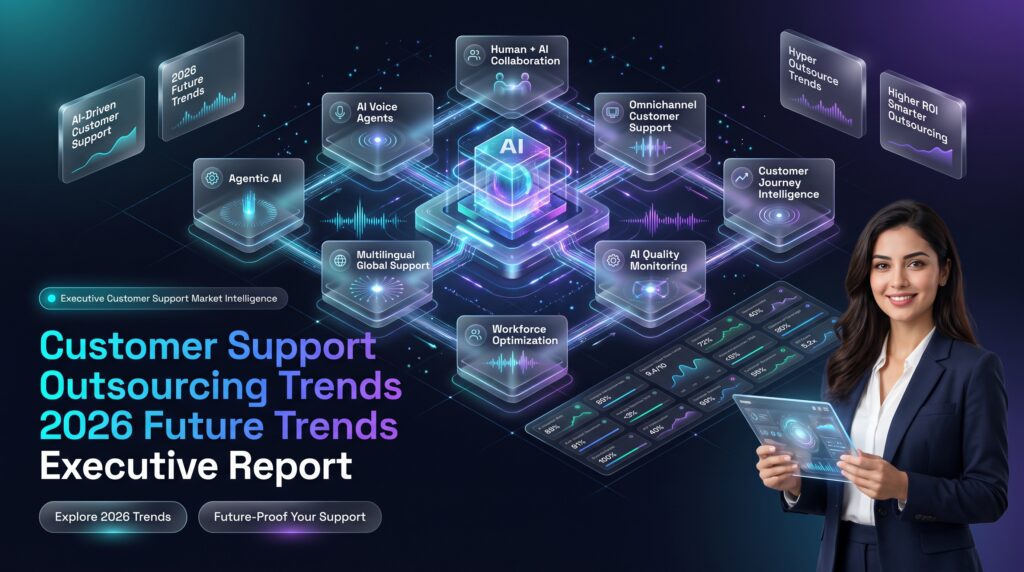
Customer support is no longer what it used to be.
Five years ago, the conversation was simple: hire more agents, reduce wait times, hit your CSAT targets. Today, the conversation looks completely different. CEOs are asking whether their support function is actually protecting revenue. COOs are questioning whether their current model can scale. And procurement teams are evaluating BPO partners not just on cost — but on intelligence, technology, and measurable business outcomes.
If you are running a business that handles significant customer interaction volume — whether you are in banking, healthcare, retail, logistics, or telecom — 2026 is a year that demands a fresh look at how you deliver customer support.
This article covers the trends that actually matter. Not the buzzwords. Not the vendor talking points. The real shifts happening inside contact centers right now — and what they mean for your business.
What You Will Learn in This Article
- Why the AI vs human support debate is now settled (and what the answer actually is)
- Which outsourcing trends will separate high-performing businesses from the rest in 2026
- How the best BPO companies in India are delivering results that onshore teams cannot match at scale
- What customer support outsourcing actually costs — with a real cost comparison
- How to evaluate vendors without getting burned
- What industries are seeing the biggest wins right now
Let’s get into it.
The State of Customer Support in 2026

The global customer support outsourcing market is projected to exceed $110 billion by 2026
Here is the uncomfortable truth most businesses are sitting with right now:
Customer expectations have accelerated. Most support operations have not.
Customers in 2026 expect instant responses across every channel — WhatsApp, email, chat, voice, social. They expect agents who understand their history. They expect their problems to be resolved in one interaction. And if they do not get that? They leave. Quietly. And they tell people.
Meanwhile, the average in-house contact center is still running on legacy technology, struggling with 28–35% annual agent attrition, and treating support as a cost line item rather than a business function that directly impacts revenue.
The gap between customer expectation and operational reality is where revenue disappears.
The good news? It is also where the biggest opportunity sits for businesses that move quickly.
The global customer support outsourcing market is growing at 8.2% annually — but the growth is not uniform. It is concentrated among businesses that are making smart decisions: choosing AI-native partners, deploying hybrid support models, and converting their customer conversations into intelligence that feeds the rest of the business.
That is the world we are operating in. Now let us talk about the specific trends shaping it.
Trend 1: The AI vs Human Debate Is Over — Hybrid Won

The most effective support operations in 2026 combine AI efficiency with human intelligence
For the last three years, businesses have been asking the wrong question.
The question was: “Should we use AI or human agents?”
The right question is: “Which interactions should AI handle, and which interactions require a human — and how do we connect both seamlessly?”
This distinction matters enormously. Here is what actually happens when businesses get it wrong:
Too much AI, too fast: Customers hit a wall. Simple queries get resolved, but anything complex loops back to the same chatbot. Escalation rates spike. CSAT drops. The cost savings evaporate when you factor in the churn that follows.
Refusing AI altogether: Cost per interaction stays high. Response times cannot compete. Agents spend the majority of their time on repetitive queries that could be automated — leaving them burnt out and underperforming on the complex conversations where they genuinely add value.
The businesses winning right now have built what the industry is calling a hybrid support model — and the architecture is more intentional than most people realize.
How the Hybrid Model Actually Works
Think of it in three tiers:
Tier 0 — Self-Service AI: Chatbots, voice bots, and knowledge base tools handle order status inquiries, FAQ resolution, account lookups, and appointment confirmations. Resolution rate here should be 70–85% for well-structured query types. No human involvement needed.
Tier 1 — AI-Assisted Human Agents: For queries that require a human touch — complaints, billing disputes, product concerns — agents handle the conversation with AI running alongside them. The AI surfaces relevant knowledge base articles, suggests responses, flags sentiment changes, and provides real-time guidance. Average Handle Time drops by 18–27%. Accuracy improves. Agents feel supported rather than overwhelmed.
Tier 2 — Senior Human Resolution: Complex escalations, high-value customer situations, emotionally charged interactions. Fully human. No automation in the conversation itself, but full intelligence context from every prior interaction.
This architecture is not theoretical. It is what the highest-performing AI-powered customer support outsourcing operations are running today — and the results are consistent.
The Numbers Behind the Hybrid Model
| Support Model | FCR Rate | CSAT Score | Cost per Interaction | Agent Attrition |
|---|---|---|---|---|
| Traditional Human-Only | 68–74% | 3.8/5.0 | $8–$18 | 28–35% |
| Pure AI / Chatbot | 71–79%* | 3.4/5.0 | $1.50–$3.50 | N/A |
| AI-Human Hybrid | 84–91% | 4.5–4.8/5.0 | $4–$9 | 18–22% |
On structured query types only. Complex query resolution drops to 31–44% without human involvement.
The hybrid model does not just reduce costs. It delivers measurably better customer experiences — which means better retention, higher lifetime value, and fewer customers leaving for a competitor.
The bottom line: If your BPO partner is still pitching you a fully automated solution or a purely human operation with no AI layer, they are selling you a 2021 solution for a 2026 problem.
Trend 2: India Is No Longer Just the Cost Option — It Is the Quality Option

India’s top BPO hubs — including Noida, Bangalore, and Hyderabad — are now home to world-class AI-native contact center operations
Here is a perception that is costing businesses real money:
“India BPO = cheap and lower quality.”
That perception is approximately five years out of date.
The best BPO companies in India in 2026 are not competing on cost alone. They are competing — and winning — on technology maturity, AI capability, talent quality, and measurable outcomes. The cost advantage still exists and it is significant. But it is now a bonus on top of genuine capability, not a trade-off against it.
Let us look at what has actually changed.
What Has Shifted in India’s BPO Sector
AI Literacy: 67% of India’s top-tier BPO workforce has received formal AI tool training by 2025. Agents working alongside OpenAI, Google Gemini, and Microsoft Copilot-integrated platforms are commonplace in Noida, Bangalore, and Hyderabad operations.
Technology Infrastructure: Tier-1 BPO operations in India are running on the same platforms that Fortune 500 companies use in-house — Genesys, Five9, Talkdesk, NICE CXone, Salesforce, Zendesk, Freshdesk. The technology gap between onshore and offshore operations has effectively closed for enterprise-grade vendors.
Compliance Architecture: ISO 27001, SOC 2 Type II, PCI-DSS, and HIPAA-compliant operations are now standard at credible India BPO vendors. This is no longer a differentiator — it is table stakes for serious enterprise programs.
English Communication Quality: This one still varies by vendor and city tier. But Tier-1 cities — particularly Noida NCR, Bangalore, Hyderabad, and Pune — have a deep talent pool of English-proficient professionals with neutral accents and strong written communication skills. Selecting the right vendor and the right location matters.
The Cost Reality in 2026
Let us be direct about the numbers, because this is where the business case either gets made or falls apart.
| Cost Component | In-House (US/UK) | India Offshore BPO |
|---|---|---|
| Agent salary + benefits | $45,000–$65,000/year | $8,000–$14,000/year |
| Technology stack | $2,000–$4,000/agent/year | Typically included in contract |
| Facilities | $3,000–$6,000/agent/year | $0 |
| Management overhead | 15–20% of headcount cost | 3–5% oversight cost |
| Recruitment & training | $4,000–$8,000 per hire | Vendor-managed |
| Total annual cost per agent | $55,000–$85,000 | $12,000–$18,000 |
For a 100-seat operation, that difference is $4–$7 million annually. For a 500-seat operation, it exceeds $25 million.
That is not a support budget line item. That is a strategic business decision.
Trend 3: Customer Support Is Becoming a Revenue Function — Not a Cost Center

Forward-thinking organizations are measuring support performance by revenue metrics — not just operational efficiency
This is the trend that most businesses are slowest to internalize — and the one with the biggest financial implications.
The conventional view of customer support: it is a necessary expense. You staff it to meet demand, you measure it on cost-per-ticket and average handle time, and you try to keep the budget as low as possible.
The emerging reality: every customer support interaction is a revenue event.
Here is what that means practically.
When a customer contacts you with a billing issue, that interaction can end one of three ways:
- The issue is resolved quickly, the customer feels valued, and they renew — or even upgrade
- The issue drags on, the customer gets frustrated, and they churn at their next renewal opportunity
- The issue is never fully resolved, and the customer leaves immediately
The difference in revenue outcome between Option 1 and Option 3 is not a support metric. It is a revenue metric. And when you multiply it across thousands of interactions per month, the financial impact becomes impossible to ignore.
What the Data Actually Shows
- A 5% improvement in customer retention increases lifetime value by 25–95% (Harvard Business Review)
- A 10-point improvement in NPS correlates to 3–7% revenue growth
- Businesses with FCR rates above 85% report 12–15% lower operational costs — savings that can be reinvested in growth
- Proactive support — reaching out before the customer contacts you — reduces churn by 8–12% in subscription businesses
The organizations that understand this are not asking “how do we reduce support costs?” They are asking “how do we make our support function generate and protect more revenue?”
That reframing changes everything: how you select your BPO partner, how you structure your SLAs, and how you measure success.
Trend 4: Predictive and Proactive Support Is Replacing the Reactive Model

Leading organizations are using behavioral data and AI to resolve customer issues before they generate inbound contact
The traditional support model is built on a simple premise: wait for the customer to contact you, then resolve their issue.
It sounds reasonable. It is also expensive, reactive, and increasingly inadequate.
Here is why: every inbound contact represents a customer who has already experienced a problem. They may already be frustrated. In some cases, they may already be considering switching. By the time they reach your agent, you are playing defense.
The businesses that are pulling ahead in 2026 have flipped this model. They are identifying customer issues before the customer picks up the phone.
How Predictive Support Works
The technology stack that makes this possible is not exotic — most businesses already have the data. They just are not using it.
A logistics company knows a shipment has been delayed before the customer does. Instead of waiting for the call, they send a proactive WhatsApp message with updated tracking and a resolution timeline. The inbound inquiry never happens.
An eCommerce business running on Shopify notices that a customer has visited the returns page three times in 24 hours without completing a return. A proactive chat initiates — not a bot, but a trained agent — offering to walk the customer through the process. The return is completed. The customer experience is positive. A potential refund complaint is avoided.
A SaaS business integrates its support platform with product usage data. When a customer has not logged in for 14 days, an automated alert triggers a support-led check-in. The conversation uncovers an onboarding issue. It is resolved. The customer continues. The churn risk disappears.
None of this requires science-fiction technology. It requires business process automation integration, good data hygiene, and a BPO partner with the operational maturity to execute proactive programs at scale.
The results speak for themselves:
| Industry | Inbound Volume Reduction | CSAT Improvement |
|---|---|---|
| eCommerce | 18–24% | +8 points |
| Telecom | 25–32% | +13 points |
| Banking | 15–20% | +9 points |
| SaaS | 22–28% | +11 points |
| Logistics | 28–35% | +14 points |
Trend 5: Compliance Is Now a Baseline — Not a Differentiator
If you are operating in a regulated industry — banking, healthcare, insurance, or any business handling payment data — this trend directly affects your vendor selection.
GDPR enforcement actions exceeded €2.9 billion in 2024. HIPAA penalties are at record levels. PCI-DSS 4.0 introduced requirements that many BPO vendors are still catching up to. The regulatory environment is not easing. It is tightening.
What this means in practical terms: any BPO partner you engage in 2026 needs to demonstrate compliance capability before the conversation moves to pricing and SLAs.
The Compliance Checklist for BPO Vendor Selection
Before shortlisting any outsourcing partner, verify the following:
- ISO 27001 certification — current, not expired
- SOC 2 Type II report — issued within the last 12 months
- PCI-DSS compliance level — Level 1 for payment-adjacent operations
- HIPAA BAA availability — mandatory for healthcare programs
- GDPR data processing agreements — mandatory for any EU customer data
- Data residency documentation — where does customer data live, and who can access it?
- Employee background verification — what is the screening process?
- Incident response SLA — how quickly are you notified of a breach? (Target: under 4 hours)
For healthcare BPO services specifically, compliance is not a checkbox exercise — it is an operational design principle. Every workflow, every data access point, every agent interaction must be architected with PHI protection as a baseline requirement.
The best BPO companies in India have invested heavily in this infrastructure. But not all of them have. And the ones that have not will not tell you upfront. This is why compliance verification is step one in any vendor evaluation — not an afterthought.
Trend 6: Outcome-Based Contracts Are Replacing the Seat-and-Hour Model
This one is changing how enterprise businesses structure their BPO relationships — and it is long overdue.
The traditional BPO contract looks like this: you pay for seats, hours, or volume. The vendor’s incentive is to fill those seats and process that volume. Quality is a secondary concern because the contract does not penalize quality failures — it only penalizes not hitting headcount or volume targets.
The problem is obvious when you say it out loud. Yet most BPO contracts are still structured this way.
Outcome-based contracts flip the incentive. The vendor is compensated — at least partially — based on achieving defined business outcomes: FCR rate, CSAT score, churn reduction, response time. When the vendor’s revenue depends on your customers being satisfied, the relationship dynamic changes completely.
Traditional vs Outcome-Based Contract Comparison
| Dimension | Traditional Contract | Outcome-Based Contract |
|---|---|---|
| What you pay for | Seats / hours / volume | Results achieved |
| Vendor incentive | Process more interactions | Resolve more interactions on first contact |
| Quality risk | Buyer bears it | Shared or vendor-weighted |
| Scalability model | Linear cost growth | Efficiency-based scaling |
| Strategic alignment | Low | High |
| Best for | Commodity support programs | Revenue-sensitive support programs |
Our recommendation: Structure at minimum 20–30% of vendor compensation against measurable outcome metrics. If a vendor refuses outcome-linked components in their contract, that tells you something important about their confidence in their own operations.
Industry Spotlight: Who Is Winning With Customer Support Outsourcing Right Now

Different industries are finding distinct advantages in outsourced customer support models
Banking and Financial Services
Digital banking has created a surge in customer interaction volume — account inquiries, fraud alerts, transaction disputes, product onboarding. The interaction types are defined and structured, making them ideal for AI-first handling.
The best outcomes in banking support come from this split: AI handles 65–75% of volume (account inquiries, balance checks, payment confirmations), while trained human agents handle the remaining 25–35% — fraud investigations, complex disputes, relationship-sensitive conversations.
The compliance requirement is non-negotiable: PCI-DSS Level 1 compliance, SOC 2 Type II certification, and full audit trail capability are minimum requirements for any banking BPO program.
Typical outcome improvement: 87% FCR on structured queries | 18% AHT reduction | 99.97% compliance adherence
Healthcare
Patient experience is not a nice-to-have in healthcare — it directly affects clinical outcomes, regulatory performance, and referral patterns.
For US hospitals and healthcare systems evaluating outsourced support, the priority stack looks like this: HIPAA compliance first, patient appointment scheduling quality second, care navigation and billing inquiry resolution third.
AI handles scheduling confirmation and routine inquiries. Human agents — with healthcare communication training — handle anything that touches clinical information, insurance disputes, or emotionally sensitive patient situations.
Typical outcome improvement: 31% reduction in scheduling errors | 24% improvement in patient satisfaction | 19% reduction in no-show rates
eCommerce and Retail
Seasonal volume spikes are the defining operational challenge for eCommerce support. A business running on Shopify or WooCommerce during peak trading periods can see 4–8x normal support volume — and the support experience during that peak directly impacts repeat purchase rates.
The solution for businesses handling 10,000+ monthly tickets is elastic outsourced capacity — teams that scale up for peaks and right-size during quieter periods, without the permanent overhead of a large in-house team.
Typical outcome improvement: 99% peak SLA adherence | 22% reduction in abandoned contacts | 14% increase in repeat purchase rate
Logistics
Real-time shipment visibility and exception management are the two highest-volume interaction types in logistics support. Both are ideal for AI-first handling — structured query types with defined resolution paths.
The complexity comes in exception management: lost shipments, delivery failures, damaged goods. These require agent judgment, carrier system access, and the ability to de-escalate frustrated customers efficiently.
Typical outcome improvement: 35% inbound volume reduction through proactive notifications | 89% same-day exception resolution
Telecom
Telco support is characterized by high complexity, high emotion, and high churn risk. Network issues, billing disputes, and contract renegotiations require agents who can simultaneously resolve technical problems and protect the customer relationship.
Typical outcome improvement: 28% churn reduction through predictive retention programs | 91% FCR on billing inquiries
What Customer Support Outsourcing Actually Costs in 2026

Understanding the real cost of customer support outsourcing helps businesses make informed build vs buy decisions
Let us cut through the vague pricing language and give you real numbers.
Outsourcing Pricing Models
Per FTE (Dedicated Team)
Most common for consistent, brand-sensitive programs. You get a dedicated team of agents working exclusively on your account.
- India offshore: $1,200–$2,500 per FTE per month
- Best for: Programs above 20 agents with consistent volume
Per Ticket / Per Interaction
Variable pricing based on volume. Lower risk for unpredictable demand.
- Voice: $2.50–$8.00 per interaction
- Chat / Email: $1.00–$3.50 per interaction
- Best for: SMBs, seasonal businesses, programs below 20 agents
Hybrid Pricing
Base FTE commitment plus variable performance-linked component.
- $1,800–$3,200 blended monthly per FTE
- Best for: Enterprise programs with outcome-based SLA requirements
Real Cost Comparison: In-House vs Outsourced
For a 100-agent customer support operation:
| Cost Category | In-House (Annual) | India BPO (Annual) | Saving |
|---|---|---|---|
| Personnel (salary + benefits) | $5.5M | $1.5M | $4.0M |
| Technology | $400K | Included | $400K |
| Facilities | $350K | $0 | $350K |
| Management overhead | $600K | $150K | $450K |
| Recruitment and training | $320K | Vendor-managed | $320K |
| Total | $7.17M | $1.65M | $5.52M (77%) |
Transition investment (Year 1 only): $180–$300K for a 100-agent program
The Year 1 net saving for a 100-agent program is typically in the $5–$5.3M range. From Year 2 onwards, the full saving is realized.
For most businesses evaluating this decision, the financial case is not close. The question is not whether to outsource — it is which partner to trust with the transition.
How to Evaluate Customer Support Outsourcing Vendors — Without Getting Burned
This is where many businesses make expensive mistakes.
The evaluation process tends to go like this: issue an RFP, collect proposals, compare pricing, select the cheapest credible option, sign a contract. Then discover six months into the engagement that “credible” was doing a lot of work in that sentence.
Here is a more reliable vendor evaluation framework.
Eight Dimensions That Actually Predict BPO Performance
1. AI Maturity
What AI tools are they running? How are they integrated? Ask for a demonstration — not a slide deck. See the actual platform. Watch an Agent Assist interaction live. If they cannot show you a working AI layer, they do not have one.
2. Compliance Architecture
Request the ISO 27001 certificate, the SOC 2 Type II report, and the PCI-DSS certification. Check the issue dates. If any document is over 12 months old, ask why.
3. Outcome-Based SLA Willingness
Propose that 25% of their compensation be tied to your defined outcome metrics. Their response to this proposal tells you everything about their confidence in their own performance.
4. Technology Stack Integration
Do they have demonstrated integrations with your existing platforms? Salesforce, Zendesk, Freshdesk, HubSpot, Genesys, Five9, Shopify, Stripe — whichever tools your business runs. Integration complexity at transition is where unexpected costs hide.
5. Industry-Specific Experience
Generic BPO experience is worth less than it sounds. Ask specifically: have they managed programs in your industry? Can they provide case studies with measurable outcomes from comparable programs?
6. Agent Quality and Training
What is their agent selection process? What ongoing training do agents receive? What is their current attrition rate? Attrition above 30% is a red flag — it means your agents are constantly changing, and quality consistency is impossible.
7. Analytics and Reporting Depth
What does their standard reporting look like? What insights come out of it beyond basic operational metrics? The best vendors surface product intelligence, sentiment trends, and churn signals from their interaction data — not just ticket counts and handle times.
8. Scalability
How quickly can they ramp from 20 to 50 agents? From 50 to 100? What is their maximum ramp capacity? If they cannot commit to specific ramp timelines, your seasonal or growth-driven scaling needs will not be met.
A Real-World Example: What Happens When You Get This Right
The following is representative of the type of outcomes MasCallNet delivers for clients across industries.
A direct-to-consumer FMCG brand with $180M annual revenue was running a 140-agent in-house support team at a cost of $4.1M annually. Their numbers: CSAT 3.4/5.0, NPS +12, FCR 67%, average first response time on email 22 hours.
They knew something was wrong. They did not know how wrong.
A revenue leakage analysis revealed that their 7.2% monthly churn rate on their eCommerce channel was costing them approximately $2.8M in recoverable annual revenue — customers who were leaving not because of product dissatisfaction, but because support interactions were slow, inconsistent, and resolution-light.
The decision was made to transition to an outsourced model.
What happened in six months:
The in-house team of 140 agents was replaced by a dedicated offshore team of 85 agents — supported by an AI layer handling Tier-0 and Tier-1 queries, Agent Assist tools integrated with their Zendesk platform, and a proactive notification system connected to their Shopify store.
Knowledge base reconstruction happened first — before a single agent was deployed. This is the step that most businesses skip and most transitions fail because of.
Results at Month 6:
| Metric | Before | After |
|---|---|---|
| Monthly support cost | $342K | $186K |
| CSAT | 3.4/5.0 | 4.6/5.0 |
| NPS | +12 | +41 |
| FCR | 67% | 88% |
| Email first response | 22 hours | 3.2 hours |
| Monthly churn rate | 7.2% | 4.8% |
The 33% churn reduction translated to $2.1M in recovered annual revenue. The support cost reduction was $1.87M. Combined financial impact in Year 1: approximately $3.97M — on an investment of $2.23M.
That is a business transformation, not a cost reduction exercise.
The Build vs Buy Decision: A Framework for 2026

The build vs buy decision depends on volume, complexity, compliance requirements, and growth trajectory
Not every business should outsource their customer support. And not every business should keep it in-house. Here is an honest framework for making the decision.
Consider Keeping Support In-House If:
- Your monthly interaction volume is below 1,500 contacts
- Your support interactions are highly specialized and require deep institutional knowledge that cannot be transferred
- Your brand requires a level of cultural nuance that offshore delivery genuinely cannot match for your specific customer base
- You are in an extremely early stage and your processes are still being defined week-to-week
Consider Outsourcing If:
- Your monthly interaction volume exceeds 2,000 contacts and is growing
- Your in-house cost per interaction is above $8
- Your CSAT is below 4.2/5.0 or your NPS is below +30
- You are facing seasonal volume spikes that your in-house team cannot absorb efficiently
- Your current team is spending more than 50% of their time on repetitive, structured queries that could be automated
- You need 24/7 coverage but cannot economically staff it in-house
The financial case for outsourcing typically becomes irrefutable above 30 agents — but the operational case often exists well below that threshold.
2026 Performance Benchmarks by Industry
Use this as your baseline when evaluating your current operation and setting SLA expectations with vendors.
| Industry | FCR Benchmark | CSAT Benchmark | NPS Benchmark | AHT (Minutes) |
|---|---|---|---|---|
| Banking / FSI | 85–91% | 4.3–4.7 | +35 to +55 | 6–9 |
| Healthcare | 82–88% | 4.4–4.8 | +40 to +60 | 7–11 |
| Retail / eCommerce | 83–90% | 4.2–4.6 | +30 to +50 | 4–7 |
| Telecom | 80–87% | 4.0–4.4 | +20 to +40 | 8–13 |
| Insurance | 83–89% | 4.2–4.6 | +25 to +45 | 9–14 |
| Logistics | 85–92% | 4.3–4.7 | +30 to +50 | 4–7 |
| FMCG | 84–90% | 4.3–4.7 | +35 to +55 | 4–7 |
If your current operation is operating below these benchmarks, you are leaving customer satisfaction — and revenue — on the table.
What to Expect in 2027 and 2028
The trends above are happening now. Here is where the industry is heading next.
Agentic AI: The next wave is not chatbots — it is autonomous AI agents that manage complete customer journeys. An AI agent that contacts the customer, identifies the issue, accesses backend systems, resolves the problem, and closes the loop without human involvement is already technically possible and will be operationally standard in defined interaction classes by 2027.
Voice Intelligence as the Primary Data Layer: As speech-to-text accuracy approaches 99%, every voice interaction becomes a structured data asset. Organizations that build voice analytics into their support operations today will have a compounding intelligence advantage that grows year over year.
Revenue Attribution at Interaction Level: The ability to tie specific support interactions to downstream revenue outcomes — retention, upsell, referral — is becoming technically achievable through Salesforce and HubSpot CRM integrations. By 2028, this will be a standard reporting expectation for sophisticated enterprise buyers.
The Agent Role Evolution: The agent job will bifurcate. AI Management Specialists will oversee AI systems, monitor quality, and handle exceptions. Relationship Specialists will handle exclusively high-value, high-complexity human interactions. Both roles will require significantly more sophistication than the traditional agent job — and compensation will reflect it.
Is MasCallNet the Right Partner for Your Business?

MasCallNet operates AI-powered contact center and customer support outsourcing programs from Noida, NCR, India for global enterprise clients
We have covered a lot of ground in this article. Before you close it, here is a direct answer to the question you are probably forming:
What does MasCallNet actually do, and is it worth a conversation?
MasCallNet is an AI-powered contact center and BPO company operating from Noida, NCR, India. We deliver customer support outsourcing services for global businesses across Banking, Healthcare, Retail, eCommerce, Telecom, Logistics, and FMCG.
Our contact center operations in Noida run on enterprise-grade technology — Genesys, Five9, Talkdesk, Salesforce, Zendesk, Freshdesk, and AI integrations with OpenAI, Google Gemini, and Microsoft Copilot.
We are not the largest BPO in India. We are not trying to be.
We operate programs where the client’s business outcome is the primary metric — not seat count, not volume processed. Every program we run is measured on FCR, CSAT, NPS, and increasingly on revenue impact metrics.
If you are evaluating customer support outsourcing, we would like the opportunity to earn a place on your shortlist. Not through a sales pitch — through a transparent conversation about your current operation, your numbers, and whether our model genuinely fits your requirements.
Frequently Asked Questions
What is the difference between AI and human customer support in 2026?
AI handles structured, transactional queries — order status, account lookups, appointment confirmation — with high efficiency and low cost. Human agents handle complex, emotional, and high-value interactions that require judgment, empathy, and relationship management. The optimal model in 2026 combines both, with AI augmenting human agent performance in real-time through Agent Assist tools. Neither pure AI nor pure human operations are competitive on their own.
Who are the best BPO companies in India for customer support outsourcing?
The best BPO companies in India in 2026 are those with demonstrable AI maturity, enterprise compliance certification, outcome-based SLA capability, and industry-specific experience. Evaluation should be based on technology stack, agent quality, compliance architecture, and past performance — not on pricing alone.
How much does customer support outsourcing to India cost?
Dedicated offshore FTE models in India range from $1,200–$2,500 per agent per month. Interaction-based pricing runs $2.50–$8.00 per voice interaction and $1.00–$3.50 per chat or email. For a 100-agent operation, total cost savings versus equivalent US or UK in-house operations typically range from 60–77%.
What industries benefit most from customer support outsourcing?
Banking, Healthcare, Retail, eCommerce, Telecom, Logistics, Insurance, and FMCG all show strong ROI from outsourced support. The highest impact is typically seen in businesses with high interaction volume, seasonal demand variation, or compliance requirements that are difficult to manage in-house.
How do I know if my business is ready to outsource customer support?
Key indicators that outsourcing makes sense: monthly interaction volume above 2,000, cost per interaction above $8, CSAT below 4.2/5.0, or significant seasonal volume variation. Readiness prerequisites include documented processes, a structured knowledge base, and data security architecture compatibility with your prospective vendor.
What should I look for in a BPO vendor contract?
Outcome-based SLA components (minimum 20–30% of compensation tied to measurable results), explicit compliance obligations, defined data security responsibilities, clear escalation and governance protocols, and specific ramp-up commitments for scaling scenarios.
The Bottom Line
Customer support outsourcing in 2026 is not what it was in 2019. The model has changed. The technology has changed. The standard has changed.
The businesses that treat support as a cost center will keep optimizing a shrinking margin. The businesses that treat support as a revenue function — backed by the right partner, the right technology, and the right contract structure — will find that their support operation is one of the highest-ROI investments they make this year.
The trends are clear. The case is made. The only question is whether you act on it.
Ready to Explore What This Looks Like for Your Business?
We work with businesses across Banking, Healthcare, Retail, eCommerce, Telecom, Logistics, and FMCG to build customer support operations that deliver measurable outcomes.
If you are evaluating outsourcing options — or questioning whether your current setup is performing at the level it should — we are happy to have a direct, no-obligation conversation about your specific situation.
Get in touch with MasCallNet →
No automated sales sequence. No SDR follow-up chain. A real conversation with someone who understands the operational details of what you are evaluating.