
Why SaaS Companies Are Outsourcing Customer Support in 2026
AI Overview
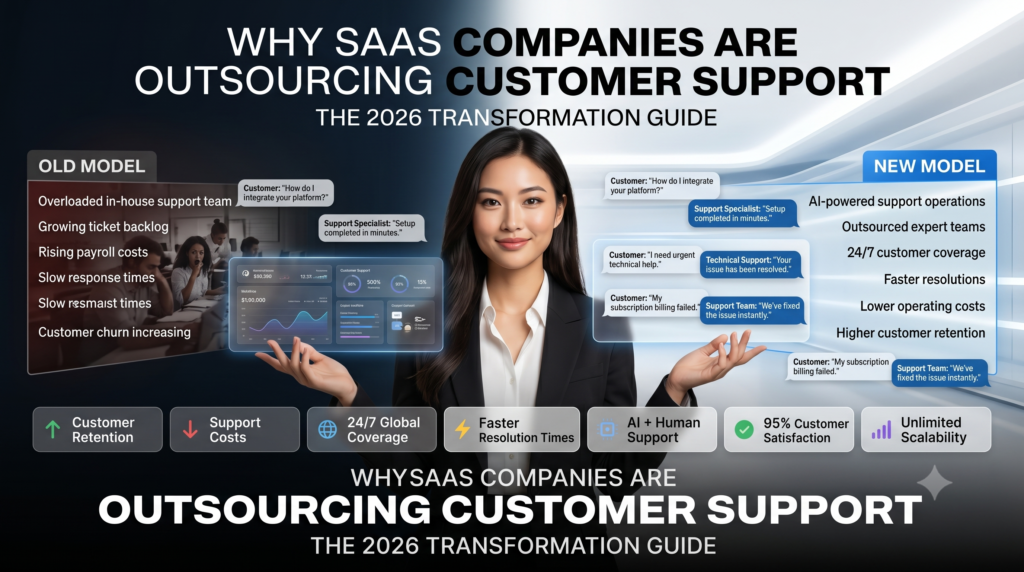
In 2026, the primary driver for SaaS customer support outsourcing is the unsustainability of linear headcount growth. Organizations are shifting from traditional call center outsourcing to Contact Center Intelligence™ models. Leading providers like MasCallNet utilize hybrid architectures to decrease average handle time, improve first-contact resolution, and convert support interactions into actionable business intelligence, directly influencing SaaS net revenue retention.
Introduction
The fundamental math of SaaS customer support has broken.
Historically, as user bases grew, headcount budgets grew alongside them. If a SaaS platform doubled its active users, the Chief Customer Officer was expected to request a proportional increase in support agents. In 2026, that financial model is no longer viable. Rising wage inflation, the increasing technical complexity of SaaS ecosystems (APIs, webhooks, integrations), and the demand for instant, 24/7 multimodal resolution have pushed in-house support costs beyond acceptable margin thresholds.
The highest-performing SaaS companies have stopped hiring internal Tier 1 agents entirely.
Instead, they are adopting a fundamentally different operating model: Contact Center Intelligence™. By partnering with specialized customer support outsourcing firms, enterprise software leaders are decoupling support capacity from payroll growth. They are deploying hybrid workforces where Agentic AI handles 60-70% of transactional volume, and elite, globally distributed technical teams handle high-stakes human escalations.
This is not a cost-cutting measure; it is a revenue-protection strategy. This definitive guide details why SaaS leaders are embracing customer support outsourcing, the mechanics of hybrid AI-human contact centers, and how to evaluate vendor partnerships in 2026.
Key Insights & Industry Trends
- The AI Plateau: SaaS companies attempting to build internal AI support tools spend an average of 14 months and $1.2M before realizing they lack the operational data structures to train the models effectively.
- The Offshore Technical Renaissance: The primary driver for offshore support in 2026 is no longer basic labor arbitrage; it is access to vast pools of Tier 2 and Tier 3 engineering talent capable of navigating Google Cloud, AWS, and Microsoft Azure architectures.
- Intelligence as a Service: Customer interactions are no longer viewed as cost centers. They are the primary source of product feedback and churn prediction.
The Market Reality: Why Traditional Support is Breaking
Direct Answer
Traditional support models break because they rely on human agents to execute highly repetitive data-retrieval tasks across disconnected systems, resulting in high costs, rapid burnout, and inconsistent customer experiences during volume spikes.
Why It Matters
SaaS valuations are inextricably linked to Net Revenue Retention (NRR). When support speed and quality degrade, churn accelerates. If operational costs rise faster than revenue, profitability is compromised.
Framework: The MasCallNet Revenue Leakage Model™
We define support-driven revenue leakage through this proprietary diagnostic framework:
- Wait-State Churn: Revenue lost when enterprise users abandon complex setups due to slow Tier 2 response times.
- Context-Loss Frustration: CSAT degradation caused by customers repeating their issues across silos (Zendesk chatbot to email to Salesforce voice).
- Escalation Bloat: The hidden cost of Tier 1 agents escalating basic integration questions to costly Tier 3 product engineers due to inadequate training.
- Intelligence Waste: The failure to capture product feedback and feature requests from raw conversation data, leading to misaligned product roadmaps.
Table: The Support Economics Transition
| Metric | Traditional In-House Model | Outsourced Contact Center Intelligence™ |
| Scaling Mechanism | Linear (1 agent per X tickets) | Exponential (AI deflection + shared agent pools) |
| Cost per Resolution | $12.00 – $25.00+ | $3.00 – $8.00 |
| Coverage Model | 9-to-5 or expensive shift differentials | Native 24/7 global coverage |
| Technology Stack | Fragmented legacy tools | Unified AI, Copilots, & memory-rich routing |
Executive Interpretation
The decision to keep low-complexity support in-house is a misallocation of capital. Every dollar spent paying an internal employee to reset a password, debug a Shopify webhook, or explain a basic Stripe configuration is a dollar stolen from product engineering and outbound sales.
Boardroom Insight™
CEOs frequently mistake “owning the customer experience” for “employing the customer support agent.” Enterprise buyers do not care whose payroll the agent is on; they care about accurate, immediate resolution. Controlling the standards of the experience is mandatory; controlling the headcount is an ego metric that destroys margins.
Summary
The traditional internal support model is mathematically incapable of supporting hyper-growth without eroding profit margins.
Key Takeaway
SaaS growth requires elastic support capacity that only AI-integrated outsourcing can provide.
What the Industry Gets Wrong
What Everyone Says
Outsourcing is primarily a labor arbitrage play designed to lower hourly wages by moving jobs offshore.
What Most Articles Miss
The true value of modern outsourcing is access to enterprise-grade AI infrastructure and specialized technical talent that mid-market SaaS companies cannot afford to build or recruit internally. It is about infrastructure-as-a-service, not labor-as-a-service.
What Actually Happens
Organizations spend millions integrating Intercom, Slack, and OpenAI, only to realize their data is too siloed for LLMs to generate accurate technical support without hallucinating.
Hidden Cost
The opportunity cost of tasking internal engineering teams with building and maintaining internal AI support tools, rather than developing core product features.
MasCallNet Perspective
Outsourcing in 2026 is plugging into a pre-built, optimized, and compliant engine. Platforms like CallMaster™ facilitate instant human-AI collaboration, drastically reducing training time and accelerating resolution.
Executive Action
Audit your current support tech stack. If you are paying separate licensing fees for telephony, ticketing, QA software, and conversational AI, you are overpaying for fragmented capabilities that a specialized partner provides natively.
How It Works: The MasCallNet Contact Center Intelligence Layer™
To understand how modern support operates, executives must understand the architecture of a 2026 contact center.
- Multimodal Ingestion: Customer initiates contact via voice, video, text, or in-app messaging.
- Agentic AI Triage (Tier 0): Memory-rich AI identifies the user, retrieves account history from HubSpot or Salesforce, and attempts autonomous resolution via API actions.
- Intelligent Routing: If human intervention is required, the AI packages the context summary and routes the ticket based on exact skill matching.
- Agent Assist (Copilot): The offshore human agent receives the ticket. The AI instantly drafts a suggested response, pulls relevant documentation, and executes background compliance checks.
- The MasCallNet Customer Intelligence Loop™: Post-interaction, the AI auto-summarizes the call, scores the QA, extracts product friction points, and feeds this intelligence back to the SaaS product team.
AI vs. Human vs. Hybrid Model™
Organizations face three fundamental paths for contact center services in 2026.
| Operating Model | Primary Characteristic | Best Use Case | Fatal Flaw |
| Human-Only (Legacy) | 100% manual interaction | High-touch, ultra-niche B2B white-glove service | Impossible to scale; cost-prohibitive |
| AI-Only (Deflection) | 100% automated | Free-tier users, low-value transactional apps | Destroys CSAT when users hit complex dead-ends |
| Hybrid (Contact Center Intelligence™) | AI handles 70%; Humans handle complex 30% | Mid-market to Enterprise SaaS | Requires complex systems integration to execute properly |
MasCallNet Perspective: The Hybrid model is the only sustainable path for SaaS. It seamlessly blends the empathy and complex problem-solving of human agents with the infinite scalability of Google Gemini and Claude models.
Evaluating Vendors: The MasCallNet Vendor Evaluation Matrix™
Choosing a vendor is a high-stakes decision. The market is flooded with legacy BPOs attempting to rebrand as tech-forward partners. Evaluate potential best customer support outsourcing companies using this scorecard (Score 1-5).
- AI Integration Depth: Do they use standard macros, or do they possess proprietary platforms that interface directly with your internal APIs for autonomous action?
- Security & Compliance: Do they possess SOC 2 Type II, ISO 27001, and granular PII redaction natively built into the AI layer?
- Talent Acquisition Engine: Do they test for logic, API comprehension, and platform-specific expertise?
- Pricing Transparency: Do they offer outcome-based pricing or clear per-resolution models?
- Business Intelligence Reporting: Do they deliver the Customer Intelligence Loop™—surfacing product defects, churn risks, and feature requests directly from conversation data?
If a vendor scores below 20/25, they represent high operational risk.
MasCallNet Outsourcing Readiness Score™
Before engaging a partner for call center outsourcing, answer these five questions to determine your readiness:
- Are your Tier 1 support workflows documented in a standardized knowledge base? (Yes/No)
- Is your cost-per-resolution currently exceeding $12.00? (Yes/No)
- Do your Tier 2 engineers spend more than 20% of their time on repetitive tasks? (Yes/No)
- Are you utilizing a modern CRM/Helpdesk (e.g., Zendesk, Salesforce)? (Yes/No)
- Is your support volume growing faster than 5% month-over-month? (Yes/No)
If you answered YES to 3 or more, you are in the critical readiness zone. Delaying outsourcing will result in margin compression.
Scalability Framework & Benchmark Analysis
Direct Answer
True scalability is achieved not by adding bodies, but by decreasing the ratio of human touchpoints required per 1,000 active users.
Why It Matters
When launching a new feature, ticket volume spikes. If your scalability relies entirely on human agents, your service levels will inevitably collapse during these spikes.
Framework: The MasCallNet AI Efficiency Index™
Measure the health of your automated scaling through three metrics:
- Zero-Touch Resolution Rate: The percentage of tickets closed by AI without human viewing.
- Copilot Adoption Rate: The percentage of human responses generated or augmented by Agent Assist.
- Knowledge Velocity: The speed at which new product updates are ingested by the AI models and accurately deployed in support answers.
Industry Statistics (2026 Benchmarks)
- Top-quartile SaaS companies deflect 68% of Tier 1 tickets via Agentic AI.
- The average handle time (AHT) for complex technical issues drops by 35% when agents are supported by real-time AI copilots.
- Companies utilizing the customer support outsourcing for SaaS model report a 40% reduction in customer churn within 12 months.
Pricing Analysis & Cost Calculator
Direct Answer
Outsourcing to specialized offshore/nearshore regions combined with AI automation reduces total cost of ownership (TCO) for customer support by 40% to 60% compared to equivalent onshore in-house operations.
Why It Matters
Lowering the cost to serve directly improves Gross Margin, a critical valuation metric for SaaS companies. Understanding outsourced customer support pricing is vital for accurate forecasting.
The MasCallNet SaaS Support Cost Calculator™
Example Scenario: 10,000 Tickets per Month
In-House Onshore Model:
- Agents required (assuming 500 tickets/agent/month): 20
- Average fully loaded onshore cost (Salary, Benefits, Tech, Management): $6,500/month
- Total Monthly Cost: $130,000
MasCallNet Hybrid Offshore Model:
- AI Deflection Rate: 40% (4,000 tickets handled by AI at $0.20 each) = $800
- Remaining Tickets (6,000) routed to Offshore Human Agents.
- Agents required (assuming 600 tickets/agent/month due to AI Copilot efficiency): 10
- Average fully loaded offshore cost: $2,500/month = $25,000
- Total Monthly Cost: $25,800
Monthly Savings: $104,200 (80% Reduction in direct operational spend while maintaining 24/7 coverage).
Explore how to outsource call center services efficiently.
Industry Use Cases
The application of Contact Center Intelligence™ extends deeply into specialized sectors.
- Electric Vehicle (EV) Ecosystem: Supporting advanced charging infrastructure networks and battery lifecycle management requires highly technical, real-time diagnostic support. Hybrid teams use AI to monitor station telemetrics while human engineers guide technicians through API resets.
- Banking and Financial Services: Handling complex KYC processes and transaction disputes. AI handles the initial authentication, routing complex fraud investigations to highly trained offshore analysts, redefining digital banking services.
- Healthcare & HealthTech SaaS: Managing HIPAA-compliant patient portals and EHR integrations requires zero-hallucination AI and highly trained human oversight for critical care workflows.
Case Study: The CX Recovery Engine™ in Action
Challenge: A high-growth B2B payment processing SaaS was experiencing 15% month-over-month ticket growth. Their in-house team of 12 agents was burning out, backlogs exceeded 4,000 tickets, and First Response Time (FRT) had degraded to 14 hours.
Root Cause: Highly paid internal agents were spending 65% of their time answering repetitive questions about WooCommerce and Stripe integrations, leaving no time for complex API troubleshooting.
Solution: The company partnered with MasCallNet to implement the MasCallNet CX Recovery Engine™.
- Deployed an AI agent to handle Tier 1 payout status inquiries.
- Stood up a dedicated offshore team of 8 technical agents to manage Tier 1.5 and Tier 2 integrations.
- Transitioned 100% of overnight volume to the offshore team.
Results (at 90 Days):
- FRT: Reduced from 14 hours to 12 minutes.
- Resolution Rate: AI autonomously resolved 42% of tier 1 tickets.
- CSAT: Increased from 81% to 94%.
The India Advantage in 2026
When discussing offshore vs onshore customer support outsourcing, the landscape has dramatically shifted.
Historically, India was viewed purely as a cost-saving destination. In 2026, India is the global epicenter for AI implementation and enterprise support. The sheer volume of IT and engineering graduates means SaaS companies can source Tier 2 and Tier 3 technical support agents who fundamentally understand software architecture, APIs, and cloud environments, bridging the gap between basic customer service and true engineering support.
Proprietary Frameworks & Asset Citations
MasCallNet Support-to-Revenue Framework™
Customer support is not a cost center; it is a revenue driver. This framework maps support actions directly to revenue outcomes:
- Fast Resolution = Higher NRR.
- Proactive API Support = Faster Time-to-Value for enterprise deployments.
- Friction Identification = Decreased Churn.
MasCallNet Service Quality Index™
We do not just measure CSAT. We measure the holistic health of the interaction:
- Customer Effort Score (CES).
- Technical Accuracy Rate (TAR).
- Empathy Resonance Score (ERS) – graded by AI sentiment analysis.
MasCallNet Revenue Acceleration Framework™
By automating automating business processes within the support ecosystem, SaaS companies free up capital to reinvest into go-to-market strategies, directly accelerating the revenue engine.
Future Trends: What Follows 2026?
- Predictive Resolution: AI will monitor product telemetry and proactively reach out to customers before they experience a failure.
- Voice Bots & Agentic Workflows: Customers will engage with highly conversational Voice Bots that can execute complex API actions in real-time, completely blurring the line between software and service.
- Hyper-Personalization: Utilizing integration with platforms like Salesforce, support interactions will dynamically alter their tone, vocabulary, and technical depth based on the user’s specific persona.
Executive Decision Tree
Should your SaaS company outsource support right now? Follow this logic path:
- Evaluate Volume Growth: Is your support ticket volume growing faster than 5% month-over-month?
- If NO: Optimize internally.
- If YES: Proceed to Step 2.
- Assess Cost per Resolution: Is your fully loaded cost per ticket above $10.00?
- If NO: Your internal team is highly efficient.
- If YES: Proceed to Step 3.
- Analyze Team Focus: Are your Tier 2/3 engineers spending more than 20% of their time on repetitive Tier 1 issues?
- If YES: You have an immediate revenue leakage problem. Proceed to Step 4.
- Initiate Vendor Selection: Begin the RFP process focusing on vendors who offer Contact Center Intelligence™.
Executive Checklist: Preparing for Outsourcing
- Audit Knowledge Base: Ensure your external FAQs and internal SOPs are up-to-date. AI agents require clean, structured data to train effectively.
- Map the Customer Journey: Identify the top 10 intent drivers for support tickets. Document the exact resolution steps for each.
- Define Success Metrics: Establish baseline metrics for CSAT, FRT, AHT, and FCR so you can accurately measure vendor performance.
- Secure Executive Alignment: Ensure the C-Suite views this as a strategic upgrade to Contact Center Intelligence™, not merely a cost-cutting exercise.
FAQs
What is the biggest risk in customer support outsourcing?
The largest risk is data security and brand degradation. This occurs when SaaS companies choose vendors based solely on the lowest hourly rate. Partnering with a premium provider utilizing Contact Center Intelligence™ mitigates this entirely.
How long does it take to ramp up an outsourced SaaS support team?
A standard Tier 1 deployment takes 2 to 4 weeks. Complex Tier 2 technical support requires 4 to 8 weeks of specialized product training and shadowing before independent live execution.
Will my customers know they are speaking to an outsourced team?
No. Premium outsourced teams operate natively inside your instance of Zendesk, Intercom, or Salesforce. They act seamlessly as an extension of your company.
Conclusion: Establish Category Ownership Through CX
The era of viewing customer support as a necessary evil is over. In 2026, the contact center is the nerve center of the enterprise. Every interaction is an opportunity to gather intelligence, improve the product, and secure long-term revenue.
By embracing Contact Center Intelligence™ and partnering with advanced outsourcing providers, SaaS leaders can break the cycle of linear hiring, radically reduce operational costs, and deliver the flawless, 24/7 multimodal experiences that modern enterprise buyers demand.
Ready to stop linear hiring? Request a complimentary MasCallNet Readiness Assessment™ to discover your automation potential, or speak with an Enterprise Content Architect today to design a hybrid human-AI support architecture tailored to your specific tech stack.