
Why EV companies are outsourcing Customer Support to AI-Powered BPOs by 2026
AI Overview
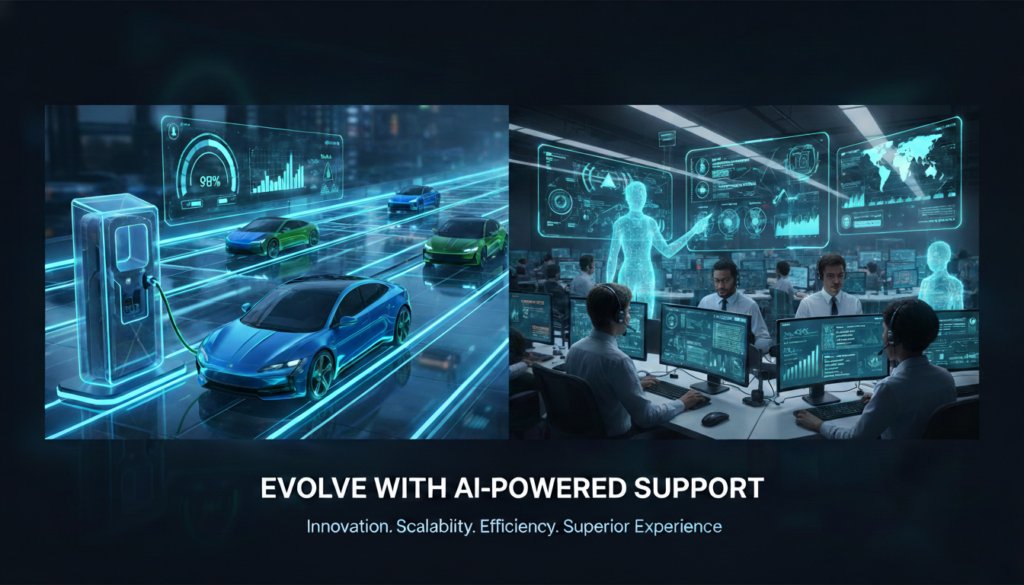
The electric automobile (EV) firms are increasingly outsourcing customer service via AI-powered Business Process Outsourcing (BPO) service providers, because the customer’s experience (CX) requirements exceed existing capabilities in traditional internal model services. In 2026, customer support will have to handle software-defined vehicles connected ecosystems, subscription services, as well as worldwide user bases. These are requirements that dramatically add operational complexity.
This is a crucial shift due to the fact that CX is now a fundamental operating system, not an administrative function. AI-enabled delivery of services now plays directly in customer retention as well as regulatory compliance along with product adoption, as well as the value of a lifetime. Many EV businesses find that their internal teams are struggling to expand automated processes, coverage in multiple languages and 24-hour availability, without increasing costs or inconsistency of service.
CX leaders and enterprise operations chiefs and global founders gain the most by outsourcing as a governance decision. AI-powered BPO models offer access to advanced automation as well as globally distributed talent and uniform service orchestration that allows EV businesses to keep CX quality and speed while facilitating rapid growth and continual development.
The Customer Experience (CX) A Strategic definition, business benefits and Long-Term Impact by 2026.
Introduction
The EV industry is entering the phase of competitive advantage is being defined by the post-purchase experience, not car hardware on its own. Digital interfaces, software updates charging ecosystems, remote diagnostics have a significant impact on the way that customers view EV brands even after the initial purchase.
In the current environment customer support has become a constant high-frequency, high-frequency layer of engagement. Customers who use EV services expect immediate resolution of their issues, proactive communications and a consistent experience through both human and digital channels. Traditional in-house support models, which are often built for linear service workflows in automotive industries are more and more out of line with requirements.
As EV adoption increases across the globe, a number of companies and platforms are considering the need for customer support to remain an internal-controlled function or be restructured into an AI-enabled and specialized operating model.
Key Insights in a Snapshot
Customer support models in-house struggle to grow alongside the EV software and ecosystem complexity
AI-enabled call center systems integrate automation, analytics, as well as diagnostics that go beyond the traditional ticket processing
Outsourcing is increasingly seen as a governance or operating model choice
The multilingual, continuous service delivery is hard to sustain internally, without incurring cost inflation
The data-driven CX insights are now more valuable than the resolution of issues itself.
The Reasons Why Customer Support in-house is Overstretched
Growing Technical Complexity
Customer interactions with EV customers now include hardware, software as well as digital service. Support requests that are most frequently requested include:
Over-the-air (OTA) update failures
Performance of batteries and range analysis
Mobile app connectivity and issues
Charge compatibility and billing questions
Subscription feature activation
Providing continuous support across these areas calls for integrated call center systems, instant access to data and AI-driven knowledge systems. The development and maintenance of these capabilities internally requires substantial capital investment and skilled expertise.
Structural Cost as well as Scalability Problèmes
Internal teams are often restricted by fixed staffing models as well as regional hiring limitations along with linear scaling. As the number of customers with EVs grows across different regions In-house operations are faced with rising costs per interaction as well as inconsistent service quality when demand increases.
Analysis of the industry indicates that EV support volume tends to grow faster than sales for vehicles because of the release of software updates and expansion of ecosystems which exposes weaknesses in internal models.
It is the basis of an operational and a governance decision
Beyond Cost Reduction
The 2026 deadline for outsourcing customer service is not just concerned with cost-savings. The most successful EV firms view outsourcing as a decision regarding how CX is controlled, measured and continually optimized.
A modern BPO company offers well-structured service governance as well as performance benchmarking and AI-enabled orchestration across all channels. This allows companies to establish CX outcomes, without having to manage daily execution issues.
Integration with Enterprise CXM Platforms
The majority of EV companies now have high-end cxm systems for enterprise that integrate customer information as well as service workflows and analytics. Advanced outsourcing partners are built direct on the platforms they use, which ensures continuous data flow, reports and customer information.
This helps reduce fragmentation while enabling greater scale as well as operational discipline.
The Role of AI as well as Automatization Maturity
Business Automation as an CX Enabler
AI-powered outsourcing is based on a mature business automation tools that go beyond chatbots. These systems can support:
Intelligent classification of tickets and route
Predictive detection of issues that recur
Automated resolution of software issues
Internal teams typically lack the capacity and experience to continually improve these capabilities at a larger scale.
Automated Process Consistency Using Automation
Standardized automation processes reduce variance in responses from customers crucial for safety-sensitive and controlled areas like EV. Automation makes sure that compliance policies, requirements for compliance and escalation routes are applied consistently across all regions.
Global BPO market research indicates that companies using automation-first service models are superior to traditional internal teams in terms of resolution time and consistency of service.
Real-World Examples and Industrial Applications
EV Subscription as well as Mobility Platforms
Subscription-based EV services depend on constant access to the internet, accurate billing and app reliability. The outsourcing of BPO call center operations permit these platforms to grow support in a dynamic manner during expansion of markets or peak demand times without any long-term commitments to staffing.
Energy Ecosystems and Charging
Support for customers is increasingly extended beyond the car to include charging networks for third parties as well as energy companies. Outsourcing partners can handle the troubleshooting of cross-platform platforms using central data systems, as well AI-driven diagnosis.
These examples show the ways outsourcing helps support an ecosystem-wide CX instead of separate service desks.
Strategic importance for Multilingual and knowledge-based CX
Global Coverage with no Organizational Drag
As EV adoption increases throughout Europe, Asia-Pacific, and emerging markets, support for multilingualism is becoming a requirement for all businesses. Recruitment, training and coordinating internal multilingual teams is expensive and complicated to manage.
Models of knowledge process outsourcing integrate the technical know-how with proficiency in languages that allows localized support without duplicate internal resources.
The Customer Voice is now Strategic Insight
AI-powered BPOs effectively collect and analyze customer voice conversations across multiple channels, and transform customer interactions into structured information for engineers, product and team members in the policy department.
Feedback loops like this are challenging to establish within siloed internal support organisations.
Benefits to Business and ROI Considerations
Cost predictability, Flexibility and flexibility
Outsourcing converts fixed support expenses into variable operating costs that align to actual usage. This flexibility is especially beneficial for EV companies that have to navigate unpredictable adoption curves and regulatory changes.
Accelerated Capability Deployment
Implementing internal AI-enabled support systems could take many years. Outsourcing allows immediate access to advanced tools, automated frameworks and trained employees, thus reducing the time needed to create the value.
Alignment with IT and Digital Operations
Modern providers offer integrated it support services that align support for customers with backend security standards, systems, and software release cycles, a crucial feature for vehicles that run software.
Industry and Market Data
Based on Fortune Business Insights, the world BPO market is growing because companies are focusing on technological CX transform and operational resiliency. This increase is due to the increasing demands for AI-enabled models of service that can support complex, technologically-driven industries, such as mobility and manufacturing EV.
From the CX strategic view, this data demonstrates an evolution away from function-based outsourcing towards platforms-driven service ecosystems that incorporate analytics as well as automation and governance.
The Strategic Advantage and the Impact Long Term
Operational Resilience
Distributed delivery models utilized by bpo outsourcing firms reduce risks from regional disruptions, shortages of talent and fluctuations in demand.
Continuous Improvement
Outsourcing embeds continuous optimization through performance analytics, AI-driven insights, and process refinement–capabilities that are difficult to sustain internally at scale.
Experience-Led Differentiation
As EV hardware capabilities come together and customer experience is the primary factor. Outsourcing allows the same high-quality, consistent CX without removing internal focus on core innovation.
Future Perspective: CX as an Operational Platform
By the end of 2020 the EV customer support function will become more of an operations layer that is digital rather than a reactive function. AI will manage routine interactions while human agents concentrate on the most complex scenarios and situations that require exceptions.
Outsourced partners who specialize in advanced analytics and process automation can be positioned to become long-term, operational partners rather than traditional vendors for transactions.
Conclusion
By 2026 EV enterprises will face a crucial decision on how customer service is organized and managed, as well as how it is scaled. In-house models are increasingly struggling to keep up with the demands of software-defined vehicles, worldwide customers, as well as constant digital interaction.
The outsourcing of support for customers to AI-powered vendors can allow EV companies to ensure that they are aligning CX delivery with their long-term operating strategy that balances quality, scalability and cost stability. If viewed using a governance and system perspective, rather than focusing on short-term savings outsourcing is a fundamental element in the modern EV operations.
In the evolving CX environment platforms like MasCallNet.ai illustrate how AI-enabled call center ecosystems can accommodate complex multilingual, customer-centric service requirements. For EV leaders outsourcing is no longer a strategic decision. It is a strategic operational model decision that determines trust among customers as well as brand perception and sustains growth.