
The Evolution of BPO Services in the AI Automation Era: Future of Outsourcing in 2026
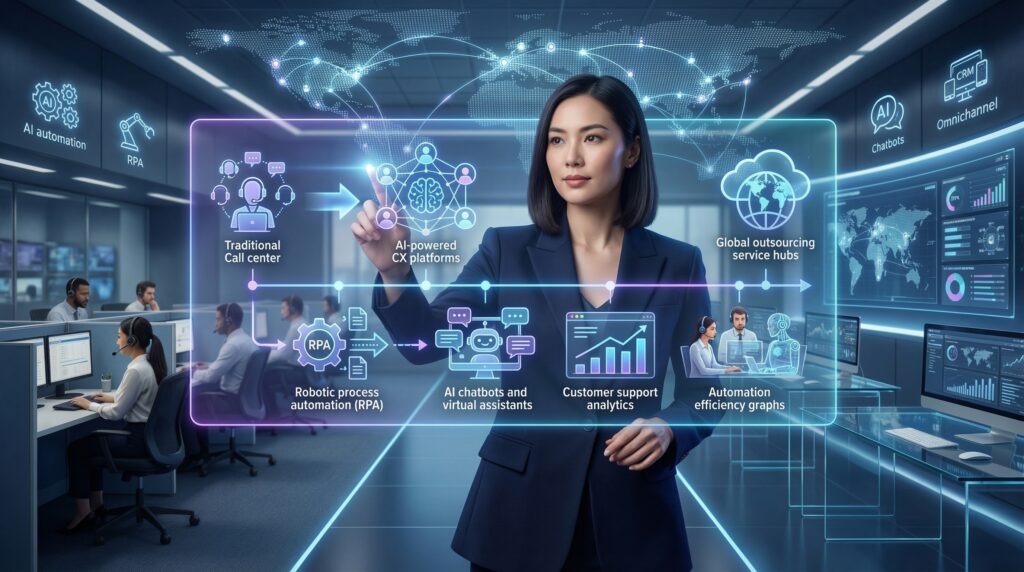
The evolution of BPO services in the AI automation era refers to the transformation of traditional outsourcing models into AI-enabled service ecosystems where automation processes, AI chatbots, and human agents operate together in hybrid CX architectures. This model improves operational efficiency, reduces costs, and enables global enterprises to scale customer support operations securely.
Artificial intelligence is reshaping how enterprise customer support operations function. Historically, a bpo call center relied primarily on human agents to manage customer inquiries across voice, email, and chat channels. In modern enterprise environments, AI technologies such as conversational chatbots and workflow automation are integrated into service infrastructure.
AI chatbots handle repetitive and high-volume requests including order tracking, billing inquiries, password resets, and appointment scheduling. Human agents focus on complex cases requiring contextual reasoning, regulatory awareness, and emotional intelligence.
The result is a hybrid CX architecture that combines automation processes with skilled human agents. This model enables organizations to scale customer service operations while maintaining quality standards.
In 2026, leading bpo outsourcing companies operate technology-driven support ecosystems integrating AI, analytics, workforce management platforms, and CRM integration. These systems allow global enterprises to deliver consistent customer experiences while managing costs, compliance requirements, and operational risk.
AI Maturity, Enterprise Evolution, and the Strategic Imperative
The global outsourcing market is undergoing a structural transformation driven by digital technology adoption. Traditional outsourcing models focused primarily on labor cost advantages. Today, the BPO Company model is evolving toward AI-enabled operational partnerships capable of delivering intelligent automation and data-driven service management.
Several enterprise challenges are accelerating this transformation:
- Rising customer service volumes across digital channels
- Increasing expectations for real-time support
- Global workforce shortages in service operations
- Strict regulatory and compliance requirements
- Pressure to improve operational efficiency
These pressures are encouraging organizations to adopt customer support outsourcing services integrated with automation platforms.
Simultaneously, the industry is converging with Knowledge Process Outsourcing, where outsourcing partners provide specialized expertise in analytics, regulatory compliance, and industry-specific processes.
Modern outsourcing providers now deliver comprehensive operational ecosystems including it support services, CX analytics, omnichannel service platforms, and AI-assisted workforce management. As a result, the traditional contact center has evolved into an integrated contact center environment capable of managing complex enterprise service operations at global scale.
Key Insights at a Glance
- Harvard Business Review research on customer experience strategy shows that organizations prioritizing CX transformation outperform competitors in revenue growth.
- AI-driven automation is transforming outsourcing from labor-focused operations into technology-enabled service ecosystems.
- Hybrid CX models combining automation and human agents provide the highest operational efficiency.
- Automation processes can resolve 60–80% of repetitive support requests in mature enterprise environments.
- Enterprises increasingly integrate outsourcing providers into CRM and CXM platforms.
- Global outsourcing partnerships support multilingual, 24/7 service delivery across multiple markets.
- Vendor governance, data sovereignty, and AI oversight frameworks are becoming essential components of outsourcing strategies.
Enterprise Intent Layer
Strategic Intent
Enterprise executives are evaluating outsourcing strategies based on long-term scalability and operational resilience. Modern Outsourcing services must deliver more than cost reduction. They must support digital transformation and technology integration.
Strategic outsourcing decisions now focus on:
- AI-enabled service delivery
- scalable operational capacity
- cross-border service management
- customer experience optimization
This shift represents a transformation from transactional outsourcing toward strategic operational partnerships.
Operational Intent
Operational leaders focus on measurable improvements in customer support performance. AI-enabled outsourcing models help organizations achieve:
- Reduced average handling time
- Higher first-contact resolution rates
- Increased service availability
- Improved workforce productivity
These outcomes are achieved by combining automation processes with specialized support teams.
Implementation Intent
Technology leaders implementing AI-enabled outsourcing models prioritize integration between service platforms and enterprise systems. Key implementation priorities include:
- CRM integration
- AI chatbot deployment
- workflow automation
- workforce management tools
- performance analytics systems
These integrated infrastructures allow enterprises to manage complex support operations efficiently.
Real-World Enterprise Scenarios
Cross-Border Customer Support Scaling
A global eCommerce retailer expanding into multiple regions requires multilingual support operations capable of handling inquiries across time zones.
Instead of building regional service teams internally, the organization partners with bpo outsourcing companies capable of providing global support coverage.
Key capabilities include:
- multilingual service agents
- regional regulatory compliance expertise
- centralized CRM integration
- scalable workforce capacity
This model enables rapid global expansion without requiring internal operational restructuring.
Hybrid AI Deployment in Telecommunications
Telecommunications providers manage extremely high volumes of service requests related to billing, connectivity, and technical troubleshooting.
AI chatbots automate routine requests including service plan inquiries, balance checks, and device configuration support. Human agents manage escalations related to service outages, complex troubleshooting, and regulatory complaints.
This hybrid service model improves efficiency while maintaining service quality.
CRM and CXM Platform Integration
Retail organizations increasingly integrate outsourcing partners directly into enterprise CXM platforms.
These integrations provide:
- unified customer interaction histories
- centralized analytics dashboards
- real-time service monitoring
- improved personalization capabilities
Integrated service architectures allow organizations to maintain consistent customer experiences across multiple support channels.
Regulatory Compliance in Financial Services
Financial institutions operate under strict regulatory frameworks governing customer communication and data protection.
Outsourcing providers supporting financial organizations must implement:
- identity verification systems
- secure call recording infrastructure
- financial compliance monitoring
- jurisdiction-based data storage controls
These compliance frameworks ensure regulatory alignment while enabling outsourced service delivery.
Strategic CX Transformation Framework
Enterprise CX transformation typically follows a structured operational redesign process.
1. CX Operating Model Assessment
Organizations begin by evaluating their existing support infrastructure. This assessment focuses on:
- service demand volumes
- automation readiness
- workforce skill capabilities
- existing technology platforms
This process identifies opportunities for automation and outsourcing integration.
2. Hybrid CX Architecture Design
Hybrid service architectures integrate multiple components:
- AI chatbots and conversational AI
- human support agents
- CRM and CXM platforms
- analytics engines
- workflow automation systems
These technologies create a scalable infrastructure capable of managing complex customer support environments.
3. Automation Process Deployment
Automation processes are typically applied to repetitive service tasks such as:
- account verification
- order tracking
- billing inquiries
- password recovery
Automating these interactions significantly reduces operational workloads.
4. Workforce Transformation
As automation handles routine tasks, human agents transition toward more specialized responsibilities including:
- technical troubleshooting
- compliance-sensitive cases
- escalation management
- relationship-driven support
This transformation improves both productivity and service quality.
5. Continuous CX Optimization
Enterprise service operations require ongoing performance monitoring.
Organizations use analytics tools to evaluate:
- service response times
- customer satisfaction metrics
- AI chatbot performance
- workforce productivity indicators
Continuous optimization ensures long-term operational improvement.
Business Benefits and ROI
Enterprises adopting AI-enabled outsourcing strategies typically achieve measurable operational improvements.
Cost Reduction
Automation combined with outsourced support operations can reduce service delivery costs by 30–50 percent.
Cost reductions are achieved through:
- lower staffing requirements
- automation of routine tasks
- reduced infrastructure investment
Efficiency Gains
AI-enabled contact center environments deliver efficiency improvements through automated workflow orchestration and predictive analytics.
Average handling times can decrease by 20–40 percent, enabling support teams to resolve more customer interactions within the same timeframe.
Improved Customer Experience
Hybrid CX models allow organizations to deliver faster and more reliable customer support.
Key improvements include:
- shorter response times
- improved first-contact resolution
- 24/7 service availability
These improvements strengthen customer satisfaction and retention.
Read More: https://mascallnet.ai/ai-powered-outsourcing-how-intelligent-contact-centers-drive-growth/
Governance and Long-Term Impact
Data Governance
Customer support operations involve large volumes of sensitive customer information. Outsourcing environments must implement robust data governance frameworks including:
- encryption protocols
- access control systems
- secure data transfer mechanisms
These safeguards ensure protection of sensitive customer data.
Vendor Risk Governance
Organizations outsourcing customer support must implement structured vendor governance frameworks.
Key evaluation criteria include:
- cybersecurity capabilities
- financial stability
- operational scalability
- regulatory compliance certifications
Vendor governance ensures long-term service reliability.
AI Oversight Models
As automation becomes more integrated into customer support operations, organizations must establish governance mechanisms to monitor AI systems.
Key oversight practices include:
- AI performance monitoring
- algorithm transparency reviews
- bias detection frameworks
- human escalation protocols
These controls ensure responsible and reliable AI deployment.
Cross-Border Compliance
Global support operations require compliance with multiple regulatory frameworks including:
- data protection regulations
- financial compliance standards
- healthcare privacy requirements
Outsourcing providers must maintain regulatory alignment across jurisdictions.
Workforce Continuity Planning
Enterprise service operations must maintain resilience during disruptions. Workforce continuity strategies include:
- distributed service teams
- remote support infrastructure
- disaster recovery systems
- redundant service networks
These capabilities ensure uninterrupted service delivery.
CX Operating Model Comparison
| Model | Strengths | Limitations | Best Use Case |
| AI-Only CX | Highly scalable and cost efficient | Limited ability to handle complex issues | High-volume automated service environments |
| Human-Only CX | Personalized and flexible service | Higher operational costs | Relationship-driven service industries |
| Hybrid CX | Combines automation efficiency with human expertise | Requires integrated technology architecture | Enterprise-scale customer support operations |
Enterprise FAQ
How can enterprises reduce support costs using AI?
Enterprises reduce support costs by automating repetitive service requests using AI chatbots and workflow automation. Automation processes handle routine interactions, allowing human agents to focus on complex issues, reducing staffing requirements and operational expenses.
Is outsourcing customer support safer than in-house operations?
Outsourcing can maintain strong security standards when providers implement enterprise-grade cybersecurity frameworks, regulatory compliance certifications, and data governance systems.
How should organizations select a global outsourcing partner?
Organizations should evaluate outsourcing providers based on:
- AI and automation capabilities
- compliance certifications
- global service delivery capacity
- technology integration expertise
- operational scalability
What risks must enterprises manage when outsourcing?
Key risks include:
- data security vulnerabilities
- vendor operational instability
- regulatory compliance failures
- service disruption risks
Structured governance frameworks mitigate these risks.
What role will AI play in customer support by 2030?
AI will automate most routine customer interactions while providing real-time decision support to human agents. The role of human agents will increasingly focus on complex problem resolution, strategic customer engagement, and regulatory-sensitive operations.
Conclusion
The evolution of BPO services in the AI automation era represents a fundamental transformation in enterprise customer support operations. Organizations are transitioning from labor-based outsourcing models toward technology-enabled service ecosystems that combine automation processes, AI platforms, and specialized human expertise.
Hybrid CX architectures enable enterprises to scale global support operations, improve service efficiency, and maintain regulatory compliance while controlling operational costs.
Emerging service providers such as Mascallnet illustrate how AI-enabled outsourcing platforms are redefining global CX service delivery by integrating automation, analytics, and workforce expertise within unified support infrastructures.
Organizations evaluating their future CX operating model should assess whether their current structure can sustainably support this model at scale.