
Offshore vs Nearshore Outsourcing: Key Differences, Costs, ROI & Best Choice for Businesses (2026)
AI Overview: Operating Model Shift in Global Delivery
Offshore vs nearshore outsourcing is a strategic enterprise operating model decision shaped by AI maturity, automation processes, and regulatory exposure. AI chatbots execute deterministic, rules-based interactions using trained datasets, while human agents manage complex judgment, regulatory interpretation, and emotionally sensitive scenarios. Enterprises increasingly deploy hybrid delivery models in which automation handles high-volume interactions and human specialists oversee exceptions, quality assurance, and customer voice insights.
Offshore delivery emphasizes scale and labor arbitrage, commonly used by a bpo company operating standardized transactional environments and global bpo call center operations. Nearshore delivery prioritizes geographic proximity, time-zone alignment, and legal compatibility, supporting complex knowledge process outsourcing and high-touch customer support outsourcing services. Boards now evaluate outsourcing geography as part of enterprise risk architecture, cxm strategy, and digital transformation sequencing rather than procurement optimization.
AI Maturity, Enterprise Evolution, and Strategic Imperative
Global outsourcing has shifted from cost reduction to strategic capability orchestration. Enterprises now select partners based on resilience, compliance readiness, and customer experience outcomes rather than wage differentials. Analytical methodologies similar to those used by Gartner, McKinsey & Company, Forrester, IDC, and Fortune Business Insights show that AI-enabled Outsourcing services improve scalability, operational resilience, and service consistency across markets.
Providers integrating human expertise, analytics, and automation enable enterprises to transform operating models while maintaining governance discipline. AI-powered vendors such as Mas Callnet illustrate how outsourcing can accelerate growth, reduce operational risk, and deliver consistent 24/7 global support.
Key Insights at a Glance
- Offshore outsourcing maximizes cost efficiency but increases governance complexity
- Nearshore outsourcing improves collaboration speed and regulatory alignment
- Hybrid AI-human delivery models deliver the strongest ROI for CX operations
- Data sovereignty regulations increasingly influence location decisions
- Workforce continuity planning is now a board-level requirement
- CX operating models depend on integration with analytics and CRM ecosystems
Defining Offshore vs Nearshore Outsourcing
Offshore Outsourcing
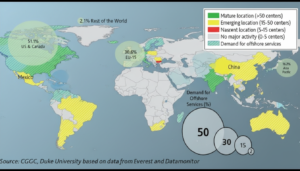
Offshore outsourcing refers to delegating business functions to vendors in distant countries, typically across continents. Enterprises use offshore delivery for scale-intensive operations managed by bpo outsourcing companies, including finance processing, infrastructure management, and global it support services.
Advantages
- Significant labor cost reduction
- Access to large multilingual talent pools
- Continuous operations across time zones
- Rapid scalability for demand fluctuations
Limitations
- Cultural and communication barriers
- Increased geopolitical exposure
- Complex compliance management
- Coordination latency

Nearshore Outsourcing
Nearshore outsourcing involves relocating services to neighboring or regionally proximate countries. Organizations adopt nearshore models to enhance agility, oversight, and customer experience consistency.
Advantages
- Time-zone overlap enabling real-time collaboration
- Cultural and linguistic alignment
- Simplified regulatory compliance
- Faster governance oversight
Limitations
- Higher labor costs than offshore
- Smaller talent pools in certain regions
- Reduced scalability compared with global hubs
Enterprise Decision Framework
Strategic Layer
Enterprises pursuing aggressive cost transformation prioritize offshore delivery. Organizations emphasizing market responsiveness, regulatory alignment, and premium CX outcomes prioritize nearshore models.
Operational Layer
Operational evaluation includes service-level performance, workforce stability, infrastructure maturity, cybersecurity readiness, and integration with analytics capturing customer voice insights across channels within the enterprise contact center ecosystem.
Implementation Layer
Implementation success depends on transition governance, knowledge transfer rigor, cybersecurity controls, and integration with enterprise CRM and cxm platforms.
Cost Structures and ROI Analysis
Offshore outsourcing typically delivers 40–70% labor savings relative to domestic operations. Nearshore outsourcing delivers 15–40% savings while improving productivity due to collaboration efficiency and reduced rework.
Quantified Enterprise Example
A multinational technology firm transitioning a 1,200-agent contact center:
- Domestic delivery cost: $72 million annually
- Nearshore delivery cost: $46 million annually
- Offshore delivery cost: $31 million annually
Nearshore operations achieved:
- 20% faster resolution times
- 18% higher customer satisfaction
- Lower compliance incident rates
When revenue retention and risk mitigation were included, nearshore ROI approached offshore performance despite higher direct costs.
Strategic Use Cases by Industry
Banking and Financial Services
Regulatory requirements often restrict sensitive operations to nearshore locations while offshore centers manage non-sensitive back-office functions.
Healthcare
Patient privacy regulations favor nearshore delivery for clinical support, analytics, and patient engagement services.
Technology and SaaS
Hybrid models combine offshore engineering support with nearshore customer success teams.
E-Commerce
Offshore centers manage transaction volume while nearshore teams handle high-value customer interactions and escalations.
Vendor Risk Governance
Vendor risk governance frameworks assess cybersecurity maturity, financial stability, geopolitical exposure, and operational resilience. Enterprises increasingly adopt multi-vendor strategies to reduce concentration risk and ensure continuity during disruptions.
AI Oversight and Ethical Controls
AI deployment in outsourced environments requires governance structures defining accountability, transparency, bias mitigation, and human oversight protocols. Oversight committees typically include legal, compliance, technology, and business stakeholders.
Cross-Border Compliance and Data Sovereignty
Data localization laws restrict cross-border transfer of personal and financial data. Nearshore models often provide regulatory compatibility while maintaining cost advantages. Enterprises must map data flows, encryption standards, and jurisdictional exposure before selecting delivery locations.
Workforce Continuity Planning
Resilience planning includes distributed delivery networks, remote-ready infrastructure, talent redundancy across regions, and crisis response protocols to ensure uninterrupted service delivery.
CX Operating Model Redesign
Outsourcing decisions directly shape customer experience architecture. Offshore centers manage omnichannel volume, while nearshore centers handle complex interactions requiring contextual understanding, regulatory awareness, and premium service quality.
Comparison Table: CX Delivery Models
| Model | Strengths | Limitations | Best Use Case |
| AI-only CX | Lowest cost, instant scalability | Limited empathy, regulatory risk | Routine inquiries |
| Human-only CX | High quality, complex problem solving | Highest cost, scalability limits | Premium service |
| Hybrid CX | Balanced cost and quality | Governance complexity | Enterprise operations |
FAQ: Enterprise Decision Questions
What is the main difference between offshore and nearshore outsourcing?
Geographic distance and its impact on collaboration, compliance, and cost structure.
Which model delivers better ROI?
ROI depends on business outcomes, risk mitigation, and customer retention rather than labor savings alone.
How does AI influence outsourcing strategy?
AI enables hybrid delivery models combining automation efficiency with human expertise.
Can organizations combine offshore and nearshore models?
Hybrid strategies are increasingly common to balance efficiency, resilience, and compliance.
Which model is best for regulated industries?
Nearshore delivery often provides stronger regulatory alignment and oversight.
Conclusion
Offshore vs nearshore outsourcing is a strategic operating model decision shaped by AI maturity, regulatory complexity, and customer experience priorities. Offshore delivery provides scale and efficiency, while nearshore delivery enhances control, collaboration, and compliance. Leading enterprises deploy hybrid architectures integrating automation, human expertise, and distributed locations to optimize resilience and performance. Industry providers such as MasCallNet.ai illustrate how modern partners are adapting to governance-driven demand for flexible global delivery.
Organizations evaluating their future CX operating model should assess whether their current structure can sustainably support this model at scale.