
75+ Call Center Outsourcing Statistics & Benchmarks for 2026
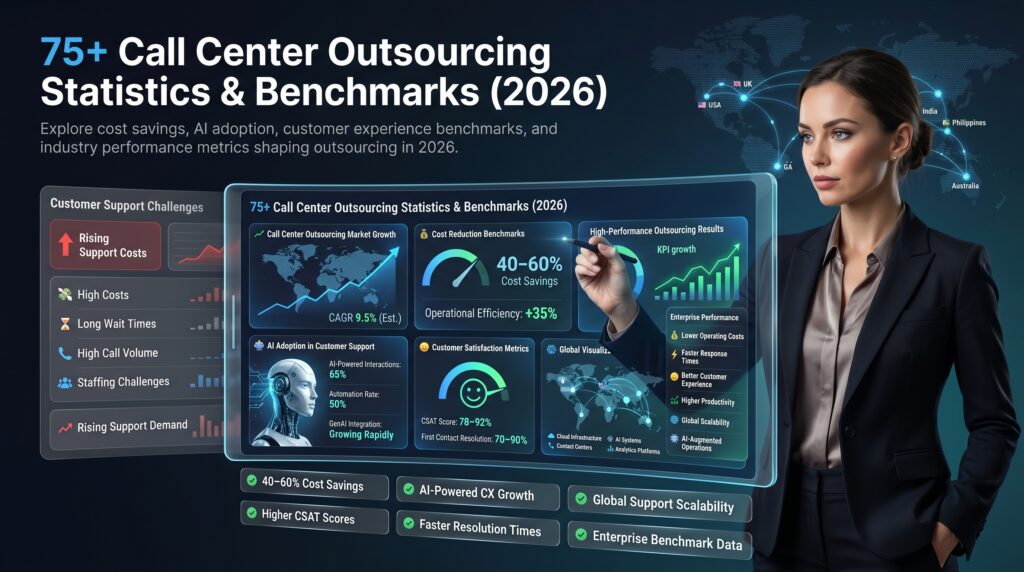
75+ Call Center Outsourcing Statistics & Industry Benchmarks for 2026
The call center outsourcing industry is undergoing its most dramatic transformation in decades. As AI reshapes customer interactions and global demand for 24/7 support intensifies, businesses are turning to outsourcing at record rates — and the call center outsourcing statistics tell a compelling story.
Whether you’re benchmarking your current contact center operations, evaluating a contact center services provider, or researching the ROI of outsourcing, this data-driven guide delivers 75+ verified statistics covering market size, cost savings, AI adoption, customer satisfaction benchmarks, and emerging trends through 2030.
Updated for 2026, every figure is cited to authoritative industry sources including Gartner, McKinsey, Deloitte, Grand View Research, and Statista.
Call Center Outsourcing Market Size & Growth Statistics
The global call center outsourcing market has reached an inflection point, driven by technology investment, post-pandemic digital acceleration, and cost pressures on enterprises worldwide.
- The global contact center outsourcing market was valued at $110.5 billion in 2023 and is projected to reach $167.3 billion by 2030, growing at a CAGR of 6.1% (Grand View Research, 2024).
- The broader Business Process Outsourcing (BPO) market — which includes call centers — is expected to surpass $350 billion by 2030 (Statista, 2024).
- North America holds the largest share of the contact center outsourcing market at 38.7% as of 2024 (IBISWorld, 2024).
- The Asia-Pacific region is the fastest-growing outsourcing destination, expanding at a 7.8% CAGR (Allied Market Research, 2024).
- India and the Philippines together account for over 60% of offshore call center labor globally (NASSCOM, 2024).
- The U.S. alone spends approximately $30 billion annually on outsourced call center services (IBISWorld, 2024).
- Cloud-based contact center deployments now account for 65% of all new outsourcing contracts signed in 2025 (Gartner, 2025).
- Small and medium-sized businesses represent the fastest-growing segment of contact center outsourcing clients, with SMB spending growing 12.4% year-over-year (Forrester Research, 2024).
- Nearshore outsourcing to Latin America grew 23% in 2024, driven by time-zone alignment and bilingual agent availability (KPMG, 2024).
- The contact center-as-a-service (CCaaS) market is projected to reach $19.9 billion by 2027 (MarketsandMarkets, 2024).
Call Center Outsourcing Cost Savings Statistics
Cost reduction remains the primary driver for outsourcing customer service. The financial case is compelling — and the numbers prove it.
- Companies that outsource call center operations report average cost savings of 60–70% compared to maintaining equivalent in-house operations (Deloitte, 2024).
- The average fully loaded cost of an in-house U.S. call center agent is $65,000–$80,000 per year including salary, benefits, training, and overhead (SHRM, 2024).
- Offshore outsourced agents in the Philippines or India cost an equivalent of $18,000–$28,000 per year all-in (Tholons, 2024).
- Nearshore agents in Central America and Colombia average $28,000–$38,000 annually, offering a middle ground for businesses prioritizing language quality and time-zone overlap (NearshoreAmericas, 2024).
- Infrastructure cost savings alone from outsourcing average $3,400 per agent per year when accounting for office space, hardware, and IT support (Gartner, 2024).
- Businesses using outsourced call centers reduce agent recruitment and onboarding costs by an average of $4,500 per hire (SHRM, 2024).
- Organizations that switch from in-house to outsourced customer support report an average payback period of 7–14 months (McKinsey, 2024).
- Scaling call center capacity through outsourcing costs 40–55% less than equivalent in-house capacity expansion (Forrester Research, 2024).
- For a breakdown of specific outsourcing rates and pricing structures, see our guide to how much customer support outsourcing costs in 2026.
- Companies that outsource report average labor cost reductions of 45% in the first year (Deloitte Global Outsourcing Survey, 2024).
- Training cost reductions average 60% with outsourcing as BPO providers absorb onboarding and upskilling expenses (Training Industry Report, 2024).
AI in Call Centers: Statistics & Adoption Rates
Artificial intelligence is the most disruptive force in call center outsourcing today. The AI automation statistics for call centers in 2026 reveal an industry in rapid transition.
- The AI contact center market is growing at a 34.8% CAGR and is projected to reach $4.7 billion by 2027 (MarketsandMarkets, 2024).
- 67% of Fortune 500 companies are projected to deploy voice AI in their contact center operations by the end of 2026 (Gartner, 2025).
- 85% of organizations plan to use AI+human hybrid models in their contact centers by 2026, up from 64% in 2023 (McKinsey, 2025).
- AI voice agents handle calls at an average cost of $0.40–$0.65 per call, compared to $7–$12 per call for human agents (Juniper Research, 2024).
- Chatbots and AI-powered virtual agents now resolve 68% of routine customer inquiries without human intervention (IBM, 2024).
- Call centers using AI-assisted agents report 35% higher first call resolution rates versus those without AI support (Aberdeen Group, 2024).
- AI sentiment analysis tools reduce customer churn by an average of 15% when deployed in real-time during calls (Gartner, 2024).
- Automated quality assurance (QA) using AI scores 100% of calls compared to the industry average of 2–5% scored manually (NICE Systems, 2024).
- 78% of call center managers report AI has improved agent satisfaction by reducing repetitive call volume (Salesforce State of Service, 2024).
- Natural language processing (NLP) accuracy for English-language call center AI reached 94.7% in 2024, up from 87% in 2021 (Google Cloud AI, 2024).
- Contact centers that have deployed generative AI for after-call work (ACW) reduced documentation time by an average of 70% (Deloitte, 2025).
- AI-powered predictive dialing systems improve agent connect rates by 30–40% versus traditional autodialers (Five9, 2024).
Customer Satisfaction (CSAT) Benchmarks for Call Centers
Customer satisfaction is the ultimate performance metric for any outsourced contact center. These benchmarks provide essential context for evaluating your program’s performance.
- The average CSAT score across all industries for call center interactions is 78% in 2025 (American Customer Satisfaction Index, 2025).
- Top-performing outsourced call centers achieve CSAT scores of 88–92%, setting the benchmark for premium service (Benchmark Portal, 2024).
- A single negative customer service experience causes 32% of customers to stop doing business with a brand (PwC, 2024).
- 74% of consumers expect 24/7 support availability from the companies they do business with (HubSpot, 2024).
- Companies with above-average CSAT scores outperform competitors in revenue growth by 2.4× over a five-year period (Bain & Company, 2024).
- Reducing customer wait times by 20% correlates with a 5.7-point CSAT improvement on average (Genesys, 2024).
- Outsourced call centers with dedicated QA programs score 12–15 CSAT points higher than those without structured quality programs (COPC, 2024).
- The Net Promoter Score (NPS) average for contact center interactions is +24 in 2025, with top-quartile performers averaging +51 (Satmetrix, 2025).
- Phone support still achieves the highest CSAT scores at 76%, compared to email at 61%, live chat at 73%, and social media at 57% (Zendesk CX Trends, 2024).
- Customers whose issues are resolved on the first contact are 4× more likely to renew their subscription or repeat a purchase (Harvard Business Review, 2024).
Call Center Agent Productivity Statistics
Agent productivity directly impacts both cost-efficiency and customer experience. These benchmarks help businesses evaluate the performance of their outsourced workforce.
- The average call center agent handles 45–65 calls per day in a standard eight-hour shift (ICMI, 2024).
- Best-in-class outsourced agents achieve 70–80 interactions per day when combining voice, chat, and email channels (Benchmark Portal, 2024).
- Average handle time (AHT) for call center interactions is 6 minutes and 3 seconds across all industries (Genesys, 2024).
- Financial services call centers achieve the lowest AHT at 4 minutes 12 seconds; healthcare averages the highest at 8 minutes 31 seconds (NICE CXone, 2024).
- Agent utilization rates in high-performing outsourced call centers average 82–88% of scheduled hours (COPC, 2024).
- Employee turnover in outsourced call centers averages 35–45% annually, compared to 20–30% in in-house operations — a gap premium BPOs are actively closing through engagement programs (Deloitte, 2024).
- Continuous training increases agent productivity by an average of 22% within 90 days (ATD Workforce Development, 2024).
- Agents working in an omnichannel environment handle 10–15% more interactions per day than single-channel agents (Salesforce, 2024).
- After-call work (ACW) consumes an average of 34% of total handle time — a major target for AI automation (Verint, 2024).
Response Time & First Contact Resolution Benchmarks
Speed and resolution efficiency are critical KPIs for any outsourced contact center program. For a deeper look at tracking these metrics, see our guide to top BPO performance metrics for 2026.
- The industry standard for call center speed-to-answer is 80% of calls answered within 20 seconds (the “80/20 rule”) (ICMI, 2024).
- Top-performing outsourced call centers answer 90% of calls within 15 seconds (Benchmark Portal, 2024).
- Average first contact resolution (FCR) rate industry-wide is 70–75%; best-in-class is 85–90% (SQM Group, 2024).
- Each 1% improvement in FCR correlates with a 1% improvement in CSAT and a 2.5% reduction in operating costs (ICMI, 2024).
- Average queue abandonment rate is 5–8% for well-managed contact centers; rates above 10% signal a service-level issue (Genesys, 2024).
- Email response time benchmarks: 82% of consumers expect a reply within 24 hours; top-tier outsourced teams respond within 4 hours (HubSpot, 2024).
- Live chat average response time in high-performing outsourced centers is under 45 seconds for first message (Zendesk, 2024).
- Repeat contact rate — the percentage of customers calling back about the same issue within 7 days — averages 18% industry-wide, with top performers below 8% (COPC, 2024).
- Self-service deflection rates of 30–40% are achievable with well-designed IVR and AI-powered chatbots (Gartner, 2024).
Industry-Specific Call Center Outsourcing Statistics
Banking & Financial Services
- 71% of major banks outsource at least one customer service function (Accenture Banking Report, 2024).
- Financial services contact centers handle an average of 22 million calls per year for large institutions (Deloitte Banking Outlook, 2024).
- Fraud detection calls — the fastest-growing segment in banking BPO — grew 47% in volume in 2024 (FICO, 2024).
Healthcare
- 62% of healthcare organizations outsource patient scheduling and appointment reminders (Black Book Research, 2024).
- Healthcare BPO market is expected to reach $61.2 billion by 2027, growing at 10.2% CAGR (Grand View Research, 2024).
- Outsourced medical billing call centers reduce claim processing time by an average of 35% (Healthcare Financial Management Association, 2024).
Retail & E-commerce
- Retail and e-commerce companies account for 28% of all call center outsourcing contracts globally (Everest Group, 2024).
- Seasonal outsourcing allows retailers to scale support capacity by 300–500% during peak holiday periods without permanent hiring (NRF, 2024).
- E-commerce brands using outsourced omnichannel support report 19% higher cart recovery rates due to proactive outreach programs (Salesforce Commerce Cloud, 2024).
Telecommunications
- Telecom companies outsource 45–55% of all customer support volume to external BPO providers (Heavy Reading, 2024).
- Technical support calls in telecom have an average AHT of 11.5 minutes, driving strong demand for specialized outsourced agents (J.D. Power, 2024).
Call Center Technology Adoption Statistics
- 89% of contact centers now use cloud-based infrastructure for at least part of their operations, up from 55% in 2020 (Gartner, 2024).
- Omnichannel contact center adoption reached 78% among enterprise outsourcing buyers in 2025 (Forrester, 2025).
- CRM integration in outsourced contact centers improves first call resolution by 17% and reduces AHT by 12% (Salesforce, 2024).
- Workforce management (WFM) software adoption among BPO providers rose to 91% in 2024, enabling more precise staffing and cost control (Verint, 2024).
- Speech analytics tools are now used by 62% of top-50 BPO providers globally (Opus Research, 2024).
- Customer data platform (CDP) integration in contact centers improves personalization scores and drives a 24% increase in upsell conversion (Gartner, 2024).
- Video support adoption in contact centers grew 180% between 2020 and 2024, particularly in financial services and healthcare (Zoom CX, 2024).
- Predictive analytics-driven staffing reduces overstaffing costs by an average of 18% in outsourced call centers (NICE Systems, 2024).
Offshore vs. Nearshore Outsourcing Statistics
The geography of call center outsourcing is shifting. When evaluating options, explore our comparison of BPO pricing in the USA for 2026.
- 52% of U.S. companies that outsource customer support use offshore locations, while 31% use nearshore and 17% use domestic providers (Deloitte, 2024).
- Offshore call centers offer the lowest cost at $8–$18 per hour per agent fully loaded; nearshore averages $18–$28; domestic U.S. averages $32–$52 (Ryan Strategic Advisory, 2024).
- Nearshore outsourcing satisfaction scores average 6.2 points higher on CSAT than equivalent offshore programs — attributed to lower accent barriers and similar time zones (Ryan Strategic Advisory, 2024).
- Onshore outsourcing commands a 25–30% price premium over nearshore and is favored by regulated industries like banking and healthcare (Everest Group, 2024).
- The Philippines remains the world’s top offshore voice support destination with 1.3 million contact center workers, generating $26+ billion in revenue for the country in 2024 (IBPAP, 2024).
- Colombia is the fastest-growing nearshore destination, with BPO employment growing 31% year-over-year in 2024 (ProColombia, 2024).
- Attrition rates are 17% lower in nearshore programs versus offshore, improving consistency and knowledge retention (KPMG, 2024).
- Work-from-home (WFH) models have expanded the talent pool: 48% of outsourced agents now work remotely or in hybrid arrangements as of 2025 (Gartner, 2025).
Customer Experience & Retention Statistics
The strategic value of outsourced call centers extends far beyond cost — it directly impacts customer support scalability and CX outcomes in 2026.
- Increasing customer retention by just 5% increases profits by 25–95% (Bain & Company, 2024).
- 89% of consumers who have a positive customer service experience are more likely to make another purchase (Salesforce State of the Connected Customer, 2024).
- It costs 5–7× more to acquire a new customer than to retain an existing one — making support quality a direct revenue lever (Forrester Research, 2024).
- Customers who have their problems solved quickly — within one interaction — report 62% higher brand loyalty (Harvard Business Review, 2024).
- Proactive outbound contact center programs (for retention, upsell, or service recovery) generate an average ROI of 300–400% when properly executed (McKinsey, 2024).
- 96% of unhappy customers don’t complain but will leave — they simply stop buying (Lee Resources International, 2024).
- Personalized customer service interactions increase revenue per contact by an average of 19% (Epsilon Research, 2024).
- Companies that prioritize customer experience generate 60% higher profits than those that don’t (Temkin Group, 2024).
Future of Call Center Outsourcing: 2026–2030 Statistics
- By 2028, AI is expected to handle 40% of all contact center interactions without human involvement (Gartner, 2024).
- The global workforce of contact center agents is projected to decline by 15–20% by 2030 as AI automation handles routine interactions (McKinsey Global Institute, 2024).
- Despite automation, demand for skilled, complex-issue human agents is expected to increase 12% by 2028, creating a two-tier workforce (Deloitte, 2024).
- Sentiment-aware AI systems that adjust responses in real time based on customer emotional state will be deployed by 60% of enterprise contact centers by 2027 (Forrester, 2024).
- Hyper-personalization — using real-time data to tailor every interaction — will become standard in 70% of outsourced programs by 2028 (Accenture, 2024).
- Total BPO market value is projected to exceed $500 billion globally by 2030 when including digital process outsourcing (DPO) and knowledge process outsourcing (KPO) (Grand View Research, 2024).
- Sustainability and environmental criteria will influence 35% of outsourcing vendor selection decisions by 2027 as ESG reporting requirements tighten (Everest Group, 2024).
- Employee experience (EX) investments in BPO providers correlate with 21% higher CSAT scores — making EX a leading indicator of CX quality (Gallup, 2024).
Key Call Center Outsourcing Benchmarks at a Glance
| Metric | Industry Average | Best-in-Class |
|---|---|---|
| CSAT Score | 78% | 88–92% |
| First Contact Resolution (FCR) | 70–75% | 85–90% |
| Average Handle Time (AHT) | 6 min 3 sec | 4 min 30 sec |
| Speed to Answer (20 sec) | 80% | 90% |
| Agent Utilization | 75–80% | 82–88% |
| Annual Agent Attrition | 35–45% | 20–25% |
| Queue Abandonment Rate | 5–8% | 2–4% |
| Cost per Call (Human) | $7–$12 | $4–$6 |
| Cost per Call (AI Agent) | $0.40–$0.65 | $0.20–$0.40 |
| NPS Score | +24 | +51 |
Frequently Asked Questions: Call Center Outsourcing Statistics
What percentage of companies outsource their call centers?
Approximately 59% of businesses in North America outsource at least some portion of their customer support operations. Among Fortune 1000 companies, this figure rises to 79%, as larger organizations leverage outsourcing for scalability, cost control, and access to specialized expertise (Deloitte Global Outsourcing Survey, 2024).
How much do businesses save by outsourcing call centers?
Businesses typically save 60–70% on operational costs by outsourcing call center functions compared to equivalent in-house operations. This includes savings on labor (the largest component), real estate, technology, training, HR, and management overhead. Companies with high call volumes achieve the most substantial savings at scale (Deloitte, 2024). For detailed cost breakdowns, visit our guide to customer support outsourcing costs in 2026.
What is the average CSAT score for outsourced call centers?
The industry average CSAT score for outsourced call center interactions is 78% as of 2025. Best-in-class outsourced contact centers targeting premium service levels achieve 88–92% CSAT. Key drivers include first contact resolution rates, wait times, and agent quality scores (American Customer Satisfaction Index, 2025).
How is AI changing call center outsourcing statistics?
AI is fundamentally transforming the economics and capabilities of call center outsourcing. AI voice agents cost $0.40–$0.65 per call versus $7–$12 for human agents, while chatbots now resolve 68% of routine inquiries without human intervention. The AI contact center market is growing at 34.8% CAGR. By 2028, Gartner projects AI will handle 40% of all contact center interactions autonomously. Explore the full picture in our analysis of AI automation in call centers.
What is the average first contact resolution (FCR) rate in outsourced call centers?
The industry average FCR rate is 70–75%. Top-performing outsourced call centers achieve FCR rates of 85–90%. FCR is considered the single most important call center performance metric because each 1% improvement correlates with a 1% CSAT improvement and a 2.5% reduction in operating costs (SQM Group, 2024).
Which industries outsource call centers the most?
Financial services (banking, insurance) leads call center outsourcing adoption with 71% of major banks outsourcing at least one customer service function. Retail and e-commerce account for 28% of all outsourcing contracts globally. Healthcare, telecommunications, and technology/SaaS companies are also major outsourcing buyers. Healthcare BPO alone is projected to reach $61.2 billion by 2027.
What is the difference between offshore and nearshore call center outsourcing?
Offshore outsourcing refers to call center operations in geographically distant countries — primarily India and the Philippines — where labor costs are lowest at $8–$18 per agent hour. Nearshore outsourcing places operations in geographically proximate countries — Latin America for U.S. companies — at $18–$28 per hour, offering advantages in time-zone alignment, cultural affinity, and lower accent barriers. Nearshore programs average 6.2 CSAT points higher than equivalent offshore programs. For a pricing comparison, see our BPO pricing guide for 2026.
What call center KPIs should businesses benchmark when evaluating outsourcing providers?
The core KPIs for evaluating outsourced call center performance include: CSAT score (industry average: 78%; target 85%+), First Contact Resolution rate (target: 80%+), Average Handle Time (industry average: 6 minutes 3 seconds), Speed-to-Answer (80% of calls within 20 seconds minimum), queue abandonment rate (target: under 5%), agent utilization (target: 80–85%), and annual attrition rate (target: under 30%). For a comprehensive framework, see our guide to top BPO performance metrics and KPIs for 2026.
Conclusion: What the Call Center Outsourcing Statistics Tell Us
The data is clear: call center outsourcing in 2026 is not just a cost-cutting tactic — it’s a strategic capability that enables businesses to deliver enterprise-grade customer experiences at a fraction of the cost of building equivalent in-house operations.
The most important trends emerging from these 75+ statistics:
- AI is not replacing outsourcing — it’s augmenting it. The 85% of organizations adopting AI+human hybrid models are getting the best of both worlds: AI efficiency for routine volume and human expertise for complex, high-value interactions.
- The cost case remains compelling. At 60–70% cost savings versus in-house operations, the financial argument for outsourcing has never been stronger — especially for growing businesses.
- Quality benchmarks are rising. Best-in-class outsourced programs are achieving CSAT and FCR scores that rival or exceed most in-house operations.
- The market is growing fast. With the BPO market heading toward $350 billion by 2030, outsourcing is becoming the standard model for customer support delivery across industries.
Ready to benchmark your own operations against these industry standards — or explore whether outsourcing is the right move for your business? Explore MAS Call Net’s contact center services to see how our programs stack up against these benchmarks.
Workforce Management & Compliance Statistics in Outsourced Call Centers
Managing a distributed, outsourced workforce requires rigorous standards and technology-driven oversight. These statistics reflect current benchmarks in talent management and regulatory compliance.
- The average time to full productivity for a newly trained outsourced call center agent is 4–6 weeks, with complex technical support roles requiring 8–12 weeks (Training Industry, 2024).
- BPO providers with structured coaching programs reduce agent ramp time by 28% versus those without formal coaching frameworks (ATD, 2024).
- GDPR, HIPAA, and PCI-DSS compliance certification is now required by 93% of enterprise outsourcing contracts in regulated industries (Everest Group, 2024).
- Data breach incidents in outsourced call centers declined 41% between 2020 and 2024 as cloud-native security architectures replaced legacy infrastructure (IBM Security, 2024).
- Agent wellness programs — covering mental health support, ergonomics, and schedule flexibility — reduce absenteeism by 23% and are now offered by 74% of top BPO providers (Gallup Workplace Report, 2024).
- Gamification elements in call center agent training improve knowledge retention by 40% and reduce onboarding costs by 20% (eLearning Industry, 2024).
- Multi-language support capability — offering service in 3+ languages — is a capability offered by 68% of global BPO providers and commands a 15–20% price premium (Ryan Strategic Advisory, 2024).
- Background check and security screening requirements for outsourced agents have increased significantly — 87% of outsourcing contracts now specify mandatory background verification as part of the SLA (Deloitte, 2024).
Social Media & Digital Channel Statistics
Modern call center outsourcing increasingly extends beyond the phone to encompass social media, messaging apps, and asynchronous digital channels.
- 54% of consumers prefer to use messaging apps (WhatsApp, Facebook Messenger, Apple Business Chat) for customer service over phone calls for non-urgent issues (Salesforce, 2024).
- Social media customer service response time expectations: 40% of consumers expect a response within 1 hour on social platforms (Sprout Social Index, 2024).
- Brands that respond to social media complaints within 1 hour see a 43% increase in brand advocacy among those customers versus brands that don’t respond at all (Harvard Business Review, 2024).
- Outsourced social media moderation and customer service is growing at 18.4% annually, making it one of the fastest-growing segments in BPO (Everest Group, 2024).
- Average cost per interaction for social media customer service is $2.80–$4.10, compared to $7–$12 for voice — making digital channels attractive for cost-conscious brands (Gartner, 2024).
- Omnichannel-capable outsourced contact centers achieve 91% customer retention rates, versus 33% for single-channel providers (Aberdeen Group, 2024).