
Voice AI Customer Service: The Complete Enterprise Guide for 2026
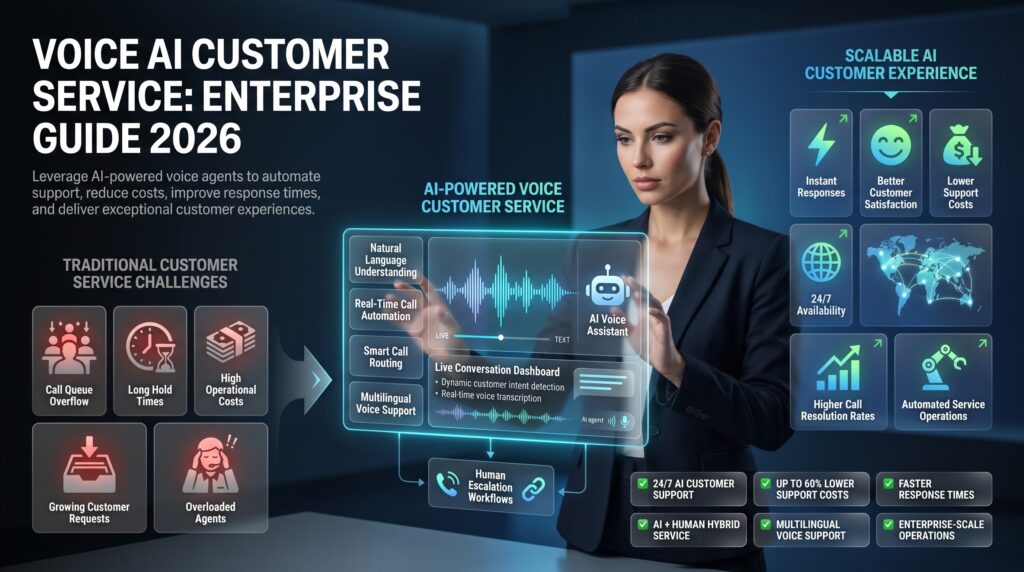
Voice AI customer service is no longer a future concept — it is reshaping how enterprises interact with millions of customers every day. In 2026, organizations across banking, retail, healthcare, and telecom are deploying intelligent voice AI agents that resolve inquiries, reduce cost-per-call by up to 95%, and deliver consistent, 24/7 support at enterprise scale.
This guide covers everything decision-makers need to know: how voice AI works, measurable ROI benchmarks, a step-by-step deployment framework, compliance requirements, and how to select the right provider. Whether you are evaluating your first voice AI pilot or scaling an existing deployment, this resource will give you a clear, practical roadmap.
What Is Voice AI in Customer Service?
Voice AI is a technology that uses artificial intelligence — specifically natural language processing (NLP), automatic speech recognition (ASR), and large language models (LLMs) — to understand spoken customer requests and deliver intelligent, context-aware responses in real time.
Unlike older automated systems, a voice AI agent can:
- Interpret intent, not just keywords
- Maintain conversational context across multiple turns
- Access live data from CRM, order management, and ticketing systems
- Escalate seamlessly to a human agent when needed
- Operate in multiple languages simultaneously
In a modern contact center, voice AI agents handle inbound calls for account inquiries, order status, appointment booking, billing disputes, password resets, and hundreds of other use cases — all without human intervention for the majority of interactions.
The global voice AI market is projected to reach $47.5 billion by 2034, growing at a CAGR of over 23%. Enterprises adopting early gain a structural cost and experience advantage that compounds over time.
How Voice AI Differs from Traditional IVR Systems
Most enterprises have lived with Interactive Voice Response (IVR) systems for decades. These legacy systems forced customers through rigid menu trees: “Press 1 for billing, press 2 for technical support.” Customer frustration was the norm — and abandonment rates reflected it.
| Feature | Traditional IVR | Voice AI |
|---|---|---|
| Input method | Keypad / simple voice commands | Natural language, full sentences |
| Conversation depth | 1-2 levels deep | Multi-turn, context-aware dialogue |
| Intent understanding | Rule-based keyword matching | NLP + LLM intent classification |
| Personalization | None | Customer history, account data, preferences |
| Self-service resolution | 15-25% | 65-85% (depending on use case) |
| Customer satisfaction | Typically low | Typically high (CSAT scores 15-30% higher) |
| Cost per interaction | $1-3 (IVR only) | $0.40 or less |
Voice AI does not merely automate a menu — it replaces a conversation. That distinction drives every metric that matters: containment rate, handle time, CSAT, and cost-per-call.
For a deeper look at how AI is transforming the broader contact center stack, see our guide on AI automation in call centers in 2026.
Key Benefits of Voice AI Customer Service
1. Dramatic Cost Reduction
The most immediate and quantifiable benefit of voice AI customer service is cost savings. Industry benchmarks consistently show:
- Human agent cost per call: $7-$12 (fully loaded: wages, benefits, training, attrition, QA)
- Voice AI cost per interaction: $0.25-$0.40
- Cost reduction: 90-95% per automated interaction
For an enterprise handling 500,000 inbound calls per month, shifting 70% to voice AI containment saves $2.3M-$4.1M per month. The math is not marginal — it is transformative.
2. 24/7 Availability at Infinite Scale
Human agents have shifts, sick days, and peak-hour limitations. Voice AI operates continuously without degradation. During promotional events, weather events, or product incidents that drive call volume spikes, voice AI scales instantly — no emergency staffing, no overtime, no quality compromise.
Enterprises that have deployed AI-powered customer support report that peak-hour abandonment rates drop by 40-60% after voice AI deployment, because capacity is effectively unlimited.
3. Consistent Quality at Every Interaction
Human agents vary. Voice AI does not. Every caller receives the same accurate, compliant, brand-aligned response. This consistency is especially valuable in regulated industries where off-script agent behavior creates compliance risk.
4. Faster Resolution Times
Average Handle Time (AHT) drops significantly with voice AI. Because the system instantly accesses customer records, account history, and live data, it resolves common inquiries in 60-90 seconds — versus 4-8 minutes for a human agent navigating multiple systems.
5. Improved Agent Experience
Counterintuitively, voice AI improves human agent experience. By absorbing routine, repetitive inquiries (order status, balance checks, FAQs), it leaves human agents to work on complex, high-value interactions they find more engaging. Agent satisfaction scores and retention rates improve measurably in post-deployment studies.
Voice AI ROI: The Numbers That Drive Boardroom Decisions
ROI data for voice AI customer service has matured significantly. Decision-makers now have access to rigorous benchmarks:
Three-Year ROI: Independent analyses place enterprise voice AI deployments at 331-391% three-year ROI when fully deployed across a contact center’s eligible call volume.
Payback Period: Most enterprises report full payback within 3-6 months of go-live — one of the shortest payback windows of any enterprise technology investment.
ROI Multiple: Gartner and Forrester research citing AI contact center investments routinely identifies a 3.7x return on investment over a 24-month horizon.
CSAT Impact: Organizations that measure NPS and CSAT before and after deployment see average improvements of 15-25 CSAT points as wait times collapse and resolution rates climb.
The ROI case is no longer theoretical — it is documented, repeatable, and accessible to enterprises of all sizes. The question for most organizations has shifted from “can we afford this?” to “can we afford not to move now?”
Voice AI Implementation: A Step-by-Step Enterprise Guide
Deploying voice AI customer service successfully requires structured planning. Here is a proven implementation framework:
Step 1: Define Use Cases and Prioritization
Start by auditing your current call volume by intent. Using call recording transcripts and IVR data, identify the top 10-20 call reasons. Rank them by volume, current handle time, automation suitability, and business impact of errors.
Typical high-priority candidates: balance inquiries, order status, appointment booking, password resets, FAQ/policy questions, payment processing.
Step 2: Data Integration Architecture
Voice AI quality depends on real-time data access. Map your integration requirements:
- CRM: customer identity, history, preferences
- Order management / ERP: live order and fulfillment status
- Ticketing / ITSM: open ticket status and routing
- Knowledge base: policies, product details, FAQs
- Authentication: caller verification (knowledge-based or biometric)
Define your API architecture before selecting a vendor — integration complexity is the single largest implementation variable.
Step 3: Design Conversation Flows
Work with your operations and CX teams to design dialogue flows for each prioritized use case. Map entry intents, required data lookups, disambiguation flows, escalation triggers, and failure handling. The quality of your conversation design directly determines containment rate.
Step 4: Select a Platform and Partner
Evaluate voice AI platforms against your integration requirements, language support, security certifications, and total cost of ownership. Key evaluation criteria are covered in the “How to Choose a Voice AI Provider” section below.
Step 5: Pilot Deployment
Deploy on a single call type with full monitoring. Define success criteria in advance: target containment rate (e.g., 75%+), CSAT threshold, error rate ceiling, escalation rate benchmark. Run the pilot for 30-60 days before expanding.
Step 6: Iterate and Expand
Analyze pilot data to identify conversation design gaps. Retrain models, refine flows, and expand to the next highest-priority use cases. Most enterprise deployments reach full-scale automation within 6-12 months.
For more context on how natural language processing powers these systems, our NLP deep-dive article is a valuable companion resource.
Voice AI + Human Agent Hybrid Models
Full automation is not the goal — the right outcome is the right automation. Mature voice AI deployments use intelligent hybrid models that blend AI handling with seamless human escalation.
- Containment-first design: Voice AI handles all interactions it can resolve confidently. Confidence thresholds are tuned to balance containment rate against error risk.
- Warm handoff with context transfer: When a call escalates, the human agent receives a real-time summary, the customer’s intent, account data, and any authentication already completed. The customer never repeats themselves.
- Human-in-the-loop for edge cases: Unusual, high-stakes, or emotionally sensitive interactions route immediately to specialized human agents.
- AI-assisted agents: Even for escalated calls, AI continues to work — providing agents with suggested responses, compliance prompts, and real-time knowledge base results.
The best deployments treat voice AI and human agents as a unified team, each handling the interactions they are best suited for. This is the foundation of modern customer experience management.
Voice AI for Different Industries
Retail and E-Commerce
Top use cases: Order status, returns and refund initiation, product availability, loyalty point balances, promotional FAQs
Key metrics: 75-85% containment rate on order inquiries; 40-60% reduction in customer service opex during peak seasons (Black Friday, holiday periods)
Banking and Financial Services
Top use cases: Balance and transaction inquiries, fraud alerts and card lock, payment processing, account verification, branch/ATM locator
Key metrics: 80%+ containment for routine inquiries; 99.9% availability eliminates after-hours service gaps; biometric voice authentication reduces fraud by 30-50%
Healthcare
Top use cases: Appointment scheduling and reminders, prescription refill requests, test result status, insurance verification, general health information
Key metrics: 60-70% scheduling automation; significant reduction in no-show rates through automated reminders; HIPAA-compliant handling of PHI
Telecommunications
Top use cases: Outage reporting and status, billing inquiries, plan changes, technical troubleshooting (first-level), port and activation support
Key metrics: Telecom leads all industries in voice AI adoption; 85%+ containment rates reported by major carriers
How to Choose a Voice AI Provider
Technical Capabilities
- ASR accuracy: Look for 95%+ word accuracy in real-world conditions (noise, accents, domain terminology)
- NLP intent coverage: Can the model handle the breadth of your top 20 use cases out of the box?
- LLM integration: Does the platform leverage large language models for open-domain conversation, or only pattern matching?
- Latency: Sub-500ms response times are required for natural conversational rhythm
- Language support: Multi-language support if your customer base requires it
Integration and Infrastructure
- Pre-built connectors: Salesforce, ServiceNow, SAP, and major CRM/ERP connectors reduce integration cost
- API-first architecture: REST/webhook integration for any system not covered by pre-built connectors
- Telephony compatibility: Genesys, NICE, Avaya, Amazon Connect compatibility
Security and Compliance
- SOC 2 Type II certification
- GDPR-compliant data processing and deletion policies
- HIPAA Business Associate Agreement (BAA) availability for healthcare
- PCI DSS compliance for payment card handling
Voice AI and Compliance: GDPR, HIPAA, and Beyond
GDPR (European Union / UK)
Voice AI deployments processing EU resident data must comply with GDPR requirements: informed consent disclosures, data minimization, right to access and deletion, and data processing agreements with all AI vendors processing EU personal data.
HIPAA (United States Healthcare)
Healthcare voice AI applications handling Protected Health Information (PHI) must execute a Business Associate Agreement with the vendor, implement audit logging for all PHI access, ensure end-to-end encryption of voice data in transit and at rest, and limit PHI retention to required periods.
PCI DSS (Payment Card Industry)
For voice AI applications that process payment card data, cardholder data must never be stored in cleartext. DTMF tone masking prevents agents or recordings from capturing card numbers. Scope reduction through tokenization is strongly recommended.
Mascallnet CallMaster: Enterprise Voice AI Built for Results
CallMaster by Mascallnet is an enterprise-grade voice AI platform engineered for contact centers that demand measurable results. Key capabilities include:
- Intelligent Voice Automation: Pre-trained domain models achieve 75-85% containment rates from day one, with continuous improvement through production learning
- Seamless Human Handoff: Full conversation summary, verified customer identity, and intent context transferred to human agents — eliminating repeat questions and reducing escalated handle time by 35%
- Real-Time Data Integration: Native connectors for Salesforce, ServiceNow, SAP, and 40+ other platforms. Custom integrations via REST API
- Enterprise Security and Compliance: SOC 2 Type II certified, GDPR data processing agreements, HIPAA BAA available. Biometric voice authentication for high-security verticals
- Proven ROI: Clients consistently achieve payback within 3-6 months and three-year ROI exceeding 300%
Request a CallMaster demo to see voice AI customer service in action with your use cases.
Frequently Asked Questions: Voice AI Customer Service
What is voice AI customer service?
Voice AI customer service is an AI-powered system that uses natural language processing and speech recognition to understand customer calls and provide intelligent, automated responses — resolving inquiries without requiring a human agent for the majority of interactions.
How much does voice AI customer service cost?
Voice AI reduces cost-per-interaction to $0.25-$0.40, compared to $7-$12 for a fully loaded human agent interaction. Enterprise deployments typically achieve full cost payback within 3-6 months of go-live.
What is the difference between voice AI and IVR?
Traditional IVR systems use rigid menu trees and keyword commands. Voice AI uses natural language processing and large language models to understand full sentences, maintain conversational context across multiple turns, and access live data to resolve complex inquiries.
Can voice AI handle complex customer service issues?
Voice AI handles 65-85% of common interactions autonomously. Complex, emotionally sensitive, or unusual interactions are escalated to human agents with full context transferred — so customers never repeat themselves.
Is voice AI customer service GDPR compliant?
Yes, when deployed with a GDPR-certified platform. Enterprise voice AI platforms provide data processing agreements, consent management, data minimization controls, and support for right-to-access and deletion requests.
How long does it take to implement voice AI?
Most enterprise deployments achieve initial go-live (first use case) in 60-90 days. Full deployment across the top 10-20 use cases typically takes 6-12 months.
What industries benefit most from voice AI customer service?
Telecommunications, retail/e-commerce, banking, and healthcare have the highest adoption and clearest ROI, due to high call volumes, structured inquiry types, and strong data infrastructure.
What is a good containment rate for voice AI?
A containment rate of 65-75% is achievable within 90 days. Mature deployments with well-tuned models and broad use case coverage regularly achieve 80-85% containment. Industry benchmarks for full-scale deployments range from 70-90% depending on vertical.
Does voice AI replace human customer service agents?
Voice AI automates repetitive, routine inquiries — not the role of a human agent. Most enterprise deployments redeploy human agents to complex, high-value interactions rather than reducing headcount, resulting in better agent satisfaction and higher-quality customer outcomes.
How does voice AI improve customer experience?
Voice AI eliminates hold times, provides 24/7 availability, delivers consistent and accurate responses, and resolves the majority of calls in under 90 seconds. CSAT scores typically improve 15-25 points after full deployment.
Conclusion: Voice AI Is the New Standard for Enterprise Customer Service
Voice AI customer service has crossed the threshold from emerging technology to enterprise standard. In 2026, organizations that have not started their voice AI journey are not waiting for a better option — they are simply falling behind.
The data is clear: 90-95% cost reduction per automated interaction, 3-6 month payback, 331-391% three-year ROI, and CSAT improvements that compound brand loyalty. The technology is mature, the compliance frameworks are established, and implementation timelines are measured in weeks, not years.
Mascallnet’s CallMaster platform combines enterprise-grade voice AI with deep contact center expertise and proven implementation methodology. Our clients achieve containment rates above 80%, and most are live within 90 days of kickoff.
Contact our team to discuss your voice AI roadmap, or request a live demonstration tailored to your industry and use cases.