
Outsourcing vs Automation: Customer Support Guide (2026)
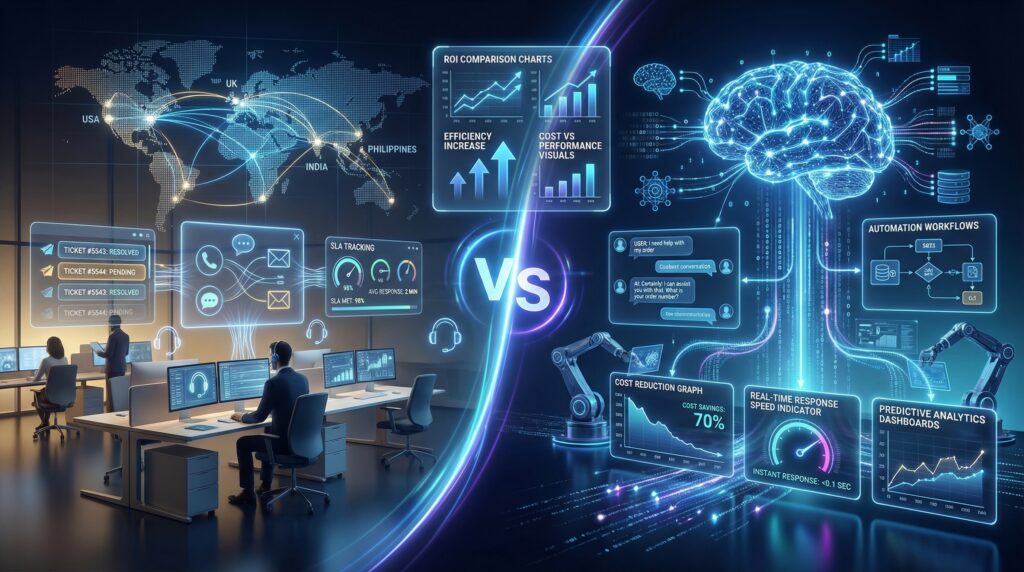
Outsourcing vs automation for customer support in 2026 compares external service delivery with AI-driven automation. Enterprises achieve optimal results through a hybrid CX model combining AI chatbots and human agents, reducing costs by up to 50%, improving efficiency, and enabling scalable, compliant 24/7 customer experience management (CXM).
What Is Outsourcing vs Automation in Customer Support?
Direct Answer:
Outsourcing involves delegating customer support to third-party providers, while automation uses AI to handle interactions without human involvement. The most effective enterprise strategy is a hybrid model combining both approaches.
Key Distinction:
- Outsourcing = Workforce externalization
- Automation = Technology-driven execution
- Hybrid = Integrated CX transformation
AI Maturity, Enterprise Evolution, and the Strategic Imperative
Outsourcing vs automation for customer support in 2026 is driven by enterprise AI maturity and the need for scalable CX operations.
According to Gartner:
- 80% of customer interactions will be AI-assisted by 2026
According to McKinsey & Company:
- Automation reduces service costs by 30–50%
- Productivity improves by up to 40%
Hybrid CX is the default enterprise model in 2026.
Organizations are integrating:
- customer support outsourcing
- contact center outsourcing
- business process outsourcing services
- Advanced automation processes
to build intelligent CX ecosystems.
Key Insights at a Glance
- AI automates 60–80% of Tier-1 queries
- Hybrid CX reduces costs by 30–55%
- Response times improve by up to 70%
- Customer voice analytics increases retention by 10–25%
- Outsourcing enables global scaling within 30–90 days
Outsourcing vs Automation vs Hybrid CX
| Model | Strengths | Limitations | Best Use Case |
| AI-only CX | Low cost, instant response, high scalability | Limited empathy, complex issue gaps | FAQs, repetitive queries |
| Human-only CX | High empathy, complex resolution | High cost, limited scalability | High-value interactions |
| Hybrid CX | Balanced cost, efficiency, quality | Requires governance maturity | Enterprise CX transformation |
AI-only CX cannot replace human-led complex support.
AI Maturity Model for Customer Support
| Level | Model | Description | Enterprise Impact |
| Level 1 | Manual CX | Fully human-driven support | High cost, low scalability |
| Level 2 | Assisted CX | Tools support agents | Moderate efficiency |
| Level 3 | Automated CX | AI handles repetitive tasks | Cost reduction begins |
| Level 4 | Hybrid CX | AI + human integration | Optimal performance |
| Level 5 | Autonomous CX | AI-driven CX with minimal human input | Maximum scalability |
Enterprises at Level 4 achieve the highest ROI.
Real-World Enterprise Case Studies
BFSI (United States & United Kingdom)
- 70% query automation
- Compliance-sensitive queries outsourced
- Result: 45% cost reduction
Healthcare Systems
- AI for scheduling and triage
- Outsourced patient support
- Result: 50% efficiency gain
Retail & eCommerce
- AI chatbots for order tracking
- Human agents for escalations
- Result: 20% CSAT improvement
Telecommunications
- Predictive AI integrated with CRM
- Hybrid support for billing/technical issues
- Result: Reduced churn
Cost, Efficiency & ROI Analysis
Enterprise Benchmark Model
Before
- 1,000 agents
- $25M annual cost
After Hybrid CX
- 65% interactions automated
- Workforce reduced to 400 agents
Results
- $10M cost savings (40%)
- 35% faster handling time
- 60% faster response time
- 25% higher resolution rates
Step-by-Step Enterprise Implementation Framework
Step 1: Assess CX Operations
- Identify high-volume queries
- Analyze cost per ticket
- Evaluate customer voice insights
Step 2: Deploy Automation
- Implement AI chatbots
- Integrate RPA workflows
- Connect with CXM platforms
Step 3: Select Outsourcing Partner
- Evaluate global delivery capabilities
- Ensure compliance certifications
- Validate AI integration readiness
Step 4: Build Hybrid CX Model
- Define escalation workflows
- Align AI-human collaboration
- Optimize performance metrics
Step 5: Establish Governance
- Monitor SLAs and KPIs
- Implement AI oversight
- Manage vendor risks
Vendor Risk Governance Matrix
| Risk Category | Risk Level | Mitigation Strategy |
| Data Security | High | Encryption, access control, audits |
| Vendor Lock-in | Medium | Multi-vendor strategy, exit clauses |
| Compliance | High | Regulatory audits, certifications |
| AI Bias | Medium | Human-in-the-loop validation |
| Operational Disruption | Medium | Backup vendors, continuity planning |
Governance, Compliance & Data Sovereignty
Enterprise Requirements
- GDPR, HIPAA compliance
- ISO 27001, SOC 2 certifications
- Data localization policies
AI Oversight Model
- Continuous monitoring
- Bias detection
- Human validation layers
Data Sovereignty
- Region-based data storage
- Regulatory alignment
- Audit readiness
Top 5 Benefits of Hybrid CX
- 30–55% cost reduction
- 35–60% efficiency improvement
- 24/7 global scalability
- Improved customer experience management (CXM)
- Real-time customer voice insights
Vendor Selection Criteria
- Proven expertise in contact center outsourcing
- AI and automation integration capabilities
- Industry-specific compliance (BFSI, healthcare)
- Global delivery infrastructure
- Transparent SLAs and pricing
- Strong governance frameworks
Future Trends (2026–2030)
Insights from International Data Corporation and Fortune Business Insights:
- AI-first contact centers becoming standard
- Generative AI transforming CX workflows
- Autonomous CX platforms emerging
- Vendor consolidation increasing
- Customer voice analytics driving strategy
FAQ
How can enterprises reduce customer support costs using AI?
By automating repetitive queries and optimizing workflows, enterprises can reduce costs by 30–50% while improving efficiency.
Is outsourcing safer than in-house operations?
Outsourcing is secure when supported by strong governance, compliance certifications, and vendor risk management.
What is the best CX model in 2026?
Hybrid CX combining AI and human agents delivers the highest efficiency, scalability, and CX quality.
What risks must enterprises manage?
Data security, compliance, vendor dependency, and AI governance risks must be actively managed.
Conclusion
Outsourcing vs automation for customer support in 2026 is a strategic decision that defines enterprise scalability, efficiency, and long-term competitiveness.
Hybrid CX is the dominant enterprise model, enabling:
- Cost optimization
- Operational efficiency
- Scalable global delivery
- Strong governance and compliance
Mascallnet represents an example of AI-enabled outsourcing providers aligning automation with enterprise CX transformation.
Organizations evaluating their future CX operating model should assess whether their current structure can sustainably support this model at scale.