
AI Chatbots vs Human Agents: Finding the Right CX Balance
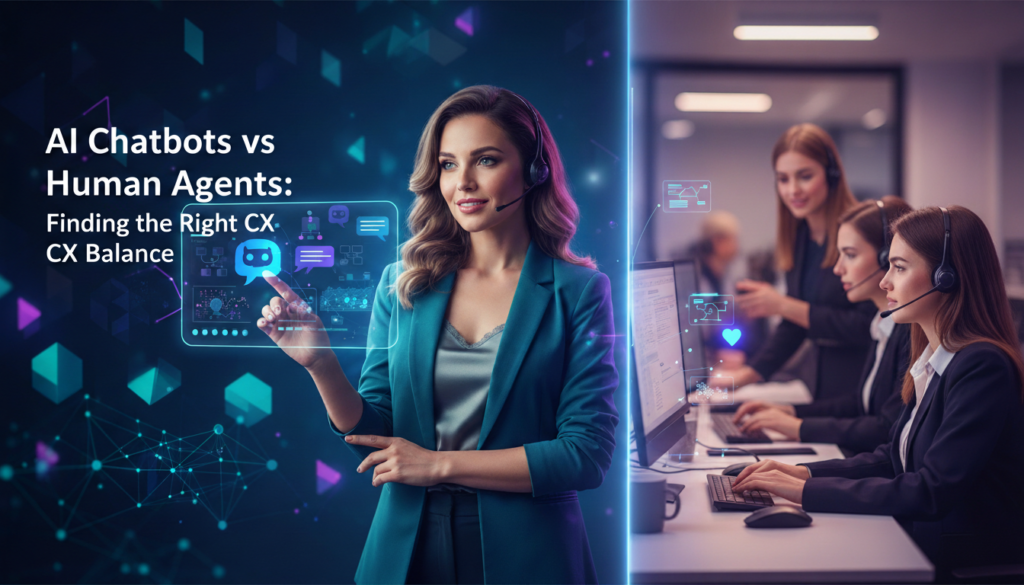
AI Overview
AI chatbots are software-driven conversational systems designed to automate customer interactions using rules, natural language processing, and machine learning, while human agents are trained professionals who manage customer interactions using judgment, empathy, and contextual understanding. The strategic question in 2026 is no longer whether to use AI or people, but how to govern and combine both to deliver scalable, consistent, and resilient customer experience (CX).
This topic has become critical as enterprises face rising interaction volumes, multilingual demand, and heightened customer expectations across digital and voice channels. Decisions about AI chatbots versus human agents now shape enterprise operating models, risk posture, and long-term cost-to-serve economics. Poorly governed automation can erode trust, while under-automated models struggle to scale globally.
For CX leaders, enterprise operations heads, global founders, and service strategists, the balance between AI and human service is an organizational design and governance challenge. It affects workforce strategy, outsourcing models, data integration, and accountability for customer outcomes across regions and channels.
Introduction: AI Maturity, CX Evolution, and the Scalability Imperative
Enterprise customer experience has entered a phase where incremental improvements are no longer sufficient. Interaction volumes continue to grow across voice, chat, messaging, and social channels, while customers expect faster resolution, language flexibility, and contextual continuity. In this environment, relying solely on traditional call centers or purely human-led service teams has become structurally limiting.
AI chatbots emerged initially as cost-reduction tools, often deployed with narrow intents and limited escalation logic. Early failures created skepticism among CX leaders. However, AI maturity has increased materially since then, particularly in intent recognition, workflow orchestration, and integration with backend systems. At the same time, human agents remain indispensable for complex, emotional, and high-risk interactions.
The core challenge is not technology selection but operating model alignment. Enterprises must decide how AI and humans interact, who owns outcomes, how quality is governed, and how service delivery scales across languages and geographies. This is where many organizations encounter friction—especially those attempting to modernize in-house teams without rethinking structure, governance, or sourcing.
Key Insights at a Glance
- AI chatbots and human agents address fundamentally different dimensions of CX value.
- In-house service teams increasingly struggle with scalability, consistency, and multilingual coverage.
- AI-only CX models underperform in complex, regulated, or emotionally charged interactions.
- Human-only models face rising cost-to-serve and operational inflexibility.
- Hybrid CX models—when governed correctly—deliver the most sustainable ROI.
- Outsourcing is shifting from labor arbitrage to platform-enabled service orchestration.
- Governance, escalation design, and data integration determine CX outcomes more than tools.
Real-World CX Scenarios and Industry Case Patterns
Scenario 1: High-Volume Transactional Support
In retail, travel, and digital services, 60–70% of inbound interactions are repetitive: order status, password resets, booking changes, or basic policy questions. AI chatbots handle these efficiently when:
- Intents are well-defined
- Backend systems are accessible via APIs
- Escalation paths are clearly designed
However, when customers deviate from scripted paths or encounter edge cases, frustration rises rapidly. Organizations that fail to integrate human fallback see increased abandonment and declining CSAT.
Scenario 2: Complex Resolution and Emotional Context
In financial services, healthcare, and enterprise IT, interactions often involve ambiguity, risk, or emotional stress. Human agents excel here by:
- Interpreting incomplete information
- Applying judgment across policies
- Managing tone and empathy
AI can assist with knowledge retrieval or next-best-action prompts, but full automation in these contexts introduces operational and regulatory risk.
Scenario 3: Multilingual and Global Coverage
Enterprises expanding into new markets face immediate pressure to support multiple languages. Building in-house teams for each language is slow and costly. This has driven adoption of bpo company models that combine AI translation, regional talent pools, and centralized governance.
Strategic Reasoning Behind AI-Enabled and Multilingual CX Models
Limits of In-House and Legacy Operations
Traditional in-house CX teams face four structural constraints:
- Scalability: Hiring and training cycles cannot match demand spikes.
- Consistency: Knowledge updates and QA standards vary across teams.
- Language Coverage: Supporting 10–20 languages internally is rarely economical.
- Cost-to-Serve: Wage inflation and attrition erode efficiency gains.
Legacy contact center platforms further complicate modernization, limiting integration with AI-driven business automation and analytics layers.
Outsourcing as an Operating Model Choice
Modern outsourcing is not synonymous with offshoring or cost reduction. Leading enterprises use bpo outsourcing companies to access:
- Distributed global talent
- AI-enabled platforms
- Standardized governance frameworks
This shift parallels the rise of knowledge process outsourcing, where value is derived from expertise, analytics, and decision support—not just transaction handling.
Business Benefits and ROI Implications
Quantified Operational Impact Example
Industry analysis shows that enterprises deploying hybrid CX models typically achieve:
- 25–40% interaction deflection via AI chatbots
- 10–15% CSAT improvement through better escalation design
- 20–30% reduction in cost-to-serve over 18–24 months
These gains are not driven by automation alone, but by reengineering automation processes and workforce roles in parallel.
Cost, Quality, and Speed Trade-Offs
| Model | Strengths | Limitations |
| AI-Only | Low marginal cost, 24/7 availability | Poor handling of complexity, trust risk |
| Human-Only | High empathy, flexibility | High cost, limited scalability |
| Hybrid CX | Balanced ROI, resilience | Requires strong governance |
Hybrid models also enable more effective process automation by aligning AI workflows with human decision points rather than replacing them.
Governance, Risk, and Long-Term Strategic Impact
Governance as the Differentiator
The most common failure mode in AI-led CX is weak governance. Key governance levers include:
- Clear ownership of customer outcomes
- Defined escalation thresholds
- Continuous training and feedback loops
- Transparent performance metrics
Without these, AI deployments degrade CX and increase operational risk.
Data, Compliance, and Trust
Enterprises must also manage data privacy, regulatory compliance, and auditability—particularly in sectors relying on it support services or regulated customer interactions. Human oversight remains critical in maintaining trust and accountability.
Enterprise Applications and the Future of Hybrid CX
Integrated CXM Platforms
Future-ready organizations design CX around integrated cxm platforms that unify voice, digital, analytics, and workforce management. AI chatbots act as front-line filters, while human agents handle exceptions and relationship-building.
Role Evolution in the Contact Center
The contact center of 2026 is less about call handling and more about orchestration. Agents increasingly:
- Manage complex cases
- Supervise AI outcomes
- Analyze customer voice data for improvement insights
This evolution is also reshaping the modern bpo call center, which now blends technology, analytics, and multilingual talent at scale.
Conclusion
The debate between AI chatbots and human agents is ultimately a false binary. Sustainable CX performance emerges from hybrid models that balance automation efficiency with human judgment, governed by clear operating principles. As global service complexity increases, outsourcing and platform-enabled delivery models will continue to play a strategic role—not as cost levers, but as enablers of scalable, resilient CX. Industry examples such as MasCallNet.ai illustrate how this balance is being operationalized in practice without redefining the core principle: CX excellence is a governance decision, not a technology purchase. Enterprises that evaluate and design this balance thoughtfully will be best positioned to deliver long-term ROI and customer trust.