
Generative AI in Customer Support (2026): Use Cases, Cost Savings, ROI & Risks
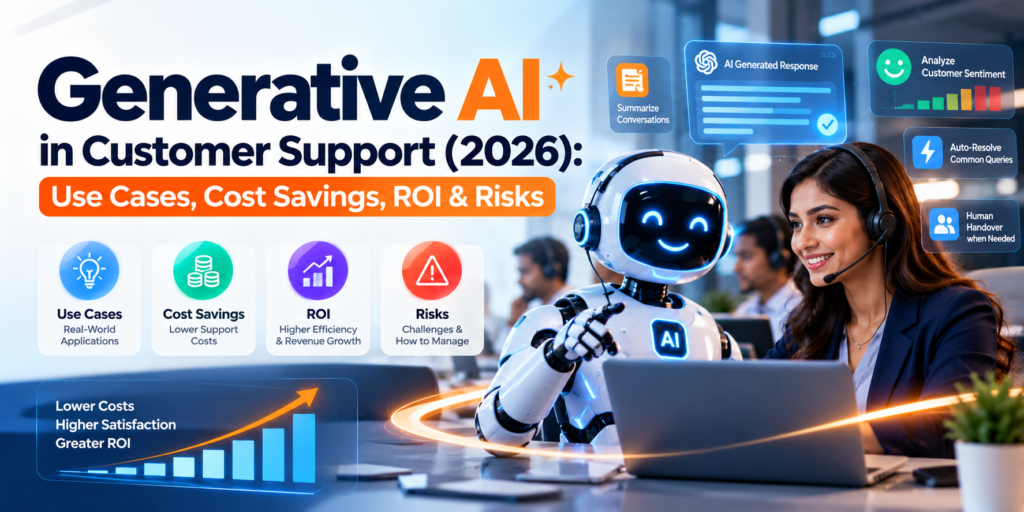
Generative AI in customer support is moving from chatbot experimentation into the operating model of modern service organizations. In 2026, the business question is no longer simply whether an AI system can answer a customer. The harder question is where generative AI actually creates economic value, where human judgment remains necessary, and how a company can deploy it without creating new quality, security or compliance problems.
This guide explains the practical use cases, cost-saving mechanisms, ROI calculation, technology architecture, risks and implementation decisions that customer service leaders should evaluate before scaling generative AI. It is also a practical reference for teams comparing AI-powered customer service approaches, from agent assist and self-service to AI-driven quality and analytics.
Executive answer: The strongest business case is usually not “replace every agent with AI.” It is to use AI selectively across repetitive interactions, agent assistance, knowledge retrieval, quality management, summarization and workflow automation, while keeping a controlled human escalation path for complex, sensitive or consequential cases. Current research supports that direction: Gartner reported in 2026 that only 24% of surveyed service and support leaders had demonstrated positive financial returns across their AI use cases, while customers increasingly expect access to a human when AI is used in service. Gartner’s 2026 research therefore points to a value-and-design problem, not simply an AI-adoption problem.
What Is Generative AI in Customer Support?
Generative AI in customer support uses large language models and related AI systems to understand customer language, retrieve relevant knowledge, generate responses, summarize interactions, assist agents and, in some controlled workflows, execute service actions. Unlike traditional rule-based chatbots, generative systems can interpret more varied language and produce context-aware responses.
For enterprises, generative AI for customer service extends beyond chatbots: it can support self-service, agent assistance, knowledge retrieval, quality assurance, conversation analytics and workflow automation across the customer journey.
The distinction matters operationally. A conventional FAQ bot may match a question to a predefined answer. A generative AI system can interpret the customer’s intent, retrieve relevant information from approved knowledge sources, formulate a response and maintain conversational context. With appropriate integrations and controls, it can also move beyond answering questions toward completing tasks.
That additional flexibility creates both the opportunity and the risk. A generative model can produce a useful response that was never explicitly scripted, but it can also produce a confident answer that is wrong. NIST identifies this phenomenon as confabulation, commonly called hallucination, and treats it as a significant generative-AI risk. NIST’s Generative AI Profile recommends managing such risks systematically rather than assuming model output is inherently reliable.
Why Generative AI Matters for Customer Service in 2026
Customer service leaders are under pressure from two directions: customers expect faster and more convenient service, while finance teams expect measurable productivity and cost improvement. AI is increasingly positioned between those demands.
Gartner reported in August 2026 that customer-service AI spending had increased by 38%, while overall service and support budgets had grown by only 2%. The same research identified GenAI chatbots, voicebots and agentic AI platforms among the technologies expected to deliver substantial future value. Gartner’s August 2026 findings also make the critical qualification: investment alone does not guarantee value.
Deloitte’s 2026 global contact-center research points in a similar direction. It identifies technology integration, legacy systems, and data security and compliance as major challenges for contact centers pursuing AI. AI-mature organizations in its survey reported substantially stronger business and experience outcomes than lower-maturity peers, but the research is not evidence that buying an AI tool by itself creates those results. The operating model around the technology matters. Deloitte Digital’s 2026 Global Contact Center Report provides that context.
Where Generative AI Creates the Most Value
The economic value of generative AI in customer support comes from several different mechanisms. Treating them all as “cost reduction” makes the business case weaker because each mechanism has a different measurement method.
| Value mechanism | How AI contributes | Useful KPI |
|---|---|---|
| Deflection | Resolves eligible customer questions without a human agent | AI resolution / eligible contacts |
| Agent productivity | Finds knowledge and drafts responses during live interactions | AHT, after-call work, cases per agent |
| Resolution quality | Provides consistent knowledge and recommended next actions | FCR, repeat contacts, QA score |
| Automation | Completes structured service tasks through connected systems | Automated task completion rate |
| Quality management | Analyzes interactions for compliance, sentiment and intent | Audit coverage, critical-error rate |
| Management leverage | Summarizes patterns across large interaction volumes | Time-to-insight, issue detection time |
The most important point is that these benefits can overlap. A shorter average handle time is not automatically a saving if the shorter interaction produces repeat contacts. Likewise, high AI containment is not a success if customers are trapped in an ineffective self-service loop.
10 Generative AI Use Cases in Customer Support

1. Conversational self-service
Generative AI can answer natural-language questions across web chat, messaging and other digital channels. The value is highest when the underlying knowledge is current, well structured and connected to the actual customer journey.
Typical use cases include order status, product information, account questions, appointment information, policy explanations and basic troubleshooting. The system should be designed to retrieve from approved sources rather than rely on the model’s general knowledge for company-specific facts.
2. Agent assist and response drafting
Agent assistance can be a stronger early use case than fully autonomous customer service. AI can retrieve relevant knowledge, summarize the interaction, suggest a response and identify the next best action while the human agent retains control.
This model is particularly useful when agents must navigate multiple knowledge sources or when new agents take time to become proficient. The economic opportunity comes from reducing search time, after-call work and avoidable process friction without removing human accountability.
3. Conversation summarization
Generative AI can turn long customer interactions into structured summaries containing the reason for contact, actions taken, customer commitments, unresolved issues and next steps. This can reduce manual documentation and make handoffs easier.
The control requirement is straightforward: summaries should be checked against the original interaction for material errors, especially in regulated or financially consequential workflows.
4. Knowledge retrieval and answer generation
Retrieval-augmented generation, or RAG, allows an AI system to retrieve relevant information from a controlled knowledge base before generating an answer. In customer service, this can reduce dependence on model memory and improve consistency.
RAG is not a magic anti-hallucination mechanism. If the source content is wrong, outdated or ambiguous, the generated answer can still be wrong. Knowledge governance therefore becomes part of AI governance.
5. Intelligent triage and intent classification
AI can classify incoming contacts by intent, urgency, sentiment, product, issue type or required skill. The result can feed routing rules so that customers reach the appropriate queue or specialist faster.
6. Quality assurance and interaction analytics
Traditional quality programs often audit a sample of interactions. AI can help analyze a much larger proportion of conversations for script adherence, required disclosures, sentiment, intent, escalation signals and other defined criteria.
The important distinction is between AI-assisted auditing and automatic truth. Critical findings should have a defined review mechanism, particularly when a quality result can affect an employee, customer or compliance outcome.
7. Sentiment and escalation-risk detection
Generative and language-based AI can identify signals associated with frustration, repeated failure, cancellation intent or escalation. These signals can trigger supervisor intervention or a different service path.
8. Multilingual support
Language models can assist with translation, multilingual response drafting and cross-language knowledge access. For enterprises serving diverse markets, this can reduce the operational burden of maintaining separate response content for every language.
However, high-stakes communications should not be treated as ordinary translation. Terminology, legal language, cultural context and product-specific wording require controlled review.
9. Back-office service automation
Some customer requests require a combination of conversation and operational work. For example, an AI system may understand a request, extract structured information, check an eligible workflow and initiate an action through an API or workflow engine.
This is a core customer support automation opportunity: the AI understands the request while connected systems execute the approved business process.
This is where generative AI begins to overlap with agentic AI. The risk also increases because the system is no longer merely generating text; it is potentially influencing or executing business processes.
10. Customer and operational insight
Large volumes of conversations contain information about product defects, recurring complaints, delivery problems, competitor mentions and unmet customer needs. Generative AI can summarize these patterns for operations, product, marketing and leadership teams.
Which Use Cases Should You Automate First?
Do not rank use cases only by how impressive the AI demonstration looks. Rank them by economic value multiplied by controllability.
| Use case | Value potential | Operational risk | Recommended starting point |
|---|---|---|---|
| Agent assist | High | Low–medium | Strong starting point |
| Summarization | High | Low–medium | Strong starting point |
| Knowledge retrieval | High | Medium | Start with controlled knowledge |
| Basic self-service | High | Medium | Automate well-defined intents |
| QA analytics | High | Medium | Use human review for critical findings |
| Complex autonomous resolution | Potentially very high | High | Scale only after controls mature |
A useful rule is: automate the interaction before you automate the judgment. If a task can be completed from approved information and deterministic business rules, it is usually easier to automate safely than a task requiring discretionary judgment.
How Generative AI Reduces Customer Support Costs

Generative AI can reduce cost through several distinct levers. The strongest business cases quantify each one separately rather than applying a generic “AI saves 30%” assumption.
1. Lower cost per resolved contact
If an eligible interaction can be resolved through AI without human handling, the direct labour required per resolution may fall. But the calculation should include AI usage, platform fees, integration, knowledge management, monitoring and exception handling.
2. Lower agent handling time
Agent assist can reduce the time spent searching for information, drafting responses and documenting interactions. The financial impact depends on whether the released capacity becomes productive work, lower overtime, lower hiring requirements or simply additional idle capacity.
3. Lower after-call work
Automated summaries, disposition suggestions and structured case notes can reduce post-interaction administration. This can be particularly useful in high-volume voice environments.
4. Higher first-contact resolution
If AI gives agents better context and better knowledge, customers may need fewer repeat contacts. The financial effect is often larger than a small reduction in handle time because repeat contacts consume capacity without creating new customer value.
5. More scalable peak capacity
AI can provide a variable layer of capacity during predictable spikes. This can reduce the need to staff solely for peak demand, although capacity planning should account for the cost and reliability of the AI layer.
6. Broader quality coverage
AI-assisted quality analysis can increase the amount of interaction data reviewed without requiring a proportional increase in manual sampling. This can reduce the operational cost of discovering systemic quality problems.
The Hidden Costs of Generative AI in Customer Support
This is where many AI business cases become unrealistic. The model API is only one component of the total cost.
| Cost category | What to include |
|---|---|
| Model usage | Input/output tokens, voice processing or other consumption-based charges |
| Platform | AI orchestration, contact-center, analytics or agent-assist licences |
| Integration | CRM, ticketing, telephony, knowledge base and API integration |
| Knowledge management | Content creation, validation, ownership and maintenance |
| Quality and governance | Evaluation, human review, monitoring and incident management |
| Security | Access controls, logging, data protection and vendor governance |
| Human exception handling | Agents and supervisors required for escalations |
| Change management | Training, process redesign and adoption |
Gartner has gone further than simply warning about implementation cost. Its January 2026 prediction was that by 2030 the cost per resolution for GenAI in customer service could exceed $3 and become higher than many offshore human-agent costs. The point is not that AI is economically unattractive. The point is that full automation is not automatically cheaper than a well-run human or hybrid operation. Gartner’s forecast specifically argues for using AI to drive customer engagement and value rather than assuming every interaction should be fully automated.
How to Calculate ROI for Generative AI in Customer Support
The correct ROI calculation starts with the baseline, not the AI vendor’s projected percentage.
Illustrative ROI formula:
Annual AI Benefit = Labour Capacity Value + Avoided Repeat Contacts + Avoided Overtime/Peak Staffing + Quality/Revenue Impact − Incremental AI Operating Cost
ROI % = (Annual AI Benefit − AI Investment) ÷ AI Investment × 100
Illustrative Example — Not MasCallNet Performance Data.
Assume a company handles 1,000,000 customer contacts per year. Suppose a controlled AI deployment eventually resolves 15% of eligible contacts without human intervention, while agent-assist productivity creates additional capacity on the remaining contacts. The company should not simply multiply 15% by total labour cost. It should determine:
- Which contacts are genuinely eligible for automation.
- How many AI-resolved contacts remain resolved after 7, 30 or 90 days.
- What percentage of released agent capacity becomes productive capacity.
- How much AI and integration infrastructure costs.
- How much human exception handling remains.
- Whether customer satisfaction, compliance or repeat-contact rates change.
The resulting ROI is therefore an operating-model calculation, not a software calculation.
AI vs Human vs Hybrid Customer Support

| Dimension | Generative AI | Human agent | Hybrid model |
|---|---|---|---|
| Simple repetitive queries | Excellent | Often inefficient | Excellent |
| Complex reasoning with business context | Variable | Strong | Strong |
| Empathy and nuanced judgement | Limited | Strong | Strong |
| 24/7 scalability | Strong | Expensive to staff continuously | Strong |
| Consistency | High when controlled | Variable | High with good governance |
| Risk of fabricated information | Requires active controls | Human error still exists | Can combine controls and judgement |
| High-consequence decisions | Use cautiously | Usually preferable | Often strongest |
Gartner’s August 2026 research found that 87% of customers said companies using GenAI for customer service should provide access to a human agent. That is a useful design signal: the human escalation path should not be treated as a failure of the AI strategy. It is part of a credible AI service strategy. Gartner’s customer research supports that conclusion.
How Generative AI Should Be Connected to the Contact Center
A production architecture normally contains more than a language model. A practical customer-support AI stack can include:
- Customer channel: web, app, messaging, email or voice.
- Conversation layer: intent detection, dialogue management and context.
- AI model layer: one or more approved language models.
- Knowledge layer: governed product, policy and process information.
- Business rules: eligibility, authentication, routing and escalation logic.
- Enterprise integrations: CRM, ticketing, order, billing and workflow systems.
- Human escalation: transfer to an agent with context preserved.
- Observability: quality, safety, cost, latency and outcome monitoring.
The architecture should make it possible to answer a basic governance question after every interaction: why did the system produce this answer or take this action? If the organization cannot trace the knowledge source, workflow, model and escalation path, it will struggle to investigate failures.
An AI contact center should therefore connect the model layer to governed knowledge, CRM data, telephony, ticketing and human escalation rather than operate as a standalone chatbot.
Generative AI Risks in Customer Support
AI risk in customer service is not limited to hallucinations. The risk profile changes according to the data, workflow and consequence of an AI output.
Hallucination and confabulation
A model can generate an answer that sounds authoritative but is false. This is especially dangerous when the answer concerns pricing, eligibility, financial products, healthcare, legal rights, account status or other consequential matters.
Data privacy and confidentiality
Customer interactions can contain personal and commercially sensitive information. Organizations need to understand where data goes, who can access it, how long it is retained, what vendors process it and how access is logged.
Prompt injection and malicious input
Customers can deliberately or accidentally provide instructions that attempt to manipulate an AI system. Connected systems increase the impact because a successful attack may influence an action rather than merely generate text.
Knowledge drift
A response can be correct when a knowledge article is published and wrong after a policy, product, price or process changes. Knowledge ownership and expiry controls therefore become operational requirements.
Automation bias
Employees may accept AI recommendations too readily because the system appears confident. Human review is not effective if reviewers simply approve every recommendation.
Customer frustration
An AI system that prevents customers from reaching a human can create a poor experience even if its average automated resolution rate looks strong. Escalation must be easy when the interaction requires judgement.
Vendor dependency
AI systems create dependencies around models, APIs, platforms, data formats and knowledge integrations. Procurement should therefore consider portability, service continuity, pricing changes and exit planning.
Security and Compliance: What Buyers Should Ask
For regulated or sensitive customer operations, AI governance should be treated as part of the operating model rather than a technology checklist.
- Where is customer data processed?
- Is customer data used to train a provider’s general model?
- What retention controls exist?
- How are privileged users authenticated and monitored?
- Can every AI action be logged?
- How are model and knowledge-base changes approved?
- What happens when the model produces an unsafe or incorrect response?
- How does a customer reach a human?
- How are vendors and subprocessors governed?
- What is the exit and business-continuity plan?
These questions should be adapted to the organization’s legal, regulatory and contractual obligations. Outsourcing or using an AI platform does not automatically transfer accountability away from the organization that owns the customer relationship.
How to Implement Generative AI in Customer Support
A controlled rollout is generally more defensible than a “replace everything” deployment.
Step 1: Establish the baseline
Measure contact volume, intent mix, AHT, FCR, repeat contacts, CSAT, QA performance, escalation rate, cost per contact and current staffing. Without a baseline, ROI becomes a vendor estimate.
Step 2: Segment the contact population
Separate repetitive, well-defined contacts from complex, emotional, regulated or exception-heavy contacts. Do not treat the entire queue as one automation problem.
Step 3: Select one or two high-value use cases
Start with a use case where the desired outcome is measurable and the downside of failure is controllable. Agent assist, summarization and knowledge retrieval are often easier to govern than autonomous decisions.
Step 4: Build the knowledge and integration layer
Connect approved information sources and required business systems. Define what the AI is allowed to read, recommend and execute.
Step 5: Establish evaluation criteria
Measure factual accuracy, resolution quality, escalation appropriateness, latency, cost and customer outcomes. Test difficult and adversarial cases before production scaling.
Step 6: Introduce human escalation
Make escalation rules explicit. A human should be available when the AI reaches a confidence threshold, encounters a prohibited workflow, detects customer frustration or reaches a business rule requiring human judgement.
Step 7: Scale only after economics and quality are proven
Expand the automation boundary when the measured results support expansion. If the economics are weak, redesign the workflow rather than automatically increasing AI volume.
When Should a Company Use AI, Outsource, or Build In-House?
These are not mutually exclusive decisions. A company can own the customer experience strategy, use generative AI for selected workflows and use an external delivery partner for the human operations layer.
| Situation | Likely fit |
|---|---|
| Low volume and highly specialised support | In-house human or hybrid |
| Large repetitive volume | AI automation with human exception handling |
| 24/7 service requirement | Hybrid AI + managed operations |
| Rapidly changing demand | Flexible hybrid or outsourced capacity |
| Highly regulated or consequential workflow | Controlled AI assistance + specialist human operation |
| Need for technology and operational expertise | Technology-enabled outsourcing or managed service |
For organizations evaluating an external operating partner, the relevant question is not simply whether the provider “uses AI.” Ask how the provider connects AI to workforce management, QA, knowledge management, escalation, security and measurable service outcomes. That is where contact center services and technology-enabled operations intersect.
What Should a Generative AI Customer Support RFP Include?
A serious RFP should test the complete operating model rather than asking vendors for a product demonstration.
- Supported channels and languages.
- Model options and model-change governance.
- Knowledge retrieval architecture.
- CRM, ticketing and telephony integrations.
- Authentication and authorization controls.
- Data retention and processing terms.
- Human escalation design.
- AI quality evaluation methodology.
- Hallucination and safety testing.
- Conversation logging and auditability.
- Pricing methodology and usage assumptions.
- Implementation and integration costs.
- Business-continuity and disaster-recovery arrangements.
- Exit and portability provisions.
If the provider can demonstrate the model but cannot explain the operating controls, the buyer has evaluated the technology but not the service.
How Much Does Generative AI Customer Support Cost?
There is no defensible single market price for generative AI customer support because cost depends on the model, channel, volume, integration complexity, automation depth, human exception rate and governance requirements.
Common commercial models include:
- Usage-based or per-token model pricing.
- Per-minute pricing for AI voice interactions.
- Per-agent or per-seat agent-assist licensing.
- Per-interaction or per-resolution pricing.
- Platform subscription fees.
- One-time implementation and integration fees.
- Managed-service or hybrid operating fees.
Buyers should request a total-cost model that separates recurring AI consumption from implementation, integration, knowledge management, human exception handling and governance. For a broader view of customer-support operating economics, see MasCallNet’s guide to outsourced customer support pricing.
Generative AI for Different Industries
Banking and FinTech
Useful applications include account information, transaction queries, product explanations, collections assistance, service triage and agent knowledge retrieval. Because financial interactions can be consequential, authentication, auditability and human escalation are particularly important. Organizations evaluating this area can also review MasCallNet’s digital banking services.
Insurance
AI can support policy questions, claim-status communication, document summarization and service triage. Human review becomes important when the interaction affects coverage interpretation, claim decisions or other consequential outcomes.
eCommerce and Retail
High-volume order, delivery, return and product questions are often suitable for automation because the underlying workflows can be relatively structured. Integration quality is critical: an AI system that cannot access current order information cannot reliably answer order-specific questions.
Telecommunications
AI can assist with plan information, troubleshooting, service requests, outage communication and retention workflows. The challenge is maintaining current product and network information while routing technical exceptions to the right specialists. In this environment, generative AI customer service workflows work best when responses are grounded in current product and network data.
Healthcare
Administrative customer support can benefit from AI, but organizations should clearly distinguish administrative assistance from clinical decision-making. The higher the consequence of an incorrect response, the stronger the requirement for controlled information, escalation and professional oversight.
The 2026 Customer Support AI Maturity Model
A useful way to assess readiness is to score the operating model rather than the AI tool.
| Level | Operating model | Typical capability |
|---|---|---|
| 1 — Manual | Human-led service with basic digital tools | Traditional CRM, knowledge and QA |
| 2 — Assisted | AI supports human agents | Summaries, retrieval, drafting, QA |
| 3 — Automated | AI resolves defined customer journeys | Self-service and workflow automation |
| 4 — Orchestrated | AI coordinates multiple systems and channels | Agentic workflows with controlled actions |
| 5 — Adaptive | Continuous optimization around customer and business outcomes | AI, humans, analytics and operations managed as one system |
Most organizations should not jump directly from Level 1 to Level 4. The operational controls developed at the assisted and automated stages become the foundation for more autonomous workflows.
The MasCallNet Customer Support AI Decision Framework
For practical evaluation, consider five questions for every candidate workflow:
- Frequency: How often does the interaction occur?
- Structure: Can the desired outcome be defined clearly?
- Consequence: What happens if the AI is wrong?
- Context: Does the AI have reliable information to complete the task?
- Escalation: Can a human take over quickly when required?
The strongest first candidates tend to be frequent, structured, low-to-moderate consequence workflows with reliable source data and straightforward human escalation. The weakest candidates are rare, ambiguous, high-consequence workflows where the AI lacks authoritative context.
What the Best Customer Support AI Strategy Looks Like in 2026
The strongest strategy is not “AI everywhere.” It is the right level of automation at each point in the customer journey.
AI should handle work where speed, consistency and scale matter. Human agents should handle work where judgement, empathy, negotiation or exception management matter. Supervisors should manage the boundary between the two. Data and quality systems should continuously measure whether the boundary is in the right place.
This is why customer support transformation increasingly looks like an operating-model redesign rather than a chatbot project. McKinsey’s 2026 customer-care research describes the shift as a move toward humans and AI agents working together to reduce friction across customer journeys. McKinsey’s 2026 analysis also emphasizes that leaders need to rewire how work gets done, not simply add another AI application to an existing process.
Executive Checklist Before You Deploy Generative AI
- Do we have a measured baseline?
- Which customer journeys are actually suitable for automation?
- What is the expected economic mechanism: deflection, productivity, quality or revenue?
- What is the full cost including integration and governance?
- What authoritative knowledge will the AI use?
- How will factual accuracy be tested?
- What happens when the AI is uncertain?
- How quickly can the customer reach a human?
- Which actions can AI execute and which require human approval?
- How will customer data be protected?
- How will model and knowledge changes be governed?
- Which KPI determines whether the deployment scales?
Frequently Asked Questions About Generative AI in Customer Support
What is generative AI in customer support?
It is the use of language models and related AI systems to understand customer interactions, retrieve information, generate responses, assist agents, summarize conversations and, in controlled workflows, perform service tasks.
Can generative AI replace customer service agents?
It can automate some interactions and reduce the amount of human work required, but replacing all agents is usually a poor operating assumption. Complex, sensitive and exception-heavy interactions still benefit from human judgement, and customers expect a human escalation path.
How does generative AI reduce customer support costs?
It can reduce cost through automated resolution, lower agent search and documentation time, fewer repeat contacts, greater peak capacity and broader quality-analysis coverage. The actual saving depends on the baseline and how released capacity is used.
What is the biggest risk of generative AI in customer service?
One major risk is confident generation of incorrect information. Other risks include privacy, security, poor escalation, outdated knowledge, automation bias and vendor dependency. NIST recommends structured risk management for generative AI.
Is AI customer support cheaper than human customer support?
Not automatically. AI has model, platform, integration, knowledge, governance and exception-handling costs. The correct comparison is cost per successful resolution at an acceptable quality level, not AI software cost versus agent salary.
What is the best first generative AI use case?
Agent assist, conversation summarization and controlled knowledge retrieval are often strong starting points because they create value while keeping a human in the loop. The best choice depends on the organization’s baseline and risk profile.
Can generative AI work with a CRM?
Yes. A production implementation can connect AI to CRM, ticketing, telephony, order, billing and workflow systems through APIs or supported integrations. Access should be limited to the data and actions required for the use case.
What is RAG in customer support?
RAG, or retrieval-augmented generation, retrieves relevant information from approved knowledge sources before the model generates a response. It can improve grounding, but it does not eliminate the need for source-quality management and response evaluation.
Should customers always be able to reach a human?
For many customer-service journeys, yes. Gartner’s 2026 research found that 87% of surveyed customers considered human access essential when companies use GenAI for customer service.
How should AI customer support ROI be measured?
Measure cost per successful resolution, AI resolution rate, repeat contacts, FCR, AHT, agent capacity, customer satisfaction, escalation quality and total AI operating cost against a pre-AI baseline.
Is generative AI suitable for regulated industries?
It can be, but the implementation must be designed around applicable legal, regulatory and contractual requirements. High-consequence workflows generally require stronger controls, auditability and human oversight.
What should an AI customer service RFP include?
An RFP should cover model architecture, integrations, knowledge management, security, privacy, evaluation, escalation, human oversight, pricing, implementation, business continuity and exit requirements.
What is the difference between generative AI and agentic AI in customer service?
Generative AI primarily produces or transforms information such as responses and summaries. Agentic AI adds planning and tool use so a system can execute multi-step tasks. Because agentic systems can take actions, governance requirements generally increase.
Can AI support voice customer service?
Yes. AI voice systems can combine speech recognition, language models, business rules and speech synthesis. A production AI voicebot should be evaluated on latency, interruption handling, accuracy, escalation and call economics, not only conversation quality.
Should companies build or buy generative AI customer support technology?
Build-versus-buy depends on strategic differentiation, integration complexity, internal engineering capability, data requirements, governance needs and time-to-value. Many enterprises use a hybrid approach: buy core technology and build organization-specific workflows and controls.
Conclusion: The Business Case Is Bigger Than the Bot
Generative AI can materially change customer support, but the strongest business cases do not begin with the model. They begin with the customer journey, the operating baseline and the economic problem. The goal is not generic AI adoption; it is measurable AI customer support improvement in cost, speed, quality and customer experience.
Use AI where it can create measurable value. Ground it in reliable knowledge. Connect it to the systems that contain the truth. Keep human escalation available. Measure the full cost of the operating model. And scale only when quality and economics support expansion.
For organizations evaluating a broader transformation, the next step is usually not another AI demo. It is an assessment of which customer journeys should be automated, assisted or kept human-led. MasCallNet provides customer support outsourcing and managed customer-experience capabilities that can be evaluated as part of that operating-model decision, including AI customer support solutions where the workflow and economics justify them.
Ready to evaluate where generative AI can create measurable value in your customer support operation? Start with the journeys, volumes, service levels, current cost structure and escalation requirements. A practical assessment can then determine what should be automated, what should remain human-led and where a hybrid model is economically justified.
Sources and Further Reading
- Gartner — Customer use of GenAI in service and support, July 2026
- Gartner — AI spending by customer service leaders, August 2026
- Gartner — Human access in GenAI customer service, August 2026
- Gartner — GenAI cost per resolution forecast, January 2026
- Deloitte Digital — 2026 Global Contact Center Report
- McKinsey — Building trust: How customer care leaders pull ahead with AI, 2026
- NIST — Artificial Intelligence Risk Management Framework: Generative AI Profile