
How to Reduce Customer Support Costs in 2026: AI & Outsourcing Strategy
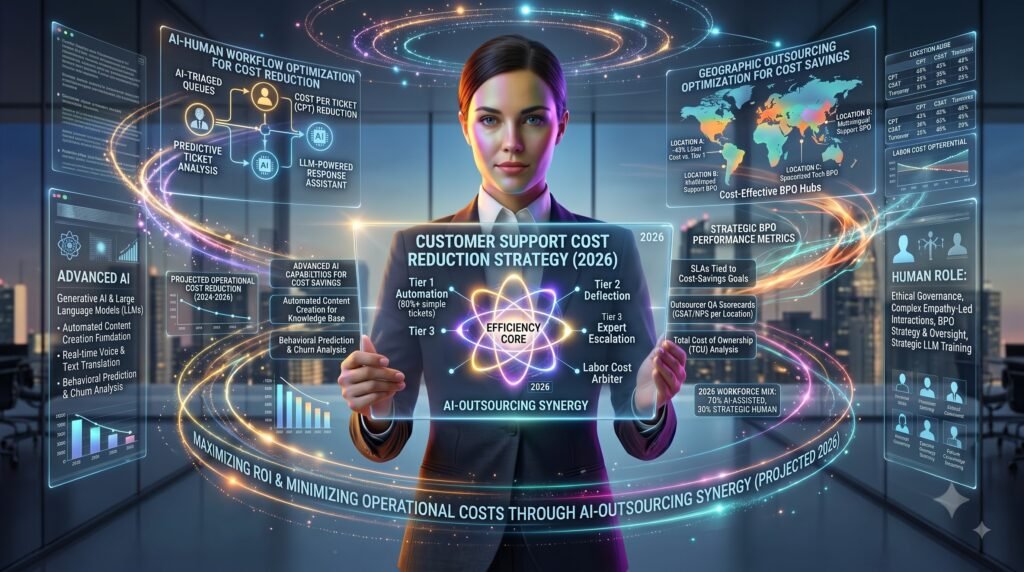
Customer support costs typically consume 5-15% of a company’s revenue, and for many growing businesses, that percentage is rising faster than the business can scale. As interaction volumes increase across email, chat, phone, and social channels, the traditional model—hire more agents, buy more software, lease more infrastructure—becomes financially unsustainable.
Two strategies now dominate cost-reduction conversations: AI-powered automation and strategic outsourcing. Both can deliver significant savings. Both can also fail badly when applied without understanding the cost structures, operational trade-offs, and business risks involved.
This guide explains how to reduce customer support costs using AI and outsourcing—not as generic tactics, but as strategic decisions matched to your business model, interaction profile, and acceptable risk. It includes total cost of ownership frameworks, realistic cost benchmarks by industry and channel, decision criteria for choosing between in-house, outsourced, AI-enabled, and hybrid models, and guidance on when cost reduction becomes counterproductive.
If you are evaluating whether to automate, outsource, or restructure your support operations to reduce costs, this article provides the frameworks to make that decision with confidence.
Why Customer Support Costs Are Rising
Customer support costs are increasing for most businesses because of structural changes in customer expectations and operating models, not simply because of poor efficiency.
Volume Growth
Digital-first businesses generate more support interactions per customer than traditional businesses. A SaaS company may receive 2-4 support interactions per active user annually. An eCommerce business may see 0.3-0.8 interactions per order. As the customer base grows, interaction volume scales proportionally—or faster, if the product, onboarding, or checkout experience has friction.
Channel Proliferation
Customers now expect support across email, live chat, phone, SMS, social media, in-app messaging, and WhatsApp. Each channel requires different staffing models, technology, and skill sets. Operating five channels costs significantly more than operating one, even when total interaction volume remains constant.
24/7 Availability Expectations
Global customer bases and always-on digital products create expectations for round-the-clock support. Providing 24/7 coverage with in-house teams typically requires three shifts and significantly higher headcount than single-shift operations.
Complexity Creep
As products mature and customer bases diversify, support inquiries become more complex. Early-stage companies may handle mostly “how do I” questions. Mature companies handle billing disputes, integration troubleshooting, compliance questions, enterprise account management, and edge cases that require research and escalation.
Labour Market Pressure
In-house support agent salaries in the United States, United Kingdom, and Australia have increased 15-25% since 2020 in many markets, driven by competition for remote-capable workers and wage inflation.
Technology Sprawl
The median support team now uses 6-10 tools: ticketing system, CRM, knowledge base, chat platform, phone system, quality assurance software, workforce management platform, analytics dashboard. Licensing costs increase as interaction volume grows, and integration complexity creates hidden IT overhead.
The result: many companies find that customer support costs are growing faster than revenue, creating pressure to find structural cost reduction without sacrificing customer experience or business outcomes.
The Total Cost of Customer Support: What You’re Actually Paying For
Most businesses track agent salaries and software licenses, but total cost of ownership includes several categories that are frequently underestimated or invisible in P&L reporting.
Labour Costs (60-70% of Total)
- Agent salaries or hourly wages: For in-house teams, this includes base pay, benefits, payroll taxes, and employer-sponsored insurance. For outsourced teams, this is the per-agent or per-interaction rate charged by the provider.
- Management and QA overhead: Typically 1 manager per 10-15 agents, plus QA analysts, workforce planners, trainers.
- Recruitment and onboarding: Agent attrition in contact centres averages 30-45% annually, requiring continuous hiring and training.
- Idle time and utilization losses: Agents are typically productive 65-75% of scheduled time after accounting for breaks, training, system downtime, and queue variability.
Technology Costs (10-15% of Total)
- Platform licenses: Ticketing systems (Zendesk, Freshdesk, Salesforce Service Cloud, Intercom) typically charge per agent per month, with costs ranging from $15/agent/month to $150+/agent/month depending on features and scale.
- Telephony: Cloud contact centre platforms (Amazon Connect, Five9, Genesys Cloud, NICE CXone) charge per-minute, per-agent, or hybrid models. Costs vary widely depending on inbound vs outbound, domestic vs international, IVR usage, and recording requirements.
- AI and automation tools: Chatbot platforms, AI agent-assist tools, and knowledge-base AI can cost $500-$5,000+ per month depending on interaction volume and sophistication.
- Integrations and middleware: Connecting support systems to CRM, billing, inventory, shipping, and product databases often requires custom development or third-party integration platforms.
Infrastructure Costs (5-10% of Total)
For in-house teams: office space, workstations, networking, security, utilities, facilities management. For remote teams: home-office stipends, equipment, VPN, security software.
For outsourced teams, infrastructure costs are typically embedded in the provider’s per-agent or per-interaction rate, but buyers should verify what is included.
Training and Knowledge Management (5-10% of Total)
- Initial agent training (typically 2-6 weeks depending on product complexity)
- Ongoing training for product updates, process changes, new tools
- Knowledge base creation, maintenance, content review
- QA feedback loops and coaching
Hidden Costs
- Escalations: When Tier 1 agents cannot resolve issues, escalations to product, engineering, billing, or account management teams create untracked internal labour costs
- Rework: Incorrect information, missed steps, or incomplete resolutions create repeat contacts, inflating volume and cost per resolution
- Customer churn: Poor support experiences increase attrition. The cost of replacing a churned customer typically far exceeds the cost of the support interaction that triggered the churn.
Total Cost Per Interaction
For most businesses, the fully loaded cost per support interaction ranges from:
- Email: $5-$15 per interaction (in-house), $3-$8 (outsourced to offshore teams)
- Chat: $4-$12 per interaction (in-house), $2-$6 (outsourced)
- Phone: $8-$25 per interaction (in-house), $4-$12 (outsourced)
- AI/Chatbot: $0.10-$2 per automated resolution
These ranges vary significantly based on geography, product complexity, average handling time, and first contact resolution rate.
Understanding total cost of ownership is essential because headline cost-reduction strategies—”switch to a cheaper helpdesk” or “hire offshore agents”—often shift costs rather than eliminate them.
Cost-Reduction Strategy 1: AI Automation
AI automation reduces costs by deflecting interactions away from human agents or by reducing the time agents spend on each interaction. The economics are compelling when the automation works reliably. The risk is deploying AI that frustrates customers, creates rework, or damages conversion rates.
How AI Reduces Costs
Ticket Deflection
AI chatbots, virtual agents, and interactive knowledge bases can resolve routine inquiries without human involvement. Effective implementations deflect 20-60% of inbound volume, depending on inquiry complexity and customer tolerance for self-service.
Common high-deflection use cases:
- Account login and password reset
- Order status and tracking
- Billing inquiries and invoice retrieval
- Knowledge base search and article retrieval
- Appointment scheduling and rescheduling
- Simple troubleshooting (connectivity, setup, common errors)
Cost impact: If an AI chatbot resolves an inquiry for $0.50 that would have cost $8 via live chat, the savings per deflected interaction is $7.50. At 10,000 deflected interactions per month, that is $75,000 in monthly savings, or $900,000 annually.
Agent Assist and Response Suggestion
AI tools embedded in agent desktops can suggest responses, surface relevant knowledge-base articles, auto-populate fields, and summarize prior interactions. This reduces average handling time (AHT) by 10-30% for interactions that still require human agents.
Cost impact: If AHT decreases from 8 minutes to 6 minutes, agent productivity increases by 25%, allowing the same team to handle 25% more volume or reducing required headcount by 20%.
Automated Summarization and Tagging
AI can automatically categorize tickets, tag intents, extract key information, and generate interaction summaries. This reduces manual QA and reporting effort and improves manager visibility.
Workflow Automation
AI can trigger actions based on interaction content: create billing adjustments, issue refunds, update account settings, schedule follow-ups, route escalations. This removes repetitive tasks from agent workflows.
Realistic AI Cost Structure
AI is not free. Total cost includes:
- Platform licensing: AI chatbot platforms typically charge based on conversation volume, ranging from $0.02-$0.50 per conversation depending on provider, complexity, and integrations.
- Large language model API costs: If the chatbot uses GPT-4, Claude, or similar models, API costs are typically $0.01-$0.20 per conversation depending on prompt length and response generation.
- Implementation and integration: Custom chatbot development, knowledge-base preparation, CRM integration, and testing typically cost $10,000-$100,000+ depending on complexity.
- Ongoing tuning and content maintenance: AI models require continuous monitoring, response refinement, escalation-rule tuning, and knowledge-base updates. Budget 10-20% of implementation cost annually for maintenance.
Break-Even Analysis
An AI chatbot with $50,000 implementation cost, $2,000/month platform cost, and $0.50 average cost per conversation will break even when it deflects approximately 600-800 interactions per month that would otherwise cost $8 each via live chat.
Most businesses reach break-even within 3-6 months if deflection rates exceed 20%.
When AI Automation Fails
AI cost reduction fails or backfires when:
- Deflection creates frustration: Customers forced into chatbot loops without easy escalation to humans abandon transactions or churn. The cost of lost revenue exceeds the savings.
- AI provides incorrect information: Hallucinations, outdated knowledge, or misunderstood questions create rework, repeat contacts, and customer dissatisfaction. The cost per resolution increases rather than decreases.
- Implementation is under-resourced: Poorly trained AI with incomplete knowledge bases deflects poorly, escalates excessively, and erodes trust in the channel. Customers learn to avoid it.
- Edge cases dominate: If 60% of interactions are unique, complex, or emotional, deflection rates remain low and ROI suffers.
AI works best for high-volume, low-complexity, routine inquiries. It works poorly for nuanced, emotionally charged, or judgment-intensive interactions.
For a deeper exploration of how AI and outsourcing complement each other, see AI-powered customer support outsourcing.
Cost-Reduction Strategy 2: Strategic Outsourcing
Outsourcing reduces costs by shifting labour to lower-cost geographies and converting fixed costs into variable costs. The economics depend on interaction volume, wage differentials, management overhead, and quality requirements.
How Outsourcing Reduces Costs
Labour Arbitrage
The primary cost advantage comes from wage differentials. A customer support agent in the United States may cost $18-$30/hour (loaded with benefits and payroll taxes). A comparable agent in India or the Philippines may cost $6-$12/hour (fully loaded through a BPO provider). The wage differential creates a 40-60% reduction in per-interaction cost for voice and chat.
Variable Cost Model
Outsourcing converts headcount from a fixed cost to a variable cost. Instead of hiring, training, and maintaining a full-time team sized for peak volume, companies pay only for agents actively handling interactions. This eliminates idle time during low-volume periods and avoids overstaffing.
Operational Expertise
Mature BPO providers operate at scale across multiple clients, allowing them to invest in workforce management software, QA systems, training infrastructure, and process optimization that would be cost-prohibitive for a single company’s support team.
24/7 Coverage Without Shift Premiums
Offshore teams in India or the Philippines operate during their local daytime hours, which correspond to US nighttime hours. This provides natural 24/7 coverage without requiring night-shift premiums or third-shift staffing challenges.
Faster Scaling
BPO providers can typically recruit, train, and deploy additional agents within 2-4 weeks. In-house teams require 6-12 weeks to hire and onboard, creating delays during growth periods.
Realistic Outsourcing Cost Structure
Outsourcing is not simply “offshore hourly wage.” Total cost includes:
- Per-agent fees: Offshore providers typically charge $1,200-$2,500 per agent per month for dedicated agents, which includes salary, benefits, infrastructure, management, QA, reporting, and technology. This translates to approximately $6-$12 per productive hour.
- Per-interaction fees: Some providers charge per ticket, per call, or per chat. Typical offshore rates: $3-$8 per email ticket, $2-$6 per chat, $4-$12 per phone call.
- Setup and transition fees: Initial onboarding, training material development, knowledge-base preparation, and process documentation typically cost $10,000-$50,000 depending on complexity.
- Management and governance overhead: Even with outsourced operations, companies must maintain internal oversight: vendor management, QA audits, SLA monitoring, escalation handling. Budget 0.5-1 FTE internally per 20-30 outsourced agents.
- Technology and integration: The provider may use your existing helpdesk licenses (you continue paying Zendesk, Freshdesk, etc.) or you may pay for seats on the provider’s platform. Integration with your CRM, billing, and product systems may require custom development.
Total Cost of Ownership Comparison
| Cost Category | In-House (USA) | Outsourced (India) |
|---|---|---|
| Agent labour (10 agents, fully loaded) | $400,000/year | $180,000/year |
| Management (1 manager) | $80,000/year | Included in provider fee |
| Recruitment, training, attrition | $40,000/year | Included in provider fee |
| Technology (helpdesk, phone, tools) | $36,000/year | $36,000/year |
| Infrastructure (office, equipment) | $30,000/year | Included in provider fee |
| QA and workforce management tools | $12,000/year | Included in provider fee |
| Total Annual Cost | $598,000 | $216,000 |
| Cost per Agent per Year | $59,800 | $21,600 |
| Savings | — | 64% |
This is an illustrative scenario, not MasCallNet performance data. Actual savings depend on wage markets, provider pricing, interaction complexity, and quality requirements.
When Outsourcing Fails to Reduce Costs
Outsourcing can fail to deliver expected savings when:
- Transition is poorly managed: Inadequate knowledge transfer, incomplete documentation, or rushed training creates low first-contact resolution, high escalation rates, and customer dissatisfaction. The cost per resolution increases due to rework.
- Hidden costs are underestimated: If your internal team must spend significant time managing the outsourced team, answering escalations, rewriting knowledge-base articles, and fixing quality issues, internal labour costs increase and offset offshore savings.
- Quality requirements are mismatched: If your customers expect native fluency, deep product expertise, or high empathy, and the outsourced team cannot consistently deliver it, customer churn increases. The cost of replacing churned customers exceeds the labour savings.
- Volume is too low: Outsourcing works best at scale. If your interaction volume is fewer than 1,000 tickets per month, setup costs and management overhead may exceed savings.
- Vendor selection is poor: Choosing the lowest-cost provider without evaluating training quality, agent tenure, management capability, or technology maturity often results in poor service and higher total cost of ownership.
For a detailed breakdown of outsourcing pricing models by geography, see outsourced customer support pricing.
Hybrid Model: AI + Human + Outsourcing
The most cost-effective model for most businesses combines AI automation, in-house agents, and outsourced teams, with each handling the interaction types where it performs best.
How to Structure a Hybrid Model
Tier 1: AI Chatbot (Routine, High-Volume, Low-Complexity)
Deploy AI chatbots for:
- Password resets and login issues
- Order tracking and delivery status
- Billing inquiries (invoice retrieval, payment confirmation)
- Knowledge base search
- Appointment scheduling
- Simple troubleshooting
Target deflection rate: 30-50% of total inbound volume.
Tier 2: Outsourced Agents (Moderate Complexity, Scalable Volume)
Route interactions to outsourced teams when:
- The chatbot cannot resolve the inquiry
- The customer requests a human agent
- The inquiry requires account access, research, or multi-step troubleshooting
- The inquiry is routine but outside the chatbot’s training scope
Outsourced teams handle 40-60% of human-assisted volume.
Tier 3: In-House Agents (High Complexity, High Value, Sensitive)
Retain in-house teams for:
- Enterprise customer accounts
- Complex product or technical issues
- Escalations involving billing disputes, legal questions, or compliance
- High-value sales or retention conversations
- Feedback that informs product development
- VIP or executive-level support
In-house teams handle 10-30% of human-assisted volume but often represent the highest-value interactions.
Cost Impact of Hybrid Model
Assume a company receives 50,000 interactions per month:
- AI deflects 20,000 (40%) at $0.50 each = $10,000/month
- Outsourced agents handle 20,000 (40%) at $4 each = $80,000/month
- In-house agents handle 10,000 (20%) at $10 each = $100,000/month
Total cost: $190,000/month
Compare to fully in-house model:
- 50,000 interactions at $10 each = $500,000/month
Savings: $310,000/month, or 62%
This illustrative example assumes the company successfully implements AI with acceptable deflection rates, transitions appropriate volume to outsourced teams without quality degradation, and retains in-house expertise for high-value interactions. Actual results depend on execution quality.
The hybrid model allows businesses to optimize cost without sacrificing quality on interactions that matter most. It also provides redundancy: if the outsourced provider experiences an outage or quality issue, volume can be temporarily shifted to in-house teams or the AI layer.
Total Cost of Ownership Framework
To accurately compare in-house, outsourced, AI, and hybrid models, calculate total cost of ownership across all cost categories.
Step 1: Calculate Current Fully Loaded Cost
Labour Costs:
- Agent salaries/wages × number of agents
- Payroll taxes and benefits (typically 20-30% of gross wages in the US)
- Manager salaries (typically 1 manager per 10-15 agents)
- QA, training, workforce management personnel
- Recruitment costs (agency fees, job ads, interviewing time)
- Onboarding and training costs (trainer time, materials, lost productivity)
Technology Costs:
- Helpdesk/ticketing platform licenses
- Phone system or cloud contact centre platform
- CRM system (allocated to support)
- Knowledge base and self-service tools
- QA and workforce management software
- Analytics and reporting tools
- Integration and middleware platforms
Infrastructure Costs:
- Office space (rent, utilities, facilities)
- Workstations (desks, chairs, computers, headsets)
- IT support (networking, security, device management)
- Remote-work stipends (if applicable)
Operational Costs:
- Knowledge base content creation and maintenance
- Process documentation
- Quality assurance reviews
- Reporting and analytics
- Escalation handling by product, engineering, or account management teams
Hidden Costs:
- Customer churn attributable to poor support
- Revenue lost due to unresolved issues or long wait times
- Rework due to incorrect resolutions
Total Monthly Cost ÷ Total Monthly Interactions = Cost Per Interaction
Step 2: Model Alternative Scenarios
Create cost models for:
- Current in-house model (baseline)
- AI chatbot deflecting 30% of volume (calculate AI platform cost + remaining human-assisted cost)
- Outsource 50% of volume to offshore provider (calculate provider fees + retained in-house cost + management overhead)
- Hybrid model: AI deflects 40%, outsource 40%, in-house 20% (calculate combined cost)
Step 3: Include Transition and Implementation Costs
- AI implementation: Platform setup, knowledge base preparation, integration, testing ($10,000-$100,000 typical range)
- Outsourcing transition: Knowledge transfer, training material development, dual operations during transition, quality audits ($10,000-$50,000 typical range)
- Ongoing management overhead: Internal vendor management, SLA monitoring, escalation handling (0.5-1 FTE per 20-30 outsourced agents)
Amortize one-time costs over 12-24 months to calculate true monthly cost comparison.
Step 4: Adjust for Quality and Risk
If outsourcing or AI reduces first-contact resolution from 75% to 65%, the cost per resolution increases because more interactions require follow-up. If customer satisfaction declines and churn increases by 2%, the cost of replacing churned customers must be included in total cost of ownership.
Quality and customer experience are not free variables. A model that reduces cost per interaction but increases churn may increase total cost to the business.
Cost Benchmarks by Industry, Channel, and Geography
Cost per interaction varies significantly based on industry, channel, geography, and complexity. The following benchmarks represent typical fully loaded costs reported by mid-sized companies (500-5,000 employees) across various sectors.
Cost Per Interaction by Channel (In-House, United States)
| Channel | Low | Median | High |
|---|---|---|---|
| $6 | $10 | $15 | |
| Live Chat | $5 | $8 | $12 |
| Phone | $10 | $16 | $25 |
| Social Media | $4 | $7 | $12 |
| AI Chatbot (automated resolution) | $0.10 | $0.50 | $2 |
Cost Per Interaction by Channel (Outsourced, India/Philippines)
| Channel | Low | Median | High |
|---|---|---|---|
| $3 | $5 | $8 | |
| Live Chat | $2 | $4 | $6 |
| Phone | $5 | $8 | $12 |
| Social Media | $3 | $5 | $8 |
Cost Per Interaction by Industry (Median, In-House USA)
| Industry | Chat | Phone | Primary Driver | |
|---|---|---|---|---|
| SaaS | $8 | $6 | $14 | Product complexity, integration troubleshooting |
| eCommerce | $6 | $5 | $12 | Order issues, returns, shipping |
| FinTech | $12 | $10 | $20 | Regulatory questions, transaction disputes, security |
| Healthcare | $14 | $12 | $22 | HIPAA compliance, clinical inquiries, insurance |
| Telecommunications | $10 | $8 | $18 | Technical troubleshooting, billing disputes |
| Insurance | $12 | $10 | $20 | Claims, policy questions, compliance |
Higher costs in regulated industries (FinTech, Healthcare, Insurance) reflect longer training periods, compliance requirements, and higher consequences of error.
Geographic Wage Differentials (Fully Loaded Agent Cost)
| Geography | Hourly Cost (Low) | Hourly Cost (High) | Notes |
|---|---|---|---|
| United States | $18 | $30 | Higher in major metros, tech hubs |
| United Kingdom | $15 | $25 | GBP converted to USD equivalent |
| Australia | $20 | $32 | AUD converted to USD equivalent |
| Canada | $16 | $26 | CAD converted to USD equivalent |
| India (BPO provider rate) | $6 | $12 | Includes provider margin and infrastructure |
| Philippines (BPO provider rate) | $7 | $13 | Includes provider margin and infrastructure |
| Latin America (nearshore) | $10 | $18 | Mexico, Colombia, Argentina |
Sources: Gartner Contact Center Benchmarking, Deloitte Global Outsourcing Survey 2023, Forrester Customer Service Cost Analysis 2024. Costs reflect 2024-2025 market data and may vary based on interaction complexity, required language skills, and provider tier.
ROI Calculation: How to Model Your Own Savings
Use this framework to calculate expected ROI for AI automation, outsourcing, or a hybrid model.
Step 1: Baseline Current Costs
Monthly Interaction Volume by Channel:
- Email: ______
- Chat: ______
- Phone: ______
- Social: ______
- Total: ______
Current Cost Per Interaction by Channel:
- Email: $______
- Chat: $______
- Phone: $______
- Social: $______
Current Total Monthly Cost:
(Volume × Cost Per Interaction, summed across channels)
Step 2: Model AI Deflection
Target Deflection Rate: ____% (typically 20-50% depending on inquiry mix)
Deflectable Interaction Volume: Total Volume × Deflection Rate
AI Cost Per Deflected Interaction: $______ (platform cost + API cost, typically $0.10-$2)
Human-Assisted Cost for Deflected Interactions (if not deflected): $______
Monthly Savings from Deflection:
(Deflected Volume) × (Human Cost – AI Cost)
AI Implementation and Platform Costs:
- One-time implementation: $______
- Monthly platform cost: $______
Net Monthly Savings After AI Costs:
Monthly Savings – Monthly Platform Cost
Months to Break-Even:
Implementation Cost ÷ Net Monthly Savings
Step 3: Model Outsourcing
Volume to Be Outsourced: ______% of total volume
Current In-House Cost for This Volume: $______
Outsourced Cost for This Volume:
(Outsourced Volume) × (Outsourced Cost Per Interaction)
Transition and Setup Costs: $______
Ongoing Internal Management Overhead: $______ per month
Net Monthly Savings from Outsourcing:
In-House Cost – (Outsourced Cost + Management Overhead)
Months to Break-Even:
Transition Cost ÷ Net Monthly Savings
Step 4: Model Hybrid (AI + Outsourced + In-House)
AI Deflects: % at $__ per interaction
Outsourced Handles: % at $__ per interaction
In-House Handles: % at $__ per interaction
Total Monthly Cost:
(AI Volume × AI Cost) + (Outsourced Volume × Outsourced Cost) + (In-House Volume × In-House Cost) + Management Overhead
Monthly Savings vs Baseline: $______
Implementation Costs (AI + Outsourcing): $______
Months to Break-Even: ______
Step 5: Adjust for Quality Impact
If first-contact resolution decreases, cost per resolution increases:
- Current FCR: _____%
- Projected FCR after change: _____%
- Repeat-contact rate increase: _____%
- Additional cost due to rework: $______
Subtract additional rework cost from projected savings to calculate adjusted ROI.
If customer churn is expected to increase due to quality changes:
- Current monthly churn rate: _____%
- Projected churn rate: _____%
- Customer lifetime value: $______
- Monthly cost of incremental churn: (Churn increase) × (Customer base) × (LTV)
Subtract churn cost from projected savings.
This framework allows you to build a realistic, evidence-based business case rather than relying on vendor-provided ROI claims.
When Cost Reduction Becomes Counterproductive
Cost reduction is not inherently good. Reducing cost per interaction while increasing customer churn, repeat contacts, or escalations can increase total cost to the business.
Failure Mode 1: AI That Frustrates Customers
If AI chatbots cannot resolve inquiries and do not provide easy escalation to humans, customers abandon purchases, leave negative reviews, or churn. An eCommerce company that deflects pre-purchase questions to a chatbot that cannot answer product-fit questions may reduce support cost per interaction but lose conversion revenue that far exceeds the savings.
When this happens:
Customer lifetime value declines faster than cost per interaction declines. Total business profitability decreases.
How to avoid it:
Ensure AI can escalate seamlessly to humans. Measure not just deflection rate but also customer satisfaction and conversion impact. Do not force customers into AI-only channels for high-stakes interactions.
Failure Mode 2: Outsourcing That Degrades Quality
If outsourced agents lack product knowledge, language fluency, or empathy, first-contact resolution decreases, repeat contacts increase, and customers escalate to in-house teams. The company now pays for both the outsourced interaction and the in-house escalation, increasing total cost per resolution.
When this happens:
Cost per interaction appears to decrease, but cost per resolution increases. Customer satisfaction declines. Churn increases.
How to avoid it:
Select outsourcing partners based on training quality, agent tenure, and domain expertise, not solely on hourly wage. Invest in comprehensive onboarding. Monitor FCR, CSAT, and escalation rates continuously. Retain in-house agents for complex or high-value interactions.
For guidance on evaluating offshore vs nearshore options, see offshore vs onshore customer support outsourcing.
Failure Mode 3: Underinvestment in Knowledge Management
Both AI and outsourced agents depend on accurate, current, comprehensive knowledge bases. If knowledge articles are outdated, incomplete, or poorly written, agents (human or AI) provide incorrect information, creating rework, repeat contacts, and customer frustration.
When this happens:
Cost per interaction remains high because agents spend excessive time searching for information. Quality declines. Training becomes harder.
How to avoid it:
Budget 10-15% of support cost for knowledge base creation, review, and maintenance. Assign ownership. Measure article usage and effectiveness. Continuously update content based on ticket trends.
Failure Mode 4: Cost Reduction That Breaks Product Feedback Loops
In-house support teams often identify product bugs, UX friction, onboarding gaps, and feature requests that inform product development. Outsourced teams or AI systems may lack the context, incentive, or communication channels to surface this feedback effectively.
When this happens:
Product quality stagnates. Issues that could be fixed at the product level continue generating support volume indefinitely. Long-term cost increases even if short-term cost per interaction decreases.
How to avoid it:
Build structured feedback loops from outsourced teams to product and engineering. Use AI to categorize and escalate recurring issues. Ensure someone internal is accountable for acting on support-driven insights.
Failure Mode 5: Optimizing the Wrong Metric
Reducing average handling time (AHT) without considering first-contact resolution can backfire. An agent who rushes through interactions in 4 minutes instead of 7 minutes but leaves the issue unresolved creates repeat contacts. The customer now requires two 4-minute interactions instead of one 7-minute interaction. Total cost increases.
When this happens:
AHT improves but cost per resolution increases. Customer effort increases. Satisfaction declines.
How to avoid it:
Optimize for cost per resolution, not cost per interaction. Measure FCR, customer satisfaction, and repeat-contact rate alongside AHT. Reward agents for resolution quality, not speed alone.
Vendor Evaluation: What Drives Actual Outsourcing Costs
Choosing an outsourcing provider based solely on per-agent hourly rate often results in higher total cost of ownership due to poor quality, high attrition, inadequate training, or hidden fees.
What to Evaluate Beyond Hourly Rate
Agent Training and Onboarding Duration
Providers that offer 1-week training for complex products will deliver lower quality than providers that offer 3-4 weeks of training. Ask:
- How long is initial training?
- What does training include?
- Who creates training materials—us or you?
- How are product updates communicated and trained?
Agent Tenure and Attrition Rate
Annual attrition in offshore contact centres ranges from 25% to 60%. Lower attrition means better product knowledge, fewer training cycles, and higher consistency.
Ask:
- What is your average agent tenure?
- What is your annual attrition rate?
- How do you reduce attrition?
- What is your internal promotion path for agents?
Management and QA Structure
Inadequate management increases escalation rates and quality inconsistency. Ask:
- What is your manager-to-agent ratio?
- How many QA analysts support the team?
- What QA process do you use?
- How do you handle coaching and feedback?
- What dashboards and reporting do we receive?
Technology and Integration Capability
Some providers operate on outdated platforms or lack integration expertise. Ask:
- What helpdesk platforms do you support?
- Can you integrate with our CRM, billing, inventory, shipping systems?
- Do we license the software or do you?
- What telephony platform do you use?
- What AI tools do you offer?
Security, Compliance, and Data Protection
Regulated industries must verify that outsourcing partners meet data protection and compliance requirements. Ask:
- What security certifications do you hold? (ISO 27001, SOC 2, PCI-DSS, HIPAA, GDPR)
- Where is data stored?
- Who has access to customer data?
- What encryption and access controls are in place?
- How are data breaches managed?
- Can we audit your facilities and systems?
Pricing Transparency
Headline per-agent rates often exclude critical costs. Ask:
- What exactly is included in the per-agent rate? (infrastructure, management, QA, reporting, technology)
- What is excluded? (software licenses, implementation, training material development, telephony usage)
- Are there setup fees?
- Are there minimum volume commitments?
- How is pricing adjusted if volume fluctuates?
- What is the notice period for scaling up or down?
Scalability and Flexibility
Ask:
- How quickly can you add agents?
- How quickly can you reduce agents?
- What happens during seasonal peaks?
- Can you provide temporary surge capacity?
Language, Accent, and Cultural Fit
For customer-facing interactions, language fluency and cultural alignment matter. Ask:
- What percentage of agents are native English speakers?
- What percentage are fluent but non-native?
- Do you offer accent neutralization training?
- Do you train agents on our target market’s cultural norms?
References and Case Studies
Ask for references from clients in your industry handling similar complexity. Verify:
- How long has the client been with the provider?
- What were the implementation challenges?
- How is quality measured and managed?
- What has been the client’s experience with escalations, attrition, and responsiveness?
Exit Planning
Understand what happens if the relationship ends. Ask:
- What is the notice period?
- What knowledge transfer process is provided?
- Who owns training materials, knowledge base content, and process documentation?
- What happens to customer data?
- Can we transition to another provider or bring operations in-house smoothly?
Providers who cannot answer these questions clearly or who resist transparency may create higher total cost of ownership even if their headline rate is low.
For an in-depth discussion of how to structure and scale outsourced operations, see customer support outsourcing.
Implementation: How to Transition Without Disrupting Service
Poorly managed transitions create service disruptions, customer dissatisfaction, and cost overruns. Successful implementations follow structured phases.
Phase 1: Preparation (4-6 Weeks)
Audit Current Operations
Document:
- Interaction volume by channel, day, hour
- Average handling time by inquiry type
- First-contact resolution rate
- Escalation rate and escalation destinations
- Current tools, integrations, workflows
- Knowledge base completeness
- Agent training materials
Define Scope and Success Metrics
Determine:
- Which interaction types will be automated or outsourced
- Which will remain in-house
- Target deflection rates (for AI)
- Target cost per interaction
- Minimum acceptable quality thresholds (FCR, CSAT, AHT)
- SLAs (response time, resolution time, uptime)
Prepare Knowledge Base and Training Materials
Organize:
- Product documentation
- Common troubleshooting steps
- FAQ content
- Process documentation (refunds, escalations, billing adjustments)
- Example interactions
- Tone and style guidelines
Many transitions fail because companies underestimate the effort required to create structured, accessible knowledge. Budget 2-4 weeks of internal effort to prepare materials before training begins.
Phase 2: Pilot (4-8 Weeks)
Start Small
Launch AI or outsourcing with:
- A limited interaction type (e.g., password resets, order status)
- A small team (3-5 agents for outsourcing pilots)
- A single channel (e.g., email only, then expand to chat and phone)
Monitor Quality Closely
During the pilot:
- Review 100% of interactions initially, then sample once quality stabilizes
- Measure FCR, CSAT, AHT, escalation rate daily
- Identify knowledge gaps, training gaps, process gaps
- Collect agent feedback on tools, workflows, unclear instructions
Iterate Rapidly
Use pilot feedback to:
- Update knowledge base articles
- Refine escalation rules
- Improve training materials
- Adjust AI responses or routing logic
- Fix integration issues
Validate ROI Assumptions
Confirm:
- Actual cost per interaction matches projections
- Quality meets minimum thresholds
- Customer satisfaction is stable or improving
- Internal escalation load is manageable
Do not scale until pilot performance meets success criteria.
Phase 3: Scale (8-12 Weeks)
Expand Volume Gradually
Increase interaction types, channels, and agent headcount incrementally:
- Week 1-2: Add 20% of target volume
- Week 3-4: Add 40% of target volume
- Week 5-8: Add 80% of target volume
- Week 9-12: Full volume transition
Maintain Dual Operations
Keep in-house team active during scale phase to:
- Handle escalations
- Provide backup during outages or quality issues
- Validate that outsourced or AI performance remains stable under load
Continuous QA and Coaching
Continue high-frequency QA reviews (10-20% of interactions) during scale phase. Provide daily or weekly coaching sessions based on review findings.
Phase 4: Optimization (Ongoing)
Automate Continuous Improvement
Use analytics to:
- Identify recurring interaction types that could be deflected to AI
- Identify knowledge gaps causing escalations or repeat contacts
- Identify agents who consistently outperform peers (and document what they do differently)
- Identify customers who contact support repeatedly (and investigate root cause)
Refine AI Models
Continuously retrain chatbots based on:
- Interactions where customers expressed frustration
- Interactions where escalation was requested
- Interactions where the bot provided incorrect information
Optimize Routing
Use interaction metadata to route inquiries more intelligently:
- High-value customers to senior agents
- Complex technical issues to specialized teams
- Routine inquiries to AI or junior agents
- Escalation-prone customers to experienced agents
Benchmark and Adjust
Quarterly, compare:
- Cost per interaction vs target
- FCR, CSAT, AHT vs target
- Escalation rate vs baseline
- Customer churn vs baseline
Adjust staffing, training, tools, or processes based on performance trends.
Decision Framework: Which Model Is Right for Your Business
Use this framework to determine whether to pursue AI automation, outsourcing, a hybrid model, or remain fully in-house.
When AI Automation Makes Sense
Consider AI if:
- High volume of routine inquiries: 30%+ of interactions are repetitive (password resets, order status, simple troubleshooting)
- Interaction data is structured: Inquiries can be categorized into predictable intents
- Knowledge base is comprehensive: Answers to common questions are documented and accurate
- Customer tolerance for self-service is moderate to high: Customers accept chatbot interactions for low-stakes inquiries
- Budget exists for implementation: $10,000-$100,000 for setup, integration, training
AI is less suitable if:
- Most inquiries are unique, complex, or emotionally charged
- Knowledge base is incomplete or outdated
- Customers strongly prefer human interaction (common in high-touch B2B, healthcare, financial advice)
- Volume is low (fewer than 1,000 interactions/month)
When Outsourcing Makes Sense
Consider outsourcing if:
- Volume justifies economies of scale: 2,000+ interactions per month
- 24/7 coverage is required: Global customer base or always-on product
- Cost pressure is significant: Labour represents 60%+ of support budget
- Interaction complexity is moderate: Inquiries require research and troubleshooting but not deep product expertise
- Internal resources are constrained: Hiring, training, and managing a larger in-house team is difficult or slow
Outsourcing is less suitable if:
- Volume is low or highly unpredictable
- Interactions require deep product expertise that is difficult to transfer
- Regulatory or contractual restrictions limit data sharing
- Customer expectations for language fluency or cultural alignment are very high
- Support feedback directly informs product strategy and development
When Hybrid Makes Sense
Consider a hybrid model (AI + Outsourced + In-House) if:
- Interaction complexity varies widely: Some inquiries are simple and routine; others are complex and high-value
- You need cost efficiency and quality: Willing to invest in orchestration to optimize each interaction type
- Volume is growing rapidly: Need scalability without compromising quality for key customer segments
- You have mature operations capability: Can manage multiple vendors, technologies, and workflows simultaneously
When to Remain Fully In-House
Remain in-house if:
- Volume is low: Fewer than 500-1,000 interactions per month
- Support is strategically core: Customer interactions directly inform product development, sales, retention, or brand positioning
- Product complexity is extreme: Support requires expertise that takes 6+ months to develop
- Regulatory environment is restrictive: Data protection or compliance requirements make outsourcing legally or contractually difficult
- Customer expectations are exceptionally high: Enterprise SLAs, dedicated account management, white-glove service
Decision Matrix
| Factor | AI Automation | Outsourcing | Hybrid | In-House |
|---|---|---|---|---|
| Interaction volume | High (5,000+/month) | Moderate-High (2,000+/month) | High (5,000+/month) | Low-Moderate (<2,000/month) |
| Interaction complexity | Low (routine, structured) | Moderate (research, troubleshooting) | Mixed (low to high) | High (deep expertise) |
| Customer tolerance for self-service | High | Moderate | Mixed | Low |
| 24/7 coverage required | Yes | Yes | Yes | No |
| Budget for implementation | $10K-$100K | $10K-$50K | $20K-$150K | Minimal |
| Knowledge base maturity | High | Moderate | Moderate-High | Low-Moderate |
| Regulatory constraints | Low-Moderate | Low-Moderate | Low-Moderate | High |
| Strategic importance of feedback | Moderate | Low-Moderate | Moderate-High | High |
This matrix provides guidance, not absolute rules. Many businesses benefit from piloting multiple approaches and optimizing based on measured results.
Frequently Asked Questions
What is the average cost per customer support interaction in 2026?
For in-house teams in the United States, the fully loaded cost per interaction ranges from $5-$15 for email, $8-$25 for phone, and $4-$12 for live chat, depending on industry complexity and average handling time. Outsourced costs are typically 40-60% lower.
How much can AI reduce customer support costs?
AI chatbots can reduce cost per interaction by 40-70% for inquiries that are successfully deflected from human agents. Typical deflection rates range from 20-50% depending on inquiry complexity and implementation quality. Total support cost reduction depends on what percentage of volume can be deflected and the cost of AI implementation and maintenance.
What is the ROI timeline for outsourcing customer support?
Most companies reach break-even within 3-6 months after accounting for transition costs, provider setup fees, and initial quality stabilization. Long-term ROI depends on sustained quality and effective vendor management.
Should I outsource customer support offshore or nearshore?
Offshore (India, Philippines) offers the greatest labour cost savings (50-65% reduction vs US in-house), making it suitable for high-volume, moderate-complexity interactions. Nearshore (Latin America) offers smaller cost savings (30-40% reduction) but closer time zones and potentially stronger cultural alignment, making it suitable for real-time collaboration or customers sensitive to accent. The decision depends on cost sensitivity, volume, and customer expectations.
What are the hidden costs of outsourcing customer support?
Common hidden costs include: transition and knowledge-transfer effort (internal team time), ongoing vendor management (0.5-1 FTE per 20-30 outsourced agents), quality issues that create rework and repeat contacts, technology integration and licensing, escalation handling by internal teams, and potential customer churn if quality declines.
How do I calculate cost per customer support interaction?
Divide total monthly support costs (agent labour, management, technology, infrastructure, training, QA) by total monthly interactions. Ensure all cost categories are included, and calculate separately by channel (email, chat, phone) if costs vary significantly.
What is a good first-contact resolution rate for customer support?
Industry benchmarks for FCR range from 70-85% depending on interaction complexity. Higher FCR reduces repeat contacts and total cost per resolution. FCR below 70% often indicates knowledge gaps, inadequate training, or poor routing.
Can AI completely replace human customer support agents?
No. AI is effective for routine, high-volume, low-complexity inquiries, but struggles with nuanced, emotionally charged, or judgment-intensive interactions. Most businesses achieve best results with a hybrid model where AI handles routine inquiries and humans handle complex or high-value interactions.
How long does it take to implement AI customer support automation?
Initial implementation typically requires 4-12 weeks depending on integration complexity, knowledge base readiness, and desired sophistication. Continuous optimization and training are ongoing. Budget 2-4 weeks for knowledge preparation, 2-4 weeks for platform setup and integration, and 4-8 weeks for pilot and refinement before scaling.
What is the cost difference between in-house and outsourced customer support?
Outsourcing to India or the Philippines typically reduces labour costs by 50-65% compared to in-house teams in the United States, United Kingdom, or Australia. Total cost savings are typically 40-50% after accounting for vendor management, technology, and transition costs.
How do I choose a customer support outsourcing provider?
Evaluate providers based on: agent training duration and quality, average agent tenure and attrition rate, management and QA structure, technology and integration capability, security and compliance certifications, pricing transparency, references from similar clients, and cultural and language fit. Do not select based solely on hourly rate.
What metrics should I track for customer support cost optimization?
Track: cost per interaction by channel, cost per resolution (accounting for repeat contacts), first-contact resolution rate, average handling time, customer satisfaction score (CSAT), escalation rate, agent utilization rate, deflection rate (for AI), and customer churn rate. Optimize for cost per resolution and customer satisfaction, not cost per interaction alone.
When should I keep customer support in-house instead of outsourcing?
Keep support in-house when: volume is low (fewer than 500-1,000 interactions/month), support is strategically core to product development or brand, interactions require deep expertise that takes months to develop, regulatory or contractual restrictions limit outsourcing, or customer expectations for quality are exceptionally high.
How does customer support outsourcing to India reduce costs?
India offers a large pool of English-speaking, educated talent at significantly lower labour costs than Western markets. Fully loaded agent costs in India (through BPO providers) range from $6-$12/hour compared to $18-$30/hour in the United States. India also provides natural 24/7 coverage due to time zone differences.
What is the cost of implementing a customer support chatbot?
Implementation costs range from $10,000-$100,000 depending on complexity, integration requirements, and knowledge base preparation. Ongoing platform and API costs typically range from $500-$5,000/month depending on conversation volume. Break-even typically occurs within 3-6 months if deflection rates exceed 20%.
Can outsourcing customer support damage customer satisfaction?
Yes, if the outsourced team lacks training, product knowledge, language fluency, or management support. Successful outsourcing requires comprehensive onboarding, continuous QA, clear escalation paths, and selection of a provider based on quality, not solely on cost. Monitor CSAT and FCR closely during and after transition.
What is the difference between cost per interaction and cost per resolution?
Cost per interaction measures the cost of a single email, chat, or call. Cost per resolution measures the total cost to fully resolve a customer’s issue, which may require multiple interactions. Optimizing for cost per interaction without considering resolution quality can increase cost per resolution if repeat contacts rise.
How do I reduce average handling time without hurting quality?
Provide agents with better tools: AI-powered response suggestions, integrated knowledge bases, CRM data visibility, and streamlined workflows. Improve training and onboarding. Automate repetitive tasks (data entry, tagging, summarization). Do not pressure agents to rush interactions at the expense of first-contact resolution.
What percentage of customer support inquiries can be automated with AI?
Deflection rates vary by industry and inquiry mix. Typical successful implementations deflect 20-50% of volume. Routine inquiries (password resets, order tracking, FAQ lookups, simple troubleshooting) deflect well. Complex, emotionally charged, or unique inquiries do not.
Is it cheaper to build an in-house AI chatbot or use a platform?
For most businesses, using a platform (Intercom, Zendesk AI, Freshdesk Freddy, Ada, Ultimate.ai) is faster and more cost-effective than building custom AI, unless interaction volume exceeds 100,000/month or unique requirements justify custom development. Platforms offer faster deployment, lower upfront cost, and ongoing model updates.
How MasCallNet Helps Businesses Reduce Customer Support Costs
Reducing customer support costs requires more than switching vendors or deploying a chatbot. It requires understanding your current cost structure, identifying which interactions can be automated or outsourced without quality loss, designing a delivery model that matches your business complexity and risk tolerance, and managing the transition without disrupting service.
MasCallNet works with businesses that need to reduce support costs while maintaining or improving customer experience. If you are evaluating AI automation, outsourcing, or a hybrid model and need help building a realistic cost and quality framework, we can help you model the options, assess feasibility, and structure a transition that aligns with your business objectives.