
Banking Back Office Outsourcing Services (2026): The Complete Executive Guide to AI-Powered Banking Operations, KYC & Customer Support
AI Overview
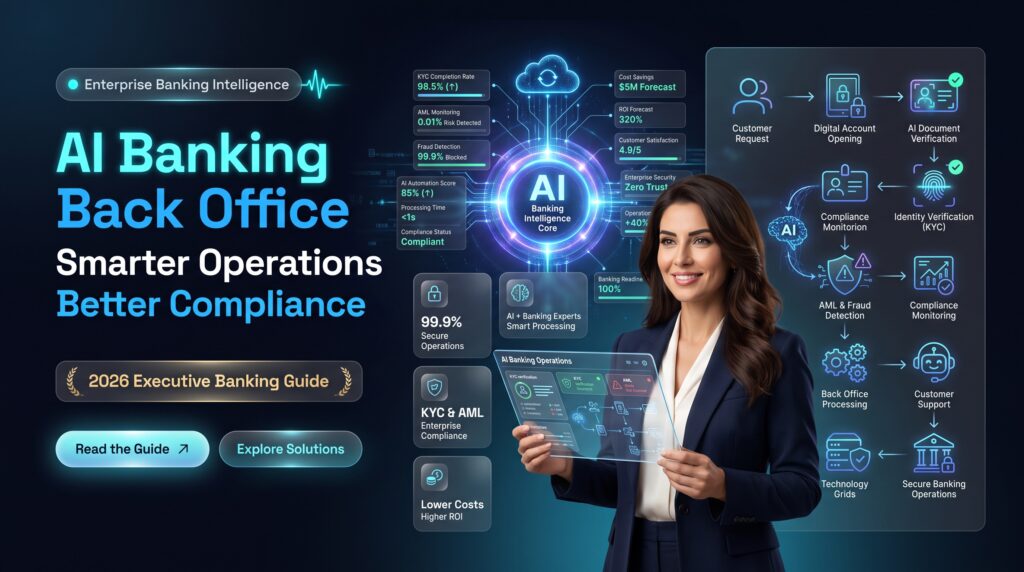
Banking back office outsourcing in 2026 is no longer a cost-reduction play. It is a competitive infrastructure decision. Banks and fintech firms that outsource operations to AI-powered BPO providers are reducing per-transaction costs by 40–65%, improving KYC completion rates by 35%, and scaling customer support capacity without proportional headcount growth. The Indian BPO industry — projected to reach $19.93 billion by 2025 — remains the dominant delivery model, combining English-language proficiency, regulatory literacy, and AI-native workforce capabilities. This guide covers operational models, vendor selection, pricing benchmarks, ROI frameworks, and executive decision criteria.
Executive Introduction
There is a version of banking back office outsourcing that most articles describe: cost savings, offshore labor arbitrage, and operational handoffs. That version was accurate in 2015.
In 2026, the reality is structurally different.
The banks and fintech companies generating the strongest operational returns are not simply outsourcing tasks. They are outsourcing entire intelligence layers of their business — KYC adjudication, fraud pattern recognition, customer sentiment analysis, and compliance documentation — to AI-native providers who deliver outcomes that in-house teams cannot replicate at equivalent cost or speed.
This is the shift that separates banking back office outsourcing as a cost center from banking back office outsourcing as a revenue and compliance accelerator.
Every customer interaction, every KYC flag, every loan processing exception, and every support escalation generates intelligence. The organizations winning in 2026 are those that treat this intelligence as a strategic asset — not an operational byproduct.
This guide is written for the executives responsible for that decision: CEOs, COOs, CIOs, Heads of Operations, and Procurement Leaders evaluating outsourcing partnerships for banking and financial services operations.
Key Insights at a Glance
| Insight | Data Point |
|---|---|
| Global BPO market size (2026 est.) | $350+ billion |
| India BPO industry revenue (2025 est.) | $19.93 billion |
| Average cost reduction via AI-powered BPO | 40–65% |
| KYC processing time reduction | 35–50% |
| Customer support ticket deflection via AI | 55–70% |
| First Contact Resolution improvement (outsourced vs in-house) | +18–24 percentage points |
| Average time-to-deploy outsourced banking support team | 4–8 weeks |
| Banking BPO CSAT benchmark (India delivery) | 87–92% |
Section 1: The Market Reality — Why Banking Operations Are at an Inflection Point
Direct Answer
Banking and financial services firms face an operational paradox in 2026: customer expectations are at an all-time high, regulatory complexity has never been greater, and operational budgets are under sustained pressure. Back office outsourcing — specifically AI-powered back office outsourcing — resolves this paradox without forcing a trade-off between quality and cost.
Why It Matters
The traditional banking operating model — where back office functions are staffed internally, powered by legacy systems, and managed through manual workflows — is generating measurable competitive disadvantage.
Consider what in-house banking operations teams are dealing with:
- KYC compliance costs have increased 25–35% over the past five years due to regulatory expansion (FATF guidelines, PMLA amendments, FinCEN updates)
- Customer support volume in digital banking has grown 60–80% since 2020 as mobile-first users generate higher interaction frequency
- Loan processing backlogs average 7–12 business days in traditionally staffed environments vs. 2–4 days with AI-assisted workflows
- Fraud monitoring false-positive rates remain 70–80% in rule-based systems, consuming analyst time on non-events
The banks and fintech firms that are closing this gap are doing so through strategic outsourcing — not as an emergency measure, but as a deliberate infrastructure choice.
Industry Benchmark Table: In-House vs. Outsourced Banking Operations
| Operational Metric | In-House (Traditional) | AI-Powered BPO (2026) | Performance Delta |
|---|---|---|---|
| KYC Completion Time | 5–8 business days | 2–3 business days | 50–60% faster |
| Cost per KYC Case | $18–$35 | $7–$14 | 55–60% lower |
| Customer Support AHT | 7–11 minutes | 4–6 minutes | 40–45% reduction |
| First Contact Resolution | 62–68% | 80–86% | +18–24 points |
| Loan Processing Time | 7–12 days | 2–4 days | 65–70% faster |
| Fraud Alert False Positives | 70–80% | 40–55% | 25–30% reduction |
| Compliance Documentation Accuracy | 88–92% | 96–99% | +7–11 points |
| Cost per Support Interaction | $8–$15 | $3–$6 | 55–65% lower |
Source: MasCallNet operational benchmarks, industry aggregates, 2024–2026.
Executive Interpretation
These are not marginal improvements. A bank processing 50,000 KYC cases per year at an average in-house cost of $25 per case spends $1.25 million annually on KYC compliance operations. At an AI-powered BPO rate of $10 per case, that cost drops to $500,000 — a $750,000 annual saving on a single process. Multiply that across loan processing, customer support, and fraud operations, and the strategic case is unambiguous.
Key Takeaway
Banking back office outsourcing in 2026 is not about finding cheaper labor. It is about accessing AI-native operational infrastructure that in-house teams cannot economically build or maintain.
Section 2: What Banking Back Office Outsourcing Actually Covers in 2026
Direct Answer
Modern banking back office outsourcing spans five core operational domains: compliance and KYC operations, customer support and contact center services, loan and credit processing, financial data management, and fraud and risk operations. Each domain has been transformed by AI integration.
The Five Domains of Banking Back Office Outsourcing
Domain 1: KYC & AML Compliance Operations
KYC (Know Your Customer) and AML (Anti-Money Laundering) operations represent the highest-risk, highest-cost domain in banking back office functions.
What is outsourced:
- Customer onboarding document verification
- Identity authentication (PAN, Aadhaar, passport, utility bills)
- Beneficial ownership verification
- PEP (Politically Exposed Person) screening
- Adverse media monitoring
- SAR (Suspicious Activity Report) preparation
- Ongoing transaction monitoring
- Periodic KYC refresh campaigns
AI integration in 2026:
- OCR + NLP for document extraction and validation
- Machine learning for risk scoring at onboarding
- Real-time sanctions list matching (OFAC, UN, EU)
- Behavioral analytics for transaction anomaly detection
MasCallNet has observed that banks outsourcing KYC operations with integrated AI tools reduce their compliance team’s escalation workload by 40–55%, allowing senior compliance officers to focus on judgment-intensive cases rather than document review.
Domain 2: Customer Support & Contact Center Operations
What is outsourced:
- Inbound customer support (voice, chat, email, WhatsApp)
- Account inquiry and balance resolution
- Card dispute management
- Loan status inquiries
- Digital banking support (app troubleshooting, password resets)
- Complaint escalation management
- Collections and payment reminders
- Cross-sell and upsell support interactions
AI integration:
- Conversational AI and voice bots for tier-1 deflection
- Agent Assist (real-time knowledge surface during live calls)
- Sentiment analysis for escalation prediction
- Predictive routing based on customer history and intent
For a detailed view of AI-powered customer support outsourcing models, see: AI-Powered Customer Support Outsourcing in 2026
Domain 3: Loan & Credit Processing
What is outsourced:
- Loan application intake and document collection
- Credit bureau data pulling and formatting
- Underwriting support and data packaging
- Loan disbursement documentation
- EMI calculation and schedule generation
- Mortgage processing support
- Auto loan and personal loan servicing
Benchmark: AI-assisted loan processing reduces human error rates from 3–5% to under 0.8%, and decreases processing cycle time by 60–70%.
Domain 4: Financial Data Management & Reconciliation
What is outsourced:
- Daily transaction reconciliation
- GL (General Ledger) maintenance support
- MIS report generation
- Data migration and cleansing
- Portfolio reporting
- Regulatory reporting preparation (Basel III, RBI submissions)
Domain 5: Fraud & Risk Operations
What is outsourced:
- Real-time fraud alert triage
- Chargeback management
- Account takeover investigation support
- Card-not-present fraud review
- Risk model validation support
Service Coverage Matrix
| Service Domain | Outsourceable Functions | AI Automation Level | Human Judgment Required |
|---|---|---|---|
| KYC & AML | Document verification, screening | High (60–75%) | Risk adjudication, edge cases |
| Customer Support | Tier-1 inquiries, complaints | High (55–70%) | Escalations, complex disputes |
| Loan Processing | Data collection, formatting | Medium (40–55%) | Credit decisions, exceptions |
| Data Management | Reconciliation, reporting | Very High (70–85%) | Exception handling |
| Fraud Operations | Alert triage, case prep | High (55–65%) | Investigation, SAR filing |
Section 3: AI vs. Human vs. Hybrid — The 2026 Operating Model Decision
Direct Answer
The most important operational decision in banking back office outsourcing is not whether to outsource — it is which model to deploy across which function. AI-only, human-only, and hybrid models each have specific use cases, performance profiles, and cost structures.
The MasCallNet AI-Human-Hybrid Matrix™
This framework maps decision logic across three variables: complexity, regulatory exposure, and customer impact.
| Criteria | AI-Only | Human-Only | AI + Human Hybrid |
|---|---|---|---|
| Task Complexity | Low | High | Medium-High |
| Regulatory Risk | Low | High | Medium |
| Customer Emotional Impact | Low | High | Medium-High |
| Volume Scalability | Excellent | Limited | Excellent |
| Cost per Interaction | Lowest | Highest | Moderate |
| Error Tolerance | Very Low | Higher | Low |
| Best Use Case | Data extraction, routing, FAQ | Fraud investigation, complaint resolution | KYC review, loan processing, support |
| 2026 Performance Benchmark | 70% deflection rate | 90%+ CSAT on complex issues | Best overall quality-cost balance |
What Everyone Gets Wrong About AI in Banking BPO
The common assumption: AI will replace human agents in banking operations within 3–5 years.
The operational reality: In 2026, the highest-performing banking BPO operations are not fully automated. They are precision-hybrid — where AI handles structured, repetitive, high-volume tasks (document OCR, FAQ deflection, data formatting), and humans handle judgment-intensive, emotionally significant, and regulatorily sensitive interactions.
What high-performing organizations do differently: They define the human-AI handoff threshold explicitly — not by task category, but by confidence score. When an AI agent’s confidence in a KYC determination drops below a defined threshold (typically 85–90%), the case automatically escalates to a human analyst. This design reduces both false positives and missed risks simultaneously.
MasCallNet Operational Observation: Banks that attempt full AI automation of KYC without confidence-scoring handoffs experience a 15–25% increase in compliance exceptions within 90 days. The hybrid model — AI for data extraction and screening, human for risk adjudication — consistently outperforms both extremes.
Executive Decision Tree: Which Model Is Right for Your Operation?
START: What is the primary task type?

├── STRUCTURED + HIGH VOLUME + LOW RISK
│   └── → AI-First Automation (Document OCR, Data Formatting, FAQ Bots)
│
├── COMPLEX + JUDGMENT-INTENSIVE + HIGH REGULATORY RISK
│   └── → Human-Led with AI Assist (KYC Adjudication, Fraud Investigation)
│
├── MEDIUM COMPLEXITY + CUSTOMER-FACING + SCALABILITY NEEDED
│   └── → AI + Human Hybrid (Customer Support, Loan Processing, Complaint Handling)
│
└── STRATEGIC + RELATIONSHIP-CRITICAL
    └── → Dedicated Human Team (HNI Relationship Support, Executive Escalations)
Section 4: India’s Advantage — Why Indian BPOs Dominate Banking Operations Globally
Direct Answer
India remains the world’s dominant banking BPO delivery location in 2026 — not primarily because of cost, but because of a unique convergence of regulatory literacy, English-language capability, technology infrastructure, and AI-native workforce development that no other market replicates at scale.
The India Banking BPO Advantage Index™
| Capability Dimension | India | Philippines | Eastern Europe | Latin America |
|---|---|---|---|---|
| English Language Proficiency | Excellent | Excellent | Good | Good |
| Banking Regulatory Knowledge | Excellent | Good | Good | Fair |
| Technology Infrastructure | Excellent | Good | Excellent | Fair |
| AI/ML Workforce Availability | Excellent | Fair | Good | Fair |
| Cost Competitiveness | Excellent | Excellent | Good | Excellent |
| Time Zone Coverage (US/EU) | Good | Excellent | Good | Excellent |
| Data Security Compliance | Excellent | Good | Excellent | Fair |
| Scalability | Excellent | Good | Limited | Limited |
India scores highest on the dimensions that matter most for banking compliance operations: regulatory knowledge, AI workforce capability, and data security.
Why Regulatory Knowledge Matters More Than Cost
Banking BPO is not commodity outsourcing. A provider that understands the difference between FATF Recommendation 10 and Recommendation 16, or can navigate the nuances between RBI’s KYC Master Directions and FinCEN’s CDD Final Rule, is a fundamentally different operational partner than one that follows scripts.
Indian BPO providers — particularly those operating in Delhi NCR, Noida, Bengaluru, and Hyderabad — have built deep domain libraries in banking regulation because their client base has demanded it for two decades. This institutional knowledge is not easily replicated offshore.
Explore MasCallNet’s AI-powered contact center operations in Noida NCR: Top AI-Powered Contact Center BPO Solutions in Noida NCR 2026
Common Executive Mistake: Selecting on Rate Card Alone
The most frequent error MasCallNet observes in banking BPO procurement is evaluating providers purely on per-FTE or per-transaction pricing. A provider charging $8/hour for KYC agents who produce 3–5% error rates costs significantly more in rework, compliance exposure, and regulatory risk than a provider charging $12/hour with a 0.8% error rate and integrated AI quality checks.
The actual cost equation:
True Cost = Rate × Volume + (Error Rate × Remediation Cost) + Compliance Risk Premium
Section 5: MasCallNet Revenue Leakage Model™ — Where Banks Lose Money in Their Operations
Definition
The MasCallNet Revenue Leakage Model™ identifies six operational failure points in banking back office operations where revenue is lost, delayed, or permanently forfeited due to process inefficiency, manual error, or capacity constraints.
The Six Revenue Leakage Points in Banking Operations
Leakage Point 1: KYC Abandonment
When KYC processes are slow or document requirements are unclear, customers abandon onboarding. Industry data indicates 20–30% of digital banking applicants abandon KYC mid-process.
Impact per $100M AUM opportunity: $3–8M in lost account value per year
Leakage Point 2: Support Escalation Without Resolution
When first-contact resolution fails, customers call back, escalate to complaints, or churn. Each unresolved support interaction costs 4–6x a resolved first-contact interaction when total downstream costs are included.
Impact: 8–12% CSAT reduction; 5–15% churn acceleration
Leakage Point 3: Loan Processing Delay
Applicants who wait 10+ days for loan decisions apply to competitors. Research indicates 35–45% of applicants who don’t receive a decision within 5 business days submit parallel applications.
Impact: 15–25% loan conversion rate reduction
Leakage Point 4: Collections Timing Failure
Manual collections workflows miss the optimal contact window (typically days 3–7 post-due date). AI-assisted collections that hit the optimal window recover 25–35% more overdue receivables than manual workflows.
Impact: 2–5% of receivables portfolio permanently at risk
Leakage Point 5: Fraud False Positives
High false-positive rates in fraud operations create unnecessary customer friction — declined legitimate transactions, card blocks, account freezes. Each false positive costs $5–$25 in remediation and generates significant churn risk.
Impact: 3–7% of genuinely at-risk customers churn post-false-positive experience
Leakage Point 6: Compliance Documentation Failure
Errors in regulatory filings, KYC documentation, or AML reports trigger penalties, operational holds, and reputational damage. RBI, SEBI, and FinCEN penalties for documentation failures range from $50,000 to $5M+.
Impact: Variable, but existential at the upper range
Revenue Leakage Scoring Model
| Leakage Category | Severity | Frequency | Detectability | Risk Score (1–10) |
|---|---|---|---|---|
| KYC Abandonment | High | High | Medium | 8.5 |
| Unresolved Support | Medium | Very High | Low | 7.0 |
| Loan Processing Delay | High | Medium | High | 7.5 |
| Collections Timing | Medium | High | Low | 6.5 |
| Fraud False Positives | High | Medium | Medium | 7.0 |
| Compliance Documentation | Very High | Low | High | 8.0 |
A total score above 35 indicates material revenue and compliance risk requiring immediate operational intervention.
Section 6: Pricing Analysis — What Banking BPO Actually Costs in 2026
Direct Answer
Banking back office outsourcing pricing in 2026 follows four primary models: per-FTE monthly, per-transaction, per-outcome, and hybrid pricing. Cost varies significantly by service type, complexity, AI integration level, and geography of delivery.
Banking BPO Pricing Reference Guide 2026
| Service Category | Pricing Model | India-Based Range | Onshore (US/UK) Range | Cost Saving vs. In-House |
|---|---|---|---|---|
| KYC/AML Compliance | Per case | $7–$14/case | $35–$65/case | 50–65% |
| Customer Support (Voice) | Per FTE/month | $800–$1,400/month | $3,500–$5,500/month | 55–70% |
| Customer Support (Chat/Email) | Per FTE/month | $600–$1,100/month | $2,800–$4,500/month | 60–70% |
| Loan Processing Support | Per application | $12–$25/application | $55–$95/application | 55–70% |
| Data Entry & Reconciliation | Per FTE/month | $500–$900/month | $2,500–$4,000/month | 65–75% |
| Fraud Alert Triage | Per alert reviewed | $2–$5/alert | $15–$25/alert | 70–80% |
| AI-Augmented Hybrid Support | Hybrid (FTE + outcome) | $1,100–$1,800/month | $4,000–$6,500/month | 45–60% |
| Collections (Outbound) | Per FTE + commission | $700–$1,200/month + % | $3,000–$5,000/month + % | 55–65% |
Note: Per-FTE pricing includes agent salary, benefits, technology, management, and quality assurance overhead. Excludes software licensing.
The MasCallNet Cost Calculator Framework™
Step 1: Calculate Current In-House Cost
Annual In-House Operations Cost =
  (Number of FTEs × Average Annual Salary)
  + (FTEs × 35% Benefits & Overhead)
  + Technology & Systems Costs
  + Management & QA Costs
  + Facility Costs
Step 2: Calculate Outsourced Cost
Annual Outsourced Cost =
  (Monthly BPO Rate × FTE Equivalent × 12)
  + Transition Costs (one-time, typically 2–3 months BPO rate)
  + Vendor Management Overhead (5–8% of contract value)
Step 3: Calculate Net Savings
Net Annual Saving = In-House Cost – Outsourced Cost

ROI (Year 1) = (Net Annual Saving – Transition Cost) / Total Investment × 100

ROI (Year 2+) = Net Annual Saving / Annual Outsourced Cost × 100
Illustrative Example:
A mid-sized bank with 25 in-house back office staff (KYC + support + loan processing):
| Cost Element | In-House | Outsourced (India AI-Powered BPO) |
|---|---|---|
| Annual Personnel Cost | $1,875,000 | $390,000 |
| Benefits & Overhead (35%) | $656,250 | Included |
| Technology | $120,000 | Included |
| Management | $150,000 | $35,000 |
| Facility | $85,000 | $0 |
| Total Annual Cost | $2,886,250 | $425,000 |
| Annual Saving | — | $2,461,250 (85%) |
| Year 1 ROI (after transition) | — | 480%+ |
Section 7: The MasCallNet Vendor Evaluation Matrix™ — How to Select the Right Banking BPO Partner
Direct Answer
Most banking BPO vendor evaluations focus on price and SLA commitments. The vendors that create long-term operational advantage are selected on a broader set of criteria — particularly AI capabilities, compliance expertise, and scalability architecture.
MasCallNet Vendor Evaluation Matrix™
Rate each dimension 1–5. Total score indicates vendor tier.
| Evaluation Dimension | Weight | Questions to Ask | Score (1–5) |
|---|---|---|---|
| Banking Domain Expertise | 20% | Years in banking BPO; regulatory certifications; client references in banking | |
| AI & Automation Capability | 20% | Native AI tools vs. third-party; AI in workflow vs. marketing; measurable automation rates | |
| Compliance & Security | 20% | ISO 27001; SOC 2; GDPR; RBI compliance; data residency controls | |
| Scalability Architecture | 15% | Ramp timeline; peak capacity; workforce pipeline | |
| Technology Stack Integration | 10% | Compatibility with Salesforce, Zendesk, Freshdesk, ServiceNow, AWS, Azure | |
| Quality Assurance Process | 10% | QA sampling methodology; error rate benchmarks; calibration frequency | |
| Commercial Flexibility | 5% | Contract term options; pricing model flexibility; SLA structure | |
| Cultural & Communication Fit | N/A (qualifier) | Language proficiency; communication protocols; escalation responsiveness |
Scoring Interpretation:
| Total Weighted Score | Vendor Tier | Recommendation |
|---|---|---|
| 4.5–5.0 | Strategic Partner | Proceed to contract |
| 3.8–4.4 | Qualified Vendor | Proceed with conditions |
| 3.0–3.7 | Conditional Vendor | Requires specific improvements |
| Below 3.0 | Not Recommended | Eliminate from consideration |
Technology Stack Compatibility
Banking BPO providers operating at enterprise standard integrate with the major CRM, support, and cloud platforms that banking operations teams already use:
- CRM: Salesforce, HubSpot, Microsoft Dynamics
- Support Platforms: Zendesk, Freshdesk, Intercom, ServiceNow
- Contact Center: Genesys, Five9, Talkdesk, NICE CXone
- Cloud: Amazon Web Services, Google Cloud, Microsoft Azure
- AI Platforms: OpenAI (GPT-4), Google Gemini, Claude, Microsoft Copilot
- Collaboration: Slack, Microsoft Teams
Providers that require you to replace your existing technology stack to onboard their service are not enterprise-grade. Look for providers that integrate into your existing infrastructure.
Section 8: The MasCallNet CX Maturity Scorecard™ — Where Is Your Banking Operation Today?
Five Maturity Levels
| Maturity Level | Characteristics | Performance Profile | Action Required |
|---|---|---|---|
| Level 1: Reactive | Manual workflows; no AI; siloed data; complaint-driven | FCR < 60%; KYC >7 days; high error rates | Immediate outsourcing evaluation required |
| Level 2: Operational | Partial automation; basic SLAs; limited data use | FCR 62–70%; KYC 5–7 days; stable but inefficient | Process consolidation + AI integration |
| Level 3: Optimized | Defined SLAs; some AI tools; improving metrics | FCR 72–80%; KYC 3–5 days; improving quality | AI-native partnership evaluation |
| Level 4: Intelligent | AI-assisted workflows; predictive analytics; omnichannel | FCR 82–88%; KYC 2–3 days; proactive operations | Scale AI; optimize human-AI handoffs |
| Level 5: Autonomous | AI-first operations; real-time intelligence; continuous optimization | FCR 88%+; KYC <2 days; revenue-generating operations | Maintain; innovate; competitive advantage |
Where most banking back offices are today: Level 2 transitioning to Level 3.
Where leading fintechs and digital banks are: Level 4, targeting Level 5.
The role of an AI-powered BPO partner: Accelerate the journey from Level 2 to Level 4 in 12–18 months rather than 3–5 years.
Section 9: Banking BPO Case Study — From Compliance Backlog to Operational Excellence
Challenge
A mid-sized NBFC (Non-Banking Financial Company) operating in India with a $2.3 billion loan book was experiencing significant KYC backlog and customer support quality failures. Monthly KYC case volume had grown 140% in 18 months following a digital onboarding push, but the compliance team had grown only 30% in the same period.
Specific problems:
- KYC backlog averaging 12–14 business days
- Customer support CSAT at 71% (industry benchmark: 85%+)
- Compliance exception rate of 6.2% on KYC cases
- Customer onboarding abandonment rate of 38%
- Collections recovery rate 18 percentage points below industry benchmark
Root Cause
Internal analysis revealed three structural failures:
- Process design: KYC workflows were entirely manual, with no document pre-validation layer. Agents were reviewing complete case files including non-KYC documents, inflating review time by 40%.
- Support design: First-line support agents had no access to real-time knowledge bases. Average hold time for knowledge retrieval was 2.3 minutes per interaction.
- Collections design: Collections outreach was batch-processed every 7 days, consistently missing the 3–5 day optimal window.
Solution: MasCallNet AI-Hybrid Banking BPO Implementation
Phase 1 (Weeks 1–4): Stabilization
- Deployed 22 dedicated KYC agents with AI document pre-validation (OCR + NLP) reducing document review time by 52%
- Integrated Agent Assist into support workflows via Freshdesk API
- Established real-time quality monitoring dashboard
Phase 2 (Weeks 5–10): Optimization
- Implemented AI-powered collections scheduling — contacting customers within 3–5 days of due date based on payment behavior prediction
- Deployed WhatsApp and chat support channel for tier-1 deflection
- Introduced daily compliance calibration sessions
Phase 3 (Weeks 11–16): Intelligence Layer
- Activated predictive churn scoring on support interactions
- Built automated KYC status notification workflow (SMS + email) reducing inbound status inquiry calls by 44%
Results (6-Month Outcome)
| Metric | Pre-Implementation | Post-Implementation | Change |
|---|---|---|---|
| KYC Completion Time | 12–14 days | 2.5 days | 80% reduction |
| KYC Exception Rate | 6.2% | 0.9% | 85% reduction |
| Onboarding Abandonment | 38% | 14% | 63% reduction |
| Customer Support CSAT | 71% | 91% | +20 points |
| First Contact Resolution | 61% | 84% | +23 points |
| Collections Recovery Rate | 52% | 74% | +22 points |
| Total Operational Cost | Baseline | -58% | $1.4M annual saving |
Lessons Learned
- AI integration without human calibration creates new error patterns. Weekly calibration sessions are non-negotiable.
- The biggest KYC efficiency gain came not from AI automation, but from AI-assisted pre-validation that eliminated non-productive agent time.
- Collections optimization alone generated $420,000 in recovered receivables in six months — more than the total annual cost of the outsourcing program.
Section 10: Security, Compliance & Data Governance in Banking BPO
Direct Answer
Data security and regulatory compliance are the primary risk factors that banking executives cite when evaluating outsourcing partnerships. In 2026, best-in-class banking BPO providers operate to a higher compliance standard than most in-house teams.
Compliance Framework Requirements for Banking BPO
| Standard / Regulation | Scope | Requirement for Banking BPO |
|---|---|---|
| ISO 27001 | Information Security | Mandatory for any banking data processing |
| SOC 2 Type II | Data Security & Availability | Required for US-serving operations |
| GDPR | EU Customer Data | Required for EU customer processing |
| PCI DSS | Payment Card Data | Required for card-related operations |
| RBI KYC Master Directions | India Banking Compliance | Required for India-based banking BPO |
| PMLA 2002 (India) | AML Compliance | Mandatory for KYC/AML outsourcing |
| FATF Guidelines | Global AML Standards | Best practice for global operations |
| SEBI Regulations | Securities Operations | Required for investment-adjacent operations |
Data Security Non-Negotiables in Banking BPO Vendor Selection
A banking BPO partner that does not offer the following should not advance beyond first-round evaluation:
- End-to-end data encryption (at rest and in transit)
- Role-based access controls with audit logging
- Dedicated data environments (no shared infrastructure for banking data)
- Contractual data residency commitments
- Right-to-audit provisions
- Regular penetration testing (bi-annual minimum)
- Background verification for all agents (criminal, financial, reference)
- No personal device policy within operations floor
- Incident response SLA (maximum 4 hours for critical breach notification)
MasCallNet’s Observation: Most data security failures in banking BPO relationships originate not from technology breaches, but from inadequate access control policies and insufficient agent vetting. Technology infrastructure is table stakes. Governance discipline is the differentiator.
Section 11: Industry-Specific Banking BPO Applications
Banking & Financial Services
Core use cases: KYC/AML operations, loan processing, customer support, collections, regulatory reporting.
Key metric: Banks outsourcing back office functions to AI-powered BPO providers report 40–60% reduction in per-account operational cost.
Insurance (Adjacent)
Core use cases: Policy servicing, claims intake, KYC for insurance onboarding, premium collections, customer support.
Key metric: Insurance BPO clients report 35–50% reduction in claims intake processing time.
Fintech & Digital Banking
Core use cases: Digital onboarding support, dispute management, 24/7 customer support, API-integrated KYC.
Key metric: Fintechs using AI-hybrid BPO for support operations average 88–92% CSAT vs. 74–79% for in-house digital-first support.
Retail Banking (SME Segment)
Core use cases: SME loan processing, account management support, merchant banking support, collections.
Key metric: SME loan processing outsourcing reduces average decision cycle from 8–12 days to 2–3 days.
For healthcare sector BPO applications and compliance requirements: Healthcare BPO Services for US Hospitals 2026
Section 12: Future Trends — Banking Back Office Outsourcing in 2027 and Beyond
Trend 1: Agentic AI in Banking Operations
AI agents — autonomous AI systems capable of completing multi-step tasks without human direction — are moving from experimental to production in banking back office operations. By 2027, leading BPO providers will deploy agentic AI for end-to-end KYC case processing (document extraction → screening → risk scoring → approval/escalation) with human oversight at exception points only.
Implication for banking executives: The question shifts from “how many agents do I need?” to “what is the optimal human-to-AI-agent ratio for my risk profile?”
Trend 2: Conversation Intelligence as Regulatory Evidence
Contact center recordings and interaction transcripts are increasingly being used as regulatory evidence in banking compliance reviews. BPO providers with Conversation Intelligence capabilities — structured analysis of every interaction — are creating compliance documentation value beyond operational performance.
Trend 3: Real-Time KYC and Perpetual Monitoring
Batch KYC refresh (annual or periodic review) is being replaced by perpetual monitoring — real-time transaction and behavioral analysis that flags KYC changes as they occur. AI-powered BPO providers are positioning as perpetual monitoring partners, not just onboarding processors.
Trend 4: Voice AI Maturity in Indian Contact Centers
Voice AI accuracy for Indian-accented English in banking contexts is projected to exceed 94% by 2026–2027, making fully automated tier-1 voice support viable for the first time. This will enable BPO providers to offer true 24/7 AI-first voice support with human escalation on demand.
Trend 5: Embedded Finance & BPO Integration
As embedded finance expands (banking services within non-banking platforms — retail, logistics, healthcare), the operational support requirements become more complex and cross-industry. Banking BPO providers with multi-sector experience become strategic assets in embedded finance deployments.
Related: Automating Business Processes — MasCallNet BPA Framework
Section 13: The MasCallNet Outsourcing Readiness Score™ — Executive Self-Assessment
Before initiating a banking back office outsourcing evaluation, assess your organization’s readiness across six dimensions.
Rate each dimension 1–4 (1 = Not Ready, 4 = Fully Ready)
| Readiness Dimension | Assessment Question | Score |
|---|---|---|
| Strategic Clarity | Do you have defined outcomes (not just cost targets) for outsourcing? | |
| Process Documentation | Are your current back office processes documented to SOP level? | |
| Technology Readiness | Do you have API-accessible systems that a BPO partner can integrate with? | |
| Governance Capacity | Do you have internal capacity to manage a BPO relationship effectively? | |
| Compliance Framework | Do you have documented data governance and vendor compliance requirements? | |
| Change Management | Is leadership aligned on the outsourcing decision and communication plan? |
Scoring:
| Total Score | Readiness Level | Recommended Action |
|---|---|---|
| 20–24 | Ready | Proceed to vendor evaluation |
| 14–19 | Conditionally Ready | Address gaps before RFP |
| 8–13 | Not Ready | Build readiness program first |
| Below 8 | Not Ready | Consult before proceeding |
Section 14: Build vs. Buy — The Banking Operations Capability Decision
The Core Question
Should a bank build in-house AI-powered operations capability or partner with a specialist BPO provider?
| Decision Factor | Build In-House | Partner with AI-Powered BPO |
|---|---|---|
| Time to operational capability | 18–36 months | 4–8 weeks |
| Capital investment | $2–10M+ (technology + talent) | Operational expense |
| Risk | High (technology, talent, compliance) | Transferred to provider |
| Scalability | Limited by hiring cycles | Immediate |
| AI capability | Requires ongoing R&D investment | Continuous provider investment |
| Core competency alignment | Low (operations ≠ banking) | High (operations = BPO core) |
| Best suited for | Tier 1 banks with $10B+ AUM | Mid-size banks, NBFCs, fintechs |
Executive Recommendation: For banks below $10B AUM, building proprietary AI-powered back office operations is an economically unjustifiable distraction from core banking competency. Partner with a specialist. Maintain strategic oversight. Retain ownership of compliance frameworks and customer relationships.
The MasCallNet Strategic Roadmap™: 12-Month Banking BPO Transformation
| Phase | Timeline | Milestones |
|---|---|---|
| Phase 0: Assessment | Weeks 1–2 | Outsourcing Readiness Score; current state cost baseline; vendor longlist |
| Phase 1: Selection | Weeks 3–6 | RFP/RFI; vendor evaluation; contract negotiation |
| Phase 2: Transition | Weeks 7–14 | Process documentation; team onboarding; system integration; parallel run |
| Phase 3: Stabilization | Months 4–6 | SLA baseline; quality calibration; performance review cadence |
| Phase 4: Optimization | Months 7–9 | AI workflow expansion; automation rate increase; cost optimization |
| Phase 5: Intelligence | Months 10–12 | Predictive analytics activation; Conversation Intelligence deployment; strategic review |
Executive Checklist: Banking BPO Decision Criteria
Before signing a banking BPO contract, confirm:
Strategy
- Outsourcing outcomes defined beyond cost savings
- Executive sponsor identified and accountable
- 36-month partnership vision documented
Vendor Due Diligence
- Banking domain references verified (same industry, similar complexity)
- AI capabilities independently demonstrated (not just marketed)
- Compliance certifications validated (ISO 27001, SOC 2, PCI DSS)
- Data security protocols reviewed by internal InfoSec team
- Subcontractor and data flow disclosure obtained
Commercial
- Pricing model aligned to business outcomes (not just headcount)
- SLAs include financial penalties for underperformance
- Exit provisions documented (data return, transition support)
Operations
- Technology integration plan documented
- Escalation and governance framework agreed
- QA sampling methodology and calibration frequency defined
- Business continuity plan reviewed
Risk
- Data residency requirements met
- Regulatory notification requirements assessed
- Key person risk (dedicated team vs. shared pool) addressed
Frequently Asked Questions: Banking Back Office Outsourcing
Q: What is the minimum size for banking back office outsourcing to make economic sense?
A: Generally, organizations with 5+ FTEs performing back office functions see positive ROI from outsourcing. Below that threshold, transition costs may offset first-year savings, though strategic benefits (scalability, AI access) still apply.
Q: How long does it take to transition banking back office operations to an outsourced provider?
A: A structured transition takes 4–8 weeks for standard functions (customer support, data entry). KYC and compliance operations require 8–14 weeks to ensure regulatory compliance and quality calibration.
Q: What is the difference between offshore and nearshore banking BPO?
A: Offshore (India) offers 55–70% cost savings with excellent banking domain expertise and AI capability. Nearshore (Eastern Europe, Latin America) offers time zone alignment with EU/US at 25–40% savings, typically lower banking regulatory expertise. For banking operations where expertise matters more than time zone, offshore India delivery consistently outperforms.
Q: Can banking BPO providers handle RBI and SEBI compliance requirements?
A: Yes — Indian BPO providers operating in the banking vertical maintain current knowledge of RBI KYC Master Directions, PMLA requirements, and SEBI regulations. Verify this during due diligence by asking for specific compliance training documentation and regulatory update protocols.
Q: What happens if the BPO provider has a data breach?
A: Your contract should specify: maximum 4-hour breach notification, incident response protocol, regulatory notification support, financial liability provisions, and right to terminate without penalty in the event of a material breach. Never sign a contract without explicit data breach provisions.
Q: How do I measure banking BPO performance?
A: Establish a balanced scorecard covering: KYC completion rate and accuracy, customer support CSAT and FCR, loan processing SLA adherence, compliance exception rate, data security incident rate, and cost per transaction. Review monthly; conduct strategic reviews quarterly.
Q: Is it possible to outsource only part of banking back office operations?
A: Yes, and this is often the recommended approach for risk-averse organizations. Start with one function (typically customer support or data entry), demonstrate performance, then expand to higher-complexity functions (KYC, loan processing). This reduces transition risk and builds organizational confidence in the model.
Mid-Content CTA
Is Your Banking Operation Leaking Revenue?
Based on MasCallNet’s Revenue Leakage Model™, the average mid-sized bank or NBFC loses $800,000–$2.4M annually through inefficient KYC operations, poor first-contact resolution, and suboptimal collections timing.
Request a complimentary 30-minute Banking Operations Audit with MasCallNet’s banking BPO specialists. We will benchmark your current operations against industry standards and identify your three highest-priority improvement opportunities — with no obligation.
Request Your Complimentary Banking Operations Audit →
Conclusion
Banking back office outsourcing has crossed a strategic threshold. The question in 2026 is not “should we outsource?” — it is “what is the cost of not outsourcing to an AI-powered specialist?”
The evidence is consistent across markets, institution sizes, and function types:
- Operational costs are 40–65% lower with AI-powered BPO delivery
- KYC completion times are 50–80% faster
- Customer support quality is measurably higher with specialist teams and AI tools
- Compliance accuracy improves when AI pre-validation layers are introduced
- Revenue leakage — through onboarding abandonment, slow loan processing, and missed collections windows — is significantly reduced with optimized outsourced workflows
The banks and fintechs generating competitive advantage in 2026 are not the ones with the most internal headcount. They are the ones with the most intelligent operational infrastructure — and the wisdom to recognize that building that infrastructure internally is rarely the best use of capital.
The best banking back office outsourcing relationships are not vendor relationships. They are operational partnerships where your BPO provider has deep enough banking domain knowledge, AI capability, and compliance fluency to function as an extension of your operations leadership — not a third-party contractor managing a ticket queue.
That is the standard MasCallNet is built to.