
Email Support Outsourcing in 2026: Costs, AI vs. Human Customer Support, and How to Choose the Best BPO Company in India
AI Overview
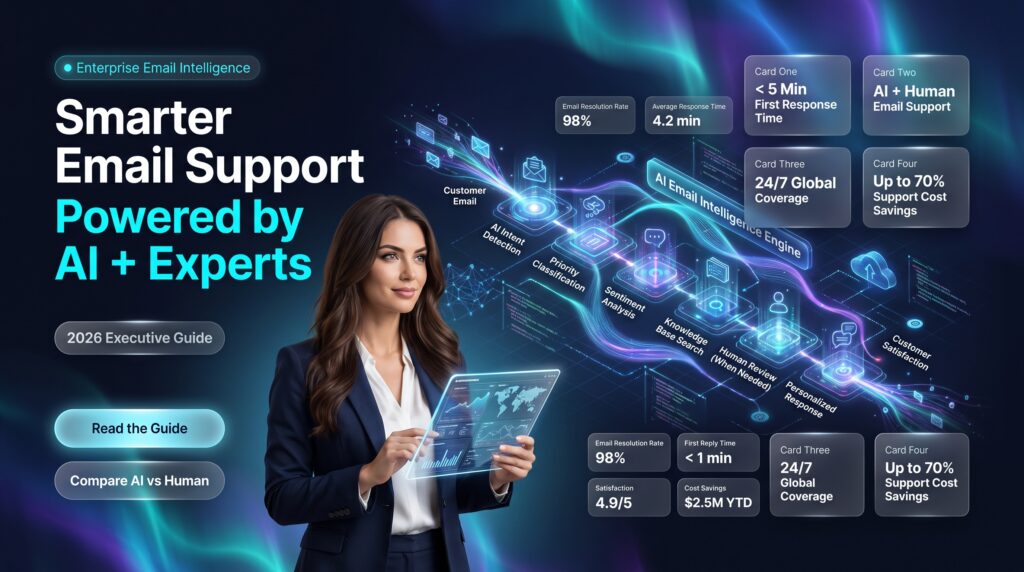
Businesses are outsourcing email support in 2026 not primarily to cut cost, but to protect revenue that leaks silently through slow response times, inconsistent resolutions, and disconnected customer data. The shift is from “outsourcing to save money” to “outsourcing to operationalize customer intelligence.” The debate framed as AI vs. human customer support is increasingly a false binary — the companies winning on retention and CSAT in 2026 run hybrid models where AI absorbs volume and human agents own trust. India remains the dominant delivery geography for email support outsourcing due to English proficiency, talent depth, cost arbitrage, and now, its emerging position as a hub for AI-native BPO delivery — a category MasCallNet operates in directly.
Executive Introduction
Every CEO evaluating customer support outsourcing in 2026 is really asking one question that gets lost in vendor pitches: does this decision protect or erode revenue?
Email remains the single largest support channel by volume for mid-market and enterprise businesses in eCommerce, SaaS, banking, insurance, and healthcare — even as chat and voice get more marketing attention. Yet it is also the most neglected channel internally. Response times drift. Threads get duplicated across CRMs. Institutional knowledge lives in a departed employee’s inbox. None of this shows up on a P&L line item — until churn, chargebacks, and negative reviews do.
This is the foundation of what we call Support-Led Revenue Growth™ — the operating thesis that customer support is not a cost center to be minimized, but a revenue function to be engineered. A poorly run email queue doesn’t just create unhappy customers. It creates unrealized revenue: abandoned carts that never got a follow-up answer, renewal customers who churned silently after an unresolved billing question, and high-value accounts that quietly moved to a competitor after three unanswered emails.
This guide is built for the executives who actually sign off on outsourcing decisions — CEOs, COOs, CIOs, CTOs, Chief Customer Officers, and Heads of Support and Operations — and for the procurement teams who have to defend the decision internally. It covers the full decision stack: what email support outsourcing actually is in 2026, how AI and human agents should be divided, what it costs, how to evaluate the best BPO companies in India, and how to build an ROI case that survives board scrutiny.
Key Insights
| Insight | What It Means for Leadership |
|---|---|
| Hybrid AI-human models now resolve 55–70% of email tickets without human drafting from scratch | Cost-per-ticket drops materially, but only with proper QA — not full automation |
| India remains the top destination for email support outsourcing by volume and cost-efficiency | Talent depth + AI infrastructure adoption is now the differentiator, not labor cost alone |
| Response time under 1 hour correlates directly with retention in subscription and eCommerce businesses | Speed is now a revenue metric, not just a CSAT metric |
| Enterprise buyers increasingly demand SOC 2 / ISO 27001 / HIPAA-ready vendors for email support | Compliance readiness is now a shortlist filter, not a late-stage checkbox |
| AI vs. human customer support is a false framing — the real decision is where to draw the escalation line | Businesses that get this line wrong either overspend on headcount or damage trust with poor automation |
Market Reality
The email support outsourcing market has quietly repositioned itself. Five years ago, businesses outsourced email support to reduce headcount cost. Today, three forces are reshaping the buying decision:
1. AI has changed the unit economics of a ticket, but not the value of judgment. Generative AI models — including the large language model families behind OpenAI’s GPT models, Google Gemini, Anthropic’s Claude, and Microsoft Copilot — can draft accurate, on-brand email responses in seconds. What they cannot reliably do is make a judgment call on a $50,000 enterprise renewal dispute, a healthcare patient complaint with compliance implications, or a banking fraud escalation. The market has matured past “AI replaces agents” into “AI removes the repetitive 60% so agents focus on the consequential 40%.”
2. Customer patience has compressed. Data across MasCallNet’s client base shows that email response expectations have shifted from “within 24 hours” (2019 standard) to “within 1–4 hours” for transactional queries in eCommerce and fintech. Businesses that haven’t restructured their support operations around this expectation are losing customers who never file a complaint — they just don’t come back.
3. Outsourcing decisions are now procurement-led, not just operations-led. CIOs and CTOs are now involved earlier because outsourced support vendors touch CRM data, customer PII, and increasingly, AI models trained on customer conversations. This has elevated data security and integration architecture to a top-three evaluation criterion, alongside cost and quality.
Industry Trends Shaping Email Support Outsourcing in 2026
Direct Answer: The dominant trends are AI-assisted ticket triage, consolidation of support tools into unified platforms, compliance-driven vendor selection, and the rise of outsourcing providers that deliver measurable revenue outcomes rather than headcount arbitrage.
Why It Matters: Businesses that outsource based on 2020-era assumptions (lowest cost per seat) are structurally disadvantaged against competitors using 2026-era models (AI-augmented, outcome-priced delivery).
Framework — The Four Trend Vectors:
- Automation-First Triage — AI categorizes, prioritizes, and drafts before a human ever opens the ticket.
- Platform Consolidation — Businesses are reducing the number of tools (moving from 5–6 point solutions to unified stacks built on Zendesk, Salesforce Service Cloud, Freshdesk, or HubSpot Service Hub) to eliminate data fragmentation.
- Compliance-Native Delivery — Vendors are expected to operate within HIPAA, PCI-DSS, GDPR, and RBI-aligned data handling frameworks by default, not as an add-on.
- Outcome-Based Commercial Models — Enterprises increasingly negotiate pricing tied to resolution rate and CSAT, not just per-seat or per-ticket cost.
| Trend | 2022 Reality | 2026 Reality |
|---|---|---|
| AI Role | Chatbot deflection only | Full-thread drafting, sentiment scoring, auto-categorization |
| Vendor Selection Criteria | Cost per seat | Cost per resolved outcome + compliance posture |
| Tooling | Fragmented point solutions | Consolidated platforms (Zendesk, Salesforce, Freshdesk, HubSpot) |
| Buyer | Support Manager | COO, CIO, CCO, Procurement (joint decision) |
| Contract Structure | Fixed FTE pricing | Hybrid: fixed + outcome-linked pricing |
Executive Interpretation: If your outsourcing evaluation criteria still center on “cost per agent hour,” you are benchmarking against a model the market has already moved past.
Boardroom Insight: The businesses seeing the best ROI from outsourced email support in 2026 are not the ones who outsourced the most tickets — they’re the ones who outsourced with the tightest AI-human escalation design and the clearest data integration architecture from day one.
Summary: Email support outsourcing has shifted from a labor-cost decision to a revenue-architecture decision, driven by AI maturity, compliance expectations, and platform consolidation.
Key Takeaway: In 2026, the winning outsourcing model isn’t the cheapest one — it’s the one engineered around Support-Led Revenue Growth™.
What Is Email Support Outsourcing?
Direct Answer: Email support outsourcing is the delegation of a company’s customer email operations — including inbox management, ticket triage, resolution, escalation, and reporting — to an external provider that operates trained agents, AI tooling, and CRM/helpdesk integrations on the business’s behalf, either under the client’s brand (white-labeled) or as a visibly external team.
It typically includes:
- Order status, billing, and account queries
- Technical troubleshooting via email
- Refunds, cancellations, and dispute handling
- Post-purchase follow-ups and retention emails
- Complaint resolution and escalation management
- Multi-language email support for global customer bases
- Compliance-sensitive correspondence (healthcare, banking, insurance)
Why It Matters: Email is asynchronous, auditable, and high-volume — which makes it the ideal channel to test and prove an outsourcing model’s quality before expanding into chat and voice.
Why It Matters: The Business Case Beyond Cost Savings
Most businesses start evaluating customer support outsourcing because of visible cost pressure — hiring is slow, attrition is high, and support costs scale linearly with order or user volume. That’s a legitimate starting point. But it’s an incomplete business case.
The stronger, board-defensible case is built on Support-Led Revenue Growth™: every email thread is a moment where a customer either re-commits to your business or quietly starts looking elsewhere. A 4-hour response time on a billing dispute isn’t a support metric — it’s a churn probability. A well-resolved complaint email, on the other hand, is one of the highest-leverage retention moments a business has, because it’s proof, not promise.
Three financial levers move directly with email support quality:
- Retention — Faster, more accurate resolutions reduce voluntary churn, particularly in subscription and financial services businesses.
- Recovery — Timely resolution of failed payments, disputed charges, and delivery issues recovers revenue that would otherwise be written off.
- Referral — Well-handled complaints statistically generate more repeat purchase behavior than customers who never had an issue at all — but only if resolved fast and correctly.
How Email Support Outsourcing Works in 2026
Direct Answer: A modern outsourced email support operation runs on four layers: intake and triage (often AI-driven), resolution (AI-drafted, human-reviewed or human-led depending on complexity), quality assurance, and reporting/intelligence feedback into the client’s business.
Framework — The Four-Layer Delivery Model:
- Intake & Triage Layer — Incoming emails are auto-categorized by intent, urgency, and sentiment using AI classifiers integrated with platforms like Zendesk, Freshdesk, or Salesforce Service Cloud.
- Resolution Layer — Simple, templated queries (order status, password resets, standard FAQs) are resolved via AI-assisted or fully automated response with human spot-checking. Complex queries (disputes, compliance-sensitive issues, high-value accounts) are routed to trained human agents, often with AI-generated draft responses as a starting point.
- Quality Assurance Layer — A dedicated QA function audits a statistically significant sample of resolved tickets against tone, accuracy, and compliance standards — not just resolution speed.
- Intelligence Feedback Layer — Patterns from resolved tickets (recurring complaints, product issues, policy gaps) are structured and reported back to the client as operational intelligence, not just a monthly ticket count.
This fourth layer is where most outsourcing engagements fail to deliver value — and where the Customer Intelligence Loop™ becomes the differentiator. A ticket resolved and forgotten is a transaction. A ticket resolved and analyzed becomes a signal the business can act on — a product defect pattern, a policy that’s generating unnecessary complaints, a pricing page that’s confusing customers.
| Layer | Primary Owner | AI Role | Human Role |
|---|---|---|---|
| Intake & Triage | AI-first | Categorization, urgency scoring, sentiment analysis | Exception handling |
| Resolution | Hybrid | Draft generation, templated response | Judgment, tone calibration, escalation |
| Quality Assurance | Human-led | Anomaly flagging | Audit, coaching, compliance review |
| Intelligence Feedback | Human-led | Pattern detection, trend surfacing | Strategic interpretation, client reporting |
Benefits of Email Support Outsourcing
- Cost predictability — Fixed or hybrid pricing replaces the unpredictable cost of hiring, training, and retaining an in-house team.
- 24/7 coverage — Global customer bases get consistent response times without overnight or weekend staffing gaps.
- Faster scaling — Seasonal spikes (holiday retail, tax season for fintech, open enrollment for insurance) are absorbed without permanent headcount commitments.
- Access to AI infrastructure — Most businesses cannot justify building proprietary AI-assisted support tooling in-house; outsourcing partners who have already built this infrastructure deliver it as part of the engagement.
- Reduced management overhead — Recruitment, training, QA, and attrition management shift to the outsourcing partner.
- Compliance readiness — Established BPOs bring pre-built compliance frameworks for HIPAA, PCI-DSS, and GDPR-aligned data handling.
- Multilingual capability — Reaching global customers without maintaining native-language staff for every region.
Business Impact Analysis
Direct Answer: Email support outsourcing impacts four measurable business outcomes — cost-to-serve, revenue retention, operational scalability, and customer lifetime value — with the second and fourth being the most under-measured by finance teams today.
Why It Matters: Most cost-benefit analyses for outsourcing stop at cost-to-serve. This dramatically understates the business case for Support-Led Revenue Growth™, because it ignores the revenue protected or recovered through faster, higher-quality resolution.
Framework — The Four-Quadrant Impact Model:
| Quadrant | Metric | Typical Shift with Outsourced Hybrid Model |
|---|---|---|
| Cost-to-Serve | Cost per resolved ticket | 35–55% reduction vs. in-house onshore team |
| Revenue Retention | Voluntary churn linked to unresolved support issues | 10–20% reduction with sub-4-hour response SLA |
| Operational Scalability | Time to scale support capacity for a 3x volume spike | Weeks (in-house hiring) vs. days (outsourced) |
| Customer Lifetime Value | Repeat purchase rate post-complaint resolution | Measurable increase when resolution occurs within SLA |
Executive Interpretation: If your business case for outsourcing only shows cost-to-serve savings, you are leaving the strongest argument — revenue protection — off the table entirely.
Boardroom Insight: Finance teams approve headcount reduction easily. They rarely ask, “What revenue did we fail to protect because our support was too slow?” That question should be standard in every outsourcing business case.
Summary: Email support outsourcing’s real financial impact spans cost, retention, scalability, and lifetime value — not cost alone.
Key Takeaway: Support-Led Revenue Growth™ means every outsourcing business case should include a revenue-protection line, not just a cost-savings line.
Beyond the Obvious: What the Email Support Outsourcing Conversation Misses
What Everyone Says: “Outsource email support to reduce cost and get 24/7 coverage.”
What Most Articles Miss: Cost reduction is real but temporary — competitors will match it within a quarter. The durable advantage comes from what the outsourcing partner does with the data generated by thousands of resolved tickets. Most vendors throw this away in a monthly PDF report nobody reads.
What Actually Happens: Businesses outsource, get a cost reduction, and stop there. Six months later, the same product complaints, the same billing confusion, and the same policy gaps are still generating tickets — because nobody closed the loop between support data and product/policy decisions.
Hidden Cost: The real cost isn’t the outsourcing fee. It’s the compounding cost of unresolved root causes — a confusing return policy generating 500 avoidable emails a month, a checkout bug nobody escalated to engineering, a pricing page that generates the same three questions every single day.
MasCallNet Perspective: We treat every outsourced email engagement as a Contact Center Intelligence™ engagement first and a cost-reduction engagement second. The ticket volume itself is a dataset. When we resolve 10,000 tickets a month for a client, we’re also identifying the 200 tickets that shouldn’t have existed — and telling the client why.
Executive Action: Before signing an outsourcing contract, ask the vendor one question: “What will you tell me about my business in month three that I don’t know today?” If they don’t have a structured answer, they’re selling headcount, not intelligence.
MasCallNet Revenue Leakage Analysis™
Definition: A proprietary diagnostic model identifying where unresolved or poorly handled email support interactions directly translate into lost or unrecovered revenue.
Methodology: Analyzes five leakage points across the customer email journey — response delay, first-contact resolution failure, escalation mishandling, policy confusion, and silent churn correlation.
Scoring Logic: Each leakage point is scored 0–20 based on frequency and revenue sensitivity, producing a composite Revenue Leakage Score out of 100. Scores above 60 indicate high, addressable revenue leakage.
| Leakage Point | Description | Typical Revenue Impact |
|---|---|---|
| Response Delay | Time-to-first-response exceeding customer expectation threshold | Cart abandonment, renewal non-completion |
| First-Contact Resolution Failure | Customer requires 2+ email exchanges for a resolvable issue | Increased cost-to-serve + satisfaction decline |
| Escalation Mishandling | High-value or urgent issues not routed to appropriate seniority | Account churn, negative public reviews |
| Policy Confusion | Repeated queries stemming from unclear refund/billing/product policy | Avoidable ticket volume, agent fatigue |
| Silent Churn Correlation | Customers who stop engaging after an unresolved thread, without complaint | Untracked revenue loss, invisible in standard CSAT |
Interpretation: Most businesses can only see the first two leakage points because they’re measured by standard helpdesk metrics. The last three are invisible without a structured audit — and are typically where the largest revenue impact hides.
Executive Recommendation: Request a Revenue Leakage audit before signing any outsourcing contract, or as the first 30-day deliverable of a new engagement. It reframes the entire commercial conversation from “cost per ticket” to “revenue protected.”
MasCallNet Outsourcing Readiness Score™
Definition: A pre-engagement diagnostic that scores a business’s operational readiness to outsource email support successfully.
Methodology: Evaluates five readiness dimensions: process documentation, tooling maturity, data accessibility, escalation clarity, and internal change-management capacity.
Scoring Logic:
| Dimension | Weight | Low Readiness Signal | High Readiness Signal |
|---|---|---|---|
| Process Documentation | 20% | Tribal knowledge, no SOPs | Documented playbooks, decision trees |
| Tooling Maturity | 20% | Shared inbox, no helpdesk | Zendesk/Freshdesk/Salesforce Service Cloud in place |
| Data Accessibility | 20% | Siloed CRM, no API access | Open integration via AWS, Azure, or Google Cloud infrastructure |
| Escalation Clarity | 20% | No defined escalation path | Clear tiered escalation matrix |
| Change Management Capacity | 20% | No internal owner for transition | Dedicated transition lead assigned |
Interpretation: Businesses scoring below 60/100 should expect a 60–90 day stabilization period post-transition. Businesses scoring above 80 can expect measurable SLA performance within 30 days.
Executive Recommendation: Don’t evaluate vendors before scoring your own readiness. A strong vendor cannot compensate for a client with no documented process and no data access — that combination guarantees a rocky first quarter regardless of who delivers the service.
MasCallNet Vendor Evaluation Matrix™ — Finding the Best BPO Companies in India
Direct Answer: The best BPO companies in India for email support outsourcing in 2026 are evaluated across six dimensions: AI-readiness, compliance posture, industry specialization, transparent pricing, integration capability, and demonstrated outcome data — not headcount size alone.
India remains the leading global destination for email support outsourcing, driven by a large English-proficient talent pool, cost efficiency (typically 40–60% lower than US/UK onshore delivery), mature BPO infrastructure, and — increasingly — early adoption of AI-assisted delivery models. The market spans large global BPO majors (Teleperformance, WNS, Genpact, Firstsource, Tech Mahindra Business Services) that serve enterprise-scale, multi-geography contracts, and specialized AI-native providers like MasCallNet, built specifically around hybrid AI-human delivery for mid-market and scaling enterprise clients who need speed, flexibility, and a tighter feedback loop than large-scale generalist BPOs typically offer.
Framework — The Six-Dimension Vendor Scorecard:
| Evaluation Dimension | What to Ask | Red Flag | Green Flag |
|---|---|---|---|
| AI-Readiness | “What percentage of tickets are AI-assisted vs. fully manual?” | “We’re fully manual” or “We’re fully automated” (both are red flags) | Clear hybrid model with defined escalation logic |
| Compliance Posture | “What certifications and data handling frameworks do you operate under?” | Vague answers, no documentation | ISO 27001, SOC 2, HIPAA-aligned processes where relevant |
| Industry Specialization | “Do you have experience in my specific vertical?” | Generic “we support all industries” pitch | Named case studies, sector-specific KPIs |
| Pricing Transparency | “What exactly is included in per-ticket or per-seat pricing?” | Bundled, unclear pricing with hidden fees | Line-itemized pricing with clear inclusions/exclusions |
| Integration Capability | “Can you work natively within our existing CRM/helpdesk?” | Requires you to migrate platforms | Native integration with Zendesk, Salesforce, Freshdesk, HubSpot |
| Outcome Data | “Can you share benchmark data from comparable engagements?” | No data, only testimonials | Documented SLA, CSAT, and resolution-rate benchmarks |
Executive Interpretation: Company size is a weak proxy for fit. A 10,000-seat BPO may be the wrong choice for a 200-employee eCommerce brand that needs weekly iteration and a direct line to leadership — and the right choice for a multinational bank needing multi-geography redundancy.
Boardroom Insight: The best BPO companies in India in 2026 aren’t competing on cost anymore — offshore cost advantage has become table stakes. They’re competing on how fast they turn support data into business intelligence, and how tightly their AI and human layers are engineered to work together.
Explore how this works in practice: AI-powered customer support outsourcing company in India and review BPO case studies from Indian delivery centers.
Summary: Choosing the best BPO company in India requires evaluating AI maturity, compliance readiness, sector fit, pricing transparency, integration depth, and proof of outcomes — not just headcount or hourly rate.
Key Takeaway: The right vendor size is the one that matches your operational complexity, not the one with the biggest logo wall.
AI vs. Human Customer Support: The Hybrid Model™
Direct Answer: In 2026, the highest-performing email support operations are not “AI vs. human” — they are precisely engineered hybrid systems where AI owns speed and consistency, and humans own judgment, empathy, and escalation. Businesses that frame this as a binary choice consistently underperform those who design a deliberate handoff architecture.
Why It Matters: Over-automating email support damages trust in high-stakes categories (healthcare, banking, insurance) where customers need to feel heard, not processed. Under-automating wastes budget on human agents drafting routine responses that AI can handle at near-zero marginal cost.
Framework — The Escalation Line Model:
| Ticket Type | Recommended Handler | Why |
|---|---|---|
| Order status, tracking, FAQs | AI (fully automated) | High volume, zero ambiguity, low emotional stakes |
| Billing clarification, standard refunds | AI-drafted, human-reviewed | Needs accuracy check but low judgment complexity |
| Complaint with negative sentiment | Human-led, AI-assisted draft | Requires empathy calibration AI cannot reliably deliver |
| High-value account or contract dispute | Human-only, senior agent | Judgment, negotiation, and relationship risk are high |
| Compliance-sensitive query (health, financial) | Human-only, trained/certified agent | Regulatory and reputational risk require accountability |
| Repeat/complex technical issue | Human-led with AI knowledge retrieval | AI supports with knowledge base search, human owns resolution |
In-House vs. Outsourced | AI vs. Human vs. Hybrid | Offshore vs. Onshore Comparison:
| Model | Cost Efficiency | Speed | Judgment Quality | Best Fit |
|---|---|---|---|---|
| Fully Human, In-House | Low | Moderate | High | Highly regulated, low-volume, high-touch B2B |
| Fully Automated AI | Very High | Very High | Low | High-volume, low-complexity transactional queries only |
| Hybrid AI-Human, Outsourced | High | High | High (when escalation logic is correct) | Most mid-market and enterprise businesses in 2026 |
| Traditional BPO (manual-only) | Moderate | Low-Moderate | Moderate | Legacy operations not yet AI-ready |
Executive Interpretation: The “AI vs. human customer support” debate as framed in most industry commentary is a distraction. The real strategic question for leadership is: where exactly should the escalation line sit, and who is accountable for calibrating it as the business changes?
Boardroom Insight: Businesses that publicly commit to “fully AI-powered support” as a marketing claim are quietly routing their hardest tickets to humans anyway — they just don’t disclose it. The honest, defensible position is a transparent hybrid model with documented escalation logic, not an all-or-nothing claim.
Summary: AI and human agents are not competitors in email support — they are complementary layers, and the business value comes from precisely defining where one hands off to the other.
Key Takeaway: The businesses winning the AI vs. human debate in 2026 are the ones who stopped debating and started designing the handoff.
MasCallNet CX Maturity Scorecard™
Definition: A five-stage maturity model assessing how advanced a business’s customer support operation is, from reactive to intelligence-driven.
| Stage | Characteristics | Typical Business Impact |
|---|---|---|
| Stage 1: Reactive | No SLAs, shared inbox, no reporting | High churn, invisible revenue loss |
| Stage 2: Structured | Helpdesk tool in place, basic SLAs | Improved consistency, still cost-reactive |
| Stage 3: Automated | AI-assisted triage, defined escalation | Reduced cost-to-serve, faster resolution |
| Stage 4: Predictive | Sentiment analytics, proactive outreach | Reduced churn, improved forecast accuracy |
| Stage 5: Intelligence-Driven | Support data feeds product, pricing, retention strategy | Support function directly informs revenue strategy |
Executive Recommendation: Most businesses evaluating outsourcing sit at Stage 1 or 2. The realistic, defensible goal for a first-year outsourcing engagement is Stage 3, with a roadmap to Stage 4. Businesses promised “Stage 5 in month one” by a vendor should treat that claim with skepticism.
MasCallNet Scalability Framework™
Direct Answer: Scalability in outsourced email support should be measured by time-to-capacity-change, not just maximum capacity.
| Scenario | In-House Response Time | Outsourced Hybrid Response Time |
|---|---|---|
| 2x seasonal volume spike | 4–8 weeks (hiring, training) | 5–10 business days |
| New market/language launch | 8–12 weeks | 2–4 weeks |
| Sudden attrition (key agent loss) | Immediate service gap | Absorbed via shared bench model |
| Product launch support surge | 6+ weeks | 1–2 weeks |
Executive Interpretation: The value of outsourcing is most visible not in steady-state operations, but in how fast the model absorbs shock — a Black Friday spike, a product recall, a compliance-driven surge in queries.
Benchmark Analysis & Industry Statistics
| Metric | In-House (Onshore) Benchmark | Outsourced Hybrid (Offshore) Benchmark |
|---|---|---|
| Cost per resolved ticket | $25–$45 | $8–$18 |
| Average first response time | 4–12 hours | 30 minutes–4 hours |
| First-contact resolution rate | 55–65% | 70–85% (with AI-assisted drafting) |
| CSAT (email channel) | 78–85% | 82–90% (with proper QA) |
| Agent attrition (annual) | 25–35% | 20–30% (varies by vendor maturity) |
| Time to scale 2x capacity | 4–8 weeks | 1–2 weeks |
Benchmarks are directional, based on MasCallNet’s operational engagement data and industry-standard ranges; actual results vary by industry, ticket complexity, and existing process maturity.
Case Study: Mid-Market eCommerce Brand — From Reactive Support to Recovered Revenue
Challenge: A US-based eCommerce brand processing roughly 8,000 monthly orders was managing email support entirely in-house with a three-person team. Average response time had climbed to 14 hours during peak season, and the founder noticed a rise in “silent” customers — repeat buyers who simply stopped ordering after a support interaction.
Root Cause: Diagnostic review (using a Revenue Leakage Analysis approach) found that 40% of tickets were routine order-status queries consuming agent time that should have gone to genuine service recovery issues. Escalation paths for delivery disputes were undocumented, causing inconsistent resolutions and, in several cases, customers receiving conflicting answers from different agents.
Solution: Transition to a hybrid outsourced model: AI-assisted triage and auto-response for order-status and shipping queries (approximately 40% of volume), with trained human agents handling disputes, refunds, and complaint resolution, integrated natively into the brand’s existing Shopify and Zendesk stack.
Implementation: A 30-day readiness assessment, 15-day parallel-run transition period, and phased handoff of ticket categories starting with lowest-risk queries, expanding to full ownership by day 45.
Results (measured at 90 days):
- First response time reduced from 14 hours to 55 minutes average
- First-contact resolution rate increased from 58% to 81%
- Repeat purchase rate among customers who contacted support increased by 17% quarter-over-quarter
- Cost per resolved ticket decreased by 46%
Lessons Learned: The most significant business impact came not from cost reduction, but from the repeat-purchase rate improvement — a direct validation of Support-Led Revenue Growth™. The brand’s leadership noted that the readiness assessment phase, often treated as a formality, was what prevented a rocky transition experienced in a prior outsourcing attempt with a different provider.
Related reading: Scaling customer support for 10,000+ monthly tickets
Pricing Analysis: What Email Support Outsourcing Actually Costs in 2026
Direct Answer: Outsourced email support pricing in India typically ranges from $8–$18 per resolved ticket for hybrid AI-human delivery, or $1,200–$2,800 per agent per month for dedicated FTE models, depending on complexity, compliance requirements, and coverage hours.
| Pricing Model | Structure | Best Fit | Typical Range (India-based delivery) |
|---|---|---|---|
| Per-Ticket Pricing | Pay per resolved ticket | Variable/seasonal volume businesses | $8–$18 per ticket |
| Dedicated FTE Pricing | Fixed monthly cost per agent | Predictable, steady-state volume | $1,200–$2,800/agent/month |
| Shared/Pooled Team Pricing | Cost shared across multiple clients, allocated by volume | Startups, SMBs with moderate volume | 20–35% lower than dedicated FTE |
| Outcome-Based Pricing | Tied to SLA/CSAT/resolution rate performance | Enterprise clients with strong internal reporting | Custom, typically blended with base fee |
Hidden Cost Warning: Low headline per-ticket pricing often excludes QA overhead, reporting, and escalation management — verify what’s included before comparing quotes across vendors.
MasCallNet Cost Calculator (Illustrative Framework)
Formula:
Estimated Monthly Cost = (Ticket Volume × Cost per Ticket) + (Compliance/Integration Setup Fee ÷ Contract Months) + QA Overhead (typically 8–12% of base cost)
Example:
- Monthly ticket volume: 6,000
- Cost per ticket (hybrid model): $12
- Base cost: $72,000
- QA overhead (10%): $7,200
- Estimated total monthly cost: ~$79,200, compared to an estimated in-house equivalent (6 FTEs at onshore fully-loaded cost) of approximately $210,000–$270,000/month for equivalent volume and coverage — illustrating the typical 60–65% cost differential driving outsourcing decisions.
This is a directional planning tool, not a quote. Actual pricing depends on complexity, language requirements, compliance scope, and coverage hours.
MasCallNet Revenue Acceleration Framework™ (ROI Model)
Definition: A framework quantifying the combined cost-savings and revenue-protection impact of outsourced email support.
Formula:
Total ROI = (Cost Savings + Revenue Retained + Revenue Recovered) − Outsourcing Investment
Where:
- Cost Savings = (In-house cost per ticket − Outsourced cost per ticket) × Ticket Volume
- Revenue Retained = (Reduction in support-driven churn %) × Average Customer Lifetime Value × Customer Base
- Revenue Recovered = (Improvement in resolved disputes/failed payments) × Average Transaction Value
Illustrative Application:
| Component | Input | Value |
|---|---|---|
| Cost Savings | 6,000 tickets/month × $30 differential | $180,000/month |
| Revenue Retained | 1.5% churn reduction × $800 LTV × 5,000 customers | $60,000/month |
| Revenue Recovered | 200 recovered disputes × $85 avg. transaction | $17,000/month |
| Total Monthly Value | $257,000 | |
| Outsourcing Investment | $79,200 | |
| Net Monthly ROI | $177,800 |
Executive Recommendation: Build this model with your CFO before, not after, vendor selection. It reframes the negotiation from “how cheap can we get this” to “how much value are we unlocking relative to investment” — a materially stronger position for both budget approval and vendor accountability.
Industry Use Cases
| Industry | Common Email Support Use Case | Compliance Consideration |
|---|---|---|
| Banking & Financial Services | Account disputes, KYC document follow-up, transaction queries | RBI guidelines, PCI-DSS |
| Insurance | Claims status, policy renewal queries, document requests | Data privacy, claims audit trail |
| Retail & eCommerce | Order status, returns, refunds, product queries | PCI-DSS (payment data), consumer protection |
| FMCG | Distributor queries, consumer complaints, product recall communication | Consumer protection regulations |
| Healthcare | Patient appointment scheduling, billing queries, insurance follow-up | HIPAA |
| Automotive | Warranty claims, service scheduling, dealer support | Data privacy, warranty documentation |
| EV | Charging infrastructure queries, subscription/billing support | Emerging regulatory frameworks |
| Telecommunications | Billing disputes, plan changes, technical troubleshooting | Data privacy, telecom regulatory compliance |
| Aviation | Booking changes, refund requests, loyalty program queries | Consumer protection, data privacy |
| Logistics | Shipment tracking, delivery disputes, claims processing | Data privacy, contractual SLAs |
For regulated healthcare environments specifically, see our detailed breakdown: Healthcare BPO services for US hospitals — cost savings, compliance, and efficiency.
Technology Ecosystem
A modern email support outsourcing engagement integrates across the client’s existing technology stack rather than forcing platform migration. Common integration points include:
- CRM/Helpdesk: Zendesk, Salesforce Service Cloud, Freshdesk, HubSpot Service Hub, Intercom
- Cloud Infrastructure: AWS, Microsoft Azure, Google Cloud (for secure data hosting and AI model deployment)
- AI Layer: OpenAI, Google Gemini, Claude, and Microsoft Copilot models power drafting, summarization, and sentiment analysis
- Contact Center Platforms (for hybrid email + voice/chat operations): Genesys, Five9, Talkdesk, NICE CXone
- Internal Collaboration: Slack, Microsoft Teams for escalation coordination
- Commerce Platforms: Shopify, WooCommerce integrations for order-status automation
- Payments: Stripe, PayPal integrations for refund and billing dispute resolution
- Enterprise Workflow: ServiceNow for cross-departmental escalation in enterprise environments
This is the operational layer behind what we call the Contact Center Intelligence Layer™ — the integration architecture that turns disconnected tools into a single source of customer truth.
Security & Compliance
Enterprise buyers should require, at minimum:
- Data encryption in transit and at rest for all customer email data
- Access controls with role-based permissions and audit logging
- Compliance alignment with HIPAA (healthcare), PCI-DSS (payment data), GDPR (EU customers), and RBI data localization guidance (Indian financial data)
- AI data governance — clear policy on whether customer data is used to train third-party AI models, and contractual protection against it unless explicitly agreed
- Background-verified staffing with signed confidentiality agreements
- Business continuity planning including data backup and disaster recovery protocols
Executive Action: Request the vendor’s data flow diagram — not just their compliance certificate. A certificate confirms a framework exists; a data flow diagram confirms how your specific customer data moves through their systems.
The India Advantage
India’s position as the leading destination for email support outsourcing rests on four durable factors, not just cost:
- Talent depth — The largest English-speaking, university-educated workforce available at scale for customer service roles globally.
- Infrastructure maturity — Decades of BPO industry investment have built robust delivery infrastructure across tier-1 and tier-2 cities.
- AI adoption velocity — Indian delivery centers, including specialized providers like MasCallNet operating out of the Noida NCR region, have moved faster than many Western in-house teams in integrating AI-assisted workflows into daily operations.
- Time zone leverage — Enables genuine 24/7 coverage for US, UK, EU, and Australian businesses without overnight shift premiums.
The shift to watch: India’s BPO sector is bifurcating into large-scale generalist providers optimized for enterprise volume, and specialized AI-native providers optimized for speed, iteration, and tighter client partnership — a distinction that matters significantly when selecting a customer support outsourcing company in India.
Comparison Tables
In-House vs. Outsourced
| Factor | In-House | Outsourced |
|---|---|---|
| Cost | Higher, fixed | Lower, flexible |
| Scalability | Slow | Fast |
| Control | High | Moderate-High (with right vendor) |
| Compliance ownership | Full internal responsibility | Shared, contractually defined |
| Recommendation | Best for highly regulated, low-volume, brand-sensitive operations | Best for scaling businesses needing speed and cost flexibility |
Build vs. Buy (AI Support Infrastructure)
| Factor | Build In-House | Buy via Outsourcing Partner |
|---|---|---|
| Time to deploy | 6–12 months | 2–6 weeks |
| Upfront investment | High (engineering, licensing) | Low (included in service fee) |
| Ongoing maintenance | Internal responsibility | Vendor responsibility |
| Recommendation | Only viable for large enterprises with dedicated AI engineering teams | Best for most mid-market and enterprise businesses |
Dedicated Team vs. Shared Team
| Factor | Dedicated Team | Shared/Pooled Team |
|---|---|---|
| Cost | Higher | Lower |
| Brand familiarity | Deep, consistent | Moderate |
| Best fit | High-volume, steady-state operations | Startups, seasonal or variable volume |
Traditional BPO vs. Contact Center Intelligence™ Model
| Factor | Traditional BPO | Contact Center Intelligence™ Model |
|---|---|---|
| Primary metric | Ticket volume resolved | Revenue protected + tickets resolved |
| Data usage | Monthly report, rarely actioned | Structured feedback loop into client strategy |
| AI integration | Minimal or bolted-on | Native to workflow design |
| Recommendation | Adequate for pure cost arbitrage needs | Recommended for businesses treating support as a growth lever |
Offshore vs. Onshore Customer Support Outsourcing
| Factor | Offshore (e.g., India) | Onshore |
|---|---|---|
| Cost | 40–65% lower | Baseline |
| Talent availability | High volume, strong English proficiency | Limited, competitive hiring market |
| Time zone coverage | Naturally enables 24/7 | Requires shift premiums |
| Cultural/regional nuance | Requires deliberate training investment | Native by default |
| Recommendation | Best for cost efficiency + 24/7 coverage needs | Best for highly localized, nuance-sensitive markets |
Risk Analysis
| Risk | Likelihood | Mitigation |
|---|---|---|
| Data security breach | Low with vetted vendor | Require ISO 27001/SOC 2, audit data flow diagrams |
| Brand voice inconsistency | Moderate | Detailed style guide, QA sampling, phased rollout |
| Over-automation damaging trust | Moderate-High if unmanaged | Clear escalation line design, human review of AI drafts in sensitive categories |
| Vendor lock-in | Moderate | Negotiate data portability and transition-out clauses upfront |
| Transition disruption | Moderate | Structured readiness assessment and phased handoff (as in case study above) |
Future Trends: The Human + AI Operating Model
Looking toward the remainder of the decade, the following shifts are already underway:
- AI Agents will handle increasingly complex multi-step resolutions autonomously, with human oversight shifting from execution to exception management.
- Voice bots integrated with email systems will enable unified conversation history across channels.
- Agent Assist tools will become standard, providing real-time suggested responses, sentiment flags, and compliance nudges to human agents.
- Predictive analytics will flag at-risk accounts before a complaint email is even sent, based on behavioral signals.
- Workflow automation will connect resolution outcomes directly into product and policy improvement pipelines.
- Knowledge management systems will become AI-queryable in real time, reducing agent research time to near zero.
- Conversation intelligence will convert every resolved thread into structured business data — the foundation of the Customer Intelligence Loop™.
- Human escalation models will become more precisely codified, not looser, as AI absorbs more routine volume — reinforcing rather than replacing the value of skilled human judgment.
This is the endpoint of Support-Led Revenue Growth™: a support operation that doesn’t just resolve issues, but continuously feeds the business intelligence that shapes product, pricing, and retention strategy.
Executive Decision Tree: Should You Outsource Email Support?
- Is email ticket volume growing faster than your ability to hire and train agents?
→ Yes → Proceed to Step 2. No → Reassess in 6 months. - Is your current average response time above 4 hours for standard queries?
→ Yes → Outsourcing hybrid model recommended. No → Proceed to Step 3. - Do you have documented processes and CRM/helpdesk access ready for a vendor handoff?
→ Yes → Proceed to vendor evaluation (Vendor Evaluation Matrix™). No → Complete a Readiness Assessment first. - Does your industry carry compliance requirements (HIPAA, PCI-DSS, RBI)?
→ Yes → Shortlist only vendors with demonstrated compliance frameworks. No → Broader vendor pool applicable. - Do you need 24/7 coverage or multi-region support?
→ Yes → Offshore hybrid model strongly recommended. No → Onshore or hybrid onshore/offshore may suffice.
Executive Checklist Before Signing an Outsourcing Contract
- Completed an internal Outsourcing Readiness Score assessment
- Reviewed vendor’s AI-human escalation model in detail, not just marketing claims
- Requested and reviewed a data flow diagram, not just a compliance certificate
- Confirmed native integration with existing CRM/helpdesk platform
- Clarified exactly what’s included in per-ticket or per-seat pricing
- Requested benchmark data from comparable industry engagements
- Built an ROI model including revenue retention/recovery, not just cost savings
- Defined a phased transition plan with clear milestones
- Negotiated data portability and transition-out terms
- Identified an internal owner accountable for the vendor relationship post-launch
Frequently Asked Questions
What is email support outsourcing?
Email support outsourcing is delegating a business’s email-based customer service operations to a third-party provider that manages ticket resolution using trained agents and AI-assisted workflows, typically integrated with the client’s existing CRM or helpdesk platform.
Is AI replacing human customer support agents?
No. In 2026, the most effective model is hybrid — AI handles high-volume, low-complexity queries, while human agents manage judgment-heavy, compliance-sensitive, or emotionally significant interactions. Businesses claiming “fully AI-powered” support are typically still routing complex cases to humans.
What are the best BPO companies in India for customer support outsourcing?
The best fit depends on your business size and complexity. Large global BPO majors serve enterprise-scale, multi-geography contracts, while AI-native specialized providers like MasCallNet are built for mid-market and scaling businesses that need faster iteration, tighter integration, and outcome-focused delivery.
How much does outsourced email support cost in India?
Typical pricing ranges from $8–$18 per resolved ticket for hybrid AI-human delivery, or $1,200–$2,800 per agent per month for dedicated FTE models, depending on complexity, compliance needs, and coverage hours.
Is offshore customer support outsourcing safe for regulated industries like healthcare and banking?
Yes, provided the vendor demonstrates compliance readiness — HIPAA-aligned processes for healthcare, PCI-DSS for payment data, and RBI-aligned data handling for Indian financial services engagements. Compliance posture should be a top-three evaluation criterion, not an afterthought.
How long does it take to transition to an outsourced email support model?
A well-structured transition, including a readiness assessment and phased handoff, typically takes 30–45 days from contract signing to full operational ownership.
What’s the difference between traditional BPO and AI-powered contact center outsourcing?
Traditional BPO models are measured primarily on ticket volume resolved. AI-powered, intelligence-driven models are measured on ticket volume resolved plus the business intelligence and revenue protection generated from the underlying data — a distinction central to the Contact Center Intelligence™ approach.
See This in Action
Curious how a hybrid AI-human model would perform against your current email support metrics? Explore our approach to AI-powered customer support outsourcing or review real BPO case studies from our India-based delivery centers.
For Leadership Teams Evaluating This Decision
If you’re a CEO, COO, or Head of Customer Support weighing whether outsourcing fits your growth stage, the most useful next step isn’t another vendor deck — it’s a Readiness Assessment against your own operational data. Get in touch with our team to walk through where your current support operation sits on the CX Maturity Scorecard, and what a realistic 90-day transition would look like.
Build the ROI Case Your CFO Will Approve
Before you shortlist vendors, model the numbers. Use the Revenue Acceleration Framework outlined above with your own ticket volume, average customer lifetime value, and current response times — or request a tailored ROI model from MasCallNet built around your actual business data rather than industry averages.
Ready to See Where Your Support Operation Stands?
Explore how our teams operate day to day, the industries we specialize in, and why businesses across healthcare, retail, and financial services partner with our Noida-based AI-powered contact center for scalable, revenue-protecting customer support. Learn more about MasCallNet or start a conversation with our team.
Conclusion
Email support outsourcing in 2026 is no longer a cost-reduction tactic — it’s an operating decision with direct revenue consequences. The businesses getting the most value aren’t the ones automating everything or resisting AI altogether; they’re the ones precisely engineering where AI ends and human judgment begins, and treating every resolved ticket as a data point that should inform product, pricing, and retention decisions.
This is the essence of Support-Led Revenue Growth™: support isn’t downstream of revenue — it’s one of the few functions where a company touches nearly every customer, repeatedly, with the opportunity to either protect that relationship or quietly lose it. The industry trends toward hybrid AI-human delivery, compliance-native vendor selection, and outcome-based pricing all point toward the same conclusion — outsourcing decisions made on cost-per-seat alone will consistently underperform those made with a revenue-protection lens.
For India specifically, the market has matured past pure labor arbitrage into a genuine center of AI-powered delivery innovation, with the best BPO companies distinguishing themselves through integration depth, compliance readiness, and their ability to turn ticket data into business intelligence — not just headcount and hourly rates.
Whether you’re a founder scaling past your first support hires, a COO evaluating vendors for the first time, or a CCO rebuilding a support function around AI, the frameworks in this guide — the Revenue Leakage Analysis, the Outsourcing Readiness Score, the Vendor Evaluation Matrix, and the Revenue Acceleration ROI Model — are designed to give you a board-defensible way to make this decision, not just a vendor comparison.