
AI Voice Agent Services for Banks (2026): 24/7 Customer Support, Banking Automation & Real Cost Savings
Introduction
Call abandon rates in retail banking average 18–22%. First contact resolution sits at 62% industry-wide. The fully loaded cost of a single inbound banking call through a traditional contact center ranges from $6 to $14.
This is not a cost problem. It is a Contact Center Intelligence™ deficit.
Every customer call is a data asset. Every complaint is a churn signal. Every product inquiry is a revenue signal. Banks treating their contact centers as cost centers are systematically destroying the intelligence layer that sits between their customer base and their revenue operations.
AI voice agent services in 2026 are not about cutting headcount. They are about converting the contact center into a Support-Led Revenue Growth™ engine — where every interaction is captured, classified, and converted into intelligence that drives retention, cross-sell, and revenue forecasting.
This guide answers four questions banking executives need resolved:
- Where does AI voice automation fit in our CX strategy?
- How does AI vs human customer support compare on metrics that matter?
- What does it actually cost — and what does it return?
- Which call center outsourcing partners can be trusted at enterprise scale?
Key Benchmarks at a Glance
| Metric | 2026 Industry Benchmark |
| AI Voice Agent FCR Rate (Tier 1 queries) | 68–78% |
| Cost per AI-handled interaction | $0.45–$1.20 |
| Cost per human-handled interaction | $6.00–$14.00 |
| Cost reduction post-AI deployment | 40–60% |
| CSAT — hybrid AI model | 4.1–4.4 / 5.0 |
| NPS uplift post-AI implementation | +12–18 points |
| Deployment timeline (enterprise) | 8–16 weeks |
| Revenue influenced by AI cross-sell signals | 8–14% incremental per quarter |
Sources: Gartner Contact Center Technology Report 2025; McKinsey Global Banking Annual Review 2025; MasCallNet operational benchmarks.
What AI Voice Agents Actually Do in Banking
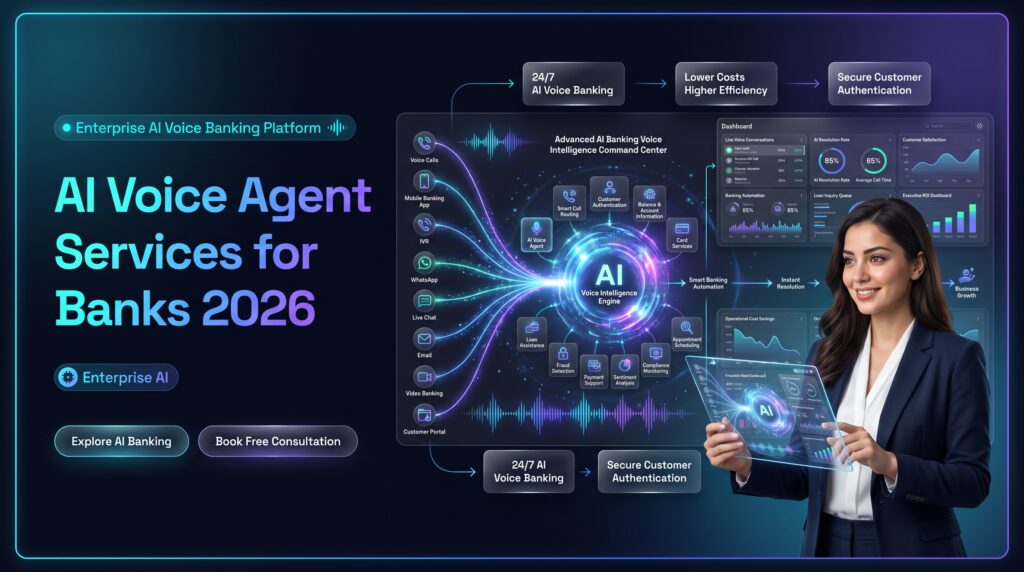
An AI voice agent is not an upgraded IVR. It is a seven-layer architecture that conducts natural-language conversations, authenticates customers, executes transactions, and transfers full context to human agents when complexity demands it.
MasCallNet AI Voice Architecture Stack™
| Layer | Function | Platforms |
| Layer 1 — Speech Interface | Converts voice to intent-classified text | AWS Transcribe, Google Cloud, Azure |
| Layer 2 — NLU Engine | Intent classification and entity extraction | OpenAI, Google Gemini, Claude |
| Layer 3 — Authentication | Voice biometrics / KBA for KYC/AML compliance | BioCatch, Nuance, internal KBA |
| Layer 4 — Core Banking API | Account data retrieval, transaction execution | Temenos, FIS, Finacle, Jack Henry |
| Layer 5 — CRM Integration | Customer record enrichment, interaction history | Salesforce, Zendesk, Freshdesk, HubSpot |
| Layer 6 — Escalation Orchestration | Context-rich transfer to human agents | Genesys, Five9, NICE CXone, Talkdesk |
| Layer 7 — Intelligence Capture | Converts every interaction into structured business data | MasCallNet Customer Intelligence Loop™ |
The critical insight: Banks deploying only Layers 1–4 achieve 20–30% cost reduction. Banks deploying all seven layers achieve 40–60% cost reduction and accumulate a proprietary customer intelligence asset that compounds in value every quarter — directly operationalizing Support-Led Revenue Growth™.
Layer 7 is where most vendors stop talking. It is where MasCallNet starts.
AI vs Human Customer Support — The Definitive Banking Comparison
The AI vs human customer support debate in banking has reached its empirical conclusion. Neither pure AI nor pure human is optimal. The measurable winner is a structured hybrid model.
MasCallNet AI vs Human Deployment Matrix™
| Dimension | Pure AI | Pure Human | Hybrid (MasCallNet) |
| Cost per interaction | $0.45–$1.20 | $6.00–$14.00 | $1.80–$3.50 blended |
| Availability | 24/7/365 | Business hours + overtime | 24/7/365 |
| FCR Rate | 68–78% | 74–82% | 79–86% |
| CSAT Score | 3.9–4.2 | 4.0–4.5 | 4.1–4.5 |
| Compliance Error Rate | 0.04–0.12 per 1,000 | 2.1–3.7 per 1,000 | Near-zero (AI-governed) |
| Intelligence Capture | 100% automated | 12–18% manual notes | 100% automated + enriched |
| Revenue Contribution | Low (without Layer 7) | Medium | High — AI surfaces, humans convert |
| Scalability | Instant, unlimited | Linear, expensive | Near-instant via AI surge |
The Three Interaction Zones
Zone 1 — AI-Optimal (76% of banking call volume)
Balance inquiries, card services, payment confirmation, PIN reset, branch locator. AI resolves 100% autonomously.
Zone 2 — Hybrid-Optimal
Loan status, dispute initiation, account upgrades. AI handles first 70%; human closes final 30%.
Zone 3 — Human-Critical
Fraud investigation, regulatory complaints, high-value relationship management. Human handles 100% with AI intelligence briefing.
What most articles miss: Human agents in hybrid models are not being replaced — they are being elevated. Freed from Zone 1 repetition, they focus exclusively on Zone 3 complexity where empathy, judgment, and relationship management justify their fully loaded cost. The result is a more motivated agent workforce and a structurally superior customer experience for high-stakes interactions.
Why India’s Best BPO Companies Lead Banking AI Deployment
India remains the global center of gravity for customer support outsourcing in 2026 — not because of labor cost alone, but because of the convergence of AI engineering depth, banking domain expertise, regulatory maturity, and 30 years of institutional knowledge in financial services operations.
Offshore vs Onshore Customer Support Outsourcing
| Dimension | India Top-Tier BPO | Onshore US / UK |
| Blended FTE cost per year | $8,000–$14,000 | $45,000–$72,000 |
| Cost saving vs onshore | 42–62% | Baseline |
| AI engineering talent density | Very High | High |
| Banking domain expertise | Very High | High |
| 24/7 infrastructure maturity | Standard (no premium) | +35–45% shift premium |
| PCI-DSS / SOC 2 / ISO 27001 | Certified (top-tier providers) | Certified |
| Deployment velocity | 8–16 weeks | 16–28 weeks |
What most procurement teams miss: The sourcing conversation rarely accounts for regulatory arbitrage risk. Top-tier Indian BPO providers have invested in compliant data architecture for GLBA, FFIEC, GDPR, and RBI requirements. Mid-tier providers have not. This is the most underestimated due diligence gap in outsource call center services procurement for banking.
MasCallNet: India’s AI-Native Banking BPO
MasCallNet operates from Noida, NCR — India’s premier BPO technology corridor — delivering AI-powered contact center solutions to banking clients across the US, UK, Middle East, and Southeast Asia.
As a purpose-built AI-powered BPO company in India, MasCallNet delivers:
- 40–58% cost reduction versus equivalent onshore operations
- 91-day average time to full production deployment
- 24/7/365 coverage without shift premium or overtime liability
- PCI-DSS Level 1, SOC 2 Type II, ISO 27001:2022 certified infrastructure
- Dedicated banking vertical team — 8+ years average domain tenure
- Full seven-layer AI voice architecture with intelligence capture built in from day one
The Revenue Leakage Most Banks Are Not Measuring
MasCallNet Revenue Leakage Model™
Banks systematically undercount the true cost of contact center underperformance. Five leakage categories explain why.
Category 1 — Abandonment-Driven Churn
Customers abandoning calls have a 23% probability of initiating a competitor evaluation within 30 days. At 1M active customers with a 6% monthly abandonment rate: $24.8M annual churn risk.
Category 2 — Missed Cross-Sell Windows
A customer inquiring about loan balance is 3.4× more receptive to a refinancing offer than a cold prospect. Human agents miss 67% of these signals due to cognitive load. AI misses zero.
Category 3 — Complaint Escalation Cost
Unresolved first-contact complaints escalate at 9× the original interaction cost. AI routing reduces escalation rates 34–41%.
Category 4 — Compliance Errors
Human agents produce 2.1–3.7 compliance errors per 1,000 interactions. AI produces 0.04–0.12. Each banking compliance error carries remediation cost, fine risk, and reputational impact.
Category 5 — Intelligence Destruction
Every unanalyzed interaction discards a structured data point. A bank processing 5M annual calls through non-intelligence-enabled channels loses 5M customer signals annually — compounding blind spots in product, pricing, and retention strategy.
Benchmark: MasCallNet analysis of mid-market banking clients consistently identifies $8M–$34M in annual revenue leakage attributable to contact center underperformance. Properly architected AI deployment recovers 55–70% within 18 months.
Pricing Analysis — What Banking AI Voice Actually Costs
Four Commercial Models
| Model | Price Range | Best For | Risk |
| Consumption (per minute) | $0.08–$0.35/min | High-volume Zone 1 | Hidden integration costs |
| Outcome (per resolution) | $0.45–$1.80 | Zone 1 + Zone 2 mix | Resolution definition disputes |
| Managed Hybrid Retainer | $18K–$85K/month | Enterprise banking | None — SLA-bound |
| BPO Partnership (blended) | $12–$28/hour | Full outsourcing | Vendor selection risk |
Mid-Market Bank Cost Benchmark (250,000 monthly interactions)
| Component | Human-Only | MasCallNet AI Hybrid |
| Per-interaction cost | $10.20 | $3.10 |
| Monthly operational cost | $2,550,000 | $775,000 |
| Annual operational cost | $30,600,000 | $9,300,000 |
| Annual savings | — | $21,300,000 |
| Implementation investment | — | $380,000 |
| Net Year 1 value | — | $20,920,000 |
| Payback period | — | 6.4 months |
The hidden cost of cheap AI: Commodity solutions at $0.08–$0.12/minute consistently exclude core banking API integration ($120K–$400K), compliance certification ($80K–$200K), and ongoing model training ($40K–$120K/year). True total cost of “cheap” AI voice exceeds sticker price by 280–420% in Year 1 — the most common error in outsourced customer support pricing evaluation.
Case Study: $25.6M Value Created in 12 Months
Client: Mid-market regional bank, South Asia. 2.8M retail customers. 380,000 monthly inbound calls.
Baseline: FCR 58% · AHT 6.8 min · Abandon rate 24% · CSAT 3.6/5.0 · Annual cost: $32.4M
Root Cause (MasCallNet Diagnostic):
- 71% of Zone 1 queries reaching senior agents — $9.2M annual expertise misallocation
- Zero structured interaction analytics — product team blind to top customer pain points
- 34% callback rate — compounding cost multiplier from unresolved first-contact failures
Solution: MasCallNet deployed the full seven-layer AI voice architecture integrated with Salesforce Financial Services Cloud, core banking API, and Genesys Cloud. Human agents redeployed exclusively to Zone 3 with AI-generated briefing documents.
Results — 12 Months Post-Deployment:
| Metric | Before | After | Change |
| AI resolution rate | 0% | 74% | +74pp |
| Monthly operational cost | $2,700,000 | $1,080,000 | −60% |
| FCR Rate | 58% | 83% | +25pp |
| CSAT | 3.6 | 4.3 | +0.7 |
| Abandon Rate | 24% | 7% | −17pp |
| Cross-sell conversions (AI-surfaced) | 0 | 2,840/month | New revenue stream |
| Annual cost reduction | — | $19.4M | — |
| Annual revenue recovery | — | $6.2M | — |
| Total 12-month value | — | $25.6M | — |
Critical lesson: Intelligence layer cannot be retrofitted. Organizations that deploy AI without Layer 7 and add it later encounter data architecture conflicts costing 60–80% more than building correctly from deployment. Review full MasCallNet case studies →
ROI Framework — MasCallNet Banking AI ROI Model™
text
Banking AI Voice ROI =
[(Cost Savings + Revenue Recovery + Intelligence Value) − Total Investment]
÷ Total Investment × 100
Cost Savings = (Human cost − AI blended cost) × Monthly volume × 12
Revenue Recovery = (Churn reduction × CLV) + (Cross-sell activations × Conversion value)
Intelligence Value = (Captured signals × Conversion rate × Revenue per conversion)
ROI Maturity Timeline
| Period | Driver | Outcome |
| Month 1–3 | Zone 1 cost automation | 15–25% cost reduction |
| Month 4–6 | FCR improvement + escalation reduction | Additional 10–15% saving |
| Month 7–12 | Cross-sell capture + churn reduction | Revenue contribution begins |
| Month 13–18 | Intelligence loop maturation | Full Support-Led Revenue Growth™ operational |
| Month 19–24 | Predictive analytics | Revenue forecast accuracy +18–24% |
Security and Compliance Architecture
| Regulation | Geography | AI Voice Requirement |
| PCI-DSS Level 1 | Global | Card data excluded from AI processing layer |
| FFIEC Guidelines | US | AI vendor classified as third-party service provider |
| GLBA | US | Data sharing restrictions apply to vendor contracts |
| GDPR Article 22 | EU | Automated decision-making disclosure required |
| RBI Guidelines | India | Customer consent for AI interaction mandatory |
| DPDP Act 2023 | India | Data localization requirements apply |
| FCA Principles | UK | Explainability and fair treatment requirements |
MasCallNet compliance infrastructure: PCI-DSS Level 1 · SOC 2 Type II · ISO 27001:2022 · Zero-trust architecture · AES-256 encryption · Data residency: US, EU, India, Singapore, UAE.
Executive Decision Tree
text
Monthly call volume > 50,000?
│
├── YES → Cost per interaction > $4.00?
│ │
│ ├── YES → 50%+ volume is Zone 1?
│ │ │
│ │ ├── YES → HIGH PRIORITY deployment
│ │ │ → MasCallNet managed hybrid recommended
│ │ │ → [Request Assessment](https://mascallnet.ai/contact-us/)
│ │ │
│ │ └── NO → Audit interaction mix first
│ │ Zone reclassification typically reveals
│ │ 15–25% more AI-eligible volume
│ │
│ └── NO → Assess intelligence capture gap
│ AI deployment still recommended for
│ intelligence value even where cost
│ savings are modest
│
└── NO → Deploy AI-assisted human model first
Build data foundation now
Revisit full deployment at 50K+ volume
PCI-DSS Level 1 certified?
├── YES → Proceed to vendor evaluation
└── NO → Certification investment required (12–20 weeks)
→ [MasCallNet compliance advisory](https://mascallnet.ai/contact-us/)
Frequently Asked Questions
Q1: What is the deployment timeline for AI voice agents in banking?
8–16 weeks for banks with available core banking APIs and an existing CRM. Legacy core systems without API documentation: plan 20–28 weeks. Phased Zone 1 deployment first achieves faster ROI while Zone 2 integration completes in parallel.
Q2: How does AI vs human customer support affect banking compliance?
AI operates from rules-based compliance parameters that cannot be overridden by conversational context. On scripted regulatory interaction types, AI produces compliance errors at 0.04–0.12 per 1,000 interactions versus 2.1–3.7 per 1,000 for human agents — a 96% reduction in compliance error rate.
Q3: What is the real difference between the best customer support outsourcing companies and a technology vendor?
Technology vendors deliver platforms — and with them, full implementation risk. The best customer support outsourcing companies deliver contractually bound outcomes: FCR rate, CSAT score, cost-per-interaction, and intelligence capture SLA with financial penalty for non-performance.
Q4: How should banks evaluate outsourced customer support pricing?
Never evaluate on per-minute or per-resolution pricing alone. Require full total cost of ownership disclosure including: API integration, compliance certification, model training, human escalation infrastructure, and intelligence analytics. Providers excluding these components are presenting a partial cost — typically 280–420% below true Year 1 investment.
Q5: Why should banks choose MasCallNet over other BPO companies in India?
Three structural differentiators: banking domain specialization (8+ average years per team member), AI-native architecture (not retrofitted from traditional BPO), and intelligence accountability — MasCallNet contractually commits to intelligence capture rates, not just interaction resolution. Every engagement is a strategic asset, not an operational transaction.
Q6: How do MasCallNet’s contact center services integrate with healthcare banking products?
MasCallNet’s healthcare BPO services expertise directly informs compliant AI voice deployment at the intersection of health data and financial data — a compliance boundary that commodity AI vendors consistently mishandle. This cross-domain capability is a MasCallNet differentiation built on operational experience, not theoretical architecture.
Conclusion: Your Contact Center Is a Revenue Asset You Are Not Using
The banks that will lead through 2028 have recognized a structural truth most competitors have not: the contact center is not a cost center — it is the bank’s most underutilized revenue asset.
Every unresolved call is churn risk. Every missed inquiry signal is lost revenue. Every unanalyzed interaction is a discarded intelligence asset. The compounding cost of inaction — measured through the MasCallNet Revenue Leakage Model™ — consistently ranges from $8M to $34M annually for mid-market institutions.
The ROI is calculable. The compliance architecture is established. The best call center outsourcing partners in India are ready to deploy in 8–16 weeks with contractually guaranteed outcomes.
The question is not whether your bank can afford AI voice agents. The question is how many more quarters it can sustain the compounding cost of not having them.
Ready to Calculate Your Bank’s Revenue Leakage?
MasCallNet’s Banking CX Intelligence Assessment is a complimentary 90-minute executive session delivering:
✓ Quantified revenue leakage specific to your interaction volume
✓ Zone classification of your current query mix
✓ AI Efficiency Index™ preliminary score
✓ Cost-per-interaction benchmark vs your current operation
✓ Vendor evaluation guidance for your compliance environment
This is not a sales call. It is an intelligence session.