
In-House Customer Support vs. Outsourcing (2026): Which One Actually Saves You Money?
AI Overview
In-house customer support gives a business direct control over hiring, culture, and quality, but it carries the highest fixed cost — a fully loaded US-based agent runs $5,000–$8,000 a month versus $900–$2,500 for an equivalent outsourced agent in India, a 60–80% difference. Outsourcing converts that fixed labor cost into a variable, scalable expense, and pairing it with AI can push the effective cost per resolved ticket down even further. On AI vs. human support specifically: AI handles routine, high-volume queries (order status, password resets, FAQs) at a fraction of the cost of a human agent, but independent, enterprise-wide data shows fully-automated resolution rates average around 40% — well below the 70–80% some AI vendors advertise — so most complex, emotional, or high-value conversations still need a trained human. The model outperforming both pure in-house and pure outsourcing in 2026 is a hybrid: AI absorbing volume, human agents (often delivered through an outsourcing partner) handling judgment and relationship-critical conversations, with every interaction feeding back into the business’s CRM and decision-making. India remains the leading destination for outsourced customer support due to its cost advantage, large English-speaking talent pool, and two decades of BPO operational maturity — though outcomes vary widely between vendors, so evaluating a provider on technology fit, compliance certification, and real AI capability matters more than comparing hourly rates alone.
Executive Introduction
Every founder and operations leader eventually has this conversation. It usually starts small — a few dozen support tickets a day quietly turns into a few hundred. Response times slip. Your best salespeople start answering customer emails between calls instead of closing deals. Then someone on the leadership team finally says, “We need to fix this properly,” and the debate begins: build an in-house team, or bring in a partner to handle it?
We’ve sat on both sides of this decision for over two decades — first as operators building support teams ourselves, and today as the partner companies call in once they’re ready to scale. We’ve watched businesses overspend on in-house teams they didn’t need yet, and we’ve watched others outsource to the wrong vendor and regret it within six months.
So let’s skip the sales pitch. This is the resource we wish existed the first time we had to make this call ourselves — for CEOs, founders, COOs, CIOs, Heads of Support, and anyone accountable for the number this decision eventually shows up on: the P&L.
Our position, stated plainly: the in-house vs. outsourcing question is not really a staffing question. It’s a question of whether your support operation is set up to capture what customers are telling you and turn it into better retention, better product decisions, and better revenue — regardless of who or what is answering the ticket. Get that right, and the in-house/outsourced/AI mix becomes a straightforward cost and scale decision. Get it wrong, and you’ll overpay for either option while a competitor turns the same support conversations into growth.
Key Insights
- Fully loaded, a US-based in-house support agent costs 4–9x more than an equivalent outsourced agent in India.
- AI-native resolution can cost as little as $1–3 per ticket versus roughly $13.50 for a fully agent-assisted interaction — but only a minority of self-service attempts fully resolve without a human.
- Most companies say they “use AI” in support, but far fewer have it properly integrated into daily workflows — meaning a lot of AI claims overstate what’s actually happening operationally.
- The gap between what AI vendors advertise (70–80% deflection) and what independent, enterprise-wide data shows (low 40s%) is the single most useful number in this entire decision.
- Customers still overwhelmingly prefer a human for anything beyond a simple question — proving hybrid delivery, not full automation, is the durable model.
- India’s BPO market continues to grow rapidly, driven by cost advantage and increasingly mature AI-plus-human delivery.
- Every mishandled or unresolved support interaction is a quantifiable revenue loss — not just a satisfaction problem.
The Market Reality in 2026
The customer support market is splitting into two very different operating models: the old way — paying for seats and hours — and the new way — paying for outcomes and resolutions, powered by AI plus trained people. Businesses still buying “seats” in either model, in-house or outsourced, are structurally overpaying compared to competitors who’ve made the shift.
Global spend on AI-driven customer service is accelerating fast, and conversational AI is expected to strip tens of billions of dollars out of global contact center labor costs this year alone. At the same time, headcount hasn’t disappeared — it’s been redeployed toward the complex, judgment-heavy, high-stakes conversations that AI still can’t safely handle alone.
For a business owner, that market reality boils down to three things worth planning around:
- Labor arbitrage is still very real. India customer support labor remains priced at a fraction of US costs for comparable skill and quality.
- AI is deflationary on cost, but not yet reliable enough to run completely unsupervised at scale. The honest, enterprise-wide deflection rate is much lower than most AI vendors advertise.
- The winners are neither “AI-only” nor “people-only.” They’re running a deliberately managed hybrid — AI absorbing volume, people absorbing anything with real risk or emotion attached to it.
The takeaway most executives miss: the number that predicts your outcome isn’t “cost per agent.” It’s “cost per resolved conversation that actually protects or grows revenue” — a number almost nobody tracks, and precisely the one that should be steering this decision.
Industry Trends Shaping This Decision
| Trend | What’s Driving It | What It Means for You |
| AI moves from answering questions to taking action | AI platforms now connect to CRMs and ticketing tools, not just FAQ scripts | Judge vendors on what AI can do (refunds, scheduling, changes), not just what it can say |
| Pricing shifts from per-seat to per-outcome | Buyers want accountability, not just headcount | Push back on legacy per-agent contracts; ask for outcome-linked pricing |
| Specialized outsourcing beats generalist BPOs | Regulated industries need compliance-literate agents, not generic scripts | Prioritize partners with real experience in your specific industry |
| Hybrid becomes the default, not the exception | Most leaders plan to keep humans even as AI absorbs routine volume | Design your escalation path before choosing any tool or vendor |
| Data residency and compliance reshape delivery footprints | Financial services and healthcare regulators are tightening requirements | Consider blending offshore volume delivery with an onshore compliance layer |
None of these trends alone changes the make-or-buy math. Together, they mean this can’t be a “decide once and revisit in three years” call anymore — it has to be a living decision you revisit as your volume, industry, and technology options evolve.
What “In-House” and “Outsourced” Actually Mean
In-house customer support means your company hires, trains, manages, and pays its own employees to handle customer conversations, using tools you own or license directly.
Outsourced customer support means a specialized partner delivers support on your behalf — usually using their own staff and infrastructure, working against agreed KPIs — while your customers experience it as simply “your support team.”
Here’s the confusion that trips up most comparison articles: outsourcing does not automatically mean lower quality. Quality is a function of training, governance, and how the partner is managed — not of where the agent physically sits. A poorly run in-house team underperforms constantly; we just don’t see viral horror stories about it the way we do about bad outsourcing experiences.
The Three Delivery Models
- Fully in-house — your own team, your own tools, full control, full cost.
- Traditional outsourcing — a third-party team, priced per seat, focused mainly on cost savings.
- Managed hybrid model — a blended approach where AI, offshore agents, and in-house oversight work together, priced against outcomes rather than hours. This is where the real value lives in 2026.
| Dimension | In-House | Traditional Outsourced | Managed Hybrid Model |
| Who owns the staff | You | The provider | The provider, with your oversight |
| Cost structure | Fixed, high | Variable, lower | Variable, outcome-linked |
| Speed to scale | Slow — tied to hiring | Fast — provider bench | Fastest — AI plus bench |
| How well data is used | High but siloed inside your company | Often shallow | Deep, fed back into your CRM and decisions |
| Quality control | Direct, but resource-heavy | Indirect, SLA-dependent | Direct, backed by real analytics |
The real 2026 question isn’t “in-house or outsourced?” It’s: which delivery model, at your current volume, gives you the lowest cost per resolved conversation — while still telling you what your customers are actually experiencing?
The Benefits of Each Model, Honestly Compared
In-house benefits: direct control over culture and hiring, a tighter feedback loop between support and product teams, simpler compliance oversight if you operate in a single, tightly regulated market, and full ownership of your customer data pipeline.
Outsourced benefits: 40–70% lower direct cost at scale, genuine 24/7 coverage without paying overnight-shift premiums, faster scaling during growth or seasonal spikes, and access to contact center technology (Genesys, Five9, Talkdesk, NICE CXone) you’d otherwise have to buy and maintain yourself.
Hybrid benefits: outsourcing’s cost curve combined with in-house-level control and compliance oversight, plus AI reducing the total ticket volume that needs a human at all — which is why most businesses past a certain size end up here.
None of these lists should be read as “pick a winner.” They’re a starting point for the next section, where the real financial impact of each choice becomes clear.
Business Impact Analysis: Where the Real Money Moves
Most cost comparisons stop at labor. That’s the least interesting number in this whole decision. The bigger, harder-to-see impact shows up in four places on your P&L: labor cost, technology spend, revenue retention, and the time your leadership team spends managing the operation.
| Cost Line | In-House Impact | Outsourced Impact | Hybrid (AI + Outsourced) Impact |
| Direct labor | Highest, fixed | 40–70% lower | Lower still, as AI absorbs volume |
| Technology spend | High — you buy and maintain licenses | Often bundled into the provider’s pricing | Bundled, with AI licensing shared across the partnership |
| Turnover cost | High in competitive hiring markets | Absorbed by the provider | Absorbed by the provider, and reduced further by AI |
| Revenue retention | Depends entirely on training quality | Depends entirely on SLA quality | Highest — if reporting actually connects support to renewals |
| Management overhead | High — HR, scheduling, facilities | Lower, contract-managed | Lowest, dashboard-managed |
Here’s the part that gets missed in most boardroom discussions: when a cost-cutting decision is approved purely on the labor line, the business usually captures only part of the value — and sometimes loses more in quiet churn than it saved in salary. We’ve seen companies “save” a few hundred thousand dollars in support costs and lose several times that in renewals nobody traced back to a support quality dip, simply because nobody was tracking the connection.
A useful gut-check before approving any transition: what would a 5-point improvement — or decline — in customer satisfaction do to your renewal rate this year? If you don’t have a rough number for that, get one before you sign anything.
Why This Decision Deserves Boardroom Attention, Not Just an Ops Sign-Off
Customer support decisions usually get delegated to operations and left there. That’s a mistake in 2026, because support has quietly become three things at once:
- A retention lever. Every unresolved ticket increases the odds a customer leaves — and churn is one of the easiest revenue losses to trace, once you actually look for it.
- An early warning system. Support conversations reveal upsell opportunities and renewal risk days or weeks before they show up anywhere else in your data.
- A margin lever, not just a cost line. The gap between the cheapest possible cost-per-resolution (with well-implemented AI) and the most expensive (agent-only, no automation) is a real margin decision hiding inside an operations budget line.
What Poor Support Is Actually Costing You (Revenue Leakage)
Before comparing vendor quotes, it’s worth calculating something most businesses never write down: how much revenue is quietly leaking out through support failures right now, regardless of who’s staffing it.
There are three places this leakage typically hides:
Churn leakage — customers who cancel or don’t renew after one or more poor support experiences, whether or not they ever filed a formal complaint about it.
Expansion leakage — upsell and renewal opportunities missed because a support conversation revealed a need that never made it back to your sales or product team.
Reputation leakage — new customers you never acquired because a public review or word-of-mouth mention of a bad support experience quietly cost you a sale.
A simple way to estimate this: take your churned accounts from the last 12 months, flag the ones with a support complaint or escalation in their history, and multiply that count by your average customer lifetime value. In client engagements where we’ve run this exercise, the number is almost always larger than the entire annual support budget — sometimes two to three times larger. That’s the real stake in this decision, and it’s a number that never shows up on an outsourcing invoice.
The practical takeaway: calculate this number before you negotiate anything with a vendor. A 20%-cheaper quote that quietly increases your leakage isn’t a saving — it’s a cost you haven’t noticed yet.
Are You Actually Ready to Outsource? A Quick Self-Assessment
Not every business is ready to make this transition well, and readiness has less to do with budget than most people assume. Score yourself honestly, 1 (low) to 5 (high), on each of these:
- Process documentation — Are your workflows and escalation paths actually written down and current?
- Data and systems access — Could a new partner get secure access to your CRM or helpdesk without a lengthy custom integration?
- Defined KPIs — Do you already track first-contact resolution, response time, and satisfaction internally?
- Compliance posture — Do you have a clear data-handling policy, especially if you’re in banking, insurance, or healthcare?
- Executive ownership — Is there one named person accountable for this transition, beyond procurement?
20–25: You’re ready for a full transition within 60–90 days.
13–19: You’re ready for a phased pilot — start with one queue or channel, not everything at once.
5–12: Fix your internal process and data gaps first. A vendor can only inherit your existing setup — they can’t fix undefined KPIs or undocumented processes for you.
Most mid-market businesses we talk to score in the middle range — which is exactly why we always recommend a phased pilot over a full cutover as the default, responsible starting point.
Not sure where you’d score? Send us a quick overview of your current setup — ticket volume, team size, and tools — and we’ll give you an honest, no-obligation read on your readiness before you spend time building a full business case.
How Mature Is Your Current Support Operation?
It helps to know where your support function actually sits today before deciding what to change. Most operations fall into one of five stages:
- Reactive — you only respond to inbound issues; no proactive outreach, no structured data capture.
- Measured — you track KPIs like response time and satisfaction, but they’re not connected to revenue.
- Connected — support data feeds into your CRM and product team, with some link back to renewals.
- Predictive — support data flags churn risk and expansion opportunities before they show up anywhere else.
- Fully integrated — support actively informs product, marketing, and revenue decisions in near real time.
Most in-house teams sit at stage two. Most traditional, price-first BPOs sit there too, because per-seat pricing gives a provider no real incentive to invest in stage four or five capability unless your contract specifically asks for it. If you’re evaluating vendors, write a minimum expectation — stage three or higher — directly into your RFP and SLA, not just cost and coverage terms.
Can Your Support Operation Actually Scale When You Need It To?
Cost per agent is the number everyone compares. The number that actually predicts how painful a bad quarter will feel is: how many days does it take you to add trained capacity when volume doubles?
| Scenario | In-House | Outsourced or Hybrid |
| Volume doubles (seasonal peak) | 30–90 days to hire and train | 5–15 days, using the provider’s existing bench and AI absorption |
| Volume grows 5x (viral moment, product launch) | Often not realistic without a major hiring push | 15–30 days with provider scaling plus AI triage |
| New language or geography | A multi-month hiring cycle | Days to weeks, using the partner’s existing footprint |
| Volume drops after a peak | Layoffs, morale hit, employer brand risk | Contract flexes down, no employment liability |
The real cost of an in-house-only model usually isn’t the average month — it’s the one peak month you weren’t staffed for, and the awkward layoffs after it passes. Model both scenarios explicitly before comparing quotes; scalability is usually worth more than the headline hourly-rate difference.
How Modern Support Actually Works Behind the Scenes
Outsourced and hybrid support runs through four connected layers, whether you notice them or not:
- Capture — every conversation, on every channel, gets logged and transcribed.
2. Classify — the system tags intent, sentiment, urgency, and how relevant the conversation is to revenue.
3. Route — AI takes the routine, high-volume stuff; trained agents take anything judgment-based or emotionally sensitive.
4. Feed back — what’s learned flows back into your CRM and helpdesk (Zendesk, Salesforce, Freshdesk, HubSpot) so your product, marketing, and revenue teams can actually act on it.
| Interaction Type | Best-Fit Model | Why |
| Password reset, order status, FAQ | AI self-service | Cheap, instant, high volume |
| Billing dispute, refund | AI triage + human resolution | Needs judgment and policy application |
| Complaint or churn-risk conversation | Trained human agent | Needs empathy and escalation authority |
| Regulated conversation (banking, healthcare, insurance) | Human, often compliance-trained | Legal and compliance exposure is too high for AI alone |
| High-value account escalation | Senior agent with AI support | Revenue at risk needs speed and accuracy |
The businesses that get outsourcing “wrong” almost always skipped this routing logic entirely and just moved their existing, unoptimized process to a cheaper vendor — which only makes the same inefficiency cheaper. It doesn’t fix it.
The Real Cost of In-House Support (It’s Higher Than Most Budgets Show)
Most businesses calculate in-house cost using one number: salary. That’s the mistake that throws off the entire comparison.
A fully loaded in-house support agent in the US costs somewhere between $5,000 and $8,000 a month once you add benefits, payroll taxes, recruiting, training time, software licenses, and a share of office overhead. Multiply that across a 10-person team and you’re carrying a $700,000+ annual cost — before factoring in turnover.
Turnover is the part nobody puts in the original budget. Customer support has one of the highest attrition rates of any department in a growing company. Every agent who leaves costs you again in recruiting, ramp-up time, and the dip in quality your customers feel while the new hire gets up to speed.
Here’s how the real, fully loaded numbers typically compare:
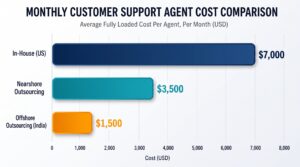
| Support Model | Estimated Monthly Cost Per Agent | What’s Included |
| In-house (US-based) | $5,000 – $8,000 | Salary, benefits, tools, overhead |
| Nearshore outsourcing | $2,500 – $4,500 | Agent, management, infrastructure |
| Offshore outsourcing (India) | $900 – $2,500 | Agent, management, infrastructure, QA |
For a 20-agent team, the gap between building in-house in the US and outsourcing to an experienced partner in India can run $1.5 million or more a year. That’s budget you could redirect into product development, marketing, or the senior hires your business actually needs to grow.
To be clear — this doesn’t mean in-house is wrong for everyone. If you’re a six-person startup where your founders personally know every customer by name, keep it in-house for now. But once you’re fielding a few hundred tickets a day, the math starts working against you fast.
Why Companies Hesitate to Outsource — And Why Most of Those Fears Are Outdated
We hear the same three objections in almost every first conversation with a new client.
“We’re worried quality will drop.”
A fair concern, and one that used to be justified. A decade ago, outsourcing often meant scripted, robotic responses from agents with no real product knowledge. That’s not today’s industry. A properly run outsourcing team is trained on your product, your tone of voice, and your systems — the same way you’d onboard an internal hire, just faster and at lower cost.
“We’ll lose control over the customer experience.”
This almost always comes from a bad experience with the wrong vendor in the past. The fix isn’t avoiding outsourcing — it’s choosing a partner who gives you real-time dashboards, recorded interactions, QA scorecards, and a dedicated account manager who treats your KPIs as their own. You should never feel like your support operation disappeared into a black box the moment you signed the contract.
“Isn’t AI going to replace all of this anyway?”
This is the question we hear the most in 2026 — and it’s the one most articles get wrong.
What the Industry Gets Wrong About This Decision
Most comparisons frame this as “cheap and risky” (outsourcing) versus “expensive and safe” (in-house). That framing is outdated and, frankly, a little lazy. What we actually see, having run both models: quality follows governance, not geography. The businesses that get burned by outsourcing almost always skipped vendor vetting and picked on price alone — and the businesses that struggle with in-house teams usually did the same thing with hiring. The hidden cost in either case isn’t the invoice. It’s the customers who quietly stop renewing after one too many bad support experiences, long before anyone connects the dots back to the support decision that caused it.
What we’d tell you to do instead: before comparing quotes, calculate what a 5-point drop in customer satisfaction is actually costing you in renewals today. That number, not the hourly rate, should be driving your decision.
AI vs. Human Customer Support: What’s Actually Changing
There’s a lot of noise right now about AI “taking over” customer support. Here’s the honest picture, based on what we see running support operations day to day.
AI is genuinely excellent at the repetitive, high-volume work — order status checks, password resets, FAQ answers, simple returns. Done right, it resolves a large share of these instantly, 24/7, without a human ever touching the ticket.
But AI still struggles with anything that needs judgment, empathy, or context: a frustrated customer threatening to cancel, a billing dispute that doesn’t fit a template, a first-time buyer who just needs to be talked through something calmly. Independent industry benchmarks back this up — enterprise-wide, fully-automated resolution rates still average around 40%, even though some AI vendors advertise numbers nearly double that in their own marketing.
That’s exactly why the businesses getting the best results in 2026 aren’t choosing “AI or humans.” They’re combining both, deliberately:

- AI handles the first response and routine queries — instantly, in dozens of languages, around the clock.
- Human agents step in for anything emotional, complex, or high-value — the conversations where a real connection is what actually saves the sale or the relationship.
- AI supports the human agents too — suggesting replies, pulling up customer history, and summarizing conversations so agents move faster without sounding like a script.
Here’s where most businesses get stuck: buying an AI chatbot license is easy. Actually integrating it with trained agents, your CRM, your ticketing system, and a clean escalation path is a different challenge — and it’s exactly the setup an experienced outsourcing partner has already built and refined across dozens of client accounts.
If you’re weighing how much of your support volume should be automated versus human-led, our AI-powered customer support outsourcing team can map out what that split should realistically look like for your ticket volume and industry.
AI vs. Human vs. Hybrid at a Glance
| Dimension | AI-Only | Human-Only | Hybrid (Recommended) |
| Cost per resolution | Lowest | Highest | Blended, closer to AI cost with human accuracy |
| First-contact resolution | Strong for simple queries only | Depends entirely on the agent | Highest overall |
| Customer trust for complex issues | Low | High | High |
| Scalability | Instant | Slow — tied to hiring | Fast |
| Best fit | FAQs, order status, routine transactions | Complaints, regulated conversations | Full support operation at any real scale |
Where This Fails: Common Mistakes We See Leaders Make
Across support, contact center, and AI-implementation projects, the pattern is consistent:
- Approving AI budgets based on a vendor’s best-case demo, not a pilot on real production data.
- Cutting support headcount before AI’s actual resolution rate is proven — not promised.
- Treating “hybrid” as a fixed 50/50 split instead of a ratio that should shift as volume and complexity change.
- Choosing the outsourcing vendor with the lowest hourly rate without asking to see attrition data or live proof of their AI capability.
The organizations that get this right run a short, structured pilot first — testing real ticket volume against a defined target — before making any budget or headcount decision. That single habit is the biggest predictor of whether a transition succeeds or turns into a cautionary tale six months later.
In-House vs. Outsourced: A Straight Comparison
| In-House Support | Outsourced Support | |
| Setup time | 2–4 months to hire and train | 2–4 weeks to go live |
| Monthly cost per agent | $5,000 – $8,000 (US) | $900 – $2,500 (India) |
| Scaling for peak season | Slow — hiring takes weeks | Fast — add agents within days |
| 24/7 coverage | Expensive (night-shift premiums) | Standard, usually built into the contract |
| Technology & AI tools | You build and maintain it yourself | Typically included in the service |
| Best for | Very small teams, highly niche products | Growing businesses, seasonal spikes, cost-conscious scaling |
Recommendation: Default to outsourced or hybrid once you’re past roughly 10–15 agents, unless support itself is your core product differentiator.
Offshore vs. Onshore
| Factor | Offshore (e.g., India) | Onshore (US/UK) |
| Cost | Lowest | Highest |
| Compliance ease | Requires deliberate governance | Often simpler for domestic regulation |
| Customer perception risk | Manageable with training | Minimal |
Recommendation: Blend offshore volume delivery with an onshore or compliance-trained layer for regulated industries.
Build vs. Buy
| Factor | Build (In-House Tech + Team) | Buy (Outsourced/Managed Service) |
| Time to value | Slow | Fast |
| Capital intensity | High | Low, pay-as-you-go |
| Innovation ownership | Fully internal | Shared with your partner |
Recommendation: Buy the delivery model; build your own playbooks and product knowledge on top of it. Don’t try to build both from scratch at once.
Dedicated Team vs. Shared Team
| Factor | Dedicated Team | Shared Team |
| Cost | Higher per agent | Lower, pooled utilization |
| Brand and process depth | Deep, exclusive focus | Shallower, split attention |
| Best for | Brand-sensitive, high-volume operations | Lower-volume, cost-first operations |
Recommendation: Dedicated agents for anything customer-facing; shared/pooled teams only for back-office or overflow work.
Where This Comes From: A Client Story
The challenge. A mid-market retail brand was running a fully in-house team of over 40 agents. Support costs had grown more than 30% year-over-year, satisfaction scores had been sliding for three straight quarters, and customer churn tied to support complaints was becoming impossible to ignore.
The root cause. A closer look showed the real problem wasn’t the team’s effort — it was the setup. Processes were outdated, KPIs were tracked but never connected back to revenue, and every single ticket, no matter how simple, was routed to a human. There was no triage layer at all.
The solution. A phased hybrid model: AI-based self-service handling routine questions like order status and returns, paired with a trained outsourced team handling escalations, billing, and loyalty disputes — all integrated directly into the client’s existing helpdesk and storefront systems.
Implementation. The rollout happened in stages over about five months — starting with a readiness assessment and clearer KPIs, then testing AI on a slice of real volume, then bringing the outsourced human team online in parallel with the shrinking in-house team, and finally a full cutover with monthly performance reviews.

The results. Support operating cost came down by roughly half. Average response time dropped from four hours to under ten minutes. Customer satisfaction climbed from 68% to 91% within two quarters — and, notably, support-related churn signals dropped by close to a third based on renewal-cohort tracking.
The lesson. The cost savings were expected. The satisfaction and retention improvement weren’t — and they only happened because the transition was planned around better routing and reporting, not just a cheaper headcount swap. Outsourcing done purely to cut cost rarely improves the customer experience. Outsourcing done to fix the underlying setup regularly does both at once.
You can see more outcomes like this across different industries in our case studies.
What Good Vendor Evaluation Actually Looks Like
Evaluate any outsourcing partner — including “best BPO in India” shortlist candidates — against six things, not just their hourly rate:
| Criterion | What to Actually Check |
| Cost transparency | An all-in rate card, with no hidden ramp-up, QA, or after-hours fees |
| Technology fit | Native integration with your CRM/helpdesk — Zendesk, Salesforce, Freshdesk, HubSpot |
| Real AI capability | A live demo of agent-assist and automation in production — not a slide deck |
| Industry and compliance experience | Verified case studies in your specific sector, not generic claims |
| Workforce quality | A real, verifiable attrition rate — anything above 35–40% is a warning sign |
| Reporting depth | Can they show you revenue-linked outcomes, not just handle time and CSAT? |
A useful rule of thumb: if a vendor’s entire pitch leads with their hourly rate, that’s the clearest signal to keep looking. The partners worth shortlisting lead with proof and capability, and get to pricing third or fourth in the conversation.
Why India Remains the Top Destination for Customer Support Outsourcing
If you’ve researched this topic, you’ve seen plenty of “best BPO companies in India” lists. Here’s why India keeps showing up at the top of that conversation, year after year:
- Cost efficiency that’s hard to match. Fully loaded agent costs in India remain 60–80% lower than hiring the same role in the US, without cutting corners on quality.
- A massive, English-proficient talent pool. India produces millions of graduates every year, many trained specifically for customer service and BPO careers.
- Genuine round-the-clock coverage. The time-zone difference that once felt like a drawback is now an advantage — it’s what enables true 24/7 support without paying overnight-shift premiums.
- Two decades of operational maturity. This isn’t a new industry finding its feet. India’s BPO sector has spent 20+ years refining training, quality systems, and compliance standards.
The catch: not every provider delivers the same experience. The market is full of vendors competing purely on the lowest hourly rate, cutting corners on training, and treating every client the same way. That’s how outsourcing gets a bad reputation in the first place.
The providers worth working with treat your account like a partnership, not a transaction — real onboarding, dedicated agents (not a shared, rotating pool), transparent reporting, and a genuine investment in understanding your product before day one. That’s exactly the model behind our customer support outsourcing services and our contact center operations in Noida/NCR.
What a Good Outsourcing Partnership Actually Looks Like
Based on the clients we’ve supported across retail, healthcare, fintech, and eCommerce, the partnerships that succeed almost always share the same five ingredients:
- Real onboarding, not a script-read.
Your team should spend real time learning your product, your customers, and your tone before ever taking a live ticket. - Dedicated agents, not a rotating pool.
Agents who work exclusively on your account build product knowledge and customer familiarity that shared, rotating teams simply can’t match. - Transparent, real-time reporting.
You should be able to check your ticket volume, response times, CSAT scores, and QA results whenever you want — not just in a monthly summary email.
A phased rollout, not an all-at-once cutover.
The smartest transitions start with one channel or ticket category, prove the quality, then scale. This protects your customer experience while trust in the new setup is being built.
Compliance that actually matches your industry.
If you’re in healthcare, fintech, or insurance, your partner needs to understand HIPAA, PCI DSS, or data localization requirements before you sign anything — not figure it out afterward. See how we approach this for healthcare BPO services and patient scheduling support.
Pricing: What Outsourced Support Actually Costs
Outsourced customer support pricing in 2026 usually falls into four models: per hour, per agent/FTE, per transaction, or outcome-based. Here’s roughly how the geographies compare on a monthly per-agent basis:
| Region / Model | Typical Monthly Cost (Per Agent) | Notes |
| Offshore — India | $900 – $2,500 | Greatest savings, largest talent pool |
| Nearshore (Latin America, Eastern Europe) | $1,800 – $3,500 | Time-zone alignment, mid-range cost |
| Onshore (US/UK) | $3,000 – $5,500 | Highest cost, simplest domestic compliance |
| AI-enabled support | Pennies to a few dollars per interaction | Highest savings; needs upfront platform investment |
A tip that saves people money: ask every vendor — including India-based providers — for both a per-seat quote and an outcome/per-resolution quote. If they resist quoting outcome-based pricing, that hesitation itself tells you something about how confident they are in their own delivery.
A Simple Cost Calculator You Can Use Today
To get a real total cost of ownership, don’t just compare hourly rates. Use this simplified formula:
In-house annual cost = (fully loaded salary × headcount) + technology licenses + facilities + (recruiting and training cost × attrition rate × headcount) + management overhead (usually 12–18% of the total).
Outsourced annual cost = (contracted rate × hours or resolutions) + one-time onboarding fee + any technology integration cost + your own vendor-management time (usually 5–8% of contract value).
Hybrid annual cost = AI platform and per-interaction cost + outsourced human team cost (scoped only to escalation volume) + your oversight time.
Worked Example (roughly 500 agent-equivalent volume)
| Model | Estimated Annual Cost | Notes |
| In-house (US-based) | $28M – $35M | 500 FTEs at $55K–$70K fully loaded, plus overhead |
| Traditional outsourcing (India) | $7M – $11M | 500 FTE-equivalent at $1,200–$2,000/month plus management |
| Hybrid (AI + outsourced) | $4.5M – $7M | AI absorbs 40–50% of volume; remaining handled by trained agents |
The hybrid model’s savings here — 75–85% versus pure in-house — are real, but never approve a cost-savings number without also checking what it does to your satisfaction scores and churn. A 75% cost cut that quietly increases churn isn’t a win; it’s a trade you didn’t know you were making.
For CEOs, COOs, and Heads of CX evaluating this at a board level: the frameworks above give you the math. Turning them into a board-ready business case using your actual ticket volume, cost, and churn data is a different exercise. If you’d like our team to build that model alongside yours, see how we approach AI-powered BPO delivery →
The ROI Case: It’s Bigger Than “We Saved Money”
A defensible business case for this decision looks at three time horizons, not just the first one:
0–6 months — Cost efficiency. The direct labor and infrastructure savings from moving to a new delivery model.
6–18 months — Operational efficiency. Faster resolution times, better first-contact resolution, and AI absorbing enough volume to change your staffing needs.
18+ months — Revenue impact. Better retention, more expansion revenue, and fewer customers quietly leaving because of a bad support experience.
Most businesses only calculate the first horizon — and then wonder, a year later, why the “successful” outsourcing project didn’t move the numbers leadership actually cared about. If your business case only has one line item — cost savings — you’ve built half a case. Add the retention and revenue side, even as a conservative range, before you take it to the board.
Want to see your own numbers instead of illustrative ones? We’ll walk your team through a working ROI model — cost, efficiency, and revenue — using your actual ticket volume, CSAT, and churn data. Review our case studies first → to see how this has played out for businesses like yours.
Where This Is Headed: AI Agents, Voice Bots, and What’s Actually Next
Looking two to three years out, a few things are becoming the norm rather than the exception:
- Agentic AI that can complete multi-step actions — issuing a refund, rebooking an appointment, updating an account — not just answering a question.
- Voice bots handling a meaningful share of phone volume with natural, low-latency conversation.
- Agent-assist tools that draft responses, summarize calls, and surface the right knowledge article in real time, so human agents move faster without sounding scripted.
- Predictive support that reaches out to a customer before they even file a ticket, based on early warning signs in their account activity.
- Outcome-based pricing becoming the market default rather than a negotiating point.
The businesses that build good habits now — clean data capture, a real routing strategy, a partner who reports on outcomes, not just activity — will absorb these advances as upgrades. The businesses still debating “in-house or outsourced?” as a yes/no question will keep re-litigating this decision every 18 months instead of compounding an advantage.
Security, Compliance, and What’s Non-Negotiable
If you’re in banking, insurance, or healthcare, compliance has to be a gating criterion in vendor selection — not a checkbox added after commercial terms are agreed.
| Industry | What to Verify |
| Banking & Financial Services | Data localization requirements, PCI DSS, SOC 2 |
| Insurance | Data privacy regulations, claims-handling protocols |
| Healthcare | HIPAA compliance, patient data residency, audit trails |
| Any industry with EU customers | GDPR-compliant data handling agreements |
Ask any vendor how their certifications translate into actual, day-to-day agent behavior — not just what’s written in a policy document. Certifications describe intent; execution is what determines your real risk.
A Simple Way to Decide What’s Right for You
Ask yourself these five questions honestly:
- How many agents do you need right now, and in 12 months? Under 10, in-house may still make sense. Above that, the cost gap becomes very hard to ignore.
- Do you have seasonal or unpredictable volume spikes? If yes, outsourcing’s ability to scale up and down quickly is a major advantage.
- Is your support quality currently inconsistent or your team overwhelmed? That’s usually a sign you need more structure — often easier to build with a partner who’s done it hundreds of times before.
- Are you in a regulated industry? Confirm any partner you’re considering has verifiable compliance credentials before going further.
- Do you want support to actually improve retention, not just close tickets? This is where the right partner does more than save you money — they help you keep customers longer.
The Executive Decision Tree
If you want a straightforward path to walk through with your leadership team, use this:
text
Is customer support the core product or differentiator of your business?
├─ Yes → Stay in-house, or use outsourcing only for overflow capacity.
└─ No → Continue.
Is your current volume under roughly 10–15 agents?
├─ Yes → Either model can work — decide on cost and your local hiring market.
└─ No → Continue.
Does your industry carry heavy compliance exposure (banking, insurance, healthcare)?
├─ Yes → Prioritize compliance-certified vendors; blend offshore volume with an
│ onshore or compliance-trained escalation layer.
└─ No → Continue.
Did you score 13+ on the readiness self-assessment above?
├─ No → Fix internal process, data, and KPI gaps before you transition.
└─ Yes → Continue.
Can you commit to a phased pilot with clear, agreed KPIs before a full rollout?
├─ Yes → Proceed with a hybrid model and a proper vendor evaluation.
└─ No → Hold off until you can commit to measuring the pilot properly.
This exists to stop the conversation from jumping straight to “in-house or outsourced?” before answering the five questions that actually determine the right answer for your business.
If your honest answers point toward outsourcing, the next step isn’t picking the cheapest quote you get. It’s finding a partner who can show you real client outcomes, not just a rate card.
Industry-Specific Use Cases
| Industry | Where Outsourcing/Hybrid Helps Most |
| Banking & Financial Services | Digital banking support, KYC queries, fraud-related questions |
| Insurance | Claims status updates, policy servicing |
| Retail & eCommerce | Order status, returns, loyalty program support — especially during seasonal spikes |
| FMCG | High-volume, low-complexity distributor and consumer queries |
| Healthcare | Appointment scheduling, insurance verification, post-discharge follow-up |
| Automotive & EV | Service scheduling, warranty questions, charging and support queries |
| Telecommunications | Billing, plan changes, technical troubleshooting |
| Aviation | Booking changes and disruption management, with strong human escalation |
| Logistics | Shipment tracking and delivery exception handling |
Across nearly every one of these industries, the pattern is the same: AI absorbs the structured, high-volume queries, and specialized human teams — increasingly delivered through outsourcing partners — handle the complexity and compliance-sensitive conversations.
The Technology Behind Modern Support
A modern support operation isn’t one tool — it’s a connected stack:
| Layer | Common Platforms |
| CRM / Helpdesk | Zendesk, Salesforce, Freshdesk, HubSpot, Intercom, ServiceNow |
| Contact Center Infrastructure | Genesys, Five9, Talkdesk, NICE CXone |
| Cloud Infrastructure | Amazon Web Services, Google Cloud, Microsoft Azure |
| Internal Collaboration | Slack, Microsoft Teams |
| Commerce & Payments | Shopify, WooCommerce, Stripe, PayPal |
| AI / Language Models | OpenAI, Google Gemini, Claude, Copilot |
Before signing with any partner, check whether their tools genuinely integrate with what you already use. A cheaper vendor that requires you to rebuild your CRM workflow around their system is adding hidden cost that never shows up in the initial quote.
Risk, Honestly Addressed
| Risk | How to Manage It |
|---|---|
| Data security exposure | Require ISO 27001/SOC 2 certification and contractual data-handling audits |
| Quality or brand risk | Use a proper vendor evaluation process, not price alone; pilot before full rollout |
| Vendor lock-in | Favor outcome-based, shorter-term contracts with a clear exit clause |
| Over-automation backlash | Cap what AI is allowed to resolve alone; always keep a visible path to a human |
| Regulatory non-compliance | Make compliance certification a gate in vendor selection, with ongoing audits |
None of these risks are a reason to default to in-house by habit — they’re reasons to reject any vendor selection process that’s driven by price alone. Staying in-house doesn’t eliminate risk; it just shifts it somewhere you’re not measuring as carefully.
Executive Checklist Before You Decide
- Calculated your real, fully loaded cost per agent — not just salary
- Estimated what a drop in customer satisfaction is currently costing you in renewals
- Built a side-by-side total cost comparison for in-house, outsourced, and hybrid
- Modeled ROI across cost, efficiency, and revenue — not cost savings alone
- Shortlisted vendors on capability and compliance first, price third or fourth
- Verified compliance certifications relevant to your industry
- Defined what AI is and isn’t allowed to resolve without a human
- Planned a phased pilot instead of an all-at-once cutover
- Set up monthly reporting on outcomes, not just activity, before signing anything
Frequently Asked Questions
Is outsourcing customer support cheaper than hiring in-house?
Yes, in almost every case once you’re past a very small team size. Outsourcing to India typically costs 60–80% less than hiring the same role in the US, once you account for salary, benefits, training, and overhead.
Will my customers notice if support is outsourced?
Not if it’s done properly. Agents trained on your product, tone, and systems should be indistinguishable from an internal team. If customers can tell, that’s usually a sign of a rushed onboarding — not a flaw in outsourcing itself.
Should I use AI or human agents for customer support?
Both, ideally. AI is excellent for fast, routine queries. Humans remain essential for complex, sensitive, or high-value conversations. The best-performing support operations in 2026 combine the two rather than picking one over the other.
How long does it take to switch from in-house to outsourced support?
A well-run transition typically takes 4–8 weeks from kickoff to full handover, especially when phased — starting with one channel or ticket type before scaling to full volume.
What should I look for in a customer support outsourcing company?
Look past the hourly rate. Check for dedicated (not shared) agents, transparent real-time reporting, relevant industry experience, and verifiable compliance certifications for your sector.
Is it safe to outsource customer support for a regulated industry like healthcare or finance?
Yes, provided your partner has documented compliance certifications and prior experience in your specific industry. Ask for evidence, not assurances, before signing anything.
What’s the difference between offshore and onshore outsourcing?
Offshore (like India) offers the biggest cost advantage; onshore simplifies domestic regulatory compliance. Many regulated businesses use both — offshore for volume, onshore or compliance-trained teams for sensitive escalations.
How do I find the best BPO company in India for my business?
Evaluate providers on technology fit, real AI capability, industry experience, attrition rates, and reporting depth — not on hourly rate alone. Ask for a live demo and references in your specific industry before signing anything.
Ready to See What This Looks Like for Your Business?
If you’re still weighing this decision, the smartest next step isn’t another spreadsheet — it’s a conversation with people who’ve made this transition work hundreds of times and can tell you honestly whether outsourcing makes sense for your volume, industry, and growth plans.
If you’re currently comparing in-house, outsourced, and hybrid options and want a second set of eyes before you sign anything with any vendor: talk to our team — no pitch deck, just a working session against the numbers in this article. If your evaluation includes contact center delivery out of Noida/NCR or pan-India coverage, take a look at our Noida/NCR contact center solutions, or explore business process automation as a complementary next step.
Handling high volume already? See how we’ve helped businesses scale support past 10,000 monthly tickets without losing quality.
You can also learn more about MasCallNet and how we’ve been building customer experience teams — in-house, outsourced, and every hybrid in between — since 2003.