
Agentic AI in Customer Service (2026): Benefits, Use Cases & How Businesses Can Automate Support
AI Overview
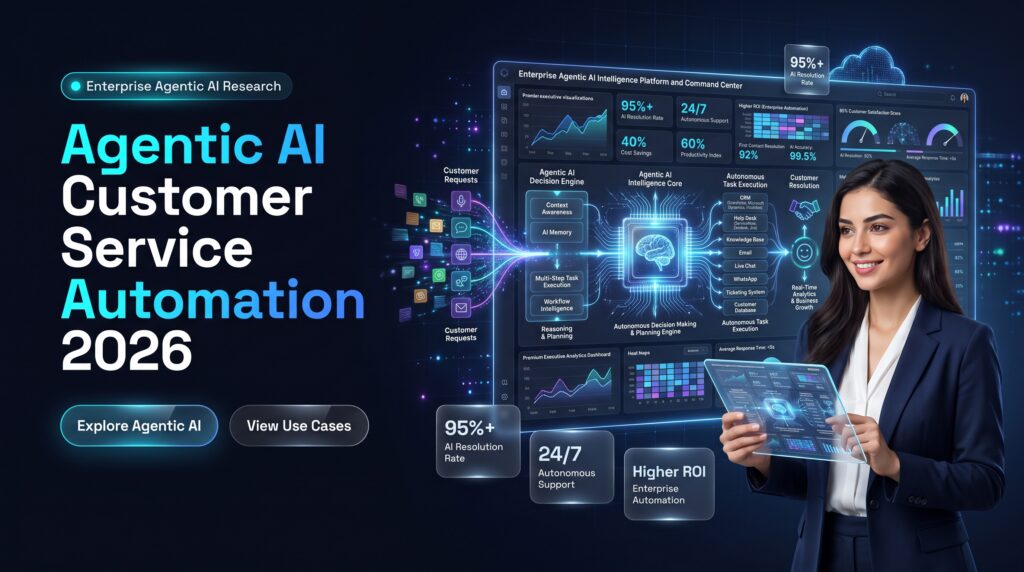
In 2026, the global AI customer service market is projected to reach $15.12 billion, growing at a 25.8% CAGR. Agentic AI has evolved from a deflection tool into an autonomous resolution engine, achieving a median deflection rate of 41.2% and driving cost-per-resolution down to $0.62 (compared to a $7.40 human baseline). The defining enterprise strategy for 2026 is the deployment of a Human-in-the-Loop AI model, blending autonomous task execution with high-value human empathy. Organizations leveraging partners like MasCallNet—one of the best BPO companies in India—are turning support centers from cost centers into revenue engines by adopting Contact Center Intelligence™, where every customer conversation is treated as an enterprise intelligence asset.
Introduction
The atomic unit of customer service has fundamentally changed. For decades, the industry optimized around human throughput: Average Handle Time (AHT), First Call Resolution (FCR), and cost-per-contact. In 2026, the enterprise focus has shifted decisively toward autonomous resolution, structural unit economics, and data extraction.
According to recent industry projections, over 91% of customer service leaders face intense executive pressure to implement AI in 2026. Yet, the majority of organizations are misallocating their investments. They treat AI as a digital shield to deflect angry customers away from human agents. This is a profound miscalculation.
At MasCallNet, we operate on a different category thesis: Contact Center Intelligence™. Customer conversations are not operational burdens to be minimized; they are enterprise intelligence assets to be mined, analyzed, and leveraged. When an organization shifts its mindset from “deflection” to “resolution,” and from “cost mitigation” to Support-Led Revenue Growth™, the contact center becomes the central nervous system of the business.
This definitive blueprint details the operational realities, financial models, and strategic frameworks required to navigate the transition to agentic AI, balance AI vs Human customer support, and select the right offshore partner to scale your operations globally.
1. Market Reality & Industry Trends (2026)
The 2026 customer service landscape is defined by the transition from generative chatbots to agentic workflows. Generative AI solved the conversational problem; agentic AI solves the operational problem.
Businesses that only adopt conversational wrappers face declining customer satisfaction (CSAT), while those adopting agentic workflows reduce operational costs by up to 71% while maintaining or improving quality.
The 2026 AI Maturity Curve
- Level 1 – Scripted Bots (Legacy): Simple decision trees and keyword matching.
- Level 2 – Generative Chatbots (2023-2024): Unstructured conversation, high hallucination risk, limited backend access.
- Level 3 – Agentic Copilots (2025): AI assists human agents with drafting, summarization, and knowledge retrieval.
- Level 4 – Autonomous Agentic AI (2026): Goal-oriented AI executing end-to-end workflows (e.g., Returns, Billing) autonomously.
The 2026 Economic Shift
| Metric | 2024 Baseline | 2026 Reality | Impact |
| AI Cost Per Resolution | $2.50 | $0.62 | 75% cost reduction |
| Human Cost Per Resolution | $6.80 | $7.40 | Rising labor costs |
| Voice AI Penetration | 6% | 19% | Shift from chat-only to multi-modal |
| Median Deflection Rate | 22% | 41.2% | Massive capacity unlock |
The economic advantage of AI is no longer a future projection; it is a current operational reality. A blended hybrid cost (human + AI) reduces the cost-to-serve by nearly three-quarters. However, failing to integrate these systems into a unified intelligence loop creates fractured customer experiences.
Boardroom Insight™: Do not measure AI by how many agents it replaces. Measure it by how much enterprise intelligence it extracts. Deflection is a vanity metric; autonomous resolution is a profitability metric.
2. Definition & How Agentic AI Works
Agentic AI utilizes large language models (LLMs) combined with tool-calling capabilities (APIs) to interpret customer intent, formulate a plan, execute necessary actions in backend systems, and verify the outcome without human prompting. This capability transforms customer service from an information-retrieval function into an operational execution function.
The MasCallNet Contact Center Intelligence Layer™
To move beyond basic text delivery, enterprise AI must sit on top of a unified middleware architecture that connects intent to execution.
[Inbound Interaction] ➔ [Perception Layer (NLP/Voice AI)] ➔ [Reasoning Layer (LLM Router)]
│
[Enterprise Outcome] [Execution Layer (APIs to CRM/ERP)] ───┘
- Perception Layer: Multi-modal intake (Voice, Chat, Email) powered by advanced foundations like OpenAI, Claude, or Google Gemini.
- Reasoning Layer: Intent classification, sentiment analysis, and workflow mapping.
- Execution Layer: Secure read/write API calls to systems of record (Salesforce, Zendesk, ServiceNow, Shopify).
- Intelligence Layer: Data extraction, tagging, and structuring for predictive business intelligence.
Generative vs. Agentic AI Capability Mapping
| Capability | Generative AI (Legacy Model) | Agentic AI (2026 Standard) |
| Primary Function | Answer questions | Complete tasks |
| Backend Access | Read-only (Knowledge Base) | Read/Write (CRM, Billing, ERP) |
| Workflow | Single-turn response | Multi-step autonomous execution |
| Error Handling | Generates text filler | Triggers contextual human escalation |
The true moat in 2026 is not the raw AI model you use, but the cleanliness and accessibility of your enterprise data. Agentic AI is only as smart as the APIs it can securely call.
3. The Great Debate: AI vs Human Customer Support
The future is not AI vs Human; it is AI + Human. AI dominates high-volume, structured intents (order tracking, password resets), while humans dominate high-emotion, complex, and unstructured intents (retention, empathy, complex troubleshooting).
Attempting to fully automate customer service alienates high-value customers. Conversely, using humans for routine tasks destroys margin.
The AI vs Human vs Hybrid Model™
- Pure AI (The Efficiency Trap): 100% automation. Low cost ($0.62/res), but risks a severe CSAT penalty on complex interactions.
- Pure Human (The Margin Trap): 100% human. High CSAT, but financially unsustainable at scale ($7.40/res).
- Contact Center Intelligence™ Hybrid: AI handles 65% to 80% of structured intents. Humans handle the remaining 20% to 35%. Blended cost drops by 71%, and CSAT improves because human agents are freed from routine tickets to provide true white-glove care.
Optimal Routing Matrix by Intent Type
| Intent Type | Complexity | Emotion | Optimal Handler | Operational Reason |
| Order Status | Low | Low | Agentic AI | Instant API retrieval is faster than human search. |
| Account Update | Medium | Low | Agentic AI | Safe, structured workflow execution via CRM. |
| Billing Dispute | Medium | High | Human Agent | Requires negotiation, empathy, and contextual judgment. |
| Service Interruption | High | High | Human Agent | High stress requires emotional validation and rapid routing. |
By 2027, 50% of companies that reduced their customer service workforce due to AI will need to rehire staff, albeit under different job titles. High-performing organizations do not lay off their best agents; they upskill them into AI trainers, workflow designers, and specialized exception handlers.
4. Offshore vs Onshore Customer Support Outsourcing
The integration of AI has fundamentally changed the offshore vs onshore customer support outsourcing calculation. Historically, onshore centers were preferred for complex linguistic nuances. Today, real-time AI normalization, automated translation, and grammar-assist tools allow offshore agents to perform at onshore quality levels at a fraction of the cost.
Labor arbitrage alone is a race to the bottom. Technology-enabled labor arbitrage (Offshore + AI) is the ultimate competitive advantage for scaling enterprises.
Comparative Operational Metrics (2026)
| Factor | Onshore (US/UK) | Offshore + AI (India – MasCallNet) | Advantage |
| Blended Hourly Rate | $35 – $55 | $12 – $18 | Offshore |
| Language Quality | Native | Native (AI-Assisted real-time correction) | Neutral |
| Scalability | Low (Tight labor market) | High (Massive tech-literate talent pool) | Offshore |
| Attrition Rate | 35% – 50% | 15% – 25% | Offshore |
The “accent barrier” of legacy BPOs has been eradicated by modern real-time voice AI. India remains the undisputed global leader in IT and CX talent. Partnering with an experienced customer support outsourcing company India allows enterprises to invest their massive labor savings back into advanced AI tooling, creating a superior customer experience at a lower total cost.
5. Identifying the Best BPO Companies in India
The best BPO companies in India have evolved from “seat-fillers” to technology integrators. They do not just provide labor; they provide the AI infrastructure, the operational workflows, and the strategic consulting required to implement true automation.
Partnering with a legacy BPO that charges strictly by the hour creates a perverse incentive: they make more money when your processes remain inefficient and human-dependent.
The MasCallNet Vendor Evaluation Matrix™
When evaluating potential partners for customer support outsourcing, score candidates across four pillars:
┌────────────────────────────────────────────────────────┐
│ MASCALLNET VENDOR EVALUATION MATRIX™ │
├───────────────────────────┬────────────────────────────┤
│ 1. Commercial Alignment │ 2. Technology Stack │
│ (Outcome-based vs │ (Native integrations │
│ hourly billing) │ with top CRMs) │
├───────────────────────────┼────────────────────────────┤
│ 3. Data Security │ 4. Domain Expertise │
│ (SOC 2 Type II, HIPAA, │ (Vertical experience, │
│ PCI-DSS compliance) │ e.g., Healthcare, BFSI) │
└───────────────────────────┴────────────────────────────┘
- Commercial Alignment: Do they offer outcome-based pricing (per resolution) or just per-hour?
- Technology Stack: Are they partnered natively with Zendesk, Salesforce, and enterprise LLMs, or relying on proprietary black-box tech?
- Data Security: Look for verified ISO 27001, SOC 2 Type II, and HIPAA compliance for sensitive industries like healthcare BPO services.
- Domain Expertise: Ensure they have specific operational experience mapping workflows in your vertical.
Your BPO should be pushing you to automate, not begging for more headcount. If your current partner is not proactively suggesting ways to reduce their own billable hours through AI, you are working with a vendor, not a partner.
6. Business Impact & ROI: The Math of Automation
Implementing agentic AI yields an average return of $3.50 for every $1 spent, with leading organizations achieving up to 8x ROI within 12 months. The economic driver is the delta between a $7.40 human resolution and a $0.62 AI resolution applied across hundreds of thousands of interactions.
The MasCallNet Support-to-Revenue Framework™
To secure CFO approval, executives must present a business case rooted in blended cost-per-resolution, cost avoidance, and revenue recovery.
- Cost Avoidance: Structured Tickets×(Human Cost−AI Cost)−Implementation CapEx
- Revenue Recovery Through CX™: Automated abandoned cart intervention + real-time churn prevention triggers.
- Upsell Velocity: AI prompting human agents with “Next Best Action” offers based on CRM data during live escalations.
Monthly ROI Projection (Example: 100,000 Tickets/Mo)
| Metric | Current State (Human Only) | Future State (MasCallNet Hybrid) |
| AI Handled Volume (65%) | 0 | 65,000 |
| Human Handled Volume | 100,000 | 35,000 |
| Cost Per AI Ticket | $0.00 | $0.80 |
| Cost Per Human Ticket | $8.00 | $3.50 (Offshore AI-Assisted) |
| Total Monthly Cost | $800,000 | $52,000 (AI) + $122,500 (Human) = $174,500 |
| Net Monthly Savings | — | $625,500 |
By leveraging a unified Customer Support Outsourcing Services partner, enterprises arbitrage both labor and technology costs simultaneously, transforming a legacy cost center into an agile profit center.
7. The MasCallNet Revenue Leakage Analysis™
Revenue leakage occurs when friction in the customer journey prevents a transaction, or when poor support execution causes premature churn. In enterprise SaaS, e-commerce, and digital banking, a 1% reduction in customer churn can result in up to a 10% increase in enterprise valuation. Support is where churn happens.
Diagnostic Leakage Mapping
- Pre-Sale Friction: Abandoned carts and drop-offs due to delayed product or shipping questions. (Resolution: Proactive Chat AI with instant agent fallback).
- Post-Sale Frustration: Extended time-to-value caused by rigid onboarding systems or slow ticket response times. (Resolution: Agentic troubleshooting workflows).
- Policy Rigidity Churn: Losing high-LTV customers over minor billing disputes because front-line agents lack flexibility. (Resolution: AI-driven micro-appeasement budgets).
By connecting your service platform (e.g., Zendesk) with your billing architecture (e.g., Stripe), you can expose the exact financial risk associated with every open ticket, allowing for priority-based routing that protects enterprise revenue.
8. Transformative Use Cases by Industry
Agentic AI requires deep vertical specialization to be effective. A retail chatbot cannot handle healthcare data. Industry-specific tuning is mandatory for compliance and functional accuracy.
Industry Benchmark Table (2026)
| Industry | Primary AI Use Case | Median Autonomous Resolution | Operational Impact |
| Retail & eCommerce | WISMO (Where is my order?), automated returns, cart recovery | 65% | Absorbs seasonal spikes without hiring temporary staff |
| Telecommunications | Account upgrades, bill shock explanation, network triage | 42% | Drops Average Handle Time (AHT) on human calls by 30% |
| Banking & Finance | Balance inquiries, password resets, fraud dispute initiation | 38% | Shifts routine interactions away from costly core banking staff |
| Healthcare | Patient appointment scheduling services, intake triage, insurance verification | 27% | Minimizes clinic no-shows and shortens billing cycles |
In sectors like digital banking services, 60% of total inbound volume is typically driven by fewer than five core intents. High-performing companies focus their initial AI engineering budgets on mastering these high-volume entry points before attempting to automate long-tail, complex user journeys.
9. Technology Ecosystem & Integration Strategies
Agentic AI must be embedded deeply within your existing technology stack. Standalone AI wrappers are obsolete; modern deployments require native integrations with platforms like Salesforce, Zendesk, AWS, Azure, and Google Cloud.
┌────────────────────────────────────────────────────────┐
│ ENTERPRISE DATA INTEGRATION │
├────────────────────────────────────────────────────────┤
│ [Zendesk / CCaaS] ◄──► [MasCallNet Middleware] │
│ ▲ ▲ │
│ │ │ │
│ ▼ ▼ │
│ [Salesforce / CRM] ◄──► [Enterprise ERP / Billing] │
└────────────────────────────────────────────────────────┘
AI that cannot read from your CRM or write to your billing system is simply an expensive, glorified FAQ search engine.
The Enterprise Support Tech Stack Architecture
| Layer | Industry Leaders | Strategic Role in AI Ecosystem |
| System of Record | Salesforce, HubSpot, ServiceNow | The primary source of truth for Agentic AI data retrieval and customer context. |
| CCaaS / Ticketing | Zendesk, Freshdesk, Genesys, Five9 | The operational interface for human-in-the-loop exception handling. |
| Reasoning Engine | OpenAI, Google Gemini, Anthropic Claude | The core linguistic and logic models powering autonomous decision making. |
| Cloud Infrastructure | AWS, Microsoft Azure, Google Cloud | Secure, low-latency environment hosting enterprise API integrations. |
The modern support organization is an engineering structure in disguise. Ensure your architecture allows for a continuous Customer Intelligence Loop, where every failed AI interaction automatically generates a structured knowledge-gap ticket, building a self-healing operational layer.
10. Case Study: Scaling Support for an Enterprise Market Leader
Challenge
A high-growth e-commerce brand experiencing 40% year-over-year volume growth faced critical support bottlenecks. During peak holiday seasons, Average Speed to Answer (ASA) spiked to 45 minutes, leading to a 15% drop in CSAT and increased cart abandonment due to delayed pre-sale response times.
Root Cause
The company relied on an onshore, all-human team managed by a traditional call center outsourcing provider billing strictly on an hourly basis. The vendor lacked the incentive to automate, causing support costs to scale linearly with ticket volume.
Solution
The brand transitioned its operations to MasCallNet’s Call Center in Noida, deploying an automated Contact Center Intelligence™ framework.
- Integrated an Agentic AI layer with Shopify and Zendesk to handle all tier-1 transactional requests (WISMO, basic refunds).
- Routed high-emotion, complex escalations to MasCallNet’s elite, AI-assisted offshore product support team.
Results
The metrics verified complete operational transformation within 60 days:
1 Autonomous Resolution Impact
Tier-1 ticket mitigation
1.Autonomous Resolution Impact:Tier-1 ticket mitigation.
Achieved an immediate 68% autonomous resolution rate on all transactional order inquiries, removing pressure from human queues.
2 Unit Economic Re-engineering
Cost-per-resolution optimization
2.Unit Economic Re-engineering:Cost-per-resolution optimization.
Blended cost-per-resolution dropped from an onshore baseline of $9.50 to $2.15, saving millions in annualized run-rate.
3 Revenue Recovery Realization
Conversion enhancement
3.Revenue Recovery Realization:Conversion enhancement.
Proactive, conversational pre-sale chat triggers reduced cart abandonment rates by 14% during peak shopping windows.
4 Customer Experience Elevation
CSAT growth
4.Customer Experience Elevation:CSAT growth.
Overall customer satisfaction metrics climbed steadily from a baseline of 3.8 up to 4.6 out of 5.0.
11. Security, Compliance, and Risk Analysis
Deploying Agentic AI introduces new vectors of risk: data exfiltration, LLM hallucinations, API vulnerabilities, and compliance breaches. These must be mitigated through strict governance, role-based access control (RBAC), and private cloud deployments.
A single AI hallucination that exposes personally identifiable information (PII) or accidentally promises an unauthorized refund can cause massive regulatory penalties and brand damage.
AI Risk Mitigation Protocols
- Hallucination Containment: Restrict the AI’s data access using strict Retrieval-Augmented Generation (RAG) models tied exclusively to verified enterprise databases.
- Data Masking & Privacy: Implement middleware that automatically strips PII (names, credit card numbers, SSNs) before sending data payloads to external LLM tokens.
- Deterministic API Guardrails: Impose strict hard-coded operational boundaries that the AI cannot override (e.g., limiting autonomous refund caps to $200 without human managerial sign-off).
- Continuous Algorithmic Auditing: Subject 5% of all autonomous resolutions to random human quality assurance (QA) checks to detect model drift early.
In highly regulated sectors like banking and healthcare, on-premise or secure virtual private cloud (VPC) instances are mandatory. Do not trade compliance for operational speed.
12. The Executive Checklist for AI Integration
Before launching an Agentic AI or AI-BPO initiative, enterprise leaders must verify that the following operational steps are complete:
- [ ] Define the Core Thesis: Shift the organizational mindset away from simple ticket deflection and toward Support-Led Revenue Growth™.
- [ ] Audit Knowledge Assets: Convert unstructured PDFs, legacy internal slack channels, and old help articles into clean, machine-readable formats.
- [ ] Assess API Integration Readiness: Ensure your primary software systems (CRM, ERP, Billing) feature stable, well-documented read/write REST APIs.
- [ ] Document Baseline Metrics: Calculate current fully loaded cost-per-resolution, AHT, and FCR to accurately map future ROI.
- [ ] Select an Integrated Partner: Choose an AI-powered BPO company India that brings native technology consulting, middleware, and operational human talent under a single contract.
- [ ] Redefine Human KPIs: Shift the incentives of your remaining human workforce away from speed metrics (AHT) and toward relationship-building metrics (CSAT, retention, customer lifetime value).
Frequently Asked Questions
Q: What is the main operational difference between Generative AI and Agentic AI?
Generative AI focuses on text production, answering user questions based on a passive text database. Agentic AI focuses on task execution, using reasoning capabilities to plan and call external APIs to modify data, process transactions, and close tickets without human intervention.
Q: Will agentic workflows completely eliminate the need for human call center agents?
No. While agentic AI can confidently resolve up to 80% of routine, transactional tasks, it cannot replicate human empathy, creative troubleshooting, or negotiation. Human agents become highly valued exception handlers and brand ambassadors who manage complex, high-risk customer relationships.
Q: How do the best BPO companies in India price their AI customer support services?
Modern providers have shifted away from strict per-hour billing. They offer blended, outcome-based pricing structures where autonomous AI resolutions are billed at a low flat rate (typically $0.50 to $1.00 per resolution), while complex escalations requiring specialized human labor are billed via traditional dedicated resource tiers.
Q: What security steps prevent an autonomous AI from executing destructive actions?
Security is maintained through deterministic guardrails. The AI is granted restricted API tokens with least-privilege access, preventing it from altering core database structures. Any high-risk operation, such as closing an enterprise account or approving a large financial transaction, requires human-in-the-loop authorization.
Q: How long does it take to deploy an AI-powered customer support outsourcing model?
A standard enterprise migration using the contact center services framework requires 4 to 8 weeks. This covers initial intent mapping, data cleaning, API development, compliance auditing, and setting up the human escalation workflows.
Conclusion & Strategic Next Steps
The era of scaling customer service by simply adding more human seats is over. In 2026, the enterprise mandate is clear: deploy Agentic AI to eliminate transactional friction, and deploy elite human talent to build lasting customer relationships.
By adopting a comprehensive contact center AI Powered BPO methodology, organizations transition their support operations from a reactive cost center to a proactive revenue engine. This requires more than just buying an AI license; it requires a structural re-engineering of your operational models, data flows, and workforce strategy. The companies that will dominate the next decade are those that master the AI-Human hybrid model today.
Is your contact center ready for the AI revolution?
- To explore how we can help you reduce costs, scale faster, and improve customer loyalty, review our specialized Customer Support Outsourcing Services.
- To read detailed performance metrics across diverse sectors, browse our comprehensive library of BPO case studies India.
- To receive a customized financial assessment detailing exactly where your current customer experience processes are losing margin, Schedule a Strategic Consultation with MasCallNet.