
AI Agent Resolution Rate Benchmark Report 2026: Industry Performance, Accuracy & Enterprise Customer Support Insights
AI Overview
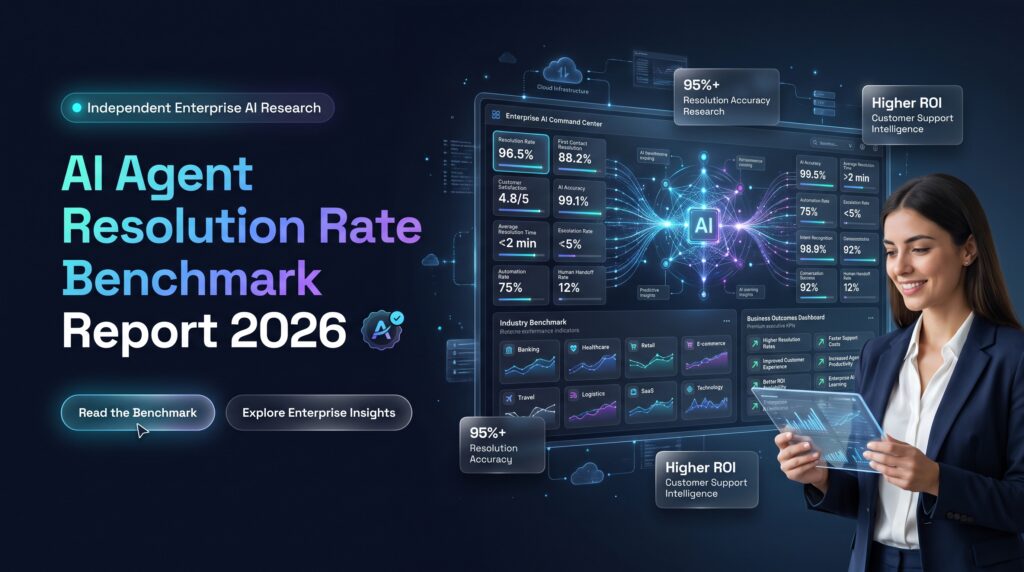
The 2026 AI Agent Resolution Rate Benchmark Report reveals a structural shift in enterprise operations. With platforms like Zendesk, Salesforce, and bespoke LLMs driving 70%+ autonomous resolution, support centers are transitioning from managing handle times to maximizing data extraction. This methodology, known as Contact Center Intelligence™, treats every customer interaction as a business asset. Consequently, AI vs human customer support is no longer a binary choice; it is a hybrid architecture where AI handles volume and specialized offshore BPOs in India handle complex, revenue-critical escalations.
Introduction
Customer support is no longer a localized operational function; it is a central revenue protection mechanism. In 2026, the debate over AI vs human customer support has definitively ended. The new mandate for the C-suite is structural integration.
As enterprises scale, the traditional metric of minimizing average handle time (AHT) is being replaced by a more aggressive objective: maximizing the intelligence extracted from every interaction. We call this Contact Center Intelligence™—the strategic thesis that customer conversations are enterprise intelligence assets. When a customer contacts your support line, they are not merely reporting a friction point; they are actively handing you product feedback, competitive intelligence, and churn indicators.
This 2026 Benchmark Report, developed for C-suite leaders, Revenue Operations, and CX strategists, dissects the operational realities of AI agent resolution rates across major industries including Banking, Healthcare, eCommerce, and Telecommunications. It evaluates the best BPO companies in India not by their ability to provide raw headcount, but by their capability to deploy autonomous AI agents seamlessly alongside highly skilled human escalation teams. If your organization is still treating contact center services exclusively as a cost center, you are actively leaking revenue to competitors who are not.
Market Reality & Industry Trends
The contact center ecosystem is compounding rapidly, driven by the shift from legacy, rules-based chatbots to generative, agentic AI capable of multi-step reasoning. Recent data from Adobe and Gartner indicates that by 2027, AI agents will autonomously resolve over 80% of routine customer service interactions.
However, beneath the macro data lies a widening gap between corporate ambition and operational readiness. While 82% of enterprise leaders have invested in AI for customer service, fewer than 15% have achieved “mature deployment” where AI is deeply integrated into core backend systems (like Shopify, Stripe, or ServiceNow).
Why the Market is Shifting
- The Outcome-Based Pricing Model: Vendor pricing has shifted from SaaS seats (paying for login licenses) to outcome-based pricing (paying $0.50 to $1.50 per resolved conversation).
- 100% Quality Assurance Coverage: Manual QA sampling (listening to 2% of calls) is obsolete. AI now monitors 100% of interactions in real-time, eliminating compliance gaps in highly regulated sectors like Insurance and Healthcare.
- The Rise of Autonomous AI BPOs: The best customer support outsourcing companies are no longer labor arbitrage vendors; they are AI systems integrators.
- Resolution Replaces Deflection: Deflection simply prevents a customer from reaching an agent. Resolution actually solves their problem autonomously.
AI Agent Resolution Rates & Benchmarks
Direct Answer
In 2026, the baseline AI agent resolution rate across global enterprise deployments is 68%, with top-tier implementations achieving 82-85% autonomous resolution for structured, transactional queries.
Why It Matters
A 10% increase in your AI resolution rate on a volume of 100,000 monthly tickets yields an immediate reduction of 10,000 human-handled escalations. This compresses blended operational costs and, more critically, frees human capital to focus on high-stakes retention workflows.
MasCallNet AI Efficiency Index™
To accurately gauge performance, enterprises must measure true efficiency, not just deflection.
- Definition: A diagnostic framework to measure the operational validity of AI deployments.
- Methodology: $$ \text{AI Efficiency} = \left( \frac{\text{Total Autonomous Resolutions}}{\text{Total Inbound Queries}} \right) \times (1 – \text{Reopen Rate within 48 Hrs}) $$
- Interpretation: Scores >75 indicate advanced agentic AI natively executing API calls. Scores <50 indicate a legacy chatbot frustrating users.
- Executive Recommendation: Tie IT and CX leadership bonuses directly to the AI Efficiency Index, penalizing high reopen rates.
Industry Benchmark Table (2026)
| Metric | 2024 Baseline | 2026 Industry Average | Top Quartile (2026) |
| AI Resolution Rate | 42% | 68% | 85%+ |
| Blended Cost Per Contact | $10.50 | $6.80 | < $4.20 |
| QA Coverage | 5% (Manual) | 100% (AI Automated) | 100% + Predictive |
| First Contact Resolution (FCR) | 65% | 75% | 91% |
| Hallucination Rate | 4.2% | < 1.0% | ~0.01% |
Executive Interpretation
The benchmark data proves that AI is rapidly absorbing the “fat middle” of customer support. The remaining 15-32% of interactions require extreme empathy, complex negotiation, or high-value judgment. This bifurcates the modern workforce: AI handles the logic and math; humans handle the emotion and escalation.
Boardroom Insight™
Most boards authorize AI investments purely to cut headcount. The strategic board authorizes AI to increase revenue per agent. If you automate 70% of tickets but fire 70% of your staff, your customer experience remains stagnant. If you automate 70% and retrain your retained staff to focus on cross-selling, onboarding, and churn prevention, you generate net-new revenue.
Summary & Key Takeaway
AI resolution rates have matured from pilot metrics into structural unit economics. Do not measure AI by how much money it saves; measure it by how much human capability it unlocks.
AI vs Human Customer Support: The Hybrid Architecture
Direct Answer
The AI vs Human Customer Support dichotomy is fundamentally flawed. The optimal 2026 model is AI-First, Human-Secured. AI acts as the massive digital net catching volume, while highly trained humans serve as the precision escalations team.
Why It Matters
Pure human support cannot scale linearly without destroying profit margins. Pure AI support cannot handle regulatory ambiguity, edge-case troubleshooting, or deep emotional distress without destroying brand equity.
MasCallNet Support-to-Revenue Framework™
- Definition: A model mapping support interactions directly to revenue outcomes.
- Methodology: Tickets are classified into Tier 0 (Autonomous Logic), Tier 1 (Human Process), and Tier 2 (Human Empathy/Save).
- Scoring Logic: Calculate Revenue Saved = (Tier 2 Save Rate) × (Customer LTV).
- Interpretation: Human agents transition from reactive cost centers to proactive revenue protection units.
- Executive Recommendation: Route all Tier 0 traffic to LLMs (like Google Gemini or Claude) and outsource Tier 1 and 2 to specialized BPOs equipped to handle the emotional load.
The Consensus vs. The Reality
What Everyone Says: “Customers hate talking to bots.” What Most Articles Miss: Customers hate talking to dumb bots. Customers actively prefer AI when it instantly executes a task (e.g., “Cancel my subscription” or “Change my flight”). They only demand humans when the bot fails. The Hidden Cost: Companies deploy rules-based legacy chatbots, label them “AI,” and trap users in loops. A frustrated customer entering a human queue takes 3x longer to appease, destroying the AHT and escalating the cost per contact to over $20. The MasCallNet Perspective: By routing intent precisely, outsource call center services can achieve a 90% CSAT on AI-resolved tickets and ensure zero-wait-time handoffs for humans.
Simulate the Financial Impact
The transition from a purely human workforce to an AI-augmented operation fundamentally changes your unit economics. Adjust the parameters below to model how shifts in AI resolution rates impact your operational expenditure.
Outsourcing to the Best BPO Companies in India
Direct Answer
The best BPO companies in India in 2026 are not selling seats or hours; they are selling tech-enabled business outcomes. They bundle enterprise-grade AI platforms with highly educated, domain-specific human operators to deliver a fixed cost-per-resolution.
Why It Matters
If a task can be executed by reading a static script, an AI will do it for $0.05. The new offshore advantage is leveraging India’s deep engineering, analytical, and technical talent pool to manage AI systems, train LLMs, and handle complex escalations.
MasCallNet Outsourcing Readiness Score™
- Definition: A diagnostic tool determining an enterprise’s readiness to transition to AI-powered outsourcing.
- Methodology: Assess API readiness, knowledge base structure (RAG-readiness), compliance posture, and executive alignment on a 1-5 scale.
- Interpretation: Do not outsource a broken process; the AI will just execute the broken process faster.
- Executive Recommendation: Complete a data hygiene sprint before releasing an RFP for an AI-powered BPO company India.
Comparison Table: Offshore vs Onshore Support (2026 AI Era)
| Factor | Legacy Onshore (US/UK) | AI-Enabled Offshore (India) |
| Cost Per Human Agent | $45,000 – $60,000 / year | Blended at Outcome Level ($10k-$15k) |
| Talent Pool Depth | Shrinking for Tier 1 roles | Vast, Tech-Fluent, AI-Native |
| Operating Model | Regional Hours, High Attrition | Native 24/7, AI + Human Handoff |
| Strategic Best Fit | Extreme VIP / Localized Legal | Modern Enterprise Scale & Growth |
The Experience-First Reality
What MasCallNet Has Observed: In complex deployments like healthcare BPO services, failure rarely stems from the AI itself. It stems from knowledge base rot. AI agents are only as smart as the unstructured data they feed on. Common Executive Mistakes: Buying a $500,000 enterprise AI platform (like Decagon or ServiceNow) but refusing to spend $50,000 to clean up and restructure the company’s internal knowledge graph. What High-Performing Organizations Do Differently: They utilize a Call Center in Noida not just for taking calls, but as a “Knowledge Ops” team—a dedicated unit that monitors what the AI fails to resolve and writes new documentation daily to patch those gaps.
The Category Thesis: Contact Center Intelligence™
To truly understand why the top Indian BPOs are winning global enterprise contracts, one must understand the shift toward Contact Center Intelligence™.
When 10,000 customers chat with your AI or speak to your agents, they are giving you a real-time roadmap of your product flaws, UI friction points, and competitor strengths.
MasCallNet Customer Intelligence Loop™
- Definition: A closed-loop system where support data dictates product engineering and marketing strategy.
- Methodology: AI tags every conversation with root-cause markers -> Data is aggregated daily into a Friction Report -> Fixes are deployed -> Support volume drops natively.
- Scoring Logic: Volume Reduction % = (Tickets prevented by product fix) / (Total historical tickets for that intent).
- Interpretation: Support actively reduces its own volume upstream.
- Executive Recommendation: Tie the Chief Product Officer’s bonus to the Customer Intelligence Loop’s success.
5 Additional Proprietary Frameworks for Enterprise Operations
To achieve Contact Center Intelligence™, enterprises must deploy rigorous operational architectures:
- MasCallNet Revenue Leakage Model™: Tracks cart abandonment post-chat failure and churn within 30 days of a high-effort support interaction. Transforms CX from a soft metric to a hard financial liability on the balance sheet.
- MasCallNet Contact Center Intelligence Layer™: The architectural stack required to harvest data from conversations. Encompasses omnichannel ingestion, real-time PII redaction, LLM Sentiment Classification, and CRM Auto-population.
- MasCallNet CX Recovery Engine™: An automated protocol for neutralizing negative customer experiences. If AI QA scores a call below 60% CSAT probability, an automated webhook triggers a personalized apology email and discount code from a manager within 10 minutes.
- MasCallNet Vendor Evaluation Matrix™: The 2026 standard for selecting a vendor. Evaluates across 4 quadrants: AI Native Architecture, Global Compliance Posture (SOC 2/HIPAA), API Extensibility, and Commercial Flexibility (Outcome-based pricing).
- MasCallNet Revenue Acceleration Framework™: Uses AI to surface contextual upsell opportunities during routine support interactions based on predictive analytics, transforming the contact center into an inbound sales engine.
Case Study: Digital Banking Services AI Transformation
Challenge
A leading US-based FinTech scaling digital banking services faced a 45% spike in customer support volume during a product launch. Their onshore team was overwhelmed, leading to 45-minute wait times and a 12% drop in CSAT.
Root Cause
90% of the volume consisted of repetitive queries: password resets, transaction disputes, and balance inquiries. Legacy vendors offered to add 100 seats, which would take 6 weeks to train and cost over $400,000.
Solution
The FinTech partnered with a leading customer support outsourcing company India to deploy an AI-First hybrid model. An LLM-powered agentic workflow was integrated directly into the banking app via API, backed by an elite offshore escalation team for complex fraud investigations.
Results
- AI Resolution Rate: Reached 72% within 30 days.
- Average Speed to Answer (ASA): Dropped from 45 minutes to 1.2 seconds.
- Cost Reduction: 64% reduction in blended cost per contact.
- Lessons Learned: You cannot out-hire a volume spike. The only scalable defense is asynchronous, agentic AI combined with offshore precision routing. Through Contact Center Intelligence™, the FinTech also identified a confusing UI element in the app and fixed it—permanently eliminating 15% of their support volume.
Industry Use Cases
- Retail and eCommerce: Automating WISMO (“Where is my order?”), processing returns autonomously via Shopify/WooCommerce integrations, and issuing immediate store credit to protect revenue.
- Healthcare: Deploying HIPAA-compliant patient appointment scheduling services where AI voicebots handle intake and data collection, passing secure context to human triage nurses.
- Telecommunications: Utilizing generative AI to instantly parse complex billing statements and explain overage charges to frustrated customers, reducing AHT by 4 minutes per escalation.
- Automotive & EV: Providing 24/7 in-car voice support for software troubleshooting and over-the-air update scheduling, escalating to engineers only for mechanical faults.
Security, Compliance & The India Advantage
Enterprise AI deployments fail without extreme security postures. Integrating OpenAI, Google Gemini, or Claude into customer data streams requires aggressive PII redaction.
The premier BPO companies in India maintain SOC 2 Type II, ISO 27001, and HIPAA compliance natively. Furthermore, India’s emergence as the global capital for AI implementation means the offshore advantage is no longer just cost—it is technical execution. When automating business processes, Indian contact centers deploy certified Salesforce administrators, prompt engineers, and data scientists alongside standard support staff. This density of technical talent allows for rapid iterations of the knowledge graph.
Risk Analysis & Future Trends
The Risks of AI Support
- Hallucination Liability: Without strict RAG (Retrieval-Augmented Generation) guardrails, generative AI can offer false policies or incorrect pricing that the enterprise is legally bound to honor.
- The Empathy Void: Forcing grieving or highly distressed customers through an AI loop causes permanent brand damage. Sentiment-triggered human routing is mandatory.
- Integration Failure: An AI that cannot read your database to take action is just a glorified FAQ page.
Future Trends (2027 & Beyond)
- Voice AI Parity: Voice bots will achieve the same 70%+ resolution rates currently seen in text/chat channels, utilizing ultra-low latency models.
- Predictive Resolution: AI will solve problems before the customer realizes they exist (e.g., detecting a failed API call and automatically emailing the user a fix).
- The End of Pure-Play BPOs: Vendors selling “human hours” without an integrated AI strategy will face mass enterprise churn.
Executive Decision Tree: Build vs. Buy vs. Partner
- Is customer support your core proprietary IP?
- YES -> Build (In-house AI engineering on AWS/GCP).
- NO -> Proceed to Step 2.
- Do you have >500 agents and high internal engineering maturity?
- YES -> Buy (License CCaaS like Genesys/NICE and manage internally).
- NO -> Proceed to Step 3.
- Do you need rapid scale, zero CapEx, and guaranteed financial outcomes?
- YES -> Partner (Outsource to an AI-powered call center BPO).
Executive Action Checklist
- [ ] Audit Knowledge Base: Is your documentation structured for LLM ingestion?
- [ ] Map API Endpoints: Can an AI agent securely access billing, shipping, and CRM data?
- [ ] Define Escalation Triggers: Have you mapped exact sentiment and intent thresholds for human handoff?
- [ ] Evaluate Partners: Have you assessed Customer Support Outsourcing Services that offer native AI integration?
- [ ] Shift KPIs: Are you tracking Contact Center Intelligence™ metrics like Revenue Saved instead of just AHT?
FAQs
What is a good AI agent resolution rate in 2026? A strong baseline is 68%, while optimized enterprise deployments exceed 80%. Anything below 50% indicates poor API integration or a disorganized knowledge base.
How does AI affect outsourced customer support pricing? Outsourced customer support pricing is shifting from a per-hour model to an outcome-based model (e.g., $0.90 per resolved ticket). This aligns vendor incentives with enterprise goals—fast, accurate resolution.
Is offshore vs onshore customer support outsourcing still a debate? The debate has shifted. You onshore strategic management and extreme VIP support, and you offshore the AI systems management and complex Tier 2 escalations to highly skilled, tech-fluent teams (primarily in India) to achieve an optimal blend of technology and human judgment.
Conclusion
The transition to AI-native customer support is not a technological upgrade; it is a structural business transformation. The 2026 benchmarks unequivocally prove that organizations clinging to purely human, localized support models will be priced out of the market by competitors operating at a $4.00 blended cost-per-contact with superior CSAT.
However, the goal is not to eradicate the human element. The goal is Contact Center Intelligence™. By utilizing AI to resolve the mundane, enterprises can elevate their human operators to focus on Support-Led Revenue Growth. Customer conversations are enterprise intelligence assets, and how you mine, route, and resolve those conversations will dictate your market position for the next decade.
To achieve category dominance, leaders must partner with elite outsourcing providers that architect solutions where AI and humans operate in seamless tandem. The technology is ready. The benchmarks are set.
If your current operations are struggling to scale, suffering from high attrition, or failing to convert support data into product insights, it is time to evaluate your architecture. Contact our strategy team today for a custom operational audit and discover how much revenue your current support architecture is leaving on the table.