
17 Reasons US & UK Companies Outsource Customer Experience to India: Cost Savings, Skilled Talent & 24/7 Support
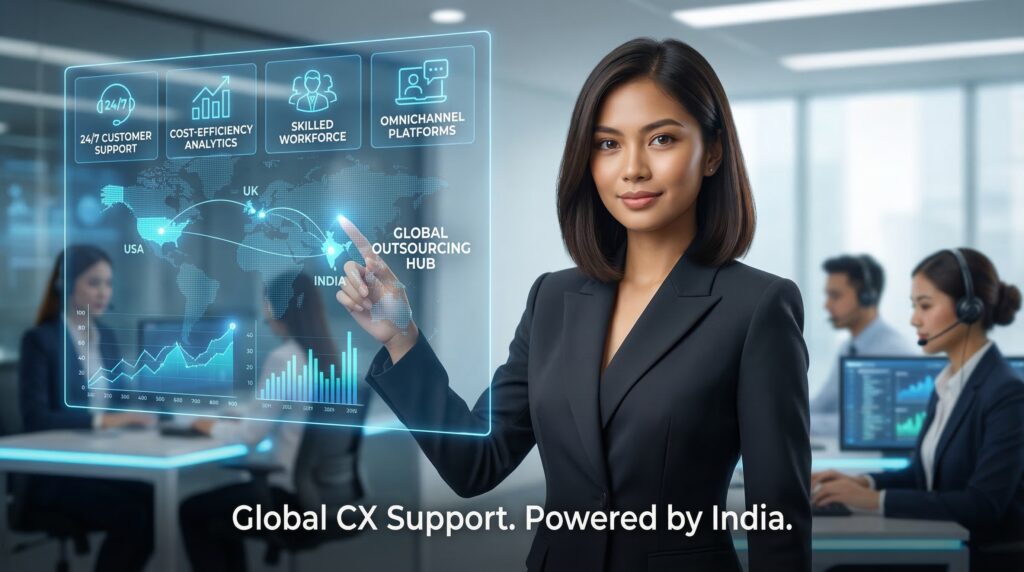
US and UK companies outsource customer experience to India to reduce operational costs, access a large skilled workforce, enable 24/7 global support, and deploy AI-enabled CX operations at scale. India’s mature outsourcing ecosystem, multilingual talent, and advanced digital infrastructure make it a strategic hub for enterprise customer support outsourcing services.
Artificial intelligence is transforming the way enterprises design and operate customer experience systems. Modern service models no longer rely exclusively on human agents or automated tools. Instead, organizations are implementing hybrid CX architectures that combine AI-driven automation with human expertise.
AI chatbots and automation platforms manage high-volume, repetitive inquiries such as order tracking, account updates, and billing questions. Human agents handle complex or sensitive interactions that require contextual judgment, regulatory interpretation, or empathy.
This hybrid model enables organizations to improve response speed, maintain service quality, and manage operating costs effectively.
India has emerged as a global delivery hub for this transformation. Leading outsourcing providers operate cloud-based Contact Center platforms that integrate artificial intelligence, workforce management, and analytics. These platforms allow enterprises in the United States and United Kingdom to scale global service operations efficiently while maintaining regulatory compliance and operational resilience.
AI Maturity, Enterprise Evolution, and the Strategic Imperative
Customer experience has become one of the most important competitive differentiators for global organizations. Research across multiple industries shows that customer expectations continue to increase while operational complexity expands.
Enterprises must now support:
- omnichannel customer interactions
- real-time service delivery
- digital engagement across multiple platforms
- data-driven service optimization
Traditional in-house support structures often struggle to scale under these conditions.
As a result, many enterprises are redesigning their CX operating models around three structural pillars:
- Artificial intelligence and automation
- globally distributed service teams
- specialized outsourcing partners
Within this framework, India has developed one of the largest ecosystems of BPO outsourcing companies delivering global customer operations.
These organizations provide integrated service capabilities including customer support outsourcing services, knowledge process outsourcing, analytics, and technology-enabled Outsourcing services for enterprise operations.
For companies in the United States and United Kingdom, outsourcing customer experience operations to India enables scalable service delivery, improved cost efficiency, and access to highly skilled talent pools.
Key Insights at a Glance
- Enterprises outsourcing CX operations can reduce service costs by 40–60 percent.
- India hosts one of the world’s largest BPO company ecosystems supporting global enterprises.
- Global organizations achieve 24/7 service coverage through distributed service centers.
- AI-powered automation processes significantly reduce call volumes and operational workload.
- Advanced analytics platforms capture and analyze customer voice signals to improve service design.
- Outsourcing allows rapid workforce expansion during peak demand cycles.
- Integrated cxm platforms improve customer data visibility and service personalization.
17 Strategic Reasons US & UK Companies Outsource Customer Experience to India
1. Large Operational Cost Advantage
Labor and infrastructure costs in India remain significantly lower than those in Western markets.
Typical enterprise savings include:
- 40–60% lower operational labor costs
- reduced infrastructure expenses
- lower recruitment and training costs
These savings allow organizations to invest more heavily in digital transformation initiatives and product innovation.
2. Access to a Highly Skilled Workforce
India produces millions of graduates annually across disciplines such as business administration, engineering, healthcare administration, and finance.
This talent base allows outsourcing providers to support advanced customer interactions including:
- financial services support
- healthcare claims assistance
- enterprise software troubleshooting
- technical service operations
Many global companies therefore leverage Indian service centers for knowledge process outsourcing functions in addition to traditional customer service operations.
3. 24/7 Global Service Availability
Customer expectations now require continuous service availability across multiple time zones.
India’s geographic location enables continuous service coverage for:
- North American markets
- European markets
- Asia-Pacific regions
This capability allows organizations to maintain round-the-clock support without expanding domestic staffing.
4. Mature Outsourcing Ecosystem
India has developed one of the most sophisticated outsourcing ecosystems in the world.
The ecosystem includes:
- advanced telecommunications networks
- cloud-based service platforms
- cybersecurity infrastructure
- workforce training institutions
Many enterprises rely on Indian BPO call center operations to manage large-scale customer service environments.
5. AI and Automation Integration
Modern outsourcing providers increasingly deploy AI technologies to improve service efficiency.
These technologies include:
- conversational chatbots
- robotic process automation
- predictive analytics systems
- intelligent call routing platforms
Such automation processes reduce manual workloads while improving response speed and service accuracy.
6. Omnichannel Customer Engagement
Customers now interact through multiple digital channels.
These channels include:
- voice calls
- live chat
- social media
- messaging applications
Modern Contact Center platforms unify these communication channels, allowing agents to manage customer interactions through a single integrated interface.
7. Rapid Operational Scalability
Customer service demand fluctuates across seasons, marketing campaigns, and product launches.
Outsourcing providers allow enterprises to scale service capacity rapidly by:
- expanding agent teams
- deploying additional infrastructure
- activating automation tools
This scalability helps organizations maintain service performance during demand spikes.
8. Workforce Continuity and Resilience
Distributed service operations reduce the risk of operational disruption.
Many outsourcing providers maintain:
- multiple service locations
- remote workforce infrastructure
- disaster recovery protocols
These capabilities ensure continuity during natural disasters, infrastructure failures, or other disruptions.
9. Cross-Border Compliance Expertise
Customer service operations must comply with numerous regulatory frameworks across different markets.
Outsourcing providers often maintain dedicated compliance teams managing requirements related to:
- financial services regulations
- healthcare privacy standards
- international data protection laws
This expertise helps enterprises operate within complex regulatory environments.
10. Enterprise System Integration
Modern service environments integrate directly with enterprise technology systems.
These integrations commonly include:
- CRM platforms
- cxm platforms
- enterprise resource planning systems
- knowledge management tools
This integration allows agents to access customer information in real time, improving service speed and resolution quality.
11. Vendor Consolidation Strategies
Many enterprises seek to reduce the number of operational vendors they manage.
Large outsourcing providers offer integrated portfolios that include:
- customer support outsourcing services
- analytics and reporting
- it support services
- digital service operations
This consolidation simplifies vendor management and governance.
12. Customer Voice Analytics
Modern CX platforms capture large volumes of interaction data.
Analytics platforms process customer voice signals to identify patterns such as:
- product quality issues
- service bottlenecks
- emerging customer needs
- potential churn indicators
These insights help organizations improve customer experience strategies.
13. Multilingual Service Capability
Global companies frequently require support in multiple languages.
Many Indian outsourcing providers now offer multilingual service teams capable of supporting customers across international markets.
This capability enables consistent service delivery worldwide.
14. Faster CX Technology Adoption
Specialized outsourcing providers often implement new technologies faster than internal teams.
Capabilities commonly deployed include:
- AI-powered chatbots
- automated knowledge bases
- real-time analytics dashboards
- intelligent service routing systems
These technologies accelerate digital CX transformation.
15. Performance Improvement and Service Quality
Outsourcing partners typically maintain structured training programs and performance monitoring systems.
Organizations often report improvements such as:
- faster response times
- higher first-contact resolution rates
- improved customer satisfaction metrics
These improvements result from specialized operational expertise.
16. Strategic Focus on Core Business
Managing large customer service operations requires significant operational resources.
Outsourcing allows organizations to focus on strategic priorities such as:
- product development
- market expansion
- innovation initiatives
Operational service functions are managed by specialized providers.
17. CX Operating Model Transformation
The most significant driver of outsourcing is the need to redesign enterprise CX operating models.
Modern service organizations combine:
- artificial intelligence
- distributed workforce models
- cloud-based platforms
- advanced analytics
Outsourcing partners provide the infrastructure and operational capabilities required to support this transformation at scale.
Read More: https://mascallnet.ai/ai-powered-outsourcing-how-intelligent-contact-centers-drive-growth/
Business Benefits and ROI
Enterprises implementing outsourced hybrid CX models often experience measurable operational improvements.
Example transformation outcomes include:
| Metric | Before Outsourcing | After Outsourcing |
| Customer support cost | $12M annually | $7M annually |
| Average response time | 5.5 minutes | 2.3 minutes |
| First contact resolution | 65% | 85% |
| Customer satisfaction | 80% | 92% |
These improvements result from AI integration, workforce optimization, and advanced analytics deployment.
Governance and Long-Term Operational Impact
Outsourcing relationships require robust governance frameworks.
Key governance areas include:
Data Governance
Organizations must implement policies controlling data access, encryption, and storage.
Vendor Risk Management
Enterprises evaluate outsourcing providers based on cybersecurity posture, financial stability, and compliance certifications.
AI Oversight Models
AI-enabled service platforms require oversight mechanisms ensuring algorithm transparency and human escalation pathways.
Regulatory Compliance
Global service operations must comply with evolving international data protection laws and industry-specific regulations.
Business Continuity Planning
Enterprises must maintain operational redundancy and disaster recovery protocols across service locations.
CX Delivery Model Comparison
| Model | Strengths | Limitations | Best Use Case |
| AI-Only CX | Lowest cost, rapid automation | Limited problem solving capability | High-volume simple queries |
| Human-Only CX | Strong empathy and flexibility | Higher operational cost | Complex or sensitive issues |
| Hybrid CX | Balanced efficiency and quality | Requires governance and integration | Enterprise global service operations |
FAQ — Enterprise CX Outsourcing
Why do US and UK companies outsource customer experience to India?
Enterprises outsource CX operations to India primarily to reduce operational costs, access a large skilled workforce, provide 24/7 service coverage, and implement scalable AI-enabled customer support systems.
How much cost savings can enterprises achieve through outsourcing?
Global organizations typically achieve cost reductions between 40 and 60 percent by outsourcing customer support operations to specialized service providers.
What risks must enterprises manage when outsourcing CX operations?
Key risks include data security, regulatory compliance, vendor dependency, operational continuity, and service quality monitoring.
How do AI technologies improve outsourced customer service?
AI technologies automate repetitive service tasks, improve response speed, enable predictive analytics, and enhance customer interaction routing.
How should enterprises select a CX outsourcing partner?
Enterprises typically evaluate providers based on operational scale, compliance certifications, technology infrastructure, AI capabilities, workforce expertise, and global delivery capabilities.
Conclusion
Global enterprises are redesigning their customer experience operating models in response to increasing service complexity, digital transformation, and rising customer expectations.
Outsourcing CX operations to India allows organizations to achieve:
- scalable service operations
- significant cost efficiencies
- access to highly skilled talent
- AI-enabled service delivery
- global workforce resilience
Within this transformation landscape, service providers such as Mascallnet demonstrate how integrated outsourcing platforms can combine artificial intelligence, advanced analytics, and distributed service operations to support enterprise CX transformation.
Organizations evaluating their future CX operating model should assess whether their current structure can sustainably support this model at scale.