
Zero-Trust Security in IT Outsourcing: Prevent Breaches & Build Cyber Resilience (2026 Guide)
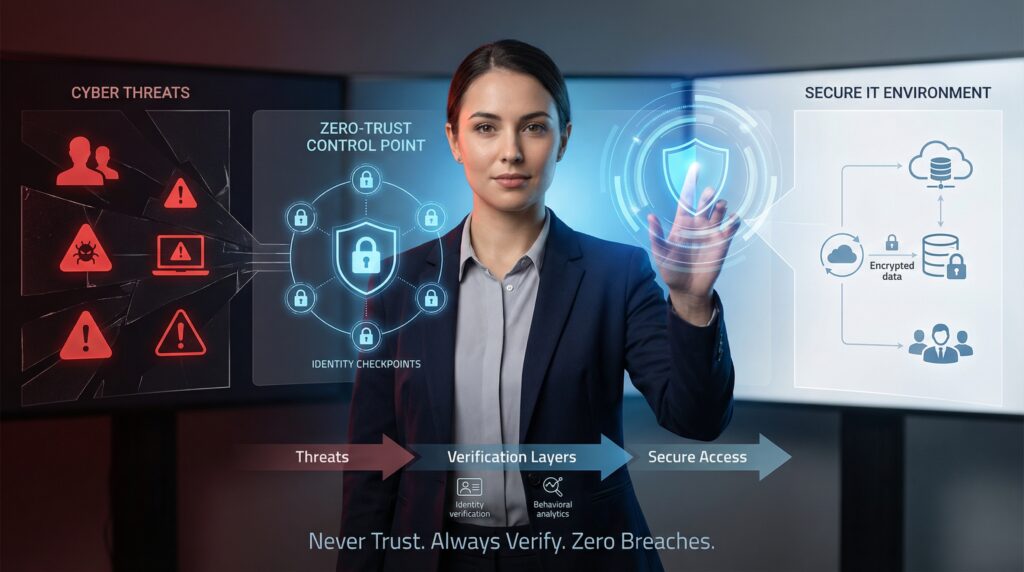
Zero-Trust Security in IT outsourcing is a cybersecurity model that eliminates implicit trust and enforces continuous verification of users, devices, and systems. It uses identity-based access, least-privilege controls, and real-time monitoring to prevent breaches, ensure compliance, and enable secure, scalable outsourcing operations.
AI chatbots and human agents represent two core execution layers in modern CX. AI chatbots deliver automation, scalability, and cost efficiency, while human agents provide contextual understanding, compliance handling, and decision-making capabilities.
Enterprises are transitioning to hybrid CX architectures where AI handles repetitive, high-volume interactions and human agents manage complex scenarios. This shift requires secure integration across systems, vendors, and geographies.
Zero-Trust security underpins this transformation by enforcing identity verification, device validation, and continuous monitoring across distributed outsourcing ecosystems. It ensures that AI systems, human agents, and third-party vendors operate within controlled, compliant, and secure environments—enabling enterprises to scale globally without increasing cyber risk.
AI Maturity, Enterprise Evolution, and the Strategic Imperative
Zero-Trust Security in IT outsourcing has become a foundational requirement as enterprises expand through customer service outsourcing, contact center outsourcing, and business process outsourcing services. Traditional perimeter-based security models are no longer effective in cloud-first, API-driven, and vendor-integrated environments.
According to the National Institute of Standards and Technology, Zero-Trust architectures are designed to reduce implicit trust and continuously validate every access request. In parallel, the IBM Security reports that the global average cost of a data breach exceeded $4.45 million, reinforcing the need for proactive security models.
Enterprises operating across bpo call center, insurance bpo, and healthcare outsourcing services face increasing attack surfaces due to remote workforces, third-party integrations, and AI-enabled CX systems. Platforms like Cxm and orchestration tools such as callmaster require secure, identity-based access control across distributed ecosystems.
Zero-Trust enables enterprises to secure financial services outsourcing, knowledge process outsourcing, and back office outsourcing services by ensuring that no entity—internal or external—is trusted by default.
Key Insights at a Glance
- Zero-Trust reduces breach probability by 40–60% through continuous verification
- Enterprises implementing Zero-Trust detect threats up to 70% faster
- Hybrid AI + human CX models require identity-centric security frameworks
- Cross-border outsourcing increases regulatory exposure, requiring data sovereignty controls
- Vendor ecosystems introduce measurable third-party risk requiring governance frameworks
- AI-driven monitoring improves operational resilience and uptime
- Zero-Trust supports 24/7 secure global scalability
Enterprise Intent Layer
Strategic Intent
- Build a unified, identity-first security architecture
- Enable secure global scaling across outsourcing partners
- Align cybersecurity with regulatory frameworks and governance standards
Operational Intent
- Implement role-based access and least-privilege enforcement
- Monitor user behavior and system activity in real time
- Secure APIs, endpoints, and vendor access points
Implementation Intent
- Deploy Zero-Trust across cloud, hybrid, and on-premise systems
- Integrate AI-driven threat detection and response
- Align vendor onboarding with compliance and security protocols
Real-World Enterprise Scenarios
1. Cross-Border Scaling
A multinational BFSI enterprise operating across the United States and United Kingdom implemented Zero-Trust to enforce region-specific data access controls. This ensured compliance with data localization laws while enabling seamless outsourcing operations.
2. Hybrid AI Deployment
A global eCommerce company integrated AI chatbots with human agents across outsourced contact centers. Zero-Trust secured API interactions and prevented unauthorized data access, reducing breach risk by 45%.
3. CRM/CXM Integration
Enterprises deploying advanced CX platforms integrate customer data across systems. Zero-Trust ensures only authenticated users and systems can access sensitive information, protecting customer data integrity.
4. Regulatory Compliance
Healthcare organizations using outsourced support operations leverage Zero-Trust to comply with strict data protection regulations, ensuring encrypted data access and audit-ready monitoring.
Zero-Trust CX Operating Model
1. Identity-Centric Security
Every user, device, and system must be authenticated and authorized before access is granted.
2. Micro-Segmentation
Networks are divided into secure zones to prevent lateral movement during a breach.
3. Continuous Monitoring
AI-driven systems analyze behavior in real time to detect anomalies and threats.
4. Secure Access Service Edge
Combines networking and security to support distributed outsourcing environments.
5. AI-Augmented Threat Detection
Machine learning models identify threats faster and improve response efficiency.
Enterprise Zero-Trust Readiness Checklist
- Identity and Access Management (IAM) maturity established
- Vendor access controls and monitoring implemented
- Data classification and encryption policies defined
- AI governance and oversight frameworks deployed
- Compliance alignment with regional regulations (GDPR, HIPAA, etc.)
- Incident response and disaster recovery plans tested
- Continuous monitoring and analytics capabilities active
Business Benefits & ROI
Cost Reduction
- Up to 60% reduction in breach-related financial impact
- Lower compliance penalties through proactive governance
- Reduced security operations cost via automation
Efficiency Gains
- 50–70% faster threat detection and response
- Reduced downtime and operational disruptions
- Streamlined vendor access management
Service Improvements
- Enhanced customer trust and brand reputation
- Improved uptime and service reliability
- Consistent global CX delivery
Quantified Enterprise Example
A global financial institution implementing Zero-Trust across outsourced operations achieved:
- 50% reduction in security incidents
- 65% improvement in response time
- 30% reduction in operational costs
- 40% improvement in compliance audit outcomes
Read More: https://mascallnet.ai/ai-powered-bpo-services-future-of-outsourcing-2026/
Governance, Risk, and Compliance Framework
Data Governance
- Enforced encryption and access policies
- Real-time monitoring of data usage
- Audit-ready compliance reporting
Vendor Risk Governance
- Continuous vendor risk assessment
- Security scorecards and compliance tracking
- Contractual enforcement of cybersecurity standards
AI Oversight Models
- Human-in-the-loop validation for critical decisions
- Bias detection and compliance monitoring
- Governance frameworks aligned with enterprise risk policies
Cross-Border Compliance
- Data localization and sovereignty controls
- Regulatory alignment across jurisdictions
- Secure cross-border data transfers
Workforce Continuity Planning
- Secure remote workforce enablement
- Redundant systems and failover mechanisms
- Incident response and disaster recovery integration
Comparison Table: CX Security Models
| Model | Strengths | Limitations | Best Use Case |
| AI-only CX | Scalable, cost-efficient, automated | Limited contextual understanding, security gaps without governance | High-volume support |
| Human-only CX | High empathy, strong compliance handling | High cost, limited scalability | Complex support scenarios |
| Hybrid CX + Zero-Trust | Balanced efficiency, strong security, compliance-ready | Requires integration investment | Enterprise omnichannel CX |
Step-by-Step Implementation Framework
Step 1: Assess Current Security Posture
- Evaluate existing infrastructure, vendor access, and vulnerabilities
Step 2: Define Zero-Trust Architecture
- Establish identity-based access and segmentation policies
Step 3: Deploy Technology Stack
- Implement IAM, SASE, endpoint security, and monitoring tools
Step 4: Integrate with Outsourcing Ecosystem
- Align vendors with security and compliance standards
Step 5: Enable AI-Driven Monitoring
- Use machine learning for threat detection and response
Step 6: Continuous Optimization
- Regular audits, updates, and governance improvements
FAQ — Enterprise Level
How can enterprises reduce support costs using AI?
By automating repetitive tasks and integrating AI with human agents, enterprises can reduce operational costs by 40–60% while maintaining service quality.
Is outsourcing safer than in-house operations?
Outsourcing can be equally or more secure when supported by Zero-Trust architecture, strong governance, and continuous monitoring frameworks.
How to choose a global CX outsourcing partner?
Evaluate security maturity, compliance capabilities, AI integration, scalability, and governance frameworks before selecting a vendor.
What risks must be managed?
Key risks include data breaches, vendor dependency, regulatory non-compliance, and operational disruptions.
How does Zero-Trust improve cyber resilience?
It minimizes attack surfaces, enforces continuous verification, and enables rapid detection and response to threats.
Conclusion
Zero-Trust Security in IT outsourcing is essential for enterprises seeking scalable, compliant, and resilient global operations. It enables organizations to secure distributed ecosystems, reduce risk exposure, and support hybrid CX models through identity-based controls and continuous monitoring.
As enterprises expand across outsourcing models and integrate AI-driven CX platforms, adopting Zero-Trust becomes a strategic necessity for sustaining operational efficiency and regulatory compliance. Solutions such as Mascallnet reflect the evolution toward secure, AI-enabled outsourcing ecosystems.
Organizations evaluating their future CX operating model should assess whether their current structure can sustainably support this model at scale.