
How AI & RPA Are Transforming FMCG Customer Support Operations: Speed, Savings & Satisfaction
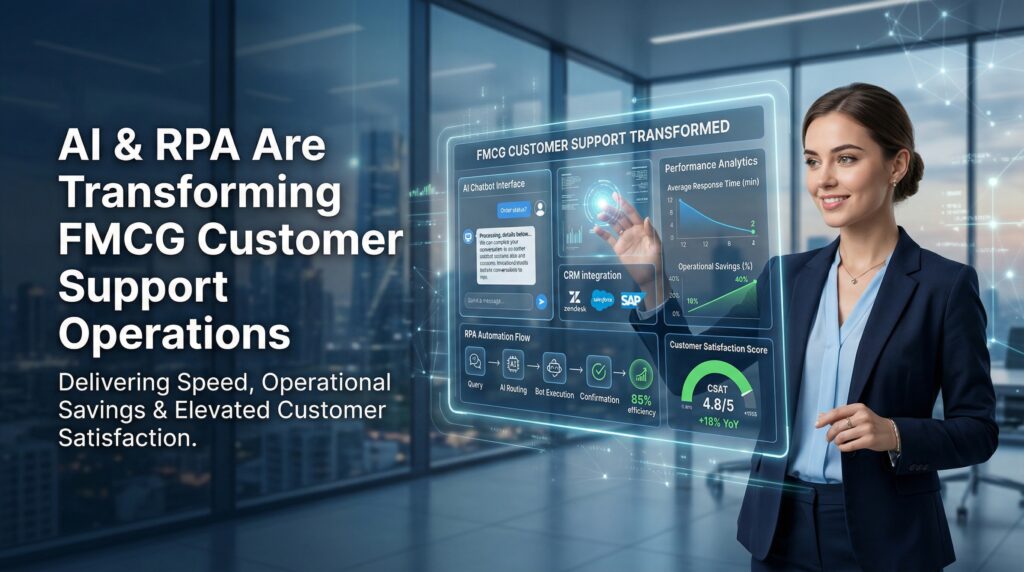
AI and RPA transform FMCG customer support by automating high-volume interactions, enabling hybrid AI-human workflows, and ensuring 24/7 service. Enterprises benefit from faster resolution, reduced costs, improved compliance, and scalable operations capable of managing global demand fluctuations.
AI chatbots handle high-volume, routine inquiries using natural language processing, while human agents manage complex, sensitive, or regulatory-dependent issues. Robotic Process Automation (RPA) executes structured back-office tasks such as order tracking, refunds, and CRM updates.
The combination of AI and RPA enables a hybrid CX operating model where automation manages volume and human agents focus on exceptions. This shift reduces dependency on labor-intensive models, supports continuous service delivery, and improves first-contact resolution.
For FMCG enterprises, integrating AI and RPA with CRM, ERP, and CXM platforms provides unified visibility into the customer voice, enabling proactive engagement, predictive support, and data-driven insights for operational decisions. Hybrid deployment ensures global scalability, multilingual coverage, and compliance adherence, transforming customer support from a cost center to a strategic capability aligned with enterprise goals.
Introduction
AI Maturity, Enterprise Evolution, and the Strategic Imperative
FMCG organizations face rising customer expectations, volatile demand cycles, regulatory complexity, and workforce shortages. AI and RPA are transforming FMCG customer support operations into agile, data-driven, and cost-efficient platforms.
Traditional contact centers are being redesigned into hybrid bpo call centers supported by knowledge process outsourcing, AI-powered automation processes, and integrated customer support outsourcing services. This redesign addresses the strategic imperatives of cost reduction, operational efficiency, compliance, risk mitigation, and scalable workforce deployment.
Key Insights at a Glance
- Hybrid AI-human CX can reduce operational costs by 30–50%.
- Automation improves first-contact resolution by 20–25%.
- 24/7 service delivery is achievable without proportional staffing increases.
- Regulatory compliance is enhanced via automated monitoring and auditing.
- Vendor consolidation simplifies management and reduces operational risk.
- AI-driven analytics capture customer voice for continuous CX optimization.
Enterprise Intent Layer
Strategic
- Redesign CX operating models to align with enterprise governance frameworks.
- Enable cross-border service delivery with consistent performance and compliance.
- Integrate AI and RPA into enterprise-wide transformation strategies.
Operational
- Embed AI chatbots and RPA into contact center workflows.
- Reallocate workforce toward exception management and high-value tasks.
- Standardize performance KPIs linked to business outcomes.
Implementation
- Deploy modular architecture integrating CRM, ERP, and CXM platforms.
- Implement AI governance and vendor risk management protocols.
- Utilize phased rollout to control operational and regulatory risk.
Real-World Enterprise Scenarios
Cross-Border Scaling
Global FMCG enterprises require uniform service quality across diverse regions. AI-powered outsourcing services allow consistent process execution while complying with local regulations, data sovereignty, and multilingual requirements.
Hybrid AI Deployment
Routine inquiries (order status, FAQs) are handled by AI chatbots, while human agents manage escalations, sensitive complaints, and regulatory queries. This hybrid model balances cost, speed, and customer satisfaction.
CRM/CXM Integration
Integrating AI and RPA with CRM/CXM platforms centralizes customer voice data, enabling predictive support, personalized engagement, and insights for product and operational decisions.
Regulatory Compliance
Automation ensures adherence to GDPR, CCPA, consumer protection laws, and industry standards. Continuous monitoring and reporting reduce compliance risk in complex cross-border environments.
Strategic Transformation Framework
CX Operating Model Redesign
The modern model integrates four layers:
- AI Interaction Layer: Chatbots, voice bots, self-service interfaces.
- RPA Execution Layer: Back-office processes, CRM updates, automated tickets.
- Human Expertise Layer: Exception handling, regulatory support, empathy-based interactions.
- Analytics & Governance Layer: Performance insights, compliance reporting, vendor oversight.
Implementation Architecture
- Omnichannel interfaces: voice, chat, email, social.
- Middleware integration: connecting CRM, ERP, and CXM systems.
- Analytics platform: real-time dashboards for operational and customer insights.
- Security & compliance controls: encryption, access control, and audit logging.
Vendor Selection Criteria
- Maturity of AI and RPA capabilities.
- Global delivery footprint with regulatory compliance expertise.
- System integration capability (CRM, ERP, CXM).
- Proven business continuity planning and risk management.
- Financial stability and scalable infrastructure.
Exit Strategy Planning
Enterprises must ensure data portability, documented processes, and contractual safeguards to avoid vendor lock-in and maintain operational continuity during transitions.
Business Benefits & ROI
Quantified Operational Example
Multinational FMCG company implementation of hybrid AI CX:
Cost Savings
- 40% reduction in operational support costs via automation and vendor consolidation.
Efficiency Gains
- Average handling time reduced by 35%.
- First-contact resolution increased by 22%.
Service Improvements
- Customer satisfaction scores rose 18%.
- Response times reduced from hours to minutes.
Competitive Advantages
- Scalable service for product launches and seasonal demand spikes.
- Consistent global service quality and compliance.
Governance & Long-Term Impact
Data Governance
- Centralized management ensures compliance with data privacy laws.
- Role-based access and encryption maintain data security.
Vendor Risk Governance
- Continuous performance and security monitoring of outsourcing partners.
- Contractual SLAs protect service quality and regulatory adherence.
AI Oversight Models
- Human review for automated decisions.
- Bias detection, ethical AI compliance, and audit logs.
Cross-Border Compliance
- Data residency and legal oversight for international operations.
- Automated compliance checks ensure local regulation adherence.
Workforce Continuity Planning
- Reskilling programs for human agents supporting AI augmentation.
- Contingency strategies for operational disruptions.
Data Sovereignty Considerations
- Localized data storage where required.
- Secure transmission and encryption protocols for global operations.
Comparison Table
| Model | Strengths | Limitations | Best Use Case |
| AI-only CX | Lowest cost, 24/7 availability | Limited empathy, complex issue handling | High-volume routine inquiries |
| Human-only CX | High empathy, handles complex issues | High cost, low scalability | Premium support, escalations |
| Hybrid CX | Cost-effective, scalable, compliant | Integration complexity | Enterprise-scale global operations |
FAQ — Enterprise Level
How can enterprises reduce support costs using AI?
Automating repetitive interactions and optimizing workforce allocation reduces handling time and operational expenses.
Is outsourcing safer than in-house operations?
With proper governance, outsourcing enhances security, compliance, and operational resilience through specialized infrastructure and expertise.
How to choose a global CX outsourcing partner?
Evaluate AI and RPA capabilities, integration expertise, compliance maturity, scalability, and financial stability.
What risks must be managed?
Vendor dependency, data security, compliance, business continuity, and AI governance risks.
How does AI improve customer satisfaction?
Faster response times, consistent service quality, and proactive issue resolution improve overall CX.
How can enterprises scale CX operations globally?
Deploy hybrid AI-human models, integrate with CRM/CXM systems, and ensure governance and regulatory compliance.
Conclusion
AI & RPA Are Transforming FMCG Customer Support Operations into scalable, efficient, and compliant service platforms. Enterprises adopting hybrid CX architectures gain measurable cost savings, operational efficiency, and improved customer satisfaction while maintaining governance maturity and risk oversight.
Industry providers such as Mascallnet demonstrate how AI-enabled bpo company and outsourcing services capabilities can support global enterprises in this transformation.
Organizations evaluating their future CX operating model should assess whether their current structure can sustainably support this model at scale.