
AI BPO vs Traditional Call Centers: Which Delivers Higher ROI & Lower Costs in 2026?
AI Overview
AI BPO vs Traditional Call Centers defines a structural transformation of the enterprise contact center from labor-intensive service operations to AI-orchestrated, automation-driven experience platforms. AI BPO integrates conversational AI, robotic process automation, machine learning analytics, and workflow orchestration to resolve high-volume interactions with minimal human intervention. Traditional call centers rely on human agents, manual supervision, workforce management systems, and facility-centric infrastructure.
AI chatbots and virtual agents manage deterministic and moderately complex interactions using natural language processing, while human specialists handle exceptions, regulatory disclosures, negotiations, and emotionally sensitive scenarios. This hybrid model lowers marginal cost per interaction while preserving service quality for complex engagements. Enterprises adopting AI-enabled delivery report structurally lower operating costs, improved consistency, and faster scalability across regions. As a result, AI BPO is redefining cxm architectures into data-driven operating systems optimized for omnichannel engagement, compliance enforcement, and global service continuity.
AI BPO vs Traditional Call Centers: AI Maturity, Enterprise Evolution, and the Strategic Imperative
AI BPO vs Traditional Call Centers is now evaluated as a board-level operating model decision affecting long-term cost structure, resilience, regulatory exposure, and competitive positioning. Traditional bpo call center models optimized for voice channels face structural limitations in digital-first environments characterized by asynchronous messaging, fluctuating demand, and rising labor costs across major outsourcing hubs.
Advisory perspectives associated with Gartner, McKinsey & Company, Forrester, IDC, and Fortune Business Insights indicate that AI maturity strongly correlates with service efficiency, customer satisfaction, and operational resilience. Enterprises are shifting from outsourcing labor capacity toward outsourcing outcomes, where providers deliver measurable performance improvements through automation, analytics, and predictive insights.
Wage inflation, attrition, training overhead, and infrastructure costs increase the total cost of ownership for human-centric operations. AI BPO architectures reduce dependence on physical sites and enable distributed, cloud-based delivery networks supporting 24/7 operations, disaster recovery, and cross-border scaling without proportional cost escalation.
Key Insights at a Glance
- AI-enabled delivery can reduce cost per interaction by 35–70%
- Hybrid AI-human models deliver the highest enterprise ROI
- Governance maturity determines risk exposure more than technology selection
- Cross-border compliance shapes sourcing strategies
- Workforce continuity planning becomes a strategic imperative
- Integration with enterprise platforms determines scalability outcomes
- Data sovereignty requirements influence delivery architecture
- Vendor ecosystem capability outweighs labor arbitrage advantages
Executive Decision Matrix — Boardroom Framework
| Decision Factor | AI BPO Advantage | Traditional Advantage | Hybrid Outcome |
| Cost trajectory | Declining through automation | Rising with labor costs | Optimized |
| Scalability | Near-unlimited | Facility constrained | High |
| Compliance control | Automated monitoring | Human judgment | Balanced |
| Customer experience | Consistency | Empathy | Optimal |
| Operational resilience | Distributed | Site-dependent | Strong |
Enterprise Intent Layer
Strategic Intent
Enterprises increasingly treat Outsourcing services as a strategic capability enabling digital transformation, geographic expansion, and operational resilience. AI BPO allows rapid entry into new markets without proportional workforce growth, particularly valuable for regulated industries requiring multilingual support, auditability, and secure data handling.
Operational Intent
Operational transformation focuses on optimizing automation processes across front-office and back-office workflows. Intelligent routing, predictive staffing, automated compliance checks, and real-time quality monitoring reduce inefficiencies inherent in manual supervision structures.
Implementation Intent
Implementation requires redesigning service taxonomies, governance frameworks, performance metrics, and technology architectures. Traditional metrics such as average handling time are replaced by outcome-based indicators including resolution effectiveness, customer effort score, and retention impact.
Real-World Enterprise Scenarios
Cross-Border Scaling and Follow-the-Sun Delivery
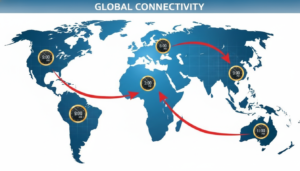
Global enterprises expanding across regions face fragmented regulations and language requirements. AI BPO platforms enable localized compliance enforcement, multilingual capabilities, and continuous service coverage without establishing large physical centers.
Hybrid AI Delivery in Regulated Environments
AI handles authentication, triage, and routine transactions while complex cases escalate to human experts, preserving compliance and service quality.
CRM and Experience Platform Integration
Integration with CRM systems provides unified visibility of the customer voice, enabling predictive analytics to identify churn risk, detect service failures, and recommend proactive interventions.
Compliance-Sensitive Operations
Financial services, healthcare, telecommunications, and public sector organizations maintain human oversight layers for regulatory disclosures, fraud detection, and ethical decision-making requirements.
Strategic Framework for Operating Model Selection
Enterprises evaluating bpo outsourcing companies apply multi-dimensional frameworks:
Technology capability
Operational resilience
Governance maturity
Workforce sustainability
Economic structure
The modern bpo company functions as an ecosystem orchestrator integrating AI vendors, cloud providers, and domain specialists. Many enterprises incorporate knowledge process outsourcing for analytics-driven functions such as compliance reviews, fraud investigations, and decision support.
Business Benefits and ROI Analysis
Structural Cost Drivers
AI BPO reduces costs through:
- Automation of repetitive interactions
- Reduced hiring and training expenditure
- Lower infrastructure and facility costs
- Predictive service optimization
- Increased workforce productivity
Quantified Enterprise Example
A multinational banking organization processing 75 million annual interactions:
Traditional model cost per interaction: $5.00
AI-enabled model cost per interaction: $2.05
Automation coverage: 60%
Annual savings: approximately $221 million
Secondary benefits include improved first-contact resolution, reduced error rates, and enhanced compliance accuracy.
Revenue Protection and Growth Impact
AI-driven insights enable proactive retention campaigns, fraud prevention, and personalized engagement, transforming service operations into revenue protection and growth engines.
Governance, Risk, and Compliance Framework
Data Governance and Sovereignty
Cross-border data regulations require localized processing, storage, and access controls. AI systems must comply with jurisdiction-specific rules governing personal data handling and retention.
Vendor Risk Governance
Enterprises assess dependency risks across AI providers, cloud platforms, and service partners. Multi-vendor strategies mitigate exposure to operational disruption and concentration risk.
AI Oversight Models
Human-in-the-loop validation
Bias detection protocols
Explainability requirements
Ethical usage policies
Continuous performance monitoring
Workforce Continuity Planning
Automation shifts workforce demand toward analytical, supervisory, and technical roles. Reskilling programs and transition planning maintain institutional knowledge and operational stability.
Cross-Border Compliance
Global delivery models must align with regional consumer protection laws, disclosure requirements, and communication recording regulations.
Comparison of CX Delivery Models
| Model | Strengths | Limitations | Best Use Case |
| AI-only CX | Ultra-low cost, scalability, consistency | Limited empathy | High-volume transactional services |
| Human-only CX | Emotional intelligence, nuanced decisions | High cost | Complex interactions |
| Hybrid CX | Balanced efficiency and quality | Governance complexity | Most enterprise environments |
Traditional Call Center Model Assessment
Traditional models remain necessary for negotiation-intensive interactions, dispute resolution, and high-value sales processes. However, acknowledged challenges include high attrition, rising wage pressure, facility costs, and limited scalability during demand spikes.
Technology and Support Ecosystem Convergence
AI BPO integrates closely with enterprise it support services, enabling automated incident resolution, predictive alerts, and self-service capabilities. This convergence creates unified service operations spanning customer support and technical assistance.
Evolution of Customer Support Outsourcing
Modern customer support outsourcing services emphasize omnichannel engagement across messaging platforms, social media, and digital interfaces rather than voice-only interactions.
Vendor Selection and Governance Checklist
Enterprises evaluating providers should assess:
AI maturity and roadmap
Compliance certifications
Data security posture
Financial stability
Integration capability
Workforce strategy
Disaster recovery readiness
FAQ — Enterprise Decision Framework
Which model delivers the highest ROI in 2026?
Hybrid AI-human models typically provide the optimal balance between cost efficiency and service quality.
What transformation timeline should enterprises expect?
Large organizations typically require 18–36 months for full operating model transition.
What are the primary risks?
Vendor dependency, integration complexity, workforce disruption, and compliance exposure.
Are AI models suitable for regulated industries?
Yes, when supported by governance, oversight, and auditability mechanisms.
Can traditional providers evolve successfully?
Many legacy providers are transitioning toward technology-enabled delivery through partnerships, acquisitions, and platform investments.
Conclusion
AI BPO vs Traditional Call Centers is fundamentally a decision about scalability, governance maturity, and long-term economic sustainability. AI-enabled delivery provides superior efficiency for high-volume interactions, while human-centric models remain essential for complex engagement scenarios. Hybrid architectures deliver the most balanced outcomes for multinational enterprises navigating regulatory complexity, workforce transformation, and rising customer expectations.
Industry platforms such as MasCallNet illustrate the shift toward integrated AI-human ecosystems designed for global delivery. Organizations evaluating their future CX operating model should assess whether their current structure can sustainably support this model at scale.