
AI vs Human Customer Support in 2026: The Complete Executive Guide to Building a Hybrid Model with the Best BPO Companies in India
AI Overview
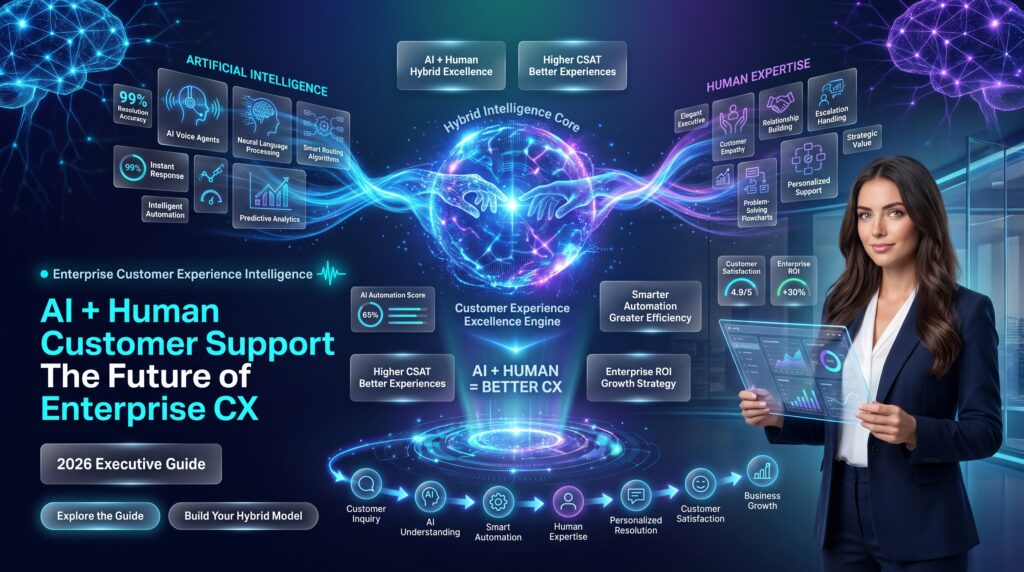
AI vs human customer support is not a replacement decision — it is an operating model design problem. Enterprises that treat AI and human agents as a single, orchestrated system, rather than competing channels, consistently show higher retention, faster resolution, and stronger revenue outcomes. This is the operating discipline we call Contact Center Intelligence™ — converting every customer conversation, AI-handled or human-handled, into a reusable business asset that improves forecasting, retention, and revenue recovery. In 2026, the best BPO companies in India are being selected on their ability to run this hybrid model at scale — not on seat pricing alone.
Executive Introduction
Every CEO, COO, and Chief Customer Officer evaluating customer support strategy this year is wrestling with a version of the same question: do we replace human agents with AI, or is that a decision we’ll regret in eighteen months?
That question, as it’s usually framed, is the wrong one. It assumes AI and human customer support are competing for the same job. They are not. AI is exceptional at consistency, speed, and scale. Humans are exceptional at judgment, trust-building, and de-escalation. Organizations that pit the two against each other — either by over-automating too fast or refusing to automate at all — consistently underperform organizations that architect them to work as one system.
We’ve spent years inside contact center operations, collections floors, CX transformation programs, and outsourcing engagements across banking, healthcare, retail, insurance, and logistics. The pattern is remarkably consistent: companies that win on customer experience in 2026 are not the ones with the most AI, and they are not the ones with the most agents. They are the ones who’ve designed the handoff between AI and humans with the same discipline a CFO applies to capital allocation.
We call this operating philosophy Contact Center Intelligence™ — the principle that every customer conversation is not merely a cost event, but a data event that should reduce churn, recover revenue, and sharpen forecasting. This is the backbone of Support-Led Revenue Growth™: support doesn’t just protect the customer relationship, it actively contributes to top-line performance when it’s architected correctly.
This guide is built for the people actually making this decision: CEOs and Founders under margin pressure, COOs accountable for service levels, CIOs and CTOs evaluating the technology stack, Chief Customer Officers accountable for retention, Heads of Operations managing day-to-day delivery, Revenue Leaders trying to connect CX to pipeline, and procurement teams comparing outsourcing partners. It covers everything from call center outsourcing fundamentals to outsourced customer support pricing, from offshore vs onshore customer support outsourcing trade-offs to a full vendor evaluation framework for identifying the best customer support outsourcing companies — because a decision that affects your cost structure and customer retention for the next three years deserves more than a five-paragraph blog post.
Key Insights
- 62% of customer support interactions in enterprise organizations can now be fully or partially automated without degrading CSAT — but only when AI is deployed with proper escalation logic, not as a blunt cost-cutting instrument.
- Organizations running a structured AI + human hybrid model report 25–45% lower cost-to-serve than pure human-staffed operations and 30–50% higher CSAT than pure AI-first deployments.
- The fastest-growing segment within contact center services in 2026 is not “AI replacing BPO” — it is AI-powered BPO, where outsourcing partners embed AI directly into human-led delivery rather than selling either in isolation.
- India remains the largest global destination for customer support outsourcing, but the basis of competition has shifted from labor arbitrage to AI-orchestration capability.
- Unresolved, mishandled, or poorly escalated customer conversations represent one of the largest — and least measured — sources of revenue leakage inside mid-market and enterprise organizations today.
- Outsourced customer support pricing models are shifting away from flat per-seat billing toward hybrid pricing tied to resolution outcomes, not headcount.
Market Reality in 2026
The customer support market has quietly split into three tiers, and most leadership teams don’t realize which tier their organization actually sits in until a diagnostic forces the conversation.
Tier 1 — Legacy Human-Only Operations. Still the majority of mid-market companies. High cost-to-serve, inconsistent quality across shifts and agents, heavy dependence on attrition-prone talent pools, and virtually no conversation-level intelligence being captured or used beyond basic SLA reporting.
Tier 2 — AI-First, Under-Governed Operations. Companies that deployed chatbots and AI voice agents aggressively between 2023 and 2025 to cut cost, often without adequate escalation design or human review sampling. Many of these organizations are now quietly walking back full automation after CSAT and NPS erosion, brand damage from mishandled escalations, and hidden costs from unresolved tickets re-entering the queue at a more expensive channel.
Tier 3 — Orchestrated Hybrid Operations. A smaller, faster-growing group treating AI and human agents as a single governed system — with clear routing logic, shared knowledge infrastructure, and conversation intelligence feeding back into sales, retention, and product teams. This is where the market is converging, and it’s the tier this guide is built to help you reach.
If your organization sits in Tier 1 or Tier 2, the gap between you and Tier 3 competitors compounds every quarter — in cost structure, in customer trust, and in the revenue intelligence your competitors are extracting from conversations you are currently discarding.
Industry Trends Shaping 2026
1. The center of gravity has shifted from “automation rate” to “resolution quality.” Boards stopped rewarding deflection percentages once the churn data behind badly deflected tickets became visible. The executive-level KPI conversation now centers on first-contact resolution, revenue retained, and time-to-value — not tickets automated.
2. Generative AI has moved from scripted bots to reasoning agents. Platforms built on large language models — OpenAI’s GPT models, Google Gemini, Anthropic’s Claude, and Microsoft Copilot — now power agent-assist tools that draft responses, summarize case history, and predict next-best-action in real time, rather than answering scripted FAQs.
3. Contact center platforms are consolidating around AI orchestration. Zendesk, Salesforce Service Cloud, Freshdesk, Genesys, NICE CXone, Five9, and Talkdesk have all rebuilt their product roadmaps around AI-human orchestration rather than pure ticketing or IVR automation.
4. Procurement teams evaluating call center outsourcing now assess AI maturity before pricing. RFPs increasingly require vendors to demonstrate their AI stack, data security posture, and escalation design as a qualifying criterion — not an optional add-on.
5. Customer conversations are being recognized as an enterprise data asset. This is the trend underpinning Contact Center Intelligence™ — forward-looking organizations are piping conversation data into CRM, forecasting, and product roadmaps, treating support interactions the way finance treats transactional data.
6. Automating business processes beyond the contact center is now table stakes. Leading organizations aren’t stopping at support automation — they’re extending AI orchestration into billing, collections, onboarding, and back-office workflows, because the same intelligence layer that improves support outcomes improves operational efficiency everywhere it’s applied. Explore how this extends beyond the contact center in our guide to automating business processes.
What Is AI + Human Customer Support?
Direct Answer: AI + human customer support — the “hybrid model” — is a service delivery architecture in which AI systems (chatbots, voice bots, and generative-AI agent-assist tools) handle high-volume, repetitive, rules-based interactions, while trained human agents handle complex, emotionally sensitive, high-value, or ambiguous interactions, connected by a governed escalation and handoff layer.
It is not “a chatbot with a human backup.” It’s a designed system with four components:
- Triage Layer — AI classifies intent, urgency, and customer value at the first point of contact, across every channel (chat, voice, email, social).
- Resolution Layer — AI resolves what it can resolve accurately and consistently: order status, password resets, appointment scheduling, billing FAQs, policy lookups, shipment tracking.
- Escalation Layer — A governed handoff to human agents with full context transferred — no “please repeat your issue” moments that erode trust.
- Intelligence Layer — Every interaction, AI-handled or human-handled, feeds a shared data layer that improves routing, forecasting, and retention strategy over time.
That fourth layer is the one almost every organization skips — and it’s the layer that separates a cost-cutting exercise from a genuine competitive advantage.
Why It Matters
Customer support has quietly become one of the highest-leverage functions in the enterprise, for three reasons boards are only now internalizing.
First, support is now a retention lever, not a cost center. In subscription, financial services, and eCommerce businesses, a single poorly handled support interaction can trigger churn worth 5–20x the cost of the interaction itself.
Second, support conversations contain revenue signals most companies throw away. Cancellation intent, upsell readiness, product friction, and competitive threats surface in support conversations weeks before they show up in churn or revenue reports — if anyone is capturing them.
Third, the AI-human staffing decision now directly affects gross margin. Support cost-to-serve is one of the few operating expense lines a CFO can meaningfully compress without touching revenue-generating headcount — provided it’s architected correctly, not simply automated aggressively.
This is precisely why Revenue Recovery Through CX™ has become a board-level conversation rather than an operations footnote. Every dropped ticket, every mishandled escalation, and every customer who churns after a poor support experience represents realized revenue loss that finance teams rarely trace back to its actual source.
Boardroom Insight: If your finance team cannot draw a line from your support KPIs to your churn numbers, you don’t have a measurement gap — you have a revenue visibility gap, and it’s larger than most CFOs assume.
Key Takeaway: Customer support is not a cost line to minimize — it’s a revenue-influencing function that most organizations still measure like a cost center.
How the Hybrid Model Actually Works
Framework: The MasCallNet Contact Center Intelligence Layer™
Definition: A four-stage operating framework governing how conversations move between AI and human agents, and how the resulting data is captured and reused across the business.
Methodology:
| Stage | Function | Owned By | Data Captured |
|---|---|---|---|
| Intake & Classification | Intent detection, urgency scoring, customer value tagging | AI (NLP models) | Intent type, sentiment, account value |
| Autonomous Resolution | FAQ, order status, scheduling, billing, policy queries | AI + Knowledge Base | Resolution time, deflection accuracy |
| Guided Escalation | Context handoff with full case history, AI-suggested response drafts | AI-Assisted Human Agent | Escalation reason, resolution outcome |
| Intelligence Feedback | Pattern detection across resolved and escalated cases | Analytics Layer | Churn signals, upsell signals, product friction |
Scoring Logic: Each interaction is scored across three axes — complexity (1–5), emotional sensitivity (1–5), and revenue value (1–5). Interactions scoring above 8 combined are routed automatically to a human agent with full AI-prepared context; interactions scoring below 8 are resolved autonomously, with a human-review sampling rate of 5–10% for quality assurance.
Interpretation: Organizations that route purely on complexity — ignoring emotional sensitivity and revenue value — tend to over-automate high-value accounts, damaging retention precisely where it matters most.
Executive Recommendation: Before selecting any AI vendor or outsourcing partner for contact center services, insist on seeing their routing logic in writing. If a vendor can’t explain how they score and route interactions beyond “our AI decides,” that’s a governance gap, not a technology feature.
Boardroom Insight: Most organizations measure automation success by how many tickets AI handled. The organizations actually protecting revenue measure it by how many high-value customers never needed to escalate — and how fast the ones who did got resolved. These are very different numbers, and most support dashboards only show you the first one.
Summary: The hybrid model works when AI and humans are governed by a shared routing and intelligence layer — not when deployed as two disconnected systems.
Key Takeaway: The value of AI + human customer support comes from the orchestration layer between them, not from either channel in isolation.
Benefits of the Hybrid Model
| Benefit | AI Contribution | Human Contribution |
|---|---|---|
| 24/7 availability | Instant response across time zones | Coverage for complex escalations |
| Cost efficiency | Handles 40–60% of volume at near-zero marginal cost | Focused on high-value, low-volume interactions |
| Consistency | Zero variance in tone, policy application, accuracy on scripted queries | Adaptive judgment for edge cases |
| Emotional intelligence | Sentiment detection, tone flagging | Empathy, negotiation, de-escalation |
| Speed | Sub-second response on common queries | Deeper problem-solving on complex cases |
| Revenue signal capture | Pattern detection across thousands of conversations | Contextual understanding of account-specific nuance |
| Scalability | Instantly absorbs demand spikes (seasonal, launch-driven) | Scales through cross-trained, outsourced teams |
| Agent well-being | Removes repetitive volume from human queues | Enables focus on meaningful, less repetitive work |
Business Impact Analysis
The financial case for hybrid support shows up in three P&L lines: cost of service, revenue retention, and forecast accuracy.
Cost of Service: Organizations moving from pure human-staffed support to a governed hybrid model typically see cost-to-serve per ticket drop 25–45%, driven primarily by AI absorbing repetitive volume rather than headcount reduction alone.
Revenue Retention: This is where Contact Center Intelligence™ delivers its highest return. When conversation data is systematically captured and routed to retention and sales teams, organizations recover 3–8% of at-risk revenue that would otherwise have gone undetected until the customer churned.
Forecast Accuracy: Support ticket volume, sentiment trends, and escalation patterns are leading indicators of churn and demand shifts. Organizations feeding this data into revenue operations report measurably tighter forecast variance — a benefit almost never mentioned in vendor pitches, but one every CFO cares about deeply. This is the practical foundation of Predictable Revenue Operations™: support data, properly structured, becomes a forecasting input rather than a lagging report.
The Uncomfortable Truth About AI-First Support
What everyone says: “AI will reduce your support costs by 50% and improve customer satisfaction.”
What most reports miss: Deflection rate and customer satisfaction are not the same metric, and optimizing for one often damages the other. A chatbot that “resolves” 70% of tickets by closing them without actually solving the customer’s problem shows up as a deflection win and a retention disaster in the same quarter.
What actually happens on the ground: We’ve observed organizations aggressively automate support, hit their deflection targets, and then quietly discover — usually four to six months later — that churn in their highest-value customer segment increased, because those were exactly the customers most likely to have complex issues that AI mishandled and routed nowhere.
Hidden Cost nobody puts in the RFP: Re-contact rate. When AI resolves a ticket incorrectly, the customer doesn’t just accept it — they come back, often angrier, often through a more expensive channel (phone instead of chat), and often ready to escalate toward cancellation. This “ghost cost” rarely appears in vendor ROI decks because it shows up in retention data, not support data.
MasCallNet Perspective: The organizations getting this right don’t ask “how much can we automate?” They ask “which 20% of our volume, if handled by a human instead of AI, protects 80% of our revenue risk?” That single reframe changes the entire architecture decision.
Executive Action: Before approving any AI automation target, request a re-contact rate analysis segmented by customer value tier. If your current vendor or internal team can’t produce this, that’s the first gap to close — not the deflection percentage.
What MasCallNet Has Observed
Across dozens of contact center, collections, and CX operations engagements, the single most common pattern is this: organizations invest in AI technology before they invest in routing governance. They buy the chatbot, plug in the knowledge base, and assume the escalation logic will “figure itself out” in production. It never does — it degrades silently until CSAT data forces a reckoning.
Common Executive Mistakes
- Treating automation percentage as the primary success metric instead of resolution quality
- Selecting an AI vendor based on demo quality rather than routing and escalation architecture
- Failing to segment automation strategy by customer value tier
- Assuming outsourcing partners will “figure out” AI integration without a defined intelligence layer
- Underestimating the internal change management required to redefine agent KPIs post-automation
What High-Performing Organizations Do Differently
They pilot the hybrid model on a single, well-understood ticket category first, measure re-contact rate and CSAT alongside deflection, and only scale automation into new categories once the escalation governance for the pilot category is proven. They also assign explicit ownership for routing conversation intelligence into sales and retention teams — this ownership almost never exists by default and has to be deliberately created.
Practical Recommendation
Start your hybrid rollout with the ticket category that has the highest volume and lowest complexity (typically order status, appointment scheduling, or basic billing queries), prove the model there, and expand deliberately — rather than attempting an enterprise-wide automation rollout in one phase.
MasCallNet Revenue Leakage Model™
Definition: A diagnostic framework quantifying how much revenue is currently leaking through poorly managed customer support interactions — before any AI or outsourcing decision is made.
Methodology: The model measures leakage across four channels:
| Leakage Channel | What It Measures | Typical Range (Unmanaged Operations) |
|---|---|---|
| Escalation Failure | Revenue lost when high-value issues are mishandled or delayed | 2–5% of at-risk ARR |
| Silent Churn | Customers who disengage without complaining after a poor support experience | 3–7% of customer base annually |
| Repeat Contact Cost | Operating cost of tickets re-opened due to incomplete resolution | 15–30% of total ticket volume |
| Missed Upsell Signal | Revenue opportunity surfaced in support conversations but never routed to sales | 5–12% of expansion revenue potential |
Scoring Logic: Each channel is scored 0–25 based on data availability, tracking maturity, and estimated dollar exposure, producing a composite Revenue Leakage Score out of 100. Scores above 60 indicate significant, recoverable revenue currently being lost through support operations.
Interpretation: Most organizations we’ve assessed score between 55 and 75 — not because their support teams are underperforming, but because no one owns the connection between support data and revenue data.
Executive Recommendation: Run this diagnostic before signing any new AI or outsourcing contract. A vendor selected without understanding your leakage profile will optimize for the wrong metric.
Key Takeaway: You cannot fix revenue leakage you have not measured — and most support operations have never measured it at all.
MasCallNet Outsourcing Readiness Score™ (Readiness Assessment)
Direct Answer: A structured maturity assessment determining whether an organization is ready to pursue call center outsourcing, automate internally, or needs operational fixes before either.
Framework:
| Dimension | Low Readiness (1) | Medium Readiness (3) | High Readiness (5) |
|---|---|---|---|
| Process Documentation | Tribal knowledge, undocumented | Partial SOPs | Fully documented workflows |
| Data Infrastructure | Siloed, no CRM integration | Basic CRM, limited integration | Unified CRM + support stack |
| Escalation Clarity | Ad hoc | Defined but inconsistent | Governed, measurable |
| Leadership Alignment | Support seen purely as cost center | Mixed executive views | Support tied to revenue KPIs |
| Compliance Readiness | Undefined data handling | Partial compliance mapping | Full compliance framework (SOC 2, HIPAA, PCI-DSS, GDPR as applicable) |
Scoring Logic: Each dimension scored 1–5; total score out of 25. Below 12: internal process work is needed before outsourcing or AI deployment will succeed. 12–19: ready for a phased hybrid rollout. Above 19: ready for full-scale outsourced or AI-augmented operations.
Executive Interpretation: Organizations that outsource before fixing process and data gaps don’t solve the underlying problem — they pay a vendor to inherit it, usually at a higher cost per resolved issue than before.
Boardroom Insight: The BPO industry has every incentive to say “yes, we can start Monday.” The vendors worth trusting will tell you when you’re not ready yet — and help you get there first.
Key Takeaway: Outsourcing readiness is a prerequisite for outsourcing success, not a formality to skip.
Vendor Evaluation Framework — MasCallNet Vendor Evaluation Matrix™
Choosing among the best customer support outsourcing companies or the best BPO companies in India requires evaluating far more than per-seat pricing.
| Evaluation Criteria | Weight | What “Good” Looks Like |
|---|---|---|
| AI Orchestration Capability | 20% | Proprietary or integrated AI layer, not just a licensed chatbot |
| Escalation Governance | 15% | Documented routing logic, context-preserving handoffs |
| Data Security & Compliance | 15% | SOC 2, ISO 27001, GDPR/HIPAA readiness where applicable |
| Industry Experience | 15% | Demonstrated case studies in your vertical |
| Technology Stack Compatibility | 10% | Native integration with Salesforce, Zendesk, Freshdesk, HubSpot, ServiceNow |
| Pricing Transparency | 10% | Clear cost-per-resolution, not just cost-per-seat |
| Scalability | 10% | Proven ability to scale from hundreds to thousands of tickets/month |
| Reporting & Intelligence | 5% | Conversation analytics feeding into business decisions, not just SLA reports |
Executive Recommendation: Score every vendor on this matrix before the pricing conversation, not after. Pricing evaluated in isolation almost always favors the vendor with the least mature technology stack, because unsophisticated automation is cheaper to sell — and more expensive to live with over a 24-month contract.
When comparing a customer support outsourcing company India option against alternatives, request BPO case studies India with measurable before/after metrics — not testimonials.
AI vs Human vs Hybrid Model™ — The Core Comparison
| Factor | Pure AI | Pure Human | Hybrid (AI + Human) |
|---|---|---|---|
| Cost per resolution | Lowest | Highest | Moderate-Low |
| Availability | 24/7/365 | Shift-dependent | 24/7/365 |
| Complex issue handling | Poor | Excellent | Excellent (routed appropriately) |
| Emotional/sensitive interactions | Poor | Excellent | Excellent (AI flags, human handles) |
| Consistency | Excellent | Variable | Excellent |
| Scalability during spikes | Excellent | Poor without overstaffing | Excellent |
| Customer trust (high-stakes issues) | Low | High | High |
| Revenue signal capture | Moderate (pattern detection) | Low (rarely systematized) | High (both captured and structured) |
| Implementation speed | Fast | Slow (hiring/training) | Moderate |
| Best fit | High-volume, low-complexity queries | High-stakes, relationship-driven interactions | Full-spectrum operations at scale |
Recommendation: Pure AI is appropriate only for narrow, low-stakes use cases. Pure human is appropriate only for very small support volumes where automation ROI doesn’t justify implementation. For any organization handling more than roughly 500 monthly support interactions across multiple channels, the hybrid model consistently outperforms both alternatives on cost, quality, and revenue protection simultaneously.
CX Maturity Scorecard™
| Stage | Characteristics | Typical Organization |
|---|---|---|
| 1. Reactive | No automation, high ticket backlog, no SLA tracking | Early-stage companies, under-resourced support teams |
| 2. Structured | Basic ticketing (Zendesk/Freshdesk), SLAs defined, no automation | Growing SMBs |
| 3. Automated | Chatbots deployed for FAQs, some self-service, limited integration | Mid-market companies |
| 4. Orchestrated | AI + human hybrid with governed routing, unified data layer | Enterprise leaders, mature outsourcing partnerships |
| 5. Intelligence-Driven | Support data feeds retention, sales, and product decisions in real time | Category leaders practicing Contact Center Intelligence™ |
Most mid-market and enterprise organizations we assess sit at Stage 2 or 3 — meaning the single highest-leverage move available to them isn’t more automation, it’s building the orchestration and intelligence layers they currently lack.
Scalability Framework: Handling Volume Without Losing Quality
What high-performing organizations do differently: They design for peak volume from day one, using AI to absorb spikes (seasonal demand, product launches, billing cycles) while maintaining a stable human core team for continuity and institutional knowledge — rather than mass-hiring and mass-firing seasonal agents, which destroys consistency and customer trust.
Hidden Cost: Linear scaling — adding headcount proportionally to ticket volume growth — is where cost-to-serve becomes structurally unsustainable. Every additional agent added without a corresponding AI deflection strategy increases fixed cost without increasing resolution capacity per dollar spent.
Organizations scaling past 10,000 monthly tickets need a structured approach to outsource call center services rather than continuing to scale in-house teams linearly with ticket volume.
Benchmark Analysis & Industry Statistics
| Metric | Industry Average (Unoptimized) | Hybrid Model Benchmark (Well-Governed) |
|---|---|---|
| First Contact Resolution (FCR) | 65–70% | 80–88% |
| Average Handle Time (AHT) | 8–12 minutes | 4–7 minutes (AI-assisted) |
| CSAT | 72–78% | 85–92% |
| Cost per ticket | $4–$8 (onshore) | $1.50–$3.50 (hybrid, offshore-supported) |
| Ticket deflection (appropriately routed) | 15–25% | 40–60% |
| Agent attrition (annual) | 30–45% (unsupported roles) | 15–22% (AI-assisted roles) |
| Re-contact rate | 20–30% | 8–15% |
| NPS impact | Flat to negative post-automation | +8 to +15 points with governed hybrid rollout |
Interpretation: Reduced re-contact rate is arguably the most underreported benchmark in the industry — it’s the clearest proxy for whether automation is actually solving problems or simply closing tickets.
Case Study 1: Revenue Recovery Through Hybrid Support (Retail/eCommerce)
Challenge: A mid-sized eCommerce and D2C retail brand processing roughly 14,000 support tickets per month across email, chat, and phone was operating a fully in-house, human-staffed support team. Cost-to-serve was rising faster than revenue, CSAT had declined to 74%, and the company had no visibility into how support interactions related to churn.
Root Cause: Diagnostic analysis using the MasCallNet Revenue Leakage Model™ revealed that 58% of ticket volume was repetitive, low-complexity queries (order status, returns, shipping) consuming senior agent time that should have been allocated to billing disputes and retention-sensitive complaints. There was no escalation governance — tickets were routed by agent availability, not by customer value or complexity.
Solution: A hybrid model was implemented: AI-driven triage and resolution for order status, shipping, and returns (integrated with the client’s Shopify and Stripe stack), with a governed escalation layer routing complex billing, cancellation-risk, and high-value account issues to a dedicated outsourced human team.
Implementation: Phased over 10 weeks — AI knowledge base build and integration (weeks 1–4), parallel-run with human oversight and QA sampling (weeks 5–7), full cutover with continuous monitoring (weeks 8–10).
Results:
- Cost-to-serve reduced by 38% within the first quarter
- CSAT improved from 74% to 89%
- First contact resolution increased from 66% to 84%
- Escalation-related churn reduced by 22%
- Support-sourced upsell signals routed to the sales team generated a measurable expansion revenue lift that had previously gone entirely untracked
Lessons Learned: The cost reduction was expected. The revenue recovery from properly routed escalations and captured upsell signals exceeded the cost savings — and it was invisible in the original business case because no one had measured it before. This is Revenue Recovery Through CX™ in practice: the return on hybrid support architecture consistently shows up in retained and recovered revenue, not just reduced expense.
Case Study 2: From Reactive to Predictable in Digital Banking Support
Challenge: A digital banking services provider was seeing rising call volumes tied to transaction disputes and card-block requests, with average handle time climbing past 11 minutes and human agents fielding a high volume of repetitive verification queries during peak hours.
Root Cause: No AI-assisted authentication or triage layer existed, meaning every call — regardless of complexity — went through the same human queue, creating bottlenecks during peak transaction periods (salary days, festival seasons) that directly increased customer complaints and regulatory-sensitive escalation delays.
Solution: An AI-first verification and triage layer was deployed to handle balance inquiries, transaction status, and card-block initiation, with all fraud-flagged and dispute-related calls routed immediately to specialized human agents with full transaction context pre-loaded.
Implementation: 8-week rollout with a compliance review gate before go-live, given the regulatory sensitivity of financial data handling.
Results:
- Average handle time reduced by 41% for routine transaction queries
- Peak-hour queue times reduced by over 50%
- Human agent capacity reallocated toward fraud and dispute resolution increased fraud-case resolution speed by 29%
- Customer complaint volume tied to wait times dropped materially within the first two months
Lessons Learned: In regulated industries, the AI-human split isn’t just an efficiency decision — it’s a compliance and risk decision. Automating the wrong interaction category in a regulated environment creates exposure that outweighs any cost savings, which is why compliance review must be a gate in the rollout plan, not an afterthought.
Pricing Analysis: What AI + Human Customer Support Actually Costs
Understanding outsourced customer support pricing requires separating three cost components vendors often bundle together to obscure true cost-per-outcome.
| Pricing Model | Typical Range | Best Fit |
|---|---|---|
| Per-seat / FTE pricing | $1,200–$3,500/month per agent (offshore) | Predictable, steady-volume operations |
| Per-ticket / per-resolution pricing | $0.80–$4.50 per ticket depending on complexity | Variable-volume, hybrid AI-human setups |
| Hybrid subscription (AI platform + managed human team) | $3,000–$15,000+/month depending on scale | Growing companies scaling from hundreds to thousands of tickets |
| Enterprise managed services | Custom, typically 20–40% lower total cost than fully in-house equivalent | Large enterprises with complex, multi-channel volume |
Offshore vs Onshore Customer Support Outsourcing
| Factor | Onshore | Offshore (India-based) |
|---|---|---|
| Cost per agent | $3,500–$6,000/month | $800–$2,000/month |
| Time zone coverage | Limited without shift premiums | Natural 24/7 coverage across US/UK/AU hours |
| Talent pool depth | Constrained, high competition | Deep, English-proficient, technically skilled talent pool |
| AI/tech adoption speed | Varies by vendor | Increasingly ahead, driven by competitive necessity |
| Cultural/language nuance | Native alignment | Strong for US/UK markets with proper training |
Interpretation: The offshore vs onshore customer support outsourcing decision in 2026 is no longer primarily about cost — it’s a capability decision. Leading offshore providers, particularly AI-powered BPO companies in India, are now matching or exceeding onshore quality benchmarks while maintaining a substantial cost advantage, which is why offshore hybrid models have become the default for scaling mid-market and enterprise support operations.
Cost Calculator: Estimating Your Hybrid Support Investment
Step 1: Monthly ticket volume × average cost-per-ticket (current, fully-loaded) = Current Monthly Cost
Step 2: Apply an estimated AI deflection rate (conservative: 35%, moderate: 50%, aggressive: 60%) to determine tickets shifted to autonomous resolution.
Step 3: Remaining tickets (post-deflection) × blended hybrid cost-per-ticket ($1.50–$3.50) = New Human-Handled Cost
Step 4: Add AI platform/licensing cost (typically $500–$5,000/month depending on scale and vendor)
Illustrative Example:
- Current: 10,000 tickets/month × $6.00 = $60,000/month
- Post-hybrid: 50% deflected (5,000 tickets autonomous) + 5,000 tickets × $2.50 = $12,500 + $2,500 (AI platform) = $15,000/month
- Estimated monthly savings: ~$45,000, alongside improved CSAT and FCR
This is a directional model — actual figures depend on ticket complexity mix, channel distribution, and industry-specific compliance requirements. A proper diagnostic (see the Outsourcing Readiness Score above) should precede any final budget commitment.
ROI Framework — MasCallNet Support-to-Revenue Framework™
Direct Answer: ROI on hybrid customer support should be calculated across three layers, not one: cost savings, revenue retention, and revenue acceleration.
| ROI Layer | What to Measure | Typical Impact |
|---|---|---|
| Cost Efficiency | Cost-per-ticket reduction, headcount optimization | 25–45% reduction |
| Revenue Retention | Churn reduction attributable to improved escalation handling | 2–8% ARR protected |
| Revenue Acceleration | Upsell/cross-sell signals captured and converted from support conversations | 3–10% expansion revenue lift |
Executive Interpretation: Most ROI models submitted to boards only include the first layer, dramatically understating the actual return and making hybrid support investment look like a cost-cutting initiative rather than what it actually is — a Predictable Revenue Operations™ lever.
Boardroom Insight: If your support transformation business case only has “cost savings” in it, you’re underselling the initiative to your own board — and setting up your CX team to be evaluated purely as a cost center next year.
Key Takeaway: The real ROI of AI + human customer support is realized in retained and accelerated revenue, not just reduced operating cost.
MasCallNet AI Efficiency Index™
Definition: A composite benchmark measuring how effectively an organization’s AI layer is performing relative to industry standards, beyond simple deflection rate.
Methodology: The Index combines four weighted components:
| Component | Weight | Measures |
|---|---|---|
| Resolution Accuracy | 35% | % of AI-resolved tickets that do not re-open within 7 days |
| Escalation Precision | 25% | % of escalations routed to the correct human specialization on first attempt |
| Response Latency | 20% | Average AI response time across channels |
| Customer Sentiment Post-Interaction | 20% | Sentiment score immediately following AI-handled resolution |
Scoring Logic: Each component scored 0–100; weighted average produces a composite AI Efficiency Index score. Scores above 80 indicate a mature, well-governed AI layer. Scores below 60 typically correlate with rising re-contact rates and declining CSAT, even when deflection rate appears healthy.
Executive Recommendation: Request this index — or the underlying data to calculate it — from any AI vendor or outsourcing partner before renewal. A vendor reporting high deflection but declining resolution accuracy is optimizing for the wrong outcome.
Industry Use Cases
Banking & Financial Services: AI handles balance inquiries, transaction dispute triage, and card-block requests; human agents manage fraud escalations, loan negotiations, and regulatory-sensitive complaints. Digital banking services increasingly route through AI-first authentication and query handling before any human touchpoint.
Insurance: AI manages policy lookups, claims status, and document collection; humans handle claims disputes, underwriting queries, and retention conversations during renewal season — historically the highest-churn-risk touchpoint in the policy lifecycle.
Retail & eCommerce: AI resolves order tracking, returns, and shipping queries integrated with platforms like Shopify, WooCommerce, Stripe, and PayPal; humans manage disputed charges, VIP customer escalations, and complex return exceptions.
Healthcare: AI supports appointment reminders, insurance verification status, and basic FAQs; human agents handle sensitive patient communication, billing disputes, and clinical scheduling exceptions. See our detailed healthcare BPO services guide and patient appointment scheduling services for a deeper breakdown of this compliance-sensitive domain.
FMCG: AI handles product availability, order tracking, and warranty registration; humans manage distributor escalations and B2B account issues.
Automotive & EV: AI manages service appointment scheduling and recall notifications; humans handle warranty disputes, charging infrastructure complaints (EV-specific), and dealership escalations.
Telecommunications: AI resolves plan queries, billing FAQs, and outage status; humans manage contract disputes, churn-risk retention calls, and technical escalations.
Aviation: AI manages booking confirmations, baggage tracking, and flight status; humans handle disruption compensation, complex itinerary changes, and loyalty program escalations.
Logistics: AI provides shipment tracking and delivery scheduling; humans resolve damage claims, delivery disputes, and B2B account management issues.
Technology Ecosystem
| Category | Representative Platforms | Role in Hybrid Model |
|---|---|---|
| CRM & Ticketing | Zendesk, Salesforce Service Cloud, Freshdesk, HubSpot, ServiceNow | System of record for customer interactions |
| Contact Center Infrastructure | Genesys, NICE CXone, Five9, Talkdesk | Voice, omnichannel routing, workforce management |
| Conversational AI / Messaging | Intercom | Chat-based automation and engagement |
| Cloud Infrastructure | Amazon Web Services, Microsoft Azure, Google Cloud | Hosting, data processing, AI model deployment |
| Generative AI Models | OpenAI, Google Gemini, Claude, Microsoft Copilot | Agent-assist, summarization, response drafting |
| Internal Collaboration | Slack, Microsoft Teams | Cross-functional escalation and knowledge sharing |
| Commerce Integration | Shopify, WooCommerce, Stripe, PayPal | Order, billing, and transaction context for support agents |
Executive Interpretation: The vendors winning enterprise deals in 2026 are not the ones with the flashiest AI demo — they are the ones whose platforms integrate cleanly across this entire stack without requiring custom engineering for every connection.
Security & Compliance
Any organization evaluating AI + human customer support outsourcing must verify:
- Data residency and processing agreements — where customer data is stored and processed, particularly for regulated industries
- SOC 2 Type II and ISO 27001 certification for any outsourcing or AI vendor handling customer data
- HIPAA compliance for healthcare-related support operations
- PCI-DSS compliance for any support interaction touching payment data
- GDPR/data privacy alignment for organizations serving EU customers
- AI model governance — whether customer data is used to train third-party AI models (it should not be, without explicit consent and contractual safeguards)
Executive Action: Request compliance documentation before technical demos. Vendors confident in their compliance posture will provide this without friction; vendors who delay or deflect are signaling a gap worth investigating further.
The India Advantage
India remains the single largest hub for call center outsourcing and BPO globally — but the reasons why have changed meaningfully since 2020.
What used to be true: India was chosen primarily for labor cost arbitrage — lower per-agent cost than US, UK, or Australian equivalents.
What’s true now: The best BPO companies in India are competing on AI orchestration capability, not just cost. India’s talent pool combines strong English proficiency, deep technical and engineering capability relevant to AI implementation and integration, and a generation of BPO operators who have spent the last three years building AI-human hybrid delivery models because global clients demanded it.
Why this matters for buyers: An organization comparing an AI-powered BPO company India option against a domestic onshore team, or against a legacy BPO still selling pure headcount, should evaluate the same three dimensions covered in the Vendor Evaluation Matrix above: AI orchestration capability, escalation governance, and compliance readiness — not cost per seat alone.
Location-specific delivery capability matters too. Noida-NCR, for example, has emerged as a significant hub combining cost advantage with strong technical talent density — see our detailed breakdown of the call center in Noida delivery model and what 24/7 global support actually looks like operationally from this region.
Boardroom Insight: The organizations still asking “should we outsource to India” are a step behind the organizations already asking “which India-based partner has the AI orchestration maturity to run our hybrid model.” That’s the real competitive question in 2026.
Comparison Tables
In-House vs Outsourced
| Factor | In-House | Outsourced |
|---|---|---|
| Setup speed | Slow (hiring, training, infrastructure) | Fast (weeks, not quarters) |
| Cost predictability | Variable (hiring cycles, attrition) | Predictable (contracted pricing) |
| Scalability | Constrained by hiring capacity | Elastic, demand-responsive |
| Institutional knowledge | Strong (if attrition is managed) | Requires deliberate knowledge transfer |
| AI investment burden | Borne entirely by the company | Often shared/embedded in vendor platform |
Recommendation: Best for highly regulated, low-volume, brand-critical interactions to stay in-house; best for scaling operations and cost optimization to outsource.
Build vs Buy (AI Support Infrastructure)
| Factor | Build In-House | Buy/Partner |
|---|---|---|
| Time to value | 9–18 months | 4–10 weeks |
| Upfront investment | High (engineering, data science talent) | Low-moderate (subscription/managed service) |
| Ongoing maintenance | Requires dedicated AI/ML team | Handled by vendor |
| Customization depth | Unlimited (with sufficient investment) | Moderate-high with modern platforms |
Recommendation: Build only if support AI is a genuine product differentiator; otherwise, buy or partner.
Dedicated Team vs Shared Team
| Factor | Dedicated Team | Shared Team |
|---|---|---|
| Cost | Higher | Lower |
| Brand/product knowledge depth | Deep | Moderate |
| Availability during spikes | Fixed capacity | Elastic across accounts |
Recommendation: Dedicated for complex, brand-sensitive, or regulated support; shared for overflow and lower-complexity volume.
Traditional BPO vs Contact Center Intelligence™ Model
| Factor | Traditional BPO | Contact Center Intelligence™ Model |
|---|---|---|
| Primary value proposition | Labor cost reduction | Cost reduction + revenue recovery + retention |
| Data usage | SLA reporting only | Conversation data feeds retention, sales, product |
| AI role | Optional add-on | Core architecture from day one |
| Success metric | Tickets closed, SLA adherence | Revenue retained, churn reduced, FCR improved |
Recommendation: Traditional BPO is adequate for pure cost arbitrage on non-critical volume; the Contact Center Intelligence™ Model is necessary wherever support interactions influence retention or revenue.
Risk Analysis
| Risk | Likelihood | Mitigation |
|---|---|---|
| Over-automation damaging high-value relationships | High if deployed without value-based routing | Implement complexity + value scoring |
| Data security/compliance gaps with outsourcing partner | Moderate | Mandatory compliance verification before contracting |
| Vendor lock-in with proprietary AI platforms | Moderate | Prioritize vendors with open integration standards |
| Agent attrition undermining hybrid model quality | High in unsupported human roles | AI-assist reduces agent burnout, improving retention |
| Brand damage from poorly handled AI escalations | Moderate-High | Governed escalation logic with human review sampling |
| Underestimating internal change management | High | Phased rollout with clear internal communication and KPI redefinition |
Future Trends
- Voice AI reaching human-parity for structured conversations, expanding autonomous resolution into phone-based support at scale, not just chat.
- Agent-assist becoming standard, not optional — every human agent working alongside a generative AI co-pilot drafting responses and surfacing account context in real time.
- Predictive support replacing reactive support — AI identifying and resolving issues before the customer contacts the company at all, based on behavioral and usage signals.
- Conversation intelligence becoming a board-level metric, reported alongside traditional financial KPIs.
- Contact Center Intelligence™ becoming the default expectation, not a differentiator — organizations that haven’t built this capability by 2027 will compete at a structural cost and retention disadvantage.
These trends reinforce the thesis running through this entire guide: customer conversations are enterprise intelligence assets, and organizations that treat them that way will consistently outperform those that treat support as a cost center to be minimized.
Executive Decision Tree
- Monthly ticket volume under 500? → Focus on process documentation and basic automation before considering outsourcing.
- Outsourcing Readiness Score below 12? → Fix internal process, data, and escalation gaps before engaging any vendor.
- Revenue Leakage Score above 60? → Prioritize a revenue-focused hybrid model, not a pure cost-reduction vendor.
- Handling regulated data (healthcare, financial, payment)? → Compliance verification is a non-negotiable first filter.
- Currently fully in-house and human-staffed? → Evaluate a phased hybrid rollout starting with your highest-volume, lowest-complexity ticket category.
- Currently AI-heavy with declining CSAT? → Audit your escalation and routing logic before adding more automation.
Executive Checklist
- Run a Revenue Leakage diagnostic before evaluating vendors
- Score your organization on the Outsourcing Readiness framework
- Define escalation routing logic based on complexity and customer value
- Require every shortlisted vendor to disclose their AI orchestration approach in writing
- Verify compliance certifications before technical evaluation
- Build a three-layer ROI model (cost, retention, acceleration) before presenting to your board
- Pilot the hybrid model on a defined ticket category before full-scale rollout
- Establish re-contact rate and FCR as core KPIs alongside deflection rate
- Assign clear ownership for routing conversation intelligence to sales and retention teams
- Extend automation thinking beyond support into broader automating business processes initiatives once the support model is proven
Frequently Asked Questions
Is AI better than human customer support?
Neither is universally better — they excel at different tasks. AI outperforms humans on speed, consistency, and availability for routine queries. Humans outperform AI on judgment, empathy, and complex problem-solving. The best outcomes in 2026 come from a governed hybrid model.
Will AI replace human customer support agents entirely?
Unlikely in the near term for organizations handling complex, sensitive, or high-value interactions. What’s happening is role transformation — human agents focus increasingly on escalations and relationship management while AI absorbs repetitive volume.
What percentage of customer support can realistically be automated?
Most organizations can safely automate 35–60% of ticket volume without degrading CSAT, provided routing is based on complexity and customer value, not automation targets alone.
How much does it cost to outsource customer support to India?
Typically $800–$2,000 per agent per month for offshore hybrid models, versus $3,500–$6,000 for onshore equivalents — though pricing should ultimately be evaluated on cost-per-resolution and revenue impact, not seat cost alone.
What are the best BPO companies in India for AI-powered customer support?
The strongest providers combine three capabilities: a demonstrable AI orchestration layer, documented escalation governance, and industry-specific compliance readiness. Request case studies with measurable before/after metrics before shortlisting.
Is it safe to outsource customer support for regulated industries like healthcare and finance?
Yes, provided the vendor maintains appropriate certifications (HIPAA, PCI-DSS, SOC 2) and can demonstrate compliance-specific operational experience, not just general BPO capability.
How long does it take to implement a hybrid AI-human support model?
A phased rollout typically takes 6–12 weeks from knowledge base build through parallel-run testing to full cutover, depending on ticket volume, integration complexity, and channel scope.
What’s the difference between contact center services and customer support outsourcing?
Contact center services typically refer to the broader infrastructure and channel management (voice, chat, email, social) supporting customer interactions, while customer support outsourcing specifically refers to delegating the staffing and operational execution of those interactions to a third-party partner — often the same partner provides both.
See This in Practice
If you’re managing high ticket volume and evaluating whether to scale internally or bring in an outsourcing partner, our detailed guide on customer support outsourcing services walks through the exact operational model we deploy for clients scaling from hundreds to thousands of monthly tickets.
Ready to See Where Your Support Operation Actually Stands?
If you’ve read this far, you’re evaluating a real decision — not browsing. Here’s how we’d suggest moving forward, depending on where you are:
If you’re still assessing internally: Run the Revenue Leakage and Outsourcing Readiness diagnostics outlined above on your own data first. They’ll tell you more about your real priorities than any vendor pitch will.
If you’re ready for an outside perspective: MasCallNet works with executive teams to assess current support operations against the frameworks in this guide — Revenue Leakage, Outsourcing Readiness, and Vendor Fit — before recommending any specific architecture. We’d rather tell you what you need than what’s easiest to sell.
If you want to see how this looks in practice: Review our BPO case studies India for measurable outcomes across healthcare BPO services, customer support outsourcing, and high-volume outsource call center services engagements.
If you’re ready to talk specifics: Contact our team for a working session on your current support architecture — no generic sales deck, just a direct conversation about your ticket volume, current cost structure, and where the hybrid model applies to your business specifically.
Conclusion
The AI vs human customer support debate, as commonly framed, is a false choice. The real strategic question facing CEOs, COOs, and Chief Customer Officers in 2026 is whether your support operation is architected to capture and act on the intelligence sitting inside every customer conversation — or whether it’s still being run as a cost center that happens to talk to customers.
Contact Center Intelligence™ resolves this false choice: AI handles volume, humans handle value, and every interaction — regardless of which one handled it — feeds a system that protects revenue, improves retention, and gives leadership visibility they didn’t have before. Organizations building this now, whether internally or through the right outsourcing partner, are establishing a structural advantage that compounds every quarter their competitors delay.
Whether you’re evaluating the best BPO companies in India, weighing offshore vs onshore customer support outsourcing, or deciding how aggressively to automate your existing team, the frameworks in this guide — Revenue Leakage, Outsourcing Readiness, Vendor Evaluation, and the three-layer ROI model — give you a way to make that decision on evidence rather than vendor promises.