
24/7 Banking Customer Support Using AI Contact Centers: The Ultimate Guide to Cost, Security & CX
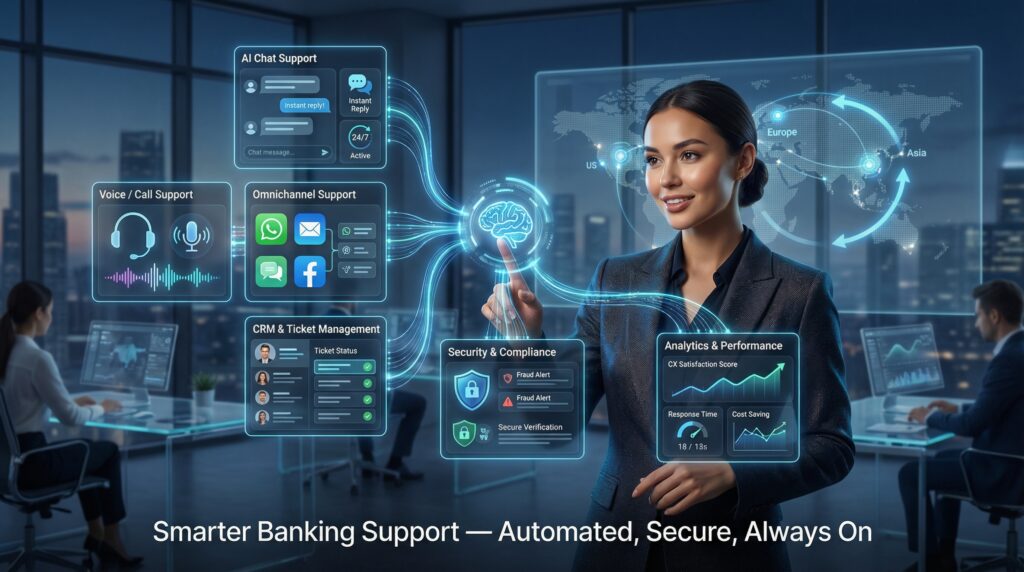
24/7 banking customer support using AI contact centers is a hybrid service model that combines AI chatbots, automation, and human agents to deliver continuous, secure, and scalable customer service. It reduces operational costs, improves response time, ensures regulatory compliance, and enhances customer experience across global banking operations.
AI contact centers are transforming banking operations by combining AI chatbots and human agents into a hybrid CX delivery model. AI chatbots handle repetitive, high-volume queries such as balance checks, KYC updates, and transaction alerts, while human agents manage complex, high-risk, or emotionally sensitive interactions.
This shift represents a move from traditional customer service outsourcing to AI-enabled CXM architectures, where automation, analytics, and human expertise coexist. Enterprises are adopting hybrid CX models to ensure 24/7 availability, reduce operational costs, and maintain regulatory compliance.
The result is a scalable operating model where AI improves efficiency and consistency, while human oversight ensures quality, governance, and trust—critical for banking and financial services environments.
What Is an AI Contact Center in Banking?
An AI contact center is a technology-driven support system that uses artificial intelligence—such as chatbots, voice bots, and predictive analytics—to automate and enhance customer interactions in banking.
Unlike traditional customer service outsourcing, AI contact centers:
- Operate 24/7 without downtime
- Automate high-volume queries
- Integrate with core banking systems
- Maintain compliance through rule-based workflows
Why Banks Are Shifting to AI Contact Centers
Global financial institutions are rapidly replacing legacy contact center outsourcing models due to increasing cost pressures, compliance complexity, and rising customer expectations.
Key Drivers:
- Rising operational costs in traditional bpo call center environments
- Demand for instant, omnichannel support
- Regulatory pressure across multiple jurisdictions
- Need for real-time fraud detection and response
- Talent shortages in customer support roles
According to insights from McKinsey & Company, AI can automate up to 70% of customer interactions in banking, significantly reducing operational overhead.
AI Chatbots vs Human Agents: Key Differences
| Capability | AI Chatbots | Human Agents |
| Availability | 24/7 | Limited shifts |
| Cost | Low | High |
| Speed | Instant responses | Variable |
| Complexity Handling | Limited to defined workflows | High |
| Compliance Handling | Rule-based automation | Judgment-based |
Best Practice: Deploy a hybrid model combining both.
AI Contact Center Architecture
Core Components:
- AI Chatbots & Voice Assistants
- CRM & CXm Integration Layer
- Data Analytics & Reporting Engine
- Compliance & Audit Systems
- Workforce Management Tools
Integrated Systems:
- Core banking platforms
- Fraud detection systems
- KYC verification tools
- Payment gateways
This architecture enables seamless business process outsourcing services across front-office and back office outsourcing services.
Key Insights at a Glance
- AI reduces banking support costs by 30–50% (source: Gartner)
- Automation handles up to 70% of queries
- Resolution time improves by 40–60%
- 24/7 support increases customer satisfaction and retention
- Compliance automation reduces regulatory risks
Real-World Use Cases in Banking
1. Account Management Automation
AI handles:
- Balance inquiries
- Mini statements
- Transaction alerts
2. Fraud Detection & Alerts
AI identifies suspicious activity and triggers alerts in real time.
3. Loan & Credit Card Support
- Application tracking
- Eligibility queries
- Document verification
4. KYC & Compliance Processes
AI automates identity verification workflows, improving efficiency in financial services outsourcing.
Case Study: Global Bank Transformation
Scenario:
A multinational bank operating across the US, UK, and Australia implemented AI-driven support.
Results:
- 65% query automation rate
- 45% cost reduction
- 50% faster response times
- Improved compliance reporting
This transformation demonstrates how AI enhances both CX and operational efficiency.
Cost Savings & ROI Breakdown
Before AI:
- Cost per interaction: $5
- Monthly volume: 1M interactions
- Total cost: $5M
After AI:
- Automation rate: 70%
- Cost per interaction: $2.5
- Total cost: $2.75M
ROI Impact:
- $2.25M monthly savings
- 45% reduction in costs
- Faster service delivery
Security & Compliance in AI Contact Centers
Key Security Measures:
- End-to-end encryption
- Role-based access control
- Data anonymization
- Secure API integrations
Compliance Standards:
- GDPR (Europe)
- FCA (UK)
- SEC (US)
- APRA (Australia)
Organizations like Forrester emphasize that AI-driven compliance automation significantly reduces audit risks.
Vendor Selection Criteria
When selecting a provider for contact center outsourcing, evaluate:
- AI maturity and automation capabilities
- Industry expertise (banking, insurance bpo)
- Compliance certifications
- Global delivery infrastructure
- Integration with CXm platforms
- Pricing transparency
Implementation Roadmap (Step-by-Step)
Step 1: Assess Current CX Maturity
Evaluate existing systems, costs, and performance gaps.
Step 2: Define Automation Scope
Identify processes suitable for AI automation.
Step 3: Select Technology & Partner
Choose AI platforms and outsourcing vendors.
Step 4: Integrate Systems
Connect AI tools with CRM, banking systems, and workflows.
Step 5: Deploy Hybrid Model
Combine AI with human agents for optimal performance.
Step 6: Monitor & Optimize
Continuously improve AI models using analytics.
Read More: https://mascallnet.ai/ai-in-banking-customer-support/
AI + Human Hybrid Model: The Future of CX
A hybrid model ensures:
- AI handles repetitive queries
- Humans manage complex issues
- Seamless escalation between both
This model is now the standard in customer experience management (Cxm) strategies.
Risks & Mitigation Strategies
Key Risks:
- Data privacy breaches
- AI bias and errors
- Vendor dependency
- Regulatory non-compliance
Mitigation:
- Strong governance frameworks
- Continuous AI monitoring
- Multi-vendor strategies
- Regular compliance audits
Comparison: AI vs Traditional vs Hybrid CX
| Model | Strengths | Limitations | Best Use Case |
| AI-only | Low cost, scalable | Limited complexity handling | High-volume queries |
| Human-only | High empathy | Expensive | Sensitive interactions |
| Hybrid | Balanced performance | Requires governance | Enterprise banking |
FAQ
What is an AI contact center in banking?
An AI contact center uses automation, chatbots, and analytics to deliver 24/7 customer support in banking.
How secure are AI banking chatbots?
They use encryption, compliance frameworks, and secure APIs to protect sensitive financial data.
How much cost can banks save using AI?
Banks can reduce customer support costs by 30–50% through automation and efficiency gains.
Is AI better than human agents?
AI improves efficiency, but human agents are essential for complex and sensitive interactions.
How to choose the right outsourcing partner?
Evaluate AI capability, compliance standards, scalability, and industry expertise.
Conclusion
24/7 banking customer support using AI contact centers is no longer optional—it is a strategic necessity for global financial institutions. By combining automation, analytics, and human expertise, enterprises can achieve scalable, secure, and cost-efficient CX operations.
This transformation enables:
- Significant cost reduction
- Improved customer satisfaction
- Stronger compliance and governance
- Global scalability
Organizations exploring this shift are increasingly partnering with providers such as Mascallnet to implement AI-driven CX strategies aligned with enterprise requirements.